
◆ Communication & PR
COMM2495 Professional Writing: what does the rubric reward?
A language model can produce a fluent, correctly punctuated business report in about three seconds. If fluency is what you are selling, you have already lost the advantage. That is good news for anyone studying COMM2495 seriously: marks have moved to what a generator cannot do, deciding what is worth saying to a particular reader and building a document someone can act on. This guide answers the seven questions Vietnamese COMM2495 students ask MAAS mentors most often.
The uncomfortable fact sitting underneath every professional writing course in 2026 is that fluency has stopped being the scarce thing. Five sources anchor the reasoning below. Miller (1984) supplies the idea that a genre is a typified response to a recurring situation, not a template. Bhatia (1993) applies that to professional documents specifically. Schriver (1997) supplies the evidence that layout shapes comprehension. Kimble (2012) supplies the evidence that plain language is preferred by expert readers, not just lay ones. Flower and Hayes (1981) supply the model of writing as a recursive process, which is why the rationale below asks about revision rather than intention.

◆ Question 1 / 7 · The course
What is COMM2495, and how is it different from your other writing courses?
Direct answer: COMM2495 is the RMIT course code for Professional Writing, delivered to undergraduate students at RMIT Vietnam Saigon South, where it runs across all three Vietnamese semesters as a program option rather than a compulsory course. It concerns writing that does work inside organisations, reports, proposals, briefs, correspondence and documentation, a different problem from writing to engage an audience online.
The four RMIT delivery codes for Professional Writing
Each row sets one RMIT delivery code beside the campus where the post says it is used.
RMIT delivery code
Campus
COMM2495
RMIT Vietnam Saigon South
COMM2782
RMIT Vietnam Hanoi
COMM2147
Melbourne City Campus
COMM2439
Singapore Institute of Management
Save this figure
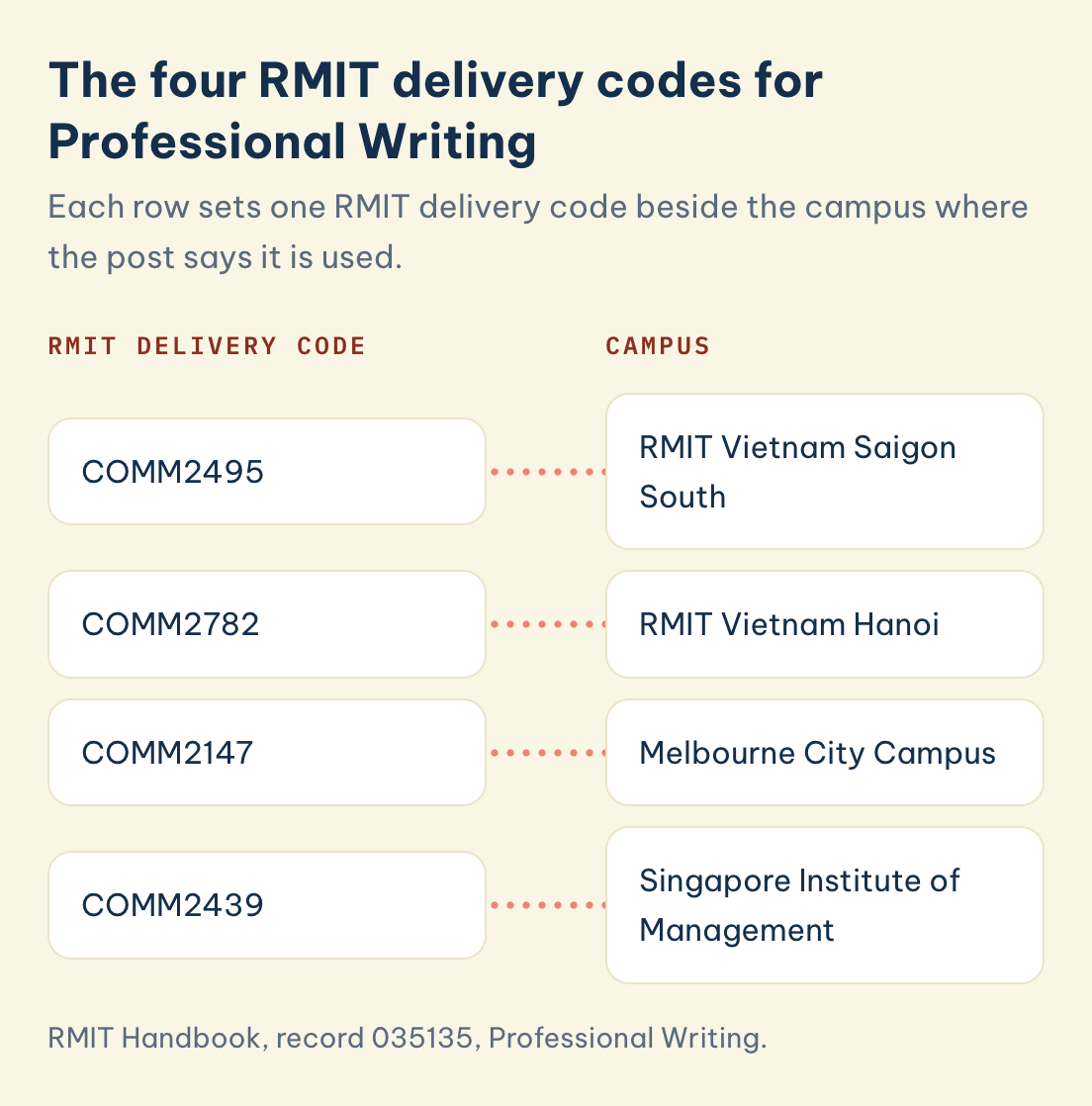
Evidence: In the RMIT Handbook the course sits under record 035135, Professional Writing, with delivery codes by campus: COMM2495 at RMIT Vietnam Saigon South, COMM2782 at RMIT Vietnam Hanoi, COMM2147 at Melbourne City Campus and COMM2439 at the Singapore Institute of Management. RMIT Vietnam program guides list it as a program option alongside alternatives such as Advertising Media and Mass Media in Asia.
Example: A student came in with a report written in the voice she used for social captions: short, punchy, personality-forward. Her mentor asked who would read it and what they would do next. It was a recommendation report for a manager who needed to approve a budget. The rewrite kept her clarity and dropped the performance, and it read as competent rather than clever.
◆ Question 2 / 7 · Well-written
Why does "well-written" no longer earn the marks it used to?
Direct answer: Because fluent prose has become cheap, so rubrics have shifted weight onto judgement. What a marker now looks for is whether you understood the reader's situation, selected the right information for the decision at hand, structured it so the reader finds what they need without hunting, and took a defensible position. Those are choices, not sentence-level skills. A document can be grammatically flawless and still fail every one of them.
Evidence: RMIT's Bachelor of Professional Communication learning outcomes require graduates to engage with emergent technologies to help solve problems and innovate, and separately to employ intellectual independence and judgement, engage critically with information and make sound evidence-based decisions. The two sit together deliberately: the technology is assumed, the judgement is what is assessed.
Example: A student submitted a proposal that read beautifully and never stated what he was asking for. His mentor asked him to write the request in one sentence at the top. He resisted, thinking it was blunt. The marker's feedback praised exactly that sentence, because it let the whole document be evaluated against a clear ask.
◆ Question 3 / 7 · Report as genre
What does it mean to treat a report as a genre rather than a style?
Direct answer: A genre is a recognisable response to a situation that recurs, which means the form is doing a job before you write a word. A recommendation report exists because someone must choose between options and justify the choice later. An incident report exists because an organisation must record what happened in a way that survives scrutiny.
When you understand the job, the conventions stop feeling arbitrary and start telling you what to include. Copying a template without understanding the job is how students produce documents that follow the format and miss the point.
Evidence: Miller (1984) argued that genres should be understood as typified rhetorical actions responding to recurrent situations, rather than as formal categories. Bhatia (1993) applied that view specifically to professional settings, defining a genre as "a recognizable communicative event characterized by a set of communicative purpose(s) identified and mutually understood by the members of the professional or academic community in which it regularly occurs" (Bhatia, 1993, p. 13), and showing how genres such as proposals and business correspondence are structured by the professional purposes they serve.
Example: A student's incident report was written as a narrative, in chronological order, with his interpretation woven through. His mentor asked what the document would be used for. It might be read months later by someone deciding accountability, the recurrent situation Miller (1984) says defines the genre in the first place. Separating verified fact from interpretation, and dating each, changed the document from a story into a record.
◆ Question 4 / 7 · The reader
How do you write for a reader who will not read every word?
Direct answer: Assume scanning, and design for it. Professional readers look for the part that concerns them, and they read that part carefully. Practically this means: put the conclusion or request first rather than building to it; use headings that state content rather than label sections, so "Costs exceed the approved budget by 12%" beats "Findings"; keep one idea per paragraph with the point in the first sentence; and use tables when you are comparing things, because comparison in prose forces the reader to hold values in memory. Layout is part of the writing, not decoration applied afterwards.
Evidence: Schriver (1997) established document design as an integrated discipline in which typography, layout and prose work together to shape comprehension, based on empirical study of how readers actually use documents. The implication is that formatting decisions are rhetorical decisions and belong in your rationale if your assessment asks for one.
Example: A student compared three vendors across price, timeline and support in 4 dense paragraphs, a wall of prose Schriver (1997) would flag as fighting the reader's actual task. Her mentor converted it into a three-column table and kept one paragraph to state which vendor she recommended and why. The word count dropped by half and the recommendation became visible for the first time.
◆ Question 5 / 7 · Plain language
Is plain language a lower standard?
Direct answer: No, and assuming it is costs students marks. Plain language means the reader can find what they need, understand it the first time, and use it. That is a functional standard, not a simplification for weak readers. Complex ideas still require precise terms, but precision is not the same as density.
The habits that matter: prefer the concrete word, keep the actor in the sentence rather than hiding behind passive constructions, break long sentences at the point where the reader would have to re-read, and define a technical term the first time only if your reader genuinely needs it.
Evidence: Kimble (2012) assembled evidence from business, government and legal contexts showing that plain-language revision reduces reader errors, saves time and money, and is generally preferred by expert readers as well as lay ones. The finding that professional audiences prefer plain versions is the one most students find surprising.
Example: A student wrote "it is recommended that consideration be given to the implementation of a revised process". Her mentor asked who should do what. "We recommend replacing the approval process" said the same thing, named the actor and lost 11 words. She had assumed the longer version sounded more professional; it mainly sounded evasive.
◆ Question 6 / 7 · Writing process
What does a strong writing process look like when the assessment includes a rationale?
Direct answer: Many professional writing assessments ask for the document plus a reflective rationale explaining your choices. Treat the process as the source material for that rationale, and keep notes as you go. Write down who the reader is and what they must decide, what you chose to leave out and why, which genre conventions you followed or broke, and what changed between drafts. Revision is where the thinking happens, not where typos get fixed, and a rationale that can describe a real revision decision is far stronger than one that describes intentions.
Evidence: Flower and Hayes (1981) modelled writing as a set of recursive cognitive processes, planning, translating and reviewing, driven by the writer's goals rather than as a linear sequence of stages. Their central claim, that competent writers move back and forth between these processes and revise goals as they write, is exactly what a rationale should evidence. Flower and Hayes built that model from protocol analysis, in which writers spoke their thoughts aloud while composing.
Example: A student's rationale said he had "aimed for clarity and professionalism", which described nothing. His mentor asked what he had actually changed in his second draft. He had moved the cost section forward after realising his reader's first question would be about money. That single decision, explained, was worth more than a page of general intentions.
◆ Question 7 / 7 · AI line
Where is the line on using AI in a professional writing course?
Direct answer: Know your own institution's rules first, because those are the ones that apply to you and they are usually stated in the course guide. Beyond compliance, there is a practical point specific to this course: the work being assessed is your judgement about a reader and a purpose, so outsourcing the drafting removes the evidence you are being marked on.
Using a tool to test whether a heading is clear, or to check whether a sentence has an actor, is editing support. Having it produce the document, the rationale or the reader analysis leaves you unable to explain your own choices, which is precisely what the rationale asks for.
Evidence: The program learning outcomes ask graduates both to engage with emergent technologies and to employ intellectual independence and judgement. Reading those together gives you the usable line: tools may support the production, they cannot supply the judgement that is being assessed. That judgement is exactly the recursive planning, translating and reviewing Flower and Hayes (1981) describe, and a generated first draft skips straight to output with none of it on record.
Example: A student generated a first draft and then could not answer his mentor's question about why the recommendation appeared in the third section. There was no reason; the tool had put it there. He rewrote from a one-page plan of his own and could defend every structural choice in his rationale.
Frequently asked questions
Is COMM2495 the same course as COMM2147 or COMM2782?
They are the same course record in the RMIT Handbook with different delivery codes by campus. COMM2495 is RMIT Vietnam Saigon South, COMM2782 is RMIT Vietnam Hanoi, COMM2147 is Melbourne City Campus and COMM2439 is the Singapore Institute of Management offering. Assessment detail can differ between offerings, so use your own course guide and Canvas shell.
Is this course useful if I do not want to be a writer?
Arguably it is most useful if you do not. Reports, proposals and briefs are how decisions get made in every organisation, and the ability to write one that a busy reader can act on transfers to management, marketing, operations and research equally.
Does writing in English as a second language disadvantage me here?
Not in the way most students fear. The marks concentrate on reader analysis, structure and judgement rather than on idiomatic flourish, and plain language standards work in your favour, since Kimble (2012) finds expert readers prefer the plain version too. Where a second-language writer genuinely needs support is proofreading discipline, which is a separate, fixable task from the thinking the course assesses.
How many references does a professional writing assignment need?
It depends on the task type, so check your brief. A workplace document may require few or none beyond its evidence sources, while an accompanying rationale usually expects you to cite writing and communication scholarship to justify your choices. Do not pad a business document with academic citations that its real reader would never want.
Can I use a real workplace document as my case?
Often yes, and it strengthens the work. Anonymise the organisation and individuals if the material is not public, remove confidential data, and check your brief first, since some tasks specify the scenario.
How MAAS mentors support COMM2495 students
MAAS works as an academic advisor, not a writing service. For COMM2495 that usually means helping you define the reader and the decision before you draft, checking that your structure surfaces the request instead of burying it, giving feedback on where prose is hiding an actor or a cost, and helping you turn real revision decisions into a rationale you can defend. You write the document; the mentor helps you see it the way its reader, and your marker, will.
If you are studying related communication courses, our guides to COMM2953 Precision Writing for Digital Engagement and COMM2789 Digital Content Creation cover neighbouring rubrics. You can also read how our academic support service works before you get in touch.
References
Bhatia, V. K. (1993). Analysing genre: Language use in professional settings. Longman.
Flower, L., & Hayes, J. R. (1981). A cognitive process theory of writing. College Composition and Communication, 32(4), 365–387. https://doi.org/10.2307/356600
Kimble, J. (2012). Writing for dollars, writing to please: The case for plain language in business, government, and law. Carolina Academic Press.
Miller, C. R. (1984). Genre as social action. Quarterly Journal of Speech, 70(2), 151–167. https://doi.org/10.1080/00335638409383686
Schriver, K. A. (1997). Dynamics in document design: Creating texts for readers. John Wiley & Sons.
Tools & resources
- RMIT Handbook record for Professional Writing (course 035135), for course learning outcomes and the delivery code attached to each campus.
- Your Canvas course shell and course guide, the only authoritative source for your assessment tasks, weightings and due dates, including the rules on tool use.
- RMIT Learning Lab, for report and proposal structures, plain-language guidance and referencing support.
- A one-page plan written before drafting: who reads this, what they must decide, what they need to know to decide it. It is the cheapest quality control in the course.
A free 20-minute consultation is a conversation about where you are with COMM2495.
Book a free consultation ▸