
◆ Communication & PR
COMM2939 Introduction to Digital Communication: how do you approach the assignment?
The RMIT course description for COMM2939 opens with a sentence that is also the marking criterion: everyone engages with digital settings daily, but professional digital communication requires advanced knowledge and skills. That experience is a starting point, not the evidence base for your assignment. Most first-year submissions lose marks here, writing as an experienced user rather than someone assessing digital issues on evidence. This guide answers the seven questions Vietnamese students ask MAAS mentors most often.

◆ Question 1 / 7 · The course
What is COMM2939, and where does it sit in the degree?
Direct answer: COMM2939 is the RMIT course code for Introduction to Digital Communication, a 12 credit point first-year course delivered at RMIT Vietnam Saigon South, within the Bachelor of Professional Communication (BP354). COMM2940 is the same course at RMIT Vietnam Hanoi, COMM2906 at RMIT Melbourne City.
Evidence: RMIT's handbook record 055681 sets out that the course introduces you to professional conduct, key social issues, and creative applications in digital communication; develops your understanding of digital communication in professional, industry and societal context; expands your understanding of how digital platforms and services shape everyday life; introduces foundational concepts in digital communication and professional practice; and develops critical skills for creating and managing compelling digital content as well as assessing digital issues based on evidence and analysis. In BP354 it sits in the first-year block alongside Introduction to Advertising and Introduction to Public Relations, before the specialist digital courses such as Precision Writing for Digital Engagement and Social Media Communication, each also worth 12 credit points.
Example: A student told her mentor she was not worried about this course because she had run her own Instagram page since secondary school. Her first draft argued that short-form video works because it holds attention, with her own posting experience as the only support. The question back was short: how could a marker check that claim? Running the page was useful context. It was not evidence.
◆ Question 2 / 7 · Daily use
Why does "I use these platforms every day" work against you?
Direct answer: Because familiarity and competence are different things, and the research literature is unusually direct about it. A first-year assignment that leans on personal platform use is making the exact assumption the field spent 20 years dismantling.
Bennett et al. (2008), writing in the British Journal of Educational Technology, reviewed the evidence behind the popular claim that a generation immersed in technology arrives with sophisticated technical skills, and found the claim rested on limited empirical evidence, anecdote and appeals to common sense. In their own words, "the debate can be likened to an academic form of a 'moral panic'" (Bennett et al., 2008), and they concluded that young people's use and skills are not uniform, with no evidence of the homogeneous technical expertise the label implies.
Kirschner and De Bruyckere (2017), in Teaching and Teacher Education, put it more bluntly: information-savvy digital natives do not exist. Their point matters for your assignment because of what follows from it. The skills attributed to this generation are the same as any other skills, in that they must be properly taught and acquired before they can be applied. Being fluent at using a platform is not the same as being able to analyse it.
The gap between using a platform fluently and being able to analyse it is the shift the course is assessing. You are moving from a user, who knows what a platform feels like, to an analyst, who can say what it does, to whom, with what evidence.
Example: A student wrote that TikTok's algorithm "shows you what you want to see". He was asked to say the same thing in a form that could be checked, and to name where the claim came from. The rewritten sentence described a documented recommendation mechanism, cited a source, and marked clearly which part was his own inference. Same idea, now assessable.
◆ Question 3 / 7 · Evidence
What does "assessing digital issues based on evidence" actually require?
Direct answer: It requires a method for judging sources, not just a willingness to cite them. The most useful method, lateral reading, was studied directly by the Stanford History Education Group, and it is not the one most students use.
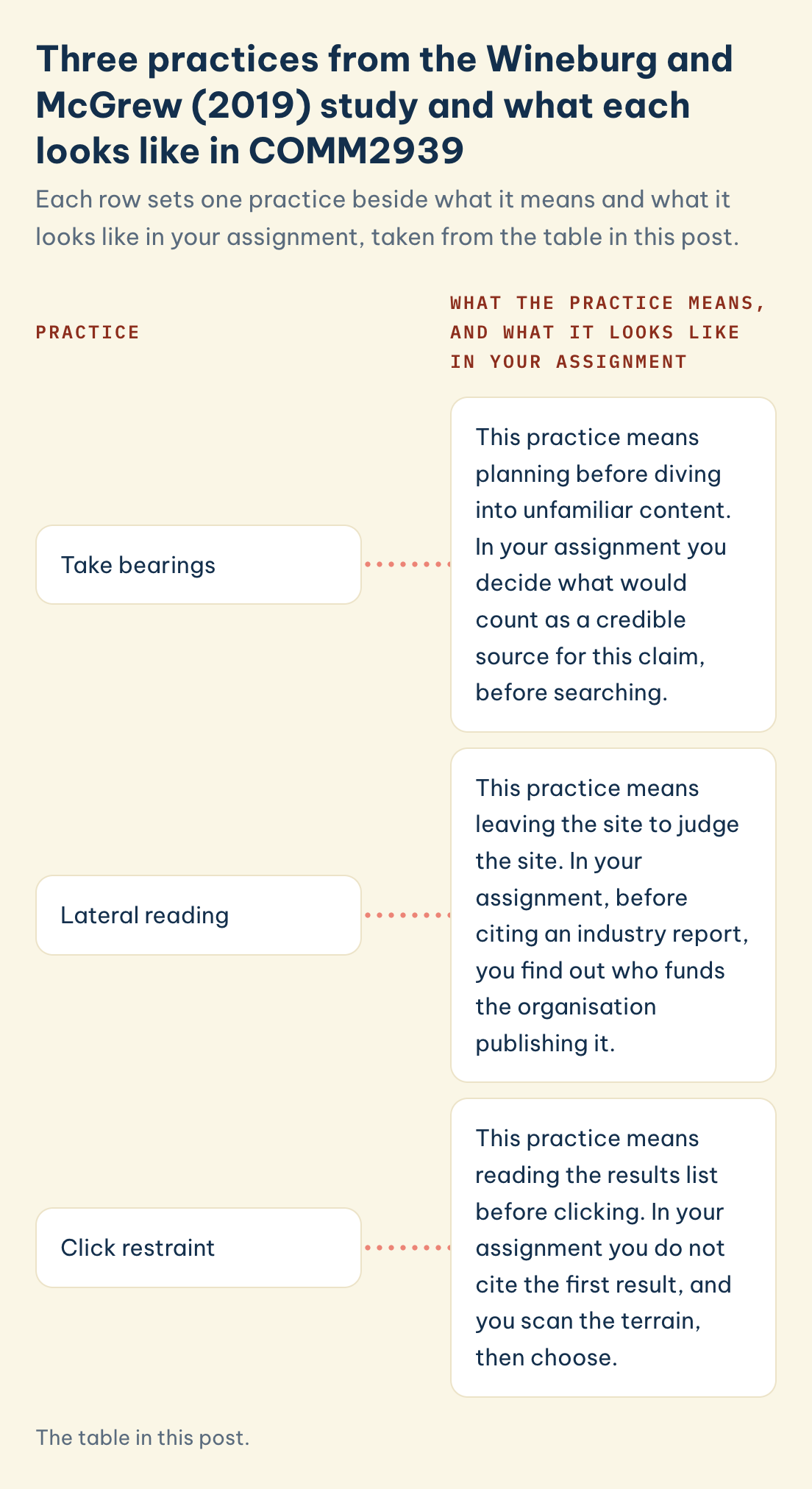
Three practices from the Wineburg and McGrew (2019) study and what each looks like in COMM2939
Each row sets one practice beside what it means and what it looks like in your assignment, taken from the table in this post.
Practice
What the practice means, and what it looks like in your assignment
Take bearings
This practice means planning before diving into unfamiliar content. In your assignment you decide what would count as a credible source for this claim, before searching.
Lateral reading
This practice means leaving the site to judge the site. In your assignment, before citing an industry report, you find out who funds the organisation publishing it.
Click restraint
This practice means reading the results list before clicking. In your assignment you do not cite the first result, and you scan the terrain, then choose.
Save this figure
Wineburg and McGrew (2019), publishing in Teachers College Record, compared how 45 experienced internet users evaluated live websites: 10 PhD historians, 10 professional fact checkers, and 25 first-year university students, meaning students alone made up 56% of the sample. Historians and students read vertically, staying on a site and parsing its content to judge its reliability, and both groups were often fooled by surface features such as official-looking logos and domain names. Fact checkers read laterally, leaving the site after a quick scan and opening new tabs to find out who was behind it. They reached better-warranted conclusions in a fraction of the time.
Note who lost. Not careless students, but PhD historians using a careful method that does not suit the medium. The lesson for COMM2939 is that source evaluation on the web is a specific technique, and the technique is to leave the page.
Three practices from that study are worth applying directly to your assignment research:
| Practice | What it means | What it looks like in your assignment |
|---|---|---|
| Take bearings | Plan before diving into unfamiliar content | Decide what would count as a credible source for this claim, before searching |
| Lateral reading | Leave the site to judge the site | Before citing an industry report, find out who funds the organisation publishing it |
| Click restraint | Read the results list before clicking | Do not cite the first result; scan the terrain, then choose |
Example: A group cited a statistic about Vietnamese social media use from a marketing agency's blog. The group was asked to spend 5 minutes finding out who the agency was and where the number originally came from. The trail ended at a survey the agency had commissioned to promote its own service. They kept the point and replaced the source.
◆ Question 4 / 7 · Failure modes
What are the common failure modes in this course?
Direct answer: Four, and they share a root, which is treating the digital world as something you already know rather than something you are investigating, the same root cause Bennett et al. (2008) traced back to anecdote standing in for evidence.
- Personal experience as evidence. Your own use of a platform is a legitimate observation to raise. It is not support for a general claim about audiences.
- Describing the platform instead of analysing the issue. A section that explains how a feature works, with no argument about what it does to whom, has answered a technical question rather than a communication one.
- Recency mistaken for relevance. A source from last month is not automatically better than one from 5 years ago. The question is whether the claim it supports still holds.
- Treating "digital" as one thing. The course asks about professional, industry and societal contexts separately, because the same platform behaves differently in each.
Example: A student's draft on misinformation described how a sharing feature works in careful detail and never said who was harmed or on what evidence. Her mentor put one question to her: what is the issue here, and who has it? The rewrite kept the feature description down to two sentences and spent the rest on the issue.
◆ Question 5 / 7 · Professional conduct
How do you handle professional conduct without turning it into a rules list?
Direct answer: Treat professional conduct as a set of judgement calls with consequences, not a compliance checklist. The course lists professional conduct alongside social issues and creative applications, which signals that it expects reasoning, not recitation, the same trained judgement Kirschner and De Bruyckere (2017) argue has to be taught rather than assumed.
The useful move is to write conduct into the analysis rather than bolting an ethics paragraph onto the end. When you describe a communication decision, say what the practitioner owed to the audience at that moment, what pressure pushed the other way, and how you would resolve it. That reads as professional practice. A separate closing paragraph beginning "ethically, it is important to consider" reads as an afterthought, and markers have seen a great many of them.
Example: A student appended a paragraph on transparency to the end of a case analysis. Her mentor moved the same content up into the section where the brand had chosen not to disclose a paid partnership, and asked her what the alternative would have cost the brand. The word count barely changed. The section became an argument.
◆ Question 6 / 7 · How much theory
How much theory belongs in a first-year assignment?
Direct answer: Enough to give you a vocabulary precise enough to make a claim testable, and no more. Foundational concepts are there to let you say something specific, not to be displayed.
A practical test: for every concept you name, check that deleting the name would make your sentence vaguer. If the sentence survives unchanged without it, the concept was decoration. First-year markers are generally more impressed by one framework used properly across a whole analysis than by five defined in the introduction and never used again.
Cite consistently in the referencing style your class guide specifies, and confirm that style in Canvas rather than assuming. Reference every claim about the world, including numbers you found in industry sources, with the source and its date.
Example: A student opened with definitions of six concepts, then wrote an analysis that used none of them. His mentor cut the definitions to the two he actually applied and asked him to use each one at least twice in the body. The draft lost 300 words and gained a grade band.
◆ Question 7 / 7 · Structure
What structure works for the COMM2939 assignment?
Direct answer: Structure it so the issue drives the analysis, not the platform:
- The issue. What is at stake, for whom, stated in a form that could be right or wrong.
- Context. Professional, industry or societal, and say which one you are working in.
- Evidence. Sources evaluated laterally, the technique Wineburg and McGrew (2019) documented, with a sentence on why each is credible.
- Analysis. What the evidence shows, including anything that cuts against your argument.
- Professional implications. What a practitioner should do differently, and what that costs.
- Limitations. What your evidence cannot tell you.
Confirm your own assessment tasks, weightings and learning outcomes in Canvas. Class guides are specific to a teaching period, and this course runs across three Vietnam semesters each year, each typically 12 weeks long.
Example: A student had written a strong analysis in which the platform was the subject of every section heading. She was asked to rewrite the headings so each named an issue instead. She changed six lines. The whole document reorganised itself around an argument.
Frequently asked questions
Is COMM2939 the same as COMM2940?
Yes, the same course at different RMIT Vietnam campuses. COMM2939 runs at RMIT Vietnam Saigon South and COMM2940 at RMIT Vietnam Hanoi. Check your own code in Canvas before quoting it in your work.
Is a first-year course marked more leniently?
Not in the way students hope. Expectations about depth are lower, but expectations about method are not, the same distinction Bennett et al. (2008) drew between familiarity and taught skill. Markers are looking for whether you have started sourcing and reasoning like a communication professional.
Can I write about a platform I personally use a lot?
Yes, and it often produces better work because you notice more. The rule is that your familiarity generates the question, and outside evidence answers it.
Can I use my own social media account as a case study?
Only if your brief permits it and you treat your own data with the same scepticism you would apply to anyone else's. State how many posts, over what period, and what the sample cannot show.
How current do my sources need to be?
Current enough that the claim still holds. A 2015 study of a platform feature that no longer exists is a poor support; a 2008 study of how expertise works is not out of date at all.
What is the fastest improvement to a draft?
Underline every general claim about audiences or platforms, then check each one has a source that is not you. Whatever is left unsupported is where the marks are going.
How MAAS mentors support COMM2939 students
MAAS works with RMIT Vietnam students as academic mentors and advisors. For a first-year course this usually means helping you make the shift the course is actually assessing: from writing as a platform user to writing as someone assessing an issue on evidence. In practice that is checking which of your claims have support and which are habits, showing you how to evaluate a source laterally before you build an argument on it, and reading your own draft against the course learning outcomes so you can see where a marker would ask for evidence. You do the research and you write the assignment. Our role is to ask the questions your marker will ask, early enough that you can still answer them.
If you want a second read, bring your brief and your current draft. We match you with a discipline-matched expert within 48 hours when our network already covers that field, or in about 2 weeks if MAAS has to recruit for it, and the first 20-minute consultation is free. Around 23% of our expert network holds a PhD. Start at our MAAS Assignment & Essay Support, or read our guides to the courses that follow this one in the same major, COMM2953 Precision Writing for Digital Engagement and COMM2955 Social Media Communication. For the underlying skill of reading what a task is actually asking, see assignment command words explained.
References
Bennett, S., Maton, K., & Kervin, L. (2008). The 'digital natives' debate: A critical review of the evidence. British Journal of Educational Technology, 39(5), 775–786. https://doi.org/10.1111/j.1467-8535.2007.00793.x
Kirschner, P. A., & De Bruyckere, P. (2017). The myths of the digital native and the multitasker. Teaching and Teacher Education, 67, 135–142. https://doi.org/10.1016/j.tate.2017.06.001
Wineburg, S., & McGrew, S. (2019). Lateral reading and the nature of expertise: Reading less and learning more when evaluating digital information. Teachers College Record, 121(11). https://doi.org/10.1177/016146811912101102
Tools & resources
- RMIT Handbook, course record for Introduction to Digital Communication: https://handbook.rmit.edu.au/ords/r/rmit/catalogue/course?p6_code=055681
- RMIT Bachelor of Professional Communication (RMIT Vietnam): https://www.rmit.edu.vn/study-at-rmit/undergraduate-programs/bachelor-professional-communication
- RMIT Vietnam course and class guides: https://www.rmit.edu.vn/students/my-studies/program-course-information/course-guides
A free 20-minute consultation is a conversation about where you are with COMM2939.
Book a free consultation ▸