
◆ Communication & PR
COMM2955 Social Media Communication: how do you approach it?
A COMM2955 draft that reports an 8% engagement rate and concludes "the campaign was successful" has not made an argument. It has quoted a number set largely by an algorithm the brand does not control, then treated that number as proof. Markers notice the gap immediately, because studying social media academically means explaining what the metric is actually measuring. This guide answers the seven questions Vietnamese COMM2955 students ask MAAS mentors most often.

◆ Question 1 / 7 · The course
What is COMM2955 and where does it sit in your degree?
Direct answer: COMM2955 is the RMIT course code for Social Media Communication delivered to undergraduate students at RMIT Vietnam Saigon South. It sits in the Digital Communication major of the Bachelor of Professional Communication. The equivalent course carries different codes elsewhere: COMM2872 at Melbourne City Campus, COMM2956 at RMIT Vietnam Hanoi and COMM2997 at Singapore Institute of Management.
Evidence: In the RMIT Handbook the course sits under record 054364, Social Media Communication, which lists those delivery codes by campus at undergraduate level. RMIT also notes that the course includes learning activities and assessment designed to connect you with industry relevant to your studies.
Example: A student assumed a study guide she found for the Melbourne offering would apply directly. The topics overlapped, but the assessment brief did not. Her mentor's first step, as always in a multi-code course, was to work from her own Canvas shell before planning a single section.
◆ Question 2 / 7 · Engagement rate
Why is engagement rate a weak foundation for an argument?
Direct answer: Because engagement rate measures reaction to what was distributed, not whether the communication objective was met, and distribution itself is shaped by platform ranking systems rather than by the brand. A post can earn high engagement while reaching the wrong audience entirely. The stronger analytical move is to state the objective first, then ask which evidence would show it was met, then explain what your available metrics can and cannot demonstrate. That paragraph alone often separates a Credit from a Distinction.
Evidence: Bucher (2012) analysed how algorithmic ranking on Facebook produces what she called the threat of invisibility, a condition in which visibility is granted by the platform rather than earned purely by content quality. Gillespie (2014) made the broader point that algorithms are not neutral conduits but encode judgements about relevance. If visibility is partly allocated, a raw engagement figure cannot be read as a straightforward verdict on the content.
Example: A student analysing a Vietnamese beverage brand reported strong engagement on a campaign post and called it effective. Her mentor asked what the campaign had been trying to do. The objective was trial among university students, and the comments were mostly tagging friends in a giveaway. Same data, opposite conclusion, and a far more interesting analysis about incentivised engagement.
◆ Question 3 / 7 · Theories
Which theories give a social media assignment academic weight?
Direct answer: Use platform theory to explain conditions, and communication theory to evaluate practice. Students usually bring only campaign vocabulary, which produces a report that reads like an agency deck. Choose two or three concepts that fit your specific case.
Six situations in a COMM2955 social media campaign and the concept that fits each
Each row sets one thing you are explaining beside the concept that fits and the argument it enables, taken from the table in this post.
What you are explaining
Concept that fits, and the argument it enables
Why one post reached far more people than another
The concept that fits is algorithmic visibility (Bucher, 2012; Gillespie, 2014). It enables the argument that reach is allocated by ranking systems, not earned by quality alone.
Why a post read fine internally and badly in public
The concept that fits is context collapse (Marwick & boyd, 2011). It enables the argument that multiple audiences receive one message in one space, with no shared context.
Whether the brand is genuinely listening
The concept that fits is dialogic communication (Kent & Taylor, 2002). It enables the argument about whether the account creates a real dialogic loop or performs responsiveness.
Why the same content behaves differently by platform
The concept that fits is networked publics and affordances (boyd, 2010). It enables the argument that persistence, searchability, replicability and scalability change what content does.
A brand under attack in comments
The concept that fits is paracrisis (Coombs & Holladay, 2012). It enables the argument about whether this is a public reputational threat or an actual crisis, and why the distinction changes the response.
Influencer content and disclosure
The concept that fits is disclosure and advertising recognition (Evans et al., 2017). It enables the argument about whether audiences recognised the content as advertising, and what follows ethically.
Save this figure
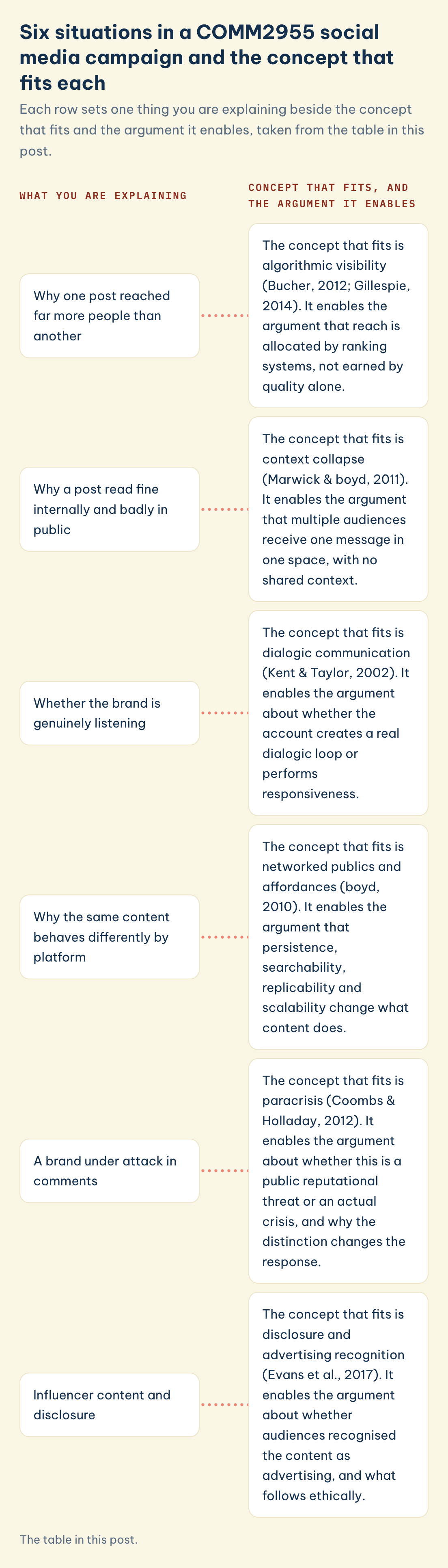
| What you are explaining | Concept that fits | The argument it enables |
|---|---|---|
| Why one post reached far more people than another | Algorithmic visibility (Bucher, 2012; Gillespie, 2014) | Reach is allocated by ranking systems, not earned by quality alone |
| Why a post read fine internally and badly in public | Context collapse (Marwick & boyd, 2011) | Multiple audiences receive one message in one space, with no shared context |
| Whether the brand is genuinely listening | Dialogic communication (Kent & Taylor, 2002) | Whether the account creates a real dialogic loop or performs responsiveness |
| Why the same content behaves differently by platform | Networked publics and affordances (boyd, 2010) | Persistence, searchability, replicability and scalability change what content does |
| A brand under attack in comments | Paracrisis (Coombs & Holladay, 2012) | Whether this is a public reputational threat or an actual crisis, and why the distinction changes the response |
| Influencer content and disclosure | Disclosure and advertising recognition (Evans et al., 2017) | Whether audiences recognised the content as advertising, and what follows ethically |
Evidence: These concepts are analytical instruments, not decoration. Marwick and boyd (2011) showed that users address an imagined audience while their actual audience is broader and unpredictable, because "social media technologies collapse multiple audiences into single contexts, making it difficult for people to use the same techniques online that they do to handle multiplicity in face-to-face conversation" (Marwick & boyd, 2011, p. 114). That mismatch explains a large share of brand missteps better than any claim about tone. Coombs and Holladay (2012) distinguished a paracrisis, a publicly visible reputational threat, from a crisis proper, and that distinction determines whether an apology is appropriate at all.
Example: A student described a brand's comment-section backlash as "a PR crisis" and recommended a public apology. His mentor introduced the paracrisis concept. Reclassified, the incident called for a measured correction rather than a full apology, which would have amplified a complaint most followers had not seen. The recommendation became defensible instead of reflexive.
◆ Question 4 / 7 · Fast-moving platforms
How do you write about a fast-moving platform without the work dating instantly?
Direct answer: Anchor claims in mechanisms rather than in current features. Platform interfaces, algorithm behaviour and even names change between the week you draft and the week your marker reads. What does not change as quickly is why a mechanism exists: why ranking systems reward watch time, why disclosure rules exist, why replicability makes content lose its original context. Write "the platform's ranking system prioritises sustained attention, which pushes creators towards X" rather than "the algorithm now favours X". The first survives an update; the second may already be wrong.
Evidence: Gillespie (2014) framed algorithms as sociotechnical arrangements embedding editorial judgement, which is exactly the level of description that remains valid when features change. boyd's (2010) affordances of networked publics, persistence, replicability, scalability and searchability, have outlasted many platform generations for the same reason.
Example: A student built an entire section on a specific feature that had been discontinued by the time she submitted. Her mentor had her rewrite one level up, explaining the audience behaviour the feature had been designed to capture. The revised section could not be falsified by a product update.
◆ Question 5 / 7 · Evidence
What counts as evidence when your case is a social media campaign?
Direct answer: Three tiers, doing different jobs. Peer-reviewed research supplies theory and contested claims. Primary material supplies your case facts: the actual posts with dates, the brand's own published statements, platform transparency and advertising libraries, disclosure labels. Industry reports supply benchmarks, used carefully and with the source's commercial interest acknowledged. Screenshots with dates are legitimate primary evidence and are far stronger than describing a post from memory. Marketing blogs summarising "the latest algorithm changes" are not evidence.
Evidence: A stated program outcome for RMIT's Bachelor of Professional Communication is engaging critically with information and making sound evidence-based decisions while actively challenging assumptions. A reference list dominated by marketing blogs demonstrates the opposite of that outcome.
Example: A student cited a marketing agency post claiming a platform had "cut organic reach by 60%". No primary source existed for the figure. His mentor did not ask him to delete the claim but to analyse it: who benefits from publishing that number, and what would count as evidence for it? That paragraph became one of the most analytical in the assignment.
◆ Question 6 / 7 · Vietnamese platforms
How should you handle Vietnamese platforms and the local context?
Direct answer: Treat local specificity as an advantage, not a complication. Many COMM2955 students analyse Vietnamese brands and audiences, where the platform mix, Facebook's continued weight, Zalo's role in direct communication, TikTok's position in discovery, differs from the Anglophone cases most textbooks use. State the difference explicitly and analyse it rather than applying a US case study's assumptions silently. Where you use theory developed elsewhere, say what transfers and what does not; that qualification is itself a critical move.
Evidence: The program is designed to prepare graduates for professional communication in an international context, engaging with diverse cultures and globally inclusive perspectives. Applying a framework across contexts without testing its fit is the failure mode that outcome is written against.
Example: A student applied a Western influencer-marketing model to a Vietnamese campaign and could not explain why the results diverged. Her mentor asked which assumption of the model did not hold locally. The model assumed disclosure norms and audience expectations that differed in her case. Naming that mismatch turned a weak application into a genuine contribution.
◆ Question 7 / 7 · Structure
What structure works, and what should be cut?
Direct answer: Lead with the communication problem, not the brand. A dependable shape: introduction stating the objective and the question you are answering; brief brand and platform context, under ten percent of the word count; analysis organised by analytical dimension, audience, platform conditions, message and response, each ending with a stated implication; evaluation against the objective you named at the start; recommendations that specify who acts, what changes and what you trade away. What gets cut is the campaign walkthrough, a chronological retelling of every post, which describes without analysing.
Evidence: RMIT assessment is criterion-referenced, so your work is measured against published rubric criteria rather than ranked against classmates. Extra description cannot lift a mark; moving words into analysis and evaluation criteria can.
Example: A student's draft covered eleven posts in order at roughly 200 words each. His mentor had him pick three posts that showed the campaign's underlying logic, and analyse those properly. The word count stayed the same; the argument appeared for the first time.
Frequently asked questions
Is COMM2955 the same course as COMM2872 or COMM2956?
They are the same course record in the RMIT Handbook with different delivery codes by campus. COMM2955 is RMIT Vietnam Saigon South, COMM2872 is Melbourne City Campus, COMM2956 is RMIT Vietnam Hanoi and COMM2997 is the Singapore Institute of Management offering. Assessment detail can differ, so use your own course guide and Canvas shell.
Can I analyse a brand I follow personally, or my own account?
Usually yes, and personal familiarity helps you spot detail. Check your brief first. If you analyse your own or an employer's account, disclose the relationship in the assignment and be careful that familiarity does not turn into advocacy; markers reward distance.
Do I need analytics access to write a good analysis?
No. Publicly visible evidence, posts with dates, comment patterns, disclosure labels, advertising libraries, supports strong analysis. What matters is being explicit about the limits of your data rather than implying you had access you did not have.
How many references does the assignment need?
Your course guide is the authority. As a working guide for an undergraduate communication assignment of this type, expect roughly eight to fifteen quality sources weighted towards peer-reviewed work, plus your primary case material. Industry sources are context, not foundation.
Are screenshots allowed as evidence?
Generally yes, and they are good practice, but check whether your brief wants them in an appendix. Date every screenshot, caption what it shows, and refer to it explicitly in the text rather than leaving the reader to interpret an image.
How MAAS mentors support COMM2955 students
MAAS works as an academic advisor, not a writing service. For COMM2955 that usually means helping you decode your own brief and rubric, testing whether your chosen campaign will yield analysable evidence before you commit, checking that your metrics claims match your stated objective, and giving feedback that shows where a campaign walkthrough should become analysis. You write the assignment; the mentor helps you see it the way a marker will.
If you are studying other courses in the Digital Communication major, our guides to COMM2953 Precision Writing for Digital Engagement and COMM2789 Digital Content Creation cover neighbouring rubrics. You can also read how our academic support service works before you get in touch.
References
boyd, d. (2010). Social network sites as networked publics: Affordances, dynamics, and implications. In Z. Papacharissi (Ed.), A networked self: Identity, community, and culture on social network sites (pp. 39–58). Routledge.
Bucher, T. (2012). Want to be on the top? Algorithmic power and the threat of invisibility on Facebook. New Media & Society, 14(7), 1164–1180. https://doi.org/10.1177/1461444812440159
Coombs, W. T., & Holladay, S. J. (2012). The paracrisis: The challenges created by publicly managing crisis prevention. Public Relations Review, 38(3), 408–412. https://doi.org/10.1016/j.pubrev.2012.04.004
Evans, N. J., Phua, J., Lim, J., & Jun, H. (2017). Disclosing Instagram influencer advertising: The effects of disclosure language on advertising recognition, attitudes, and behavioral intent. Journal of Interactive Advertising, 17(2), 138–149. https://doi.org/10.1080/15252019.2017.1366885
Gillespie, T. (2014). The relevance of algorithms. In T. Gillespie, P. J. Boczkowski, & K. A. Foot (Eds.), Media technologies: Essays on communication, materiality, and society (pp. 167–194). MIT Press.
Kent, M. L., & Taylor, M. (2002). Toward a dialogic theory of public relations. Public Relations Review, 28(1), 21–37. https://doi.org/10.1016/S0363-8111(02)00108-X
Marwick, A. E., & boyd, d. (2011). I tweet honestly, I tweet passionately: Twitter users, context collapse, and the imagined audience. New Media & Society, 13(1), 114–133. https://doi.org/10.1177/1461444810365313
Tools & resources
- RMIT Handbook course record for Social Media Communication (course 054364), for course learning outcomes and the delivery code attached to each campus.
- Your Canvas course shell and course guide, the only authoritative source for your assessment tasks, weightings and due dates.
- Platform advertising and transparency libraries, for verifying whether content was paid, and for dated primary evidence.
- Dated screenshots of the posts you analyse, collected while the campaign is live rather than reconstructed later.
A free 20-minute consultation is a conversation about where you are with COMM2955.
Book a free consultation ▸