
◆ Marketing
MKTG3120: why does "build loyalty" fail a brand audit?
There is a sentence that appears in a large share of undergraduate brand reports, usually near the recommendation: the brand is small, so it should deepen loyalty among existing customers rather than chase new ones. It sounds prudent. It is also the recommendation that the empirical brand literature has spent 35 years contradicting, and in a unit whose fourth learning outcome is a brand audit, writing it unchallenged tells the marker how far into the reading you got.
Note on the code: this guide describes the University of Sydney unit. MKTG 3120 codes exist at several North American institutions attached to introductory marketing rather than branding, so check the unit title on your own enrolment first, and confirm it maps to the University of Sydney Business School unit this guide describes, in New South Wales.

◆ Question 1 / 8 · The unit
How is the unit built?
Direct answer: MKTG3120 Building and Managing Brands is a 6-credit-point undergraduate unit in the University of Sydney Business School, offered in Semester 2, with MKTG1001 or SIEN1000 as the prerequisite. The unit treats brand equity as an organisation's most important intangible asset, echoing Aaker (1991), whose Managing Brand Equity grouped brand loyalty, awareness, perceived quality and associations into one customer-side asset.
Evidence: The unit page lists four learning outcomes, and the fourth is the one that shapes how you should write. It asks you to apply the methodologies, processes and tools available to conduct a brand audit in order to discover its sources of brand equity. The operative word is sources. An audit that concludes a brand is strong has produced a verdict; an audit that identifies where the strength comes from, and therefore what would destroy it, has produced a diagnosis. The other three outcomes concern the steps in brand building, why brand strategy sets direction for business strategy, and the integration of creating, revitalising and sustaining a portfolio.
Example: A student audited a well-known beverage brand and concluded it enjoyed high awareness and positive associations. Both claims were true and neither was useful, because nothing followed from them. The report never named which association was actually doing the work in a purchase decision, in the Keller (1993) sense of brand knowledge, so the recommendations could have been written without the audit.
Assessment tasks and weightings are published in the unit outline before teaching begins and are revised between offerings, so confirm them against the outline for your own semester rather than relying on figures circulating from a previous cohort.
◆ Question 2 / 8 · Brand audit
What does a brand audit actually require?
Direct answer: Evidence about what sits in the customer's head, gathered from customers rather than from your own reading of the brand's advertising.
Three sources of evidence for a brand audit and what each can support
Each row pairs one source of evidence with what that source can support.
Where the evidence comes from
What it can support
The brand's own advertising and website
What the brand is trying to claim
Industry commentary and press coverage
How the trade press reads the brand
Consumer recall, recognition and association data
What consumers actually hold in memory, which is the equity
Save this figure
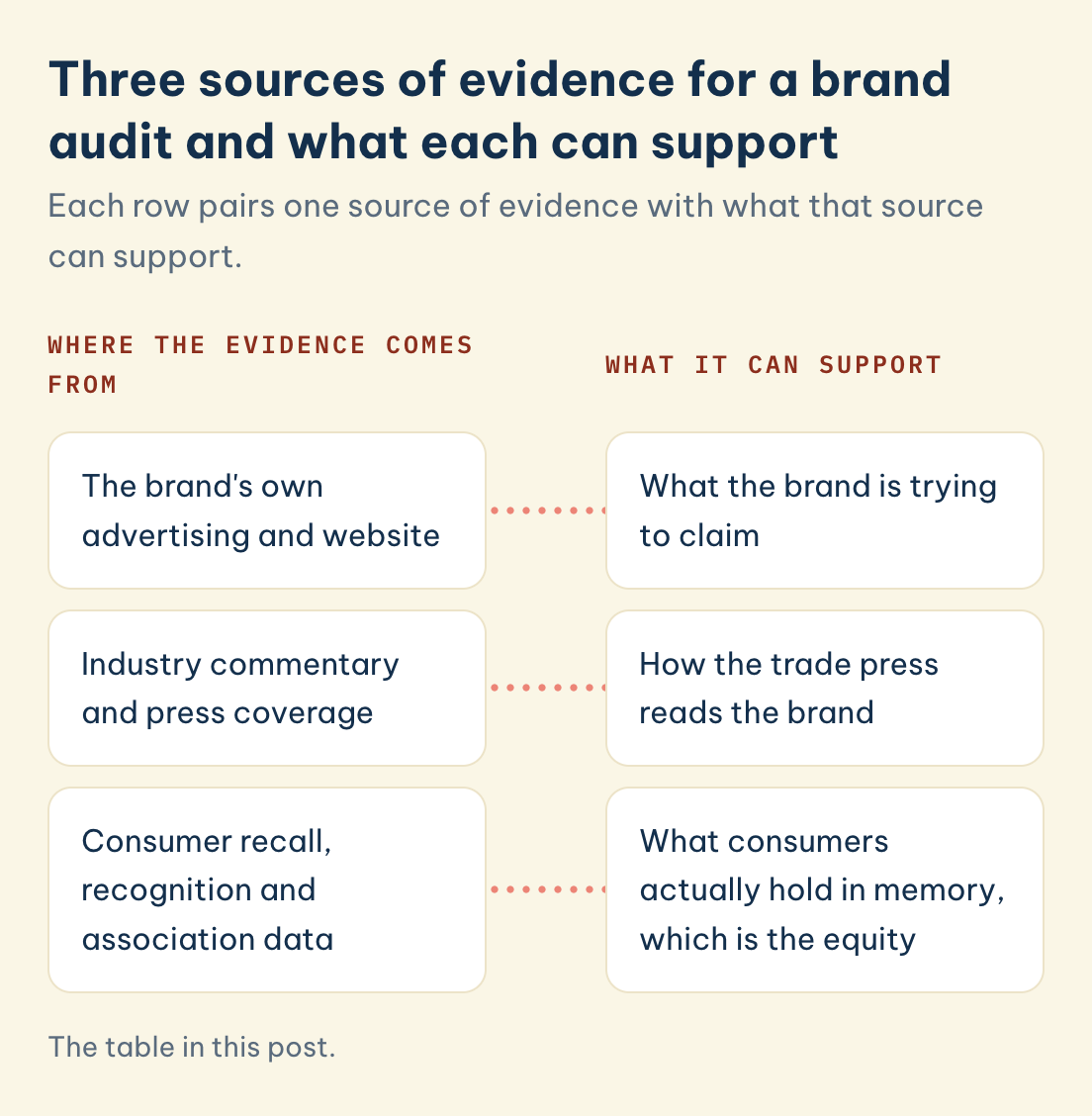
Evidence: Keller (1993) defined customer-based brand equity as the differential effect of brand knowledge on consumer response to the marketing of that brand, and the definition carries a methodological instruction that students often miss. If equity lives in brand knowledge held by consumers, then the audit's raw material is consumer memory, not the brand's own communications. Keller's model, published in the Journal of Marketing and commonly shortened to CBBE in later branding scholarship, treats that memory as the thing being measured, not the campaign that put it there. Reading a campaign and inferring what consumers must therefore associate with the brand reverses the direction of evidence. It describes what the marketer intended, which is precisely the thing an audit is supposed to test.
| Where the evidence comes from | What it can support |
|---|---|
| The brand's own advertising and website | What the brand is trying to claim |
| Industry commentary and press coverage | How the trade press reads the brand |
| Consumer recall, recognition and association data | What consumers actually hold in memory, which is the equity |
Example: Two audits of the same retailer reached opposite conclusions about its positioning. The first read the current campaign and reported a premium, design-led position. The second asked a small sample what came to mind first and found convenience and location dominating, with design barely mentioned. The second audit was worth more, closer to what Keller (1993) meant by customer-based brand equity, and it was also more uncomfortable, since it implied the campaign was not landing.
◆ Question 3 / 8 · Loyalty
Why does "build loyalty" fail as a recommendation?
Direct answer: Because small brands do not have a loyalty problem that can be solved separately from their size problem. Their lower loyalty is a consequence of their smaller customer base, not an independent weakness that a retention campaign can fix.
Evidence: Ehrenberg, Goodhardt and Barwise (1990), also in the Journal of Marketing, set out the double jeopardy pattern across repeated analyses of purchase data. They write: "In any given time period, a small brand typically has far fewer buyers than a larger brand. In addition, its buyers tend to buy it less often" (Ehrenberg, Goodhardt, & Barwise, 1990, p. 82). The two penalties arrive together, which is why the pattern is called double jeopardy, and it holds with enough regularity across categories to function as a benchmark rather than as an occasional finding. The pattern remains a core empirical regularity studied at the Ehrenberg-Bass Institute for Marketing Science, University of South Australia, founded in 2003, where Romaniuk and Sharp later extended the same buyer-behaviour tradition into salience research. The consequence for your recommendation is direct. A small brand showing below-average repeat purchase is not underperforming; it is behaving exactly as a brand of that size behaves. Recommending a loyalty programme to fix it prescribes treatment for a symptom of size.
The double jeopardy explanation does not mean loyalty work is never justified. It means the justification has to survive the benchmark. If a brand's repeat rate is below what double jeopardy predicts for its share, you have found a genuine anomaly worth investigating, and saying so demonstrates the analytical outcome far better than any recommendation made without the comparison.
Example: A student comparing two competing brands noted that the smaller one had weaker repeat purchase and recommended a loyalty scheme. Asked what repeat rate would be normal at that market share, she had not considered the question. Adding the benchmark changed the report's conclusion, because the smaller brand turned out to be performing slightly above the expected level, and the real gap was in how many people ever considered it at all, exactly the double jeopardy pattern Ehrenberg, Goodhardt and Barwise (1990) documented.
◆ Question 4 / 8 · Salience
What is salience, and why is it not the same as a positive attitude?
Direct answer: At MKTG3120, salience is the propensity for a brand to come to mind in a buying situation (Romaniuk & Sharp, 2004). A brand can be liked and still lose because it was never retrieved at the moment of choice.
Evidence: Romaniuk and Sharp (2004), writing in Marketing Theory, argued for reconceptualising brand salience away from measures of attitude strength and toward the quantity and quality of memory structures linking a brand to buying situations. The distinction matters for a brand audit because the two are measured differently. Attitude questions ask whether people rate the brand well; salience asks how readily, and in how many situations, the brand is retrieved at all. A brand with warm ratings among the few who think of it may have an availability problem that an attitude survey is structurally unable to detect.
Example: An audit of a local food brand found strong favourability scores and recommended reinforcing the emotional positioning. The awkward number was buried in the same data: only a small fraction of respondents named the brand unprompted for any purchase occasion. Favourability was high because the sample of people who thought of the brand at all was self-selected. The binding constraint was retrieval, the salience Romaniuk and Sharp (2004) described, and the recommendation addressed sentiment.
◆ Question 5 / 8 · Extensions
When does a brand extension help, and when does it leak?
Direct answer: When consumers perceive a fit between the parent brand and the new category, as Aaker and Keller (1990) set out. Fit is the variable that determines whether the extension inherits the parent's equity or simply borrows its name.
Evidence: Aaker and Keller (1990), publishing in the Journal of Marketing, tested consumer evaluations of brand extensions and found that evaluations depended on perceived fit between the original and extension product classes, interacting with the perceived quality of the parent brand, and that high quality alone does not carry an extension into a poorly fitting category. The finding gives your portfolio recommendation a testable criterion. Rather than asserting that a strong brand can extend, you can state what kind of fit your proposed extension relies on, whether the evidence supports it, and what the failure mode is if the fit turns out to be weaker than assumed.
Example: A group proposed extending a premium coffee brand into packaged snacks and justified it by the parent brand's quality. The proposal survived redrafting only after they specified the basis of fit, in this case a shared consumption occasion rather than a shared product category, and acknowledged that the argument would collapse if consumers coded the brand by product type rather than by occasion. The recommendation stayed the same, but it now matched the fit criterion Aaker and Keller (1990) tested. It became defensible.
◆ Question 6 / 8 · Strategy or tactics
Where do students confuse brand strategy with campaign tactics?
Direct answer: At the recommendation, when a set of activities is presented as a strategy, at the University of Sydney Business School and elsewhere. The second learning outcome asks you to explain why brand strategy sets the overall direction for business strategy, which is a claim about hierarchy, and tactics cannot satisfy it.
Evidence: A brand strategy specifies what the brand is meant to mean, to whom, and against what alternatives, and it therefore implies things the brand will not do. A campaign plan specifies what will be executed, when, and on which channels. Both belong in a report; they answer different questions. The diagnostic test is to ask whether a recommendation could be adopted wholesale by the brand's nearest competitor without contradiction. If it could, it describes activity rather than position.
Example: A report recommended increased social media presence, influencer partnerships and refreshed packaging. Every competitor could have done all three. Asked what the brand was choosing not to be as a result, the student named a segment the brand would stop pursuing, which converted the same three tactics into the expression of a position, the hierarchy claim MKTG3120's second learning outcome asks for, rather than a substitute for one.
◆ Question 7 / 8 · International students
Where do international students most often lose marks?
Direct answer: In the gap between reporting a framework and using it, and in citation habits at MKTG3120 that treat textbook chapters as the source of record for empirical claims.
Evidence: Third-year branding marks sit heavily on application. A section explaining what customer-based brand equity means demonstrates reading; a section applying it to produce a finding about your brand demonstrates the outcome. The citation issue compounds this. Many of the strongest claims available to you, including the double jeopardy benchmark and the salience distinction, originate in journal articles, and citing a textbook's summary of them signals a shallower engagement than citing the work itself. Where an empirical claim carries weight in your argument, cite the study that produced it.
Example: A student's draft attributed the double jeopardy pattern to a marketing textbook. Replacing that citation with the original article, and adding one sentence on the data it rested on, changed nothing in the argument and moved the referencing and analysis criteria together, exactly the standard a University of Sydney Business School marker applies.
◆ Question 8 / 8 · MAAS mentors
What do MAAS mentors actually do on a unit like this?
The work MAAS mentors do here is mostly upstream of the writing. Before you commit to an audit design, someone asks whether the evidence you plan to collect can distinguish between a salience problem and an attitude problem, because most student audits cannot and only find out at the recommendation. While you draft, the questions turn to benchmarks: what would normal look like for a brand this size, and does your finding survive that comparison. Near the end, the emphasis moves to whether each recommendation actually follows from something in your own data. You collect the evidence and you write the report, and a mentor makes sure the report is answerable when a University of Sydney Business School marker pushes on it.
If you would like a second reading of an audit design for MKTG3120 before you start collecting data, send us the brief you are working from.
Frequently asked questions
Do I need MKTG1001 before MKTG3120?
The unit page lists MKTG1001 or SIEN1000 as the prerequisite. Prerequisite structures at the University of Sydney Business School are revised between offerings, so confirm against the handbook entry for your own year of study.
Is MKTG3120 offered in Semester 1?
The published unit information lists Semester 2 delivery at Camperdown/Darlington. Confirm against the current timetable at the University of Sydney Business School before planning your enrolment sequence.
Can I audit a brand I work for or use regularly?
Familiarity helps with access and hurts with objectivity, and University of Sydney Business School markers notice when an audit reads as advocacy. If you choose a brand you know well, state that relationship early and be deliberate about seeking evidence that would embarrass your prior view.
How much primary data does a brand audit need?
Enough that your claims about consumer memory, in the sense Keller (1993) defined it, come from consumers, reported with their limitations stated. A small, honestly described sample, gathered the way Romaniuk and Sharp (2004) recommend for salience research, supports a stronger argument than secondary commentary presented as though it measured something.
Is it acceptable to disagree with a framework taught in the unit?
Yes, when the disagreement is argued from evidence rather than asserted, as with the double jeopardy debate Ehrenberg, Goodhardt and Barwise (1990) opened up. The branding literature contains genuine disputes, and showing that you know where a framework is contested is a mark of depth rather than a risk, provided you represent both positions accurately.
Related reading
References
Aaker, D. A. (1991). Managing brand equity: Capitalizing on the value of a brand name. Free Press.
Aaker, D. A., & Keller, K. L. (1990). Consumer evaluations of brand extensions. Journal of Marketing, 54(1), 27–41. https://doi.org/10.1177/002224299005400102
Ehrenberg, A. S. C., Goodhardt, G. J., & Barwise, T. P. (1990). Double jeopardy revisited. Journal of Marketing, 54(3), 82–91. https://doi.org/10.1177/002224299005400307
Keller, K. L. (1993). Conceptualizing, measuring, and managing customer-based brand equity. Journal of Marketing, 57(1), 1–22. https://doi.org/10.1177/002224299305700101
Romaniuk, J., & Sharp, B. (2004). Conceptualizing and measuring brand salience. Marketing Theory, 4(4), 327–342. https://doi.org/10.1177/1470593104047643
Tools & resources
A free 20-minute consultation is a conversation about where you are with MKTG3120.
Book a free consultation ▸