
◆ Marketing
MKTG3112 USyd: is your IMC plan integrated or just a channel list?
In MKTG3112 Marketing Communications at the University of Sydney, 50% of the Semester 2, 2026 grade sits in two individual written tasks, and the heavier one, worth 30%, asks you to review the IMC plan your own team submitted and propose a better one. The group report asks for an integrated plan, and a weak report often reads as a list of channels rather than a plan whose parts work together.
◆ Question 1 / 7 · The unit
What is MKTG3112, and is it the unit you are searching for?
Direct answer: MKTG3112 Marketing Communications is a 6 credit point undergraduate unit in the University of Sydney Business School, with MKTG1001 as its only prerequisite (The University of Sydney, 2026a). It covers advertising, sales promotion, personal selling and new media, and in 2026 it runs in Semester 2 at Camperdown/Darlington.
Evidence: The 2026 unit page lists MKTG1001 as the prerequisite, with no corequisites, no prohibitions and no assumed knowledge, and the unit is open to study abroad and exchange students. The Semester 2, 2026 outline names Peter Bryant as coordinator, sets the census date at 31 August 2026, and estimates 120 to 150 hours of student effort, based on 1.5 to 2 hours per week per credit point. It also carries a note that the information was correct at 16 July 2026. Sydney Marketing Society (n.d.) describes MKTG3112 as a 3000-level elective in the Marketing major.
The code may not be unique. A Google search on 15 September 2026 returned a Colleges of the Fenway cross-registration listing that shows MKTG3112 as Marketing Analytics at Emmanuel College in Boston. If that listing is current, it is a different subject in a different system, so study notes tagged "MKTG3112" can describe analytics work that has nothing to do with the Sydney unit. This guide covers the University of Sydney unit only.
The Sydney unit description still lists television, radio, print, outdoor and cinema alongside "new media, such as the Internet". The 2026 weekly schedule is more current than that sentence: Week 7 covers the rise of the influencer, Week 8 covers digital marketing and social media, and Week 11 covers regulation and the ethics of AI.
If you are building your own IMC plan and want a section-by-section template, our guide to writing an integrated marketing communications plan walks through one.
◆ Question 2 / 7 · Assessment
How is MKTG3112 assessed in Semester 2, 2026?
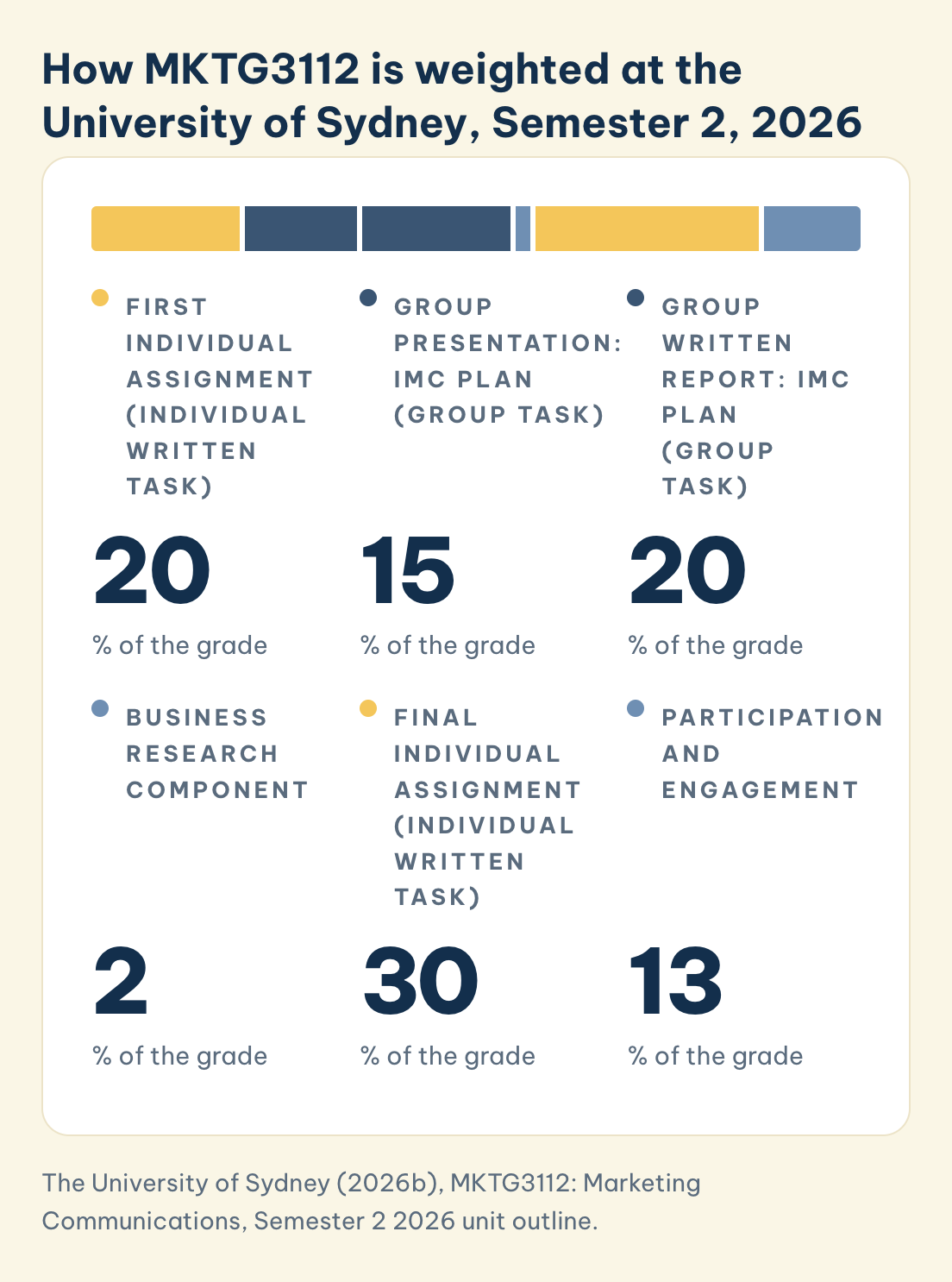
Direct answer: Six components count (The University of Sydney, 2026b). The First Individual Assignment is worth 20%, the group presentation 15%, the group written report 20%, the Business Research Component 2%, the Final Individual Assignment 30%, and participation and engagement 13%. The outline marks all six as AI allowed.
How MKTG3112 is weighted at the University of Sydney, Semester 2, 2026
Yellow marks the two individual written tasks, navy marks the two group tasks, and blue marks the Business Research Component and participation. The weights were the same in Semester 2, 2025.
First Individual Assignment (individual written task)
20
% of the grade
Group Presentation: IMC Plan (group task)
15
% of the grade
Group Written Report: IMC Plan (group task)
20
% of the grade
Business Research Component
2
% of the grade
Final Individual Assignment (individual written task)
30
% of the grade
Participation and engagement
13
% of the grade
Save this figure
| Task | Weight | Timing in 2026 | Learning outcomes assessed |
|---|---|---|---|
| First Individual Assignment | 20% | Week 4, due 3 September 2026 | LO1, LO2, LO3 |
| Group Presentation: IMC Plan | 15% | Week 11, 15 minutes per group | LO1 to LO6 |
| Group Written Report: IMC Plan | 20% | Week 12, due 29 October 2026 | LO1 to LO6 |
| Business Research Component | 2% | Week 12 | LO5 |
| Final Individual Assignment | 30% | Week 13, due 8 November 2026 | LO1 to LO5 |
| Participation and engagement | 13% | Weekly | LO1 to LO6 |
Evidence: The Semester 2, 2026 outline sets the First Individual Assignment due on 3 September 2026 with a closing date of 17 September 2026, the group report due on 29 October 2026, and the Final Individual Assignment due on 8 November 2026 with a closing date of 15 November 2026. The group presentation runs 15 minutes per group in Week 11. Participation is worth 13% and, in the outline's words, measures engagement "beyond simple attendance at tutorials", and quizzes may be used to test a selected week's content. The 2% Business Research Component can be completed either by joining a research study or by reviewing a research paper.
The University of Sydney (2025) outline for Semester 2, 2025 used the same six weights, 20%, 15%, 20%, 2%, 30% and 13%. Three things changed. The Final Individual Assignment was due on 29 November 2025 in the formal exam period and is now due in Week 13, three weeks earlier in the calendar. The group presentation moved from the mid-semester break to Week 11. The coordinator changed from Tom Van Laer to Peter Bryant. A study guide written from the 2025 offering will describe the right tasks and the wrong dates.
What to do about it: Read the weights as a map of where marks sit. The two individual written tasks carry 50%, the two group tasks carry 35%, and the Final Individual Assignment alone outweighs the group report by 10 percentage points. Late written work loses 5% of the maximum mark per calendar day and scores zero after ten days, so treat the due dates above as the real deadlines, not the closing dates.
◆ Question 3 / 7 · Integration
What does "integrated" mean in an IMC plan?
Direct answer: Integration means the channels are chosen and sequenced to work on one audience and one communication problem together. Kliatchko (2008) defines IMC around four pillars, stakeholders, content, channels and results, so a plan that describes channels without the other three pillars covers only one of Kliatchko's four.
Evidence: Kliatchko (2008) revised his earlier 2005 definition to present IMC as an audience-driven business process for managing stakeholders, content, channels and results of brand communication programs, and he added content as a pillar in that revision. His channel pillar is broad: it includes every touchpoint where a customer meets the brand, not only paid media such as radio, TV and print. Batra and Keller (2016) wrote that, with fragmented media and divided attention, "the optimal integration of marketing communications takes on increasing importance" (Batra & Keller, 2016, p. 122). They proposed two models for that task, a bottom-up model that matches each communication option to a consumer's stage in the decision journey and a top-down model that optimises the whole program.
The unit's own wording points the same way. LO2 asks you to identify "the relationship between the key elements of message strategy" in an IMC plan, and LO3 asks you to identify media that can "efficiently, effectively and creatively deliver the communication message to the target audience". Both outcomes are about relationships and fit. Neither is met by a section per channel.
What to do about it: Before your group writes a word about media, agree on one sentence stating the audience, the communication problem and the response you want. Every channel section in the report should then say which part of that sentence it serves.
◆ Question 4 / 7 · Report test
How can you test whether your group report is integrated?
Direct answer: Use Keller's (2016) seven choice criteria as an audit. Keller (2016) proposed coverage, cost, contribution, commonality, complementarity, cross-effects and conformability as tests of how well an IMC program is assembled. A channel list usually scores on coverage and cost and has nothing to say about the other five.
| Criterion (Keller, 2016) | The question it puts to your report |
|---|---|
| Coverage | What share of the target audience does each option reach, and how much do the audiences overlap? |
| Cost | What does each option cost relative to the effect it is meant to produce? |
| Contribution | What can this option achieve on its own, before any other channel is added? |
| Commonality | Do different options reinforce the same brand associations? |
| Complementarity | Do different options add associations the others cannot carry? |
| Cross-effects | Is exposure to one option designed to make another work better? |
| Conformability | Does the option still work for people who missed the earlier messages, and for different kinds of consumers? |
Evidence: Keller (2016), in the Journal of Advertising, set out these seven criteria so marketers could judge how effectively and efficiently they had combined communication options, and he listed 5 priority areas for further research. Two pairs in the list pull against each other, and that tension is where analysis starts. Commonality asks every option to repeat one meaning, while complementarity asks each option to add something the others lack. A report that maximises both at once has not made a choice. Similarly, cross-effects reward a planned sequence, while conformability asks each option to work for someone who saw nothing else.
What to do about it: Put the seven criteria in a table against your channels during Week 9, which the 2026 schedule sets aside as group feedback week in tutorials. Any criterion your report cannot answer is either a gap to fix or a trade-off to state openly.
◆ Question 5 / 7 · First assignment
What should the First Individual Assignment critique?
Direct answer: The outline asks for a situation and marketing communications analysis of an assigned company, a communication challenge for the brand, and a critique of an IMC campaign aimed at your target (The University of Sydney, 2026b). The task is worth 20% and assesses LO1, LO2 and LO3.
Evidence: Because the group presentation must build "on the first individual assignment", the challenge you identify in Week 4 becomes raw material for the group plan. A vague challenge such as "low brand awareness" gives the group nothing to design against. A challenge stated as a gap between what a defined audience currently believes and what the brand needs them to believe gives the group a target, and it gives each channel a measurable job.
The critique part is where description tends to take over. Describing a campaign lists what the brand did: the channels, the creative, the tagline. Critiquing it asks whether those choices fit the audience and the challenge, and where they did not. Keller's (2016) criteria work here as well. You can ask whether the campaign's channels reinforced one meaning, whether one execution depended on the audience having seen another, and what evidence exists that it changed anything.
What to do about it: Spend no more than a short paragraph on what the campaign contained. Give the rest of the critique to three judgements: fit with the audience, fit with the stated challenge, and the strength of the evidence that it worked.
◆ Question 6 / 7 · Final assignment
How do you review your own team's plan in the Final Individual Assignment?
Direct answer: Treat the submitted group plan as a case, not as your work to defend. The outline asks you to review your team's communication and creative strategy individually and then propose an alternative approach, and the task may also ask how you would evaluate effectiveness or what you learned (The University of Sydney, 2026b).
Evidence: This task carries 30%, the largest single weight in the unit, and it assesses LO1 to LO5, including LO5 on "intellectual curiosity, critical thinking and reflection". It comes after the group report is submitted on 29 October 2026, so the plan can no longer be changed. That makes it a post hoc review. You are not deciding whether to commit to a plan; you are explaining, with hindsight, where a committed plan was weaker than it looked.
The trap is loyalty. A review that praises the team's choices and suggests minor additions reads as a summary of the report. A review that finds the plan's weakest assumption, shows the evidence against it and builds the alternative on a different assumption demonstrates the critical thinking the outcome names. The alternative has to differ in strategy, not only in execution. Swapping one social platform for another usually changes execution. Changing the target audience, the communication objective or the core message changes strategy.
What to do about it: Run your own team's report through the seven criteria from the table above and pick the criterion it fails most clearly. Build the alternative around fixing that failure, and state how you would measure whether the fix worked, since Week 10 of the 2026 schedule is devoted to evaluating effectiveness.
◆ Question 7 / 7 · Brand equity
Where does brand equity fit into an MKTG3112 plan?
Direct answer: LO4 asks you to identify the role of IMC in creating brand meaning to build consumer-based brand equity. Keller (1993) defines customer-based brand equity as "the differential effect of brand knowledge on consumer response to the marketing of the brand" (Keller, 1993, p. 1).
Evidence: In Keller's (1993) model, brand knowledge has two components, brand awareness and brand image, and equity arises when consumers are familiar with the brand and hold favourable, strong and unique brand associations. That definition gives a communication objective something to aim at beyond reach. A plan can state which association it is trying to strengthen and why that association would change how the audience responds to the brand. LO4 is assessed in the group presentation, the group report and the Final Individual Assignment, but not in the First Individual Assignment, which assesses only LO1 to LO3.
What to do about it: Name one or two target associations in the group plan. Then check each channel against Keller's (2016) commonality criterion: does it carry those associations, or does it introduce a different message?
Frequently asked questions
What is the MKTG3112 assessment breakdown in Semester 2, 2026?
Two individual written tasks carry 20% and 30%, two group tasks on the IMC plan carry 15% and 20%, and weekly participation adds 13% with research participation adding 2%. The Semester 2, 2025 outline used the same weights.
Is AI allowed in MKTG3112 assessments?
The Semester 2, 2026 outline marks all six components as AI allowed. The University of Sydney still requires you to acknowledge any AI use, and your Canvas site holds the full instructions for each task.
Does MKTG3112 have prerequisites?
Yes. The unit page lists MKTG1001 as the prerequisite, with no corequisites, prohibitions or assumed knowledge.
Is MKTG3112 the same subject at every university?
Not necessarily. A cross-registration listing found through Google shows MKTG3112 as Marketing Analytics at Emmanuel College in Boston. Check the university name on any notes before you rely on them.
Does MAAS write MKTG3112 assignments for students?
No. MAAS works as an academic advisor. A mentor can help you test your reasoning, for example by asking which of Keller's criteria your plan fails, so that you write your own assignment and present your own work.
Related reading
For the brand side of LO4, see our guide to MKTG3120 Building and Managing Brands, which works through brand equity and salience. For the digital channels that Weeks 7 and 8 cover, read MKTG3110 Digital Marketing. If you want weekly practice critiquing campaigns before the Final Individual Assignment, our 1-on-1 university subject tutoring pairs you with a mentor.
References
Batra, R., & Keller, K. L. (2016). Integrating marketing communications: New findings, new lessons, and new ideas. Journal of Marketing, 80(6), 122–145. https://doi.org/10.1509/jm.15.0419
Keller, K. L. (1993). Conceptualizing, measuring, and managing customer-based brand equity. Journal of Marketing, 57(1), 1–22. https://doi.org/10.1177/002224299305700101
Keller, K. L. (2016). Unlocking the power of integrated marketing communications: How integrated is your IMC program? Journal of Advertising, 45(3), 286–301. https://doi.org/10.1080/00913367.2016.1204967
Kliatchko, J. G. (2008). Revisiting the IMC construct: A revised definition and four pillars. International Journal of Advertising, 27(1), 133–160. https://doi.org/10.1080/02650487.2008.11073043
Sydney Marketing Society. (n.d.). MKTG3112 Marketing Communications. https://www.smsusyd.com/mktg3112-marketing-communications
The University of Sydney. (2025). MKTG3112: Marketing Communications, Semester 2 2025 unit outline. https://www.sydney.edu.au/units/MKTG3112/2025-S2C-ND-CC
The University of Sydney. (2026a). MKTG3112: Marketing Communications. https://www.sydney.edu.au/units/MKTG3112
The University of Sydney. (2026b). MKTG3112: Marketing Communications, Semester 2 2026 unit outline. https://www.sydney.edu.au/units/MKTG3112/2026-S2C-ND-CC
Tools & resources
- University of Sydney unit page for MKTG3112 for the unit description, prerequisite and learning outcomes
- MKTG3112 Semester 2 2026 unit outline for weights, due dates and the weekly schedule
- MKTG3112 Semester 2 2025 unit outline for the earlier timing and coordinator
A free 20-minute consultation is a conversation about where you are with MKTG3112.
Book a free consultation ▸