
◆ Marketing
How to write an integrated marketing communications plan
An integrated marketing communications plan shows how each message and channel serves one audience and one objective, with each choice backed by evidence. Most marks go to the reasoning that connects the situation, the objectives, the strategy and the tactics, not to the number of channels you name. This guide sets out the sections a typical brief expects, gives a template you can adapt, and explains how markers separate critical justification from description. Every claim traces to a university teaching page, a planning-model source or a peer-reviewed article, listed under References.

◆ Question 1 / 6 · What is an integrated
What is an integrated marketing communications plan, and what is the assignment testing?
Direct answer: An integrated marketing communications (IMC) plan coordinates advertising, public relations, promotion, direct and digital channels so that they deliver one consistent message. The assignment tests whether you can justify that coordination with analysis, not whether you can name many channels.
The Open University (n.d.) reports that Belch and Belch adopt the American Association of Advertising Agencies definition, which describes IMC as "a concept of marketing communications planning that recognises the added value of a comprehensive plan" that combines communication disciplines to provide clarity, consistency and maximum communications impact. The same page lists six communication approaches: advertising, sales promotion, public relations, personal selling, direct marketing and interactive or internet marketing, and it stresses that these must deliver consistent messages (The Open University, n.d.).
Definitions have also moved on. Pennsylvania State University (n.d.) states that Schultz and Schultz define IMC as "a strategic business process used to plan, develop, execute and evaluate coordinated, measurable, brand communications programs over time", and notes that this treats IMC as an ongoing process rather than a short-term tactical decision. Kliatchko (2008) goes further and observes that little agreement remains among scholars on a formal definition, proposing that IMC is an audience-driven business process of strategically managing stakeholders, content, channels and results of brand communication programmes.
For an assignment this has a practical meaning. You are expected to pick a definition, say which one you are using, and let it shape the plan. If you adopt the process view, your plan needs an evaluation stage. If you adopt the narrower coordination view, your argument leans on message consistency. Either is acceptable when you say why.
◆ Question 2 / 6 · Which sections does
Which sections does a typical IMC plan assignment need?
Direct answer: Most briefs expect a situation analysis, objectives, a strategy covering audience and positioning, tactics across channels, an action plan with budget and timing, and a way to measure results. Smith (n.d.) packages exactly this sequence as SOSTAC: situation, objectives, strategy, tactics, actions and control.
Your unit may prescribe its own model, so read the brief and the rubric first. If it does not, SOSTAC is a safe spine because it is widely taught and easy to follow. Smith (n.d.) describes it as covering where we are now, where we want to be, how we get there, the details of the strategy, how to ensure execution, and how to know we are getting there. Smith (n.d.) places the marketing mix in the tactics stage, describing tactics as the details of strategy.
The Open University (n.d.) offers a different but compatible lens. It presents the IMC programme as developed from three inputs: the overall marketing plan with its objectives and competitor analysis, the promotional situation covering segmentation, targeting and positioning, and an analysis of the communication process covering communication goals, receiver response, and source, message and channel factors. Budget decisions feed into the planning as well. You can read this as the content of your situation and strategy sections.
Three points deserve attention before you start writing.
- Situation analysis is large, but your word count is not. Smith (n.d.) says half of a plan is the situation analysis and suggests putting the bulk in appendices with only key findings at the front. In an assignment with a strict word limit, report the findings that drive your decisions and leave the rest out.
- Objectives come in two kinds. Smith (n.d.) separates marketing objectives, such as sales, market share or conversion, from marketing communications objectives, which concern the state of mind of the audience, such as awareness, preference and consideration. An IMC plan needs the second kind, stated so that they can be measured.
- Strategy is the shortest section and the most heavily marked. Smith (n.d.) calls it the shortest and most important part of a plan and, in his experience, the weakest in most plans, because it has to make hard choices about positioning and target markets. Markers read it for exactly that.
◆ Question 3 / 6 · What does a usable IMC plan
What does a usable IMC plan template look like?
Direct answer: A usable template turns each section into a question you must answer, a decision you must justify and a source you can cite. The table below adapts the SOSTAC stages to a typical assignment, and you should reorder or rename the rows to match your brief.
| Section | The question it answers | What a marker looks for | Evidence to bring |
|---|---|---|---|
| Situation | Where is the brand now, and what matters most? | Selected findings that shape later decisions, not a full audit | Customer, competitor and environment analysis, cited |
| Objectives | What should change in the audience's mind or behaviour? | A communications objective that is specific, measurable and time-bound | A framework such as awareness, preference and consideration |
| Strategy | Which audience, which positioning, which core message? | A reasoned choice between alternatives, with the rejected option named | Segmentation and positioning theory, audience insight |
| Tactics | Which channels carry the message, and in what role? | Each channel linked to the objective and to the other channels | Channel evidence, the marketing mix, the six IMC approaches |
| Actions | Who does what, when, and with what budget? | A timeline and budget that match the tactics | A schedule, resource assumptions stated honestly |
| Control | How will you know the plan is working? | Metrics tied to each objective, and a review loop | KPIs, a measurement plan, a review point |
Smith (n.d.) notes that the final stage feeds the next situation analysis, so the plan is a loop rather than a line. A short sentence in your control section that says what you would change if the metrics disappoint shows the marker that you understand this.
A worked illustration helps. Suppose the brief asks you to plan a launch for an invented language-learning app aimed at working adults in Vietnam. Your communications objective might be to raise consideration of the app among a defined segment within a stated period, measured by a brand-tracking survey. That objective already rules out a plan that is mostly price promotions, because The Open University (n.d.) describes sales promotion as more often a short-term approach to generating sales, which sits poorly with an objective about consideration. Your strategy then chooses one positioning, say convenience for people with irregular schedules, and every channel in the tactics section has to carry it. The example is hypothetical and exists only to show the chain of logic.
◆ Question 4 / 6 · How do markers read critical
How do markers read critical justification compared with description?
Direct answer: Description tells the marker what you chose, while critical justification explains why that choice suits this audience and objective and why alternatives were weaker. University of Leeds Library (n.d.) says most assignments require analysis and evaluation, and it advises keeping descriptive statements to a minimum.
Description versus critical justification in an IMC plan
How markers read the same channel choice written two ways
Description
Critical justification
The campaign will use Instagram and email.
Instagram carries the awareness objective because the target segment already uses it daily, and email follows to move interested users toward trial.
Notes the method used
Shows how appropriate the method was
Lists a channel
Links the channel to the objective and the audience
Names the channel chosen
Names the alternative rejected and explains why
States the evidence
Admits the limits of the evidence
Save this figure
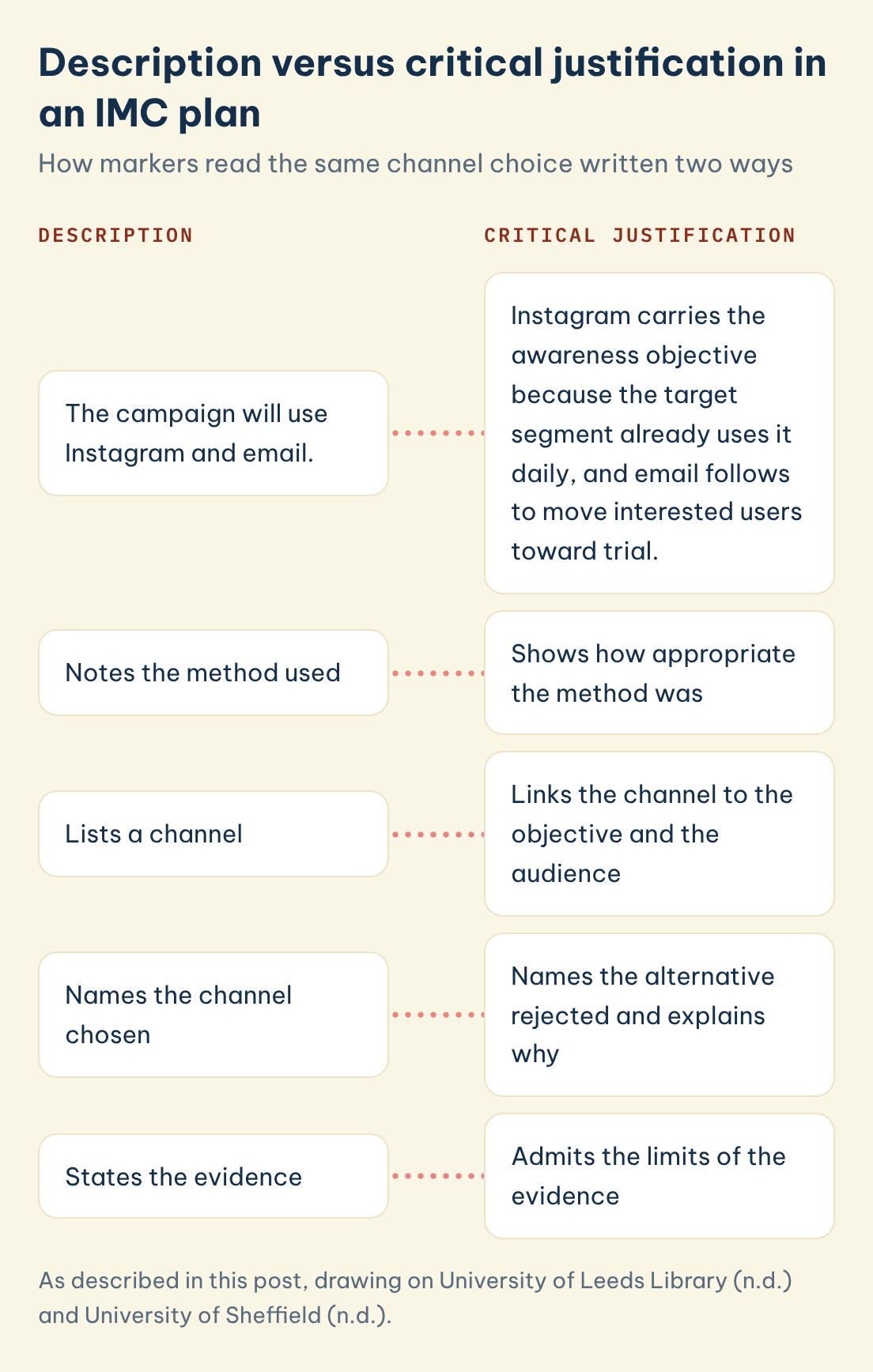
The same guidance gives a pair of examples that translate directly to a marketing plan. Rather than simply noting the method used, which it calls the descriptive approach, a critical writer shows how appropriate the method was (University of Leeds Library, n.d.). In an IMC plan, "the campaign will use Instagram and email" is description. "Instagram carries the awareness objective because the target segment already uses it daily, and email follows to move interested users toward trial" is justification, because it links the channel to the objective and to the audience.
University of Sheffield (n.d.) breaks critical writing into stages that you can reuse for every tactical choice: describe the evidence, identify limitations or gaps, highlight alternatives, and synthesise sources to show your interpretation. Applied to a channel decision, that looks like this.
- Describe the evidence: state what a source or your own analysis tells you about the audience's media habits.
- Identify limitations: admit where the evidence is thin, for example a survey from a different market.
- Highlight alternatives: name the channel you considered and rejected, and why.
- Synthesise: state your decision and how it serves the objective.
University of Sheffield (n.d.) also notes that some description is usually needed to set the scene in each paragraph, which means you do not have to avoid description altogether. The test is whether each descriptive sentence is followed by a "so what" that ties it to your objective. If it is not, it is probably padding.
Finally, check how your rubric words each criterion, because a verb such as justify or evaluate asks for more than a summary. If the rubric rewards integration, show where two channels reinforce one another rather than treating them as separate lists.
◆ Question 5 / 6 · What mistakes cost the most
What mistakes cost the most marks?
Direct answer: The most costly mistakes are listing channels without a link to an objective, writing objectives that cannot be measured, and spending the word count on situation analysis instead of strategy. Each one replaces reasoning with description, which is what the rubric penalises.
- A channel list instead of a plan. Naming social media, television and events is not integration. Integration means the message, timing and call to action are coordinated, which is the point of the definitions cited above (The Open University, n.d.).
- Objectives that describe activity. "Post three times a week" is a task, not an objective. A communications objective names what should change in the audience, in line with the awareness, preference and consideration framing described by Smith (n.d.).
- No rejected alternatives. A strategy that never mentions what it chose against reads as an assumption. One sentence naming a rejected option and the reason is usually enough.
- Metrics that do not match objectives. If the objective is consideration, counting impressions does not tell you whether it was reached. Smith (n.d.) describes the control section as listing what to measure, when, and at what cost, so that you know whether you are succeeding or failing before it is too late.
- Over-long background. Smith (n.d.) advises moving bulk analysis to appendices. Where your assignment does not allow appendices, summarise and move on.
- Unstated definitions. Because Kliatchko (2008) finds little agreement on what IMC formally is, a plan that uses the term without saying which view it adopts leaves the marker guessing.
- Missing sources. Marketing claims such as audience behaviour need a reference. Our guide to APA 7th referencing shows how to cite them cleanly.
◆ Question 6 / 6 · How can MAAS help with an
How can MAAS help with an IMC plan assignment?
Direct answer: A MAAS mentor in marketing can read your brief and rubric with you, work through the Outline, Draft and Final stages, and give feedback on how well your justification connects objectives, strategy and tactics. You write and submit your own plan.
MAAS's essay and assignment support is built around Outline, Draft and Final, with you involved at every stage and the discipline-matched mentor acting as advisor and tutor. If you are working on a specific unit, our guides to MKTG1492 marketing communication and MKTG3112 marketing communications show how two universities frame the same task, and the marketing strategy guide covers the strategy section in more depth. A free 20-minute discovery call with MAAS, a Ho Chi Minh City company, is a way to talk through your brief with no obligation, and you can book one here.
Frequently asked questions
What is the difference between an IMC plan and a marketing plan?
A marketing plan covers the whole marketing mix, while an IMC plan concentrates on communications and on making each channel deliver a consistent message. The Open University (n.d.) shows the IMC programme as depending on the overall marketing plan, so the two are linked rather than separate.
Should I use SOSTAC or my own structure for an IMC plan?
Use the structure your unit prescribes. If none is given, SOSTAC is a reasonable choice because it moves from situation to objectives, strategy, tactics, actions and control (Smith, n.d.). State in one sentence why you chose it.
How do I write objectives for an IMC plan?
Write communications objectives about what should change in the audience, such as awareness, preference or consideration, and make them specific, measurable and time-bound. Smith (n.d.) distinguishes these from marketing objectives such as sales or market share.
What does critical justification mean in a marketing assignment?
It means explaining why a choice suits the audience and objective, naming the alternatives you rejected and showing the limits of your evidence. University of Leeds Library (n.d.) contrasts noting a method with showing how appropriate it was.
Is there one agreed definition of IMC I should cite?
No single definition is universally accepted. Kliatchko (2008) reviews the debate and proposes a revised definition, and Pennsylvania State University (n.d.) quotes the Schultz and Schultz process definition. Choose one, cite it and apply it consistently.
References
Kliatchko, J. G. (2008). Revisiting the IMC construct: A revised definition and four pillars. International Journal of Advertising, 27(1), 133–160. https://doi.org/10.1080/02650487.2008.11073043
Pennsylvania State University. (n.d.). Lesson 01: Introduction to integrated marketing communications [Course page, MKTG 422]. Penn State World Campus. https://courses.worldcampus.psu.edu/welcome/mktg422/001/content/01_lesson/04_page.html
Smith, P. R. (n.d.). SOSTAC® 1-day masterclass. PR Smith Marketing. https://prsmith.org/sostac/
The Open University. (n.d.). 5.2 An integrated marketing communications framework. In Social marketing. OpenLearn. https://www.open.edu/openlearn/money-business/business-strategy-studies/social-marketing/content-section-5.2
University of Leeds Library. (n.d.). Critical writing. https://library.leeds.ac.uk/info/1401/academic-skills/105/critical-thinking/5
University of Sheffield. (n.d.). How to write critically. StudySkills@Sheffield. https://sheffield.ac.uk/study-skills/writing/critical/write
Not sure how this guide applies to your own case? Talk it through with MAAS in a free 20-minute consultation.
Book a free consultation ▸