
MKTG1492 (and its companion code MKTG1493) Marketing and Communication rewards students who build a plan where every channel choice serves one message and one audience, not those who list tactics. Most students who struggle with this RMIT marketing course are not short on ideas, but they never state what the campaign must make the audience think, feel, or do. This guide answers the seven questions Vietnamese students at RMIT ask MAAS mentors most often before they start MKTG1492.
Author: MAAS Editorial Team
Last updated: 2026-07-20
Category: marketing

What is MKTG1492 / MKTG1493 Marketing and Communication about?
Direct answer: MKTG1492 is an RMIT marketing course (MKTG1493 is the parallel code for a different cohort or campus, with substantially the same content) about planning and evaluating integrated marketing communications. It covers the communications planning process, audience insight, the paid-owned-earned channel mix, creative strategy, and measurement against communication objectives. The course assesses a plan whose parts cohere.
Evidence: The teaching frame rests on the established IMC literature: the integration principle set out by Schultz and colleagues, hierarchy-of-effects thinking for setting communication objectives at the right stage, Keller's customer-based brand equity for what communications build over time, and the Ehrenberg-Bass evidence on mental and physical availability that many current courses use to challenge loyalty-first campaign logic.
Example: A Vietnamese student at RMIT Vietnam arrived at MAAS with a plan listing six channels and a budget split. Her mentor asked what single thought the campaign had to install in the audience's mind. Once the message was written in one sentence, two channels were cut because they could not carry it, and her mark moved from a Pass-level draft to a Distinction.
What assessment does the MKTG1492 assignment usually involve?
Direct answer: Marketing communications courses at this level are commonly assessed through an individual or group communications plan for a real or set brand, often staged as situation analysis and audience insight first, then strategy and creative, then media and measurement, usually with a pitch or presentation.
You are typically asked to define the audience and objective, develop a message and creative platform, select and justify channels, and specify how success would be measured. Always confirm the exact task, word count, and weighting in your own Canvas shell, because assessment structure changes by semester, code (MKTG1492 vs MKTG1493), and campus.
Evidence: RMIT business assessments are criterion-referenced, meaning marks are awarded against published rubric criteria rather than ranked against classmates. This is set out in RMIT's Assessment policy, which is why decoding the rubric matters far more than the number of tactics you propose.
Example: A Vietnamese RMIT student spent half of a 2,000-word plan on a situation analysis and competitor review. His MAAS mentor cut it to the three findings that shaped the message and reallocated the words to the creative platform and the measurement plan. Same brand, same word count, a clear Distinction.
How is the MKTG1492 assignment graded, what does the rubric actually reward?
Direct answer: Communications rubrics at this level reward four things, roughly in this order: (1) a defined audience and a communication objective stated in terms of what should change, awareness, consideration, behaviour, with a baseline where possible, (2) a single, specific message or creative platform that the plan is built to deliver, (3) channel choices justified by audience behaviour and by what each channel can actually do, and (4) integration, budget realism, and measurement, plus academic writing and Harvard referencing. A rich list of tactics with no message is the classic Credit-level submission.
Evidence: RMIT business rubrics use criterion bands (Pass / Credit / Distinction / High Distinction). The jump from Credit to Distinction is almost always defined by "justified" and "integrated", justified channel choices and a plan whose parts reinforce each other, not by more channels or more creative ideas.
Example: A MAAS mentor marked one Vietnamese student's plan with a single test: for each tactic, which line of the message does it deliver, and to whom? Half the tactics had no answer. After the cull and a rewrite, the same plan moved up two full rubric bands.
Which frameworks should you use in MKTG1492?
Direct answer: Use a small set of frameworks that carry the plan. A workable spine is: a communications planning model to structure the work from objective to evaluation; a hierarchy-of-effects model to set the objective at the correct stage, because a campaign for an unknown brand cannot be judged on conversion; a paid-owned-earned framework to allocate roles rather than just budget; a creative brief to lock the single-minded proposition before any tactic is chosen; and a measurement framework that ties each metric to the objective. Every framework must change what appears in the plan.
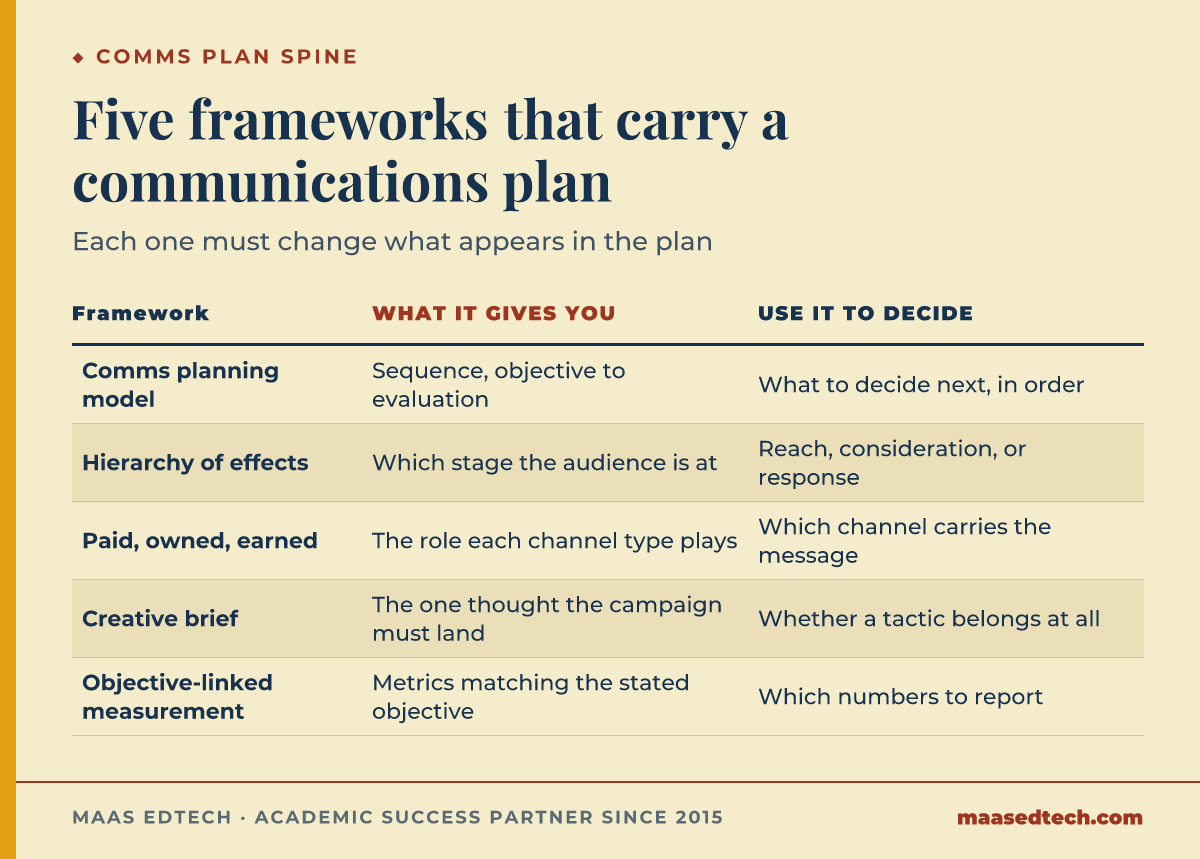
| Framework | What it gives you | Use it to decide |
|---|---|---|
| Communications planning model | A sequence from objective through strategy to evaluation | What to decide next, and in what order |
| Hierarchy of effects | Which stage the audience is at, aware, considering, acting | Whether the objective should be reach, consideration, or response |
| Paid–owned–earned | The role each channel type plays, not just its budget share | Which channel carries the message and which supports it |
| Creative brief and single-minded proposition | The one thought the campaign must land | Whether a tactic belongs in the plan at all |
| Objective-linked measurement | Metrics that correspond to the stated objective | Which numbers to report, and which vanity metrics to drop |
Evidence: These frameworks are examiner-recognised foundations: Schultz, Tannenbaum and Lauterborn (1993) for integration, Keller (1993) for brand equity built through communications, Sharp (2010) for the evidence-based challenge to loyalty-led planning, and Batra and Keller (2016) for a current model of integrating traditional and digital communications. Batra and Keller (2016) built that model to be practical rather than descriptive: it is "designed to improve the effectiveness and efficiency of integrated marketing communication programs" (Batra & Keller, 2016, p. 122), which is why the table above asks what each framework lets you decide, not just what it explains. Note that hierarchy-of-effects models are simplifications and are contested; acknowledging that while still using one to set a stage-appropriate objective is a Distinction-level move.
Example: A Vietnamese RMIT student set a sales-conversion objective for a brand with almost no awareness in the target segment. His MAAS mentor used the hierarchy to reset the objective to prompted awareness and consideration, with a conversion measure held for a later phase. The corrected objective made every downstream choice defensible.
How should you structure the MKTG1492 plan?
Direct answer: Use a message-led structure: (1) a brief situation analysis limited to findings that shape the communication, with brand background under 10% of the word count, (2) the target audience defined by behaviour and media consumption, not demographics alone, (3) the communication objective, stated with a baseline and a timeframe, (4) the message or creative platform in one sentence, (5) the channel plan with a justified role for each channel, (6) budget and schedule, and (7) measurement mapped to the objective. Put full media schedules and creative mock-ups in appendices; the body carries the argument.
Evidence: Criterion-referenced rubrics weight "objective setting", "message strategy", and "justification of channels" far above "situation analysis". Matching your word budget to the rubric weighting is the most reliable way to lift a grade without adding tactics.
Example: A Vietnamese RMIT student submitted a plan with a detailed media schedule and a measurement section reading "track engagement and reach". His MAAS mentor replaced it with three metrics tied to the stated objective, each with a baseline and a target. Same plan; it moved from a borderline Credit to a Distinction because it became accountable.
What are the most common mistakes that lose marks in MKTG1492?
Direct answer: Three recurring mistakes show up across MAAS marketing coaching. First, tactics without a message, a channel list that no single proposition holds together. Second, an objective set at the wrong stage, most often demanding conversion from an audience that has never heard of the brand. Third, vanity measurement: likes, impressions, and reach reported as success with no link to the objective and no baseline to compare against. Fixing these three lifts most drafts by at least one rubric band.
Evidence: Across MAAS marketing coaching, marker feedback before intervention clusters heavily on "plan not integrated" and "objectives not measurable", the two phrases that most often separate a Credit from a Distinction in communications rubrics.
Example: A Vietnamese student proposed a TikTok campaign, a LinkedIn series, and a print insert for one product launch. His MAAS mentor asked which audience each addressed and which message each carried; the three were aimed at different people saying different things. The revised plan kept two channels with one message and used the freed budget for frequency and the integration criterion moved from Credit to Distinction.
How long is the MKTG1492 assignment and what referencing style does it use?
Direct answer: Confirm the exact word count and style in your assessment brief, communications plans at this level commonly sit between 2,000 and 3,000 words, with appendices, media schedules, and reference lists usually excluded, and use Harvard referencing, which is RMIT's default business style. Stay within the 10% tolerance band. Cite theory from journals and textbooks rather than agency blogs, and reference every audience or media statistic with its source and date, because media consumption data ages quickly and an out-of-date figure undermines the channel choice it justifies.
Evidence: RMIT's Business school uses RMIT Harvard as its standard referencing style, documented in RMIT's Easy Cite referencing tool. Markers routinely deduct marks for over-reliance on agency sources, undated audience data, or inconsistent Harvard formatting even when the plan is strong.
Example: A Vietnamese RMIT student lost several marks because his platform-usage statistics came from an undated marketing blog and his in-text citations did not match his reference list. A MAAS pre-submission audit closed the gaps in under an hour, data re-sourced and dated, Harvard entries aligned. On his next task, clean sourcing recovered marks on a criterion requiring no extra analysis.
Frequently asked questions
Is MKTG1492 a hard course?
It is judgement-heavy rather than technically hard. Producing ideas is easy; producing a plan where every element serves one message and one measurable objective is what the rubric actually tests, and that is where most capable students sit at Credit.
What is the difference between MKTG1492 and MKTG1493?
They are parallel course codes for substantially the same Marketing and Communication content, used across different cohorts, programs, or campus offerings. The theory is the same; the brief, weighting, and due dates can differ, so always work from the brief in your own Canvas shell rather than a classmate's.
How many channels should my plan include?
Usually two or three carried properly. A plan that funds frequency on two channels almost always outscores one spread thinly across six, and explaining what you deliberately excluded and why, earns marks on the justification criterion.
Can I plan for a Vietnamese brand or market?
Often yes, unless the brief sets the brand, and it can work well because you understand local media behaviour. Source audience and platform statistics from dated, reputable research rather than agency posts, and note any local regulatory or cultural constraint on the creative.
What referencing style does MKTG1492 use?
RMIT Harvard is the default for business courses, and it applies to industry and platform data as well as literature. Confirm in your own brief and use RMIT's Easy Cite tool for consistency.
Can MAAS help me with MKTG1492?
Yes. MAAS Assignment & Essay Support coaches you through the assignment with the Outline, Draft, Final model, setting a stage-appropriate objective, writing a single-minded proposition, justifying the channel mix, building an accountable measurement plan, and a pre-submission referencing audit, all with discipline-matched experts. We coach your work; we do not write it for you.
Ready to approach MKTG1492 with a clear strategy?
If you have the ideas but not the plan, that is exactly where a discipline-matched expert helps most. MAAS Assignment & Essay Support is an academic support partner; we work alongside you through Outline, Draft, Final so the thinking stays yours and the structure earns the marks.
Bring your MKTG1492 or MKTG1493 brief and we will match you to a marketing communications mentor, 23% of our 100+ experts hold a PhD, within 48 hours when our network already covers that field. If it does not, MAAS opens a dedicated recruitment round for your case, which usually takes about two weeks.
Book a free 15-minute MKTG1492 consultation with MAAS Assignment & Essay Support →
Related guides
- MKTG1294 assignment: how do you approach Introduction to Advertising?: for creative strategy and the advertising brief
- How to approach the MRKT201 Advanced Marketing assignment?: for the segmentation and positioning that precede a campaign
- MKTG1419 assignment: how do you approach Social Media and Mobile Marketing?: for the social and mobile channel detail
- MAAS Academic Mentoring service: 1:1 coaching with PhD-level mentors in your discipline
- Course-code assignment coaching: pillar guide on tackling any unit assignment with a MAAS mentor
References
- Batra, R., & Keller, K. L. (2016). Integrating marketing communications: New findings, new lessons, and new ideas. Journal of Marketing, 80(6), 122–145. https://doi.org/10.1509/jm.15.0419
- Keller, K. L. (1993). Conceptualizing, measuring, and managing customer-based brand equity. Journal of Marketing, 57(1), 1–22. https://doi.org/10.1177/002224299305700101
- Schultz, D. E., Tannenbaum, S. I., & Lauterborn, R. F. (1993). Integrated marketing communications: Putting it together and making it work. NTC Business Books.
- Sharp, B. (2010). How brands grow: What marketers don't know. Oxford University Press.
Tools & resources
- RMIT University. (n.d.). Assessment and exams. Retrieved July 20, 2026, from https://www.rmit.edu.au/students/student-essentials/assessment-and-exams
- RMIT University. (n.d.). Easy Cite referencing tool. Retrieved July 20, 2026, from https://www.rmit.edu.au/library/study/referencing
This article is part of the MAAS Journal series for Vietnamese international students. MAAS Assignment & Essay Support is an academic support partner; we coach students through the Outline, Draft, Final delivery model with developmental feedback from discipline-matched experts. We do not write or submit work on a student's behalf.