
MRKT201 Advanced Marketing asks you to build a marketing decision on evidence about a defined segment, not to write a marketing plan template around a brand you like. Most students who struggle produce a competent situation analysis and a full marketing mix, but never justify the target customer, why that positioning beats the alternative, or how they would know the plan worked. This guide answers the seven questions Vietnamese students in Australia ask MAAS mentors most often.
Author: MAAS Editorial Team
Last updated: 2026-07-20
Category: marketing

What is MRKT201 Advanced Marketing about?
Direct answer: MRKT201 is an intermediate-to-advanced marketing unit that moves past the introductory mix into evidence-based decisions. It covers segmentation, targeting and positioning applied to real data, consumer behaviour, brand equity, and metrics such as customer lifetime value and return on marketing investment. The unit expects a justified strategy, not a description of what a company currently does.
Evidence: The teaching frame rests on the established marketing literature: Keller's customer-based brand equity model for how brand value is built in the customer's mind, Kotler and Keller's marketing-management framing for the planning process, the service-dominant logic of Vargo and Lusch for value co-creation, and Sharp's evidence-based critique of loyalty-first thinking, which many advanced units now include deliberately.
Example: A Vietnamese student in Australia arrived at MAAS with a plan targeting "young people aged 18–35 who care about sustainability", a description, not a segment. Her mentor pushed for a segment defined by an observable behaviour and reachable through a specific channel, with evidence of size. Once the target became concrete, every downstream decision in the mix had something to answer to, and her mark moved from a Pass-level draft to a Distinction.
What assessment does the MRKT201 assignment usually involve?
Direct answer: Advanced marketing units at this level are commonly assessed through an individual marketing report or plan for a real or set brand, often with a group project, a presentation or pitch, and sometimes a shorter analytical task on consumer behaviour or metrics.
You are typically asked to analyse the situation, define and justify a target segment, set a positioning, design the marketing mix to deliver it, and specify how performance would be measured. Confirm the exact task, word count, and weighting in your own subject outline, because structure varies by provider and by teaching period.
Evidence: Australian higher-education assessment in this field is criterion-referenced: marks are awarded against published rubric criteria rather than by ranking students against each other. That is why reading the rubric closely matters far more than the length of your situation analysis.
Example: A Vietnamese student spent half of a 2,000-word report on a SWOT and a competitor table before reaching segmentation. His MAAS mentor cut the analysis to the three findings that actually constrained the strategy and reallocated the words to justifying the target and the positioning. Same brand, same word count, the decision-led version earned a clear Distinction.
How is the MRKT201 assignment graded, what does the rubric actually reward?
Direct answer: Advanced marketing rubrics at this level reward four things, roughly in this order: (1) a segmentation and targeting decision justified with evidence rather than asserted, (2) a positioning that is specific, differentiating, and consistent with everything that follows, (3) a marketing mix where each element visibly serves the positioning and the segment, and (4) measurement and budget realism plus academic writing and correct referencing. A complete plan whose elements do not connect to one another is the classic Credit-level submission.
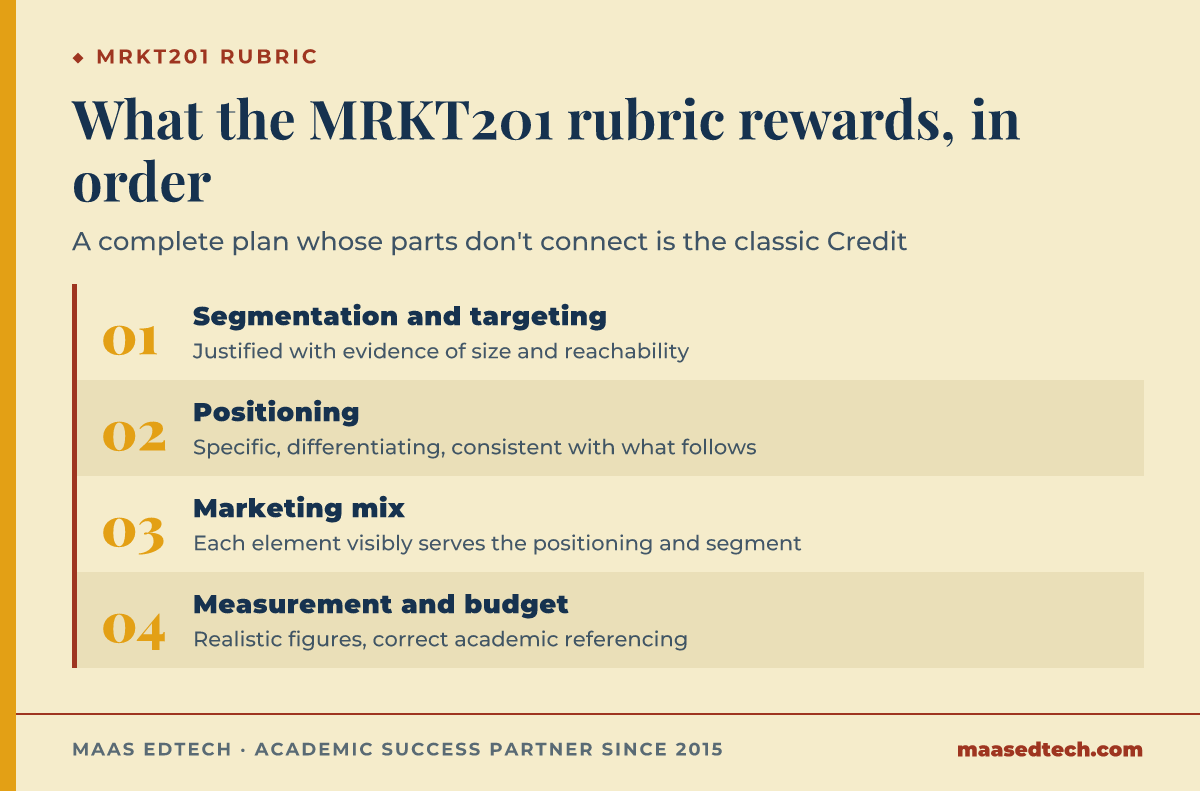
Evidence: Criterion bands in these units typically run Pass / Credit / Distinction / High Distinction, and the jump from Credit to Distinction is usually defined by the words "justified" and "integrated", a justified target and an internally consistent plan, not by more tactics or a longer competitor review.
Example: A MAAS mentor marked one Vietnamese student's draft against a single test: for each element of the mix, which line of the positioning statement does this serve? Three of the four elements had no answer, the promotion plan targeted a different audience than the pricing implied. After one alignment pass, the same plan moved up two full rubric bands.
Which frameworks should you use in MRKT201?
Direct answer: Anchor the report in a small set of frameworks that carry the decision rather than filling sections. A workable spine is: STP as the backbone, with segmentation criteria stated and defended; a positioning statement plus perceptual map to make the differentiation explicit; customer-based brand equity to explain how the brand builds meaning over time; the customer journey to place communications where decisions actually happen; and customer lifetime value or return on marketing investment to make the plan accountable. Each framework should produce a decision, not a diagram, in the same spirit Wedel and Kannan (2016) apply to analytics: a model earns its place by changing what you do next, not by decorating the report.
| Framework | What it explains | Use it to decide |
|---|---|---|
| Segmentation, targeting, positioning (STP) | Which customers to serve and how to be chosen by them | Who the plan is for and what claim it makes |
| Positioning statement and perceptual map | Where the brand sits relative to competitors in the customer's mind | Whether the differentiation is real or a slogan |
| Customer-based brand equity (Keller) | How awareness, associations, and response build brand value | Which brand asset to invest in first |
| Customer journey and touchpoints | Where and when the customer actually decides | Where to place communications and what each one must do |
| Customer lifetime value / ROMI | What a customer is worth and what the plan returns | Whether the proposed spend is defensible |
Evidence: These five frameworks are examiner-recognised, textbook-level foundations. Keller (1993) is precise about what the brand-equity row is measuring: "Customer-based brand equity is defined as the differential effect of brand knowledge on consumer response to the marketing of the brand" (Keller, 1993, p. 1). Kotler and Keller (2016) supply the marketing-management process, Vargo and Lusch (2004) the service-dominant logic, and Sharp (2010) the evidence-based challenge to loyalty and differentiation assumptions. Citing Sharp against a loyalty-heavy plan and then defending your choice anyway, is exactly the critical move that earns Distinction-level marks. Wedel and Kannan (2016) supply the metrics-row justification: in a data-rich environment, marketing analytics capability spans descriptive, predictive and prescriptive models, so a plan that only reports what happened has not yet used the data-rich environment the unit expects you to exploit.
Example: A Vietnamese student building a plan for a café used five frameworks lightly. Her MAAS mentor kept two, STP with a behaviourally defined segment, and the customer journey to show the decision happened before arrival, not in-store. That single insight changed the whole promotion plan and lifted the mark.
How should you structure the MRKT201 report?
Direct answer: Use a decision-led structure: (1) a short introduction naming the brand and the marketing problem, (2) a situation analysis limited to findings that constrain the strategy, with company background under 10% of the word count, (3) segmentation options and a justified target with evidence of size and reachability, (4) a positioning statement and a perceptual map, (5) the marketing mix with each element explicitly tied to the positioning, and (6) budget, timeline, metrics, and risks. Put full analysis tables in labelled appendices and carry only the implications into the body.
Evidence: Criterion-referenced rubrics weight "justification of target", "positioning", and "integration of the mix" far above "situation analysis". Matching your word budget to the rubric weighting is the most reliable way to lift a grade without gathering new material.
Example: A Vietnamese student submitted a report with a competitor table running to 2 pages and a one-line measurement section reading "track social media engagement". His MAAS mentor moved the table to an appendix and used the freed words to define three metrics tied to the plan's objectives, with a baseline and a target. Same research, the report moved from a borderline Credit to a Distinction because the plan became accountable.
What are the most common mistakes that lose marks in MRKT201?
Direct answer: Three recurring mistakes show up across MAAS marketing coaching. First, the target segment is a demographic description rather than a defensible segment, no evidence of size, no reachable channel, no distinct need. Second, the mix is internally inconsistent: premium positioning with discount pricing, or a communications plan aimed at a different audience than the one targeted. Third, measurement is an afterthought, "monitor engagement" with no baseline, no target, and no link to the objectives stated at the front. Fixing these three lifts most drafts by at least one rubric band.
Evidence: Across MAAS marketing coaching, marker feedback before intervention clusters heavily on "target not justified" and "plan not integrated", the two phrases that most often separate a Credit from a Distinction in advanced marketing rubrics.
Example: A Vietnamese student positioned a product as premium and artisanal, then proposed a launch discount and a mass-reach campaign. His MAAS mentor asked what the discount teaches a customer about the brand's value. The revised plan replaced the discount with a sampling activity that demonstrated quality instead of undercutting it, same budget, consistent positioning, and full marks on the integration criterion the original had failed.
How long is the MRKT201 assignment and what referencing style does it use?
Direct answer: Confirm the exact word count and style in your subject outline, individual marketing reports at this level commonly sit between 1,500 and 2,500 words, with appendices, tables, and reference lists often excluded from the count. Referencing style varies by provider: APA 7th and Harvard are both common in Australian business programs, so use whichever your outline specifies and apply it consistently. Cite theory from academic sources rather than marketing blogs, and reference every market claim, segment size, competitor share, consumer trend, with a dated source, because an unsupported market figure undermines the targeting decision it is meant to justify.
Evidence: Australian business programs typically nominate a single referencing style in the subject outline and mark consistency as part of academic-writing criteria. Markers routinely deduct marks for over-reliance on agency blogs, unreferenced market data, or reference lists that do not match in-text citations, even when the plan is strong.
Example: A Vietnamese student lost several marks because his segment-size estimate came from an undated industry blog and he cited Keller through a summary website. A MAAS pre-submission audit closed the gaps in under an hour, market data re-sourced to a dated industry report and the brand-equity model cited back to Keller (1993). On his next assessment, clean sourcing recovered marks on a criterion that requires no extra analysis at all.
Frequently asked questions
Is MRKT201 a hard unit?
It is judgement-heavy rather than technically hard. The concepts are familiar from introductory marketing, and that familiarity is the trap: the unit marks whether your decisions are justified and connected, not whether you can name the four Ps.
How specific does my target segment need to be?
Specific enough that someone could actually reach it. "Women aged 18–35" is a demographic slice; "office workers within two kilometres of the store who buy coffee on weekday mornings" is a segment you can size, reach, and design for. Evidence of size and reachability is what the rubric rewards.
Can I use a Vietnamese brand or market for my plan?
Often yes, unless your brief sets the brand, and it can work well because you understand the consumer context. The risk is a thin evidence base for market claims, check that you can source segment and competitor data with dates before committing.
Do I need primary research such as a survey?
Only if your brief asks for it, and within your provider's ethics requirements. Most assessments accept secondary evidence, industry reports, published consumer research, company disclosures, provided you cite it properly and interpret it rather than quoting it.
What referencing style does MRKT201 use?
It depends on the provider, APA 7th and Harvard are both common in Australian business programs. Use the style named in your subject outline and apply it consistently, including for industry reports.
Can MAAS help me with MRKT201?
Yes. MAAS Assignment & Essay Support coaches you through the assessment with the Outline, Draft, Final model, defining a defensible segment, sharpening the positioning, aligning the mix, building a measurement plan, and a pre-submission referencing audit, all with discipline-matched experts. We coach your work; we do not write it for you.
Ready to approach MRKT201 with a clear strategy?
If you have the research but not the decision, that is exactly where a discipline-matched expert helps most. MAAS Assignment & Essay Support is an academic support partner; we work alongside you through Outline, Draft, Final so the thinking stays yours and the structure earns the marks.
Bring your MRKT201 brief and we will match you to a marketing strategy mentor, 23% of our 100+ experts hold a PhD, within 48 hours when our network already covers that field. If it does not, MAAS opens a dedicated recruitment round for your case, which usually takes about 2 weeks.
Book a free 15-minute MRKT201 consultation with MAAS Assignment & Essay Support →
Related guides
- How to approach the MGMT302 Strategic Management assignment?: sibling guide on turning analysis into a defended decision
- How to approach the MKTG1507 Digital Marketing assignment?: for the contested-issues side of marketing
- MKTG1294 assignment: how do you approach Introduction to Advertising?: for the communications element of the mix
- MAAS Academic Mentoring service: 1:1 coaching with PhD-level mentors in your discipline
- Course-code assignment coaching: pillar guide on tackling any unit assignment with a MAAS mentor
References
- Keller, K. L. (1993). Conceptualizing, measuring, and managing customer-based brand equity. Journal of Marketing, 57(1), 1–22. https://doi.org/10.1177/002224299305700101
- Kotler, P., & Keller, K. L. (2016). Marketing management (15th ed.). Pearson.
- Sharp, B. (2010). How brands grow: What marketers don't know. Oxford University Press.
- Vargo, S. L., & Lusch, R. F. (2004). Evolving to a new dominant logic for marketing. Journal of Marketing, 68(1), 1–17. https://doi.org/10.1509/jmkg.68.1.1.24036
- Wedel, M., & Kannan, P. K. (2016). Marketing analytics for data-rich environments. Journal of Marketing, 80(6), 97–121. https://doi.org/10.1509/jm.15.0413
Tools & resources
- Tertiary Education Quality and Standards Agency. (n.d.). Higher education good practice hub. Retrieved July 20, 2026, from https://www.teqsa.gov.au/guides-resources/higher-education-good-practice-hub
This article is part of the MAAS Journal series for Vietnamese international students. MAAS Assignment & Essay Support is an academic support partner; we coach students through the Outline, Draft, Final delivery model with developmental feedback from discipline-matched experts. We do not write or submit work on a student's behalf.