
Marketing Strategy at Macquarie University is unusually honest about artificial intelligence. Rather than banning it, the published handbook entry labels the AI approach for all three assessment tasks as open, because a unit that permits AI has to find something else to assess, and this one has. 20% of the mark sits in an in-class impromptu question-and-answer session where nothing can be prepared in advance. Whatever a text generator can do, it cannot sit in that room.
Note on the code: this guide describes the Macquarie Business School unit. Curtin University also runs a MKTG3003, focused on digital marketing and e-commerce and carrying a different credit value, so check the unit title on your own enrolment before reading further.
Author: MAAS Editorial Team
Last updated: 2026-08-11
Category: marketing

How is the unit built?
Direct answer: MKTG3003 Marketing Strategy is a unit worth 10 credit points in Macquarie Business School, with entry requiring 130 credit points at 1000 level or above including MKTG2002. The published unit description frames it around the analysis process: identifying what information you need, acquiring it, interpreting it, and using it as the basis for business recommendations.
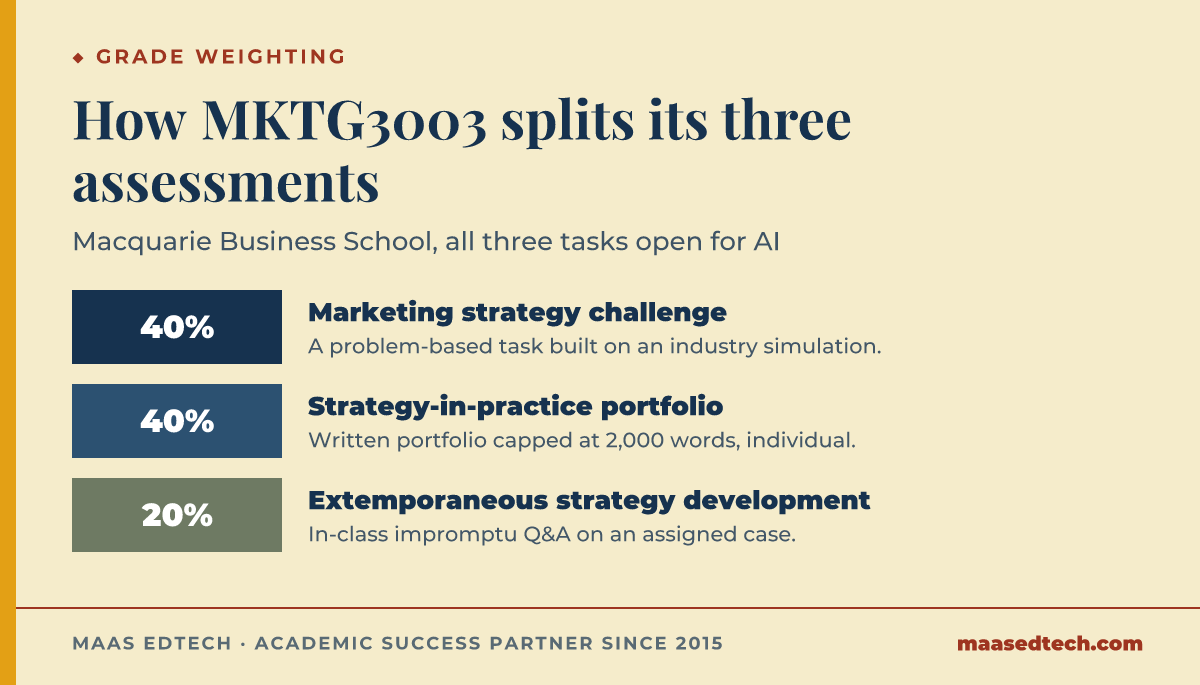
Evidence: The three published outcomes ask you to employ problem-solving skills to develop and communicate solutions across a range of marketing strategy situations, to critically analyse the theoretical and conceptual underpinnings of marketing strategies, and to develop and apply competitive strategies both individually and in collaboration. The 2026 handbook entry lists three assessments, all labelled open for AI: a marketing strategy challenge at 40%, a problem-based task built on an industry simulation; a strategy-in-practice portfolio at 40%, a written portfolio capped at 2000 words drawing on in-class case discussions; and extemporaneous strategy development at 20%, an in-class impromptu question-and-answer session on an assigned case, assessed individually. Task types and weightings are revised between offerings, and this unit's structure changed recently, so check the handbook entry for your own year before planning around any of these numbers.
Example: A student who had done well in earlier marketing units by writing strong reports found the impromptu session harder than anything he had met, because there was no draft stage and no question list. What he had was what he could say when asked.
Why does the simulation change what counts as a good answer?
Direct answer: Because a simulation answers back. In an ordinary assignment your strategy is assessed on how well it is argued. In a multi-round simulation it is also assessed against what happened when you ran it, and the marks come from what you did with that information rather than from whether the first decision was right.
| Round | The weak pattern | The pattern that earns marks |
|---|---|---|
| Opening decisions | Choose a position that sounds impressive | Choose a position and record why, in writing, before results arrive |
| First results | Explain away the outcome | Ask which assumption the result contradicts |
| Middle rounds | Change several variables at once | Change deliberately, so the next result is interpretable |
| Final report | Narrate the rounds in order | Explain what the sequence revealed about the market |
Evidence: The unit's description places the analysis process at its centre, meaning the acquisition and interpretation of information rather than the elegance of a plan. A report that recounts what the team did is a description of a process. A report explaining what each round taught them and how the strategy changed in response is an analysis of one, and only the second demonstrates the outcome about developing and applying competitive strategy.
Example: Two teams finished the simulation with similar market share. The first wrote up their decisions chronologically and concluded that their strategy had worked. The second identified the round where their pricing assumption failed, showed what they inferred from the competitor response, and explained the change that followed. The second team had a worse mid-simulation position and the better report.
What is the extemporaneous task really testing?
Direct answer: Whether your understanding survives contact with a question you did not prepare for. Prepared analysis and defensible analysis are not the same thing, and the format is designed to tell them apart.
Evidence: There is a well-documented reason this format is revealing. Rozenblit and Keil (2002) named the pattern directly: "people feel they understand complex phenomena with far greater precision, coherence, and depth than they really do" (Rozenblit & Keil, 2002, p. 521). The illusion collapses specifically when a person is asked to produce an explanation rather than to report a fact. Their finding is that this gap is much larger for explanatory knowledge than for facts or procedures. Marketing strategy is explanatory knowledge almost entirely, which is why a student can read a case, feel it is understood, and then be unable to say why one option dominates another when asked directly.
Example: A student who had read a case three times could summarise the company's situation fluently. Asked which of two segments she would abandon and why, she paused, then defended the answer she had assumed rather than one she had reasoned to. The gap was not effort. She had never tried to say it out loud.
How to prepare: before each case discussion, write in one sentence the recommendation you would defend, and in one more the strongest argument against it. Then say both aloud without reading. This takes a few minutes and is the closest available rehearsal of the assessed task.
Where does the word strategy get used incorrectly?
Direct answer: When a list of activities is presented as a strategy. This is the single most common substantive error in third-year Marketing Strategy work, and it is expensive because it goes to the outcome about critically analysing the conceptual underpinnings of strategy.
Evidence: Porter (1996), writing in Harvard Business Review, drew the distinction that still organises the field, arguing that operational effectiveness, meaning performing similar activities better than rivals, is not strategy, and that strategy involves deliberately choosing a different set of activities to deliver a distinct mix of value. The practical test follows from it: a genuine strategy implies things you have chosen not to do. A SWOT or PESTLE table catalogues options; it does not by itself commit you to one. If a recommendation could be adopted by every competitor without contradiction, it describes competence rather than position.
Example: A recommendation to improve social media engagement, invest in customer service and refresh the packaging is three sensible activities. Asked what the firm was choosing not to pursue as a result, the student had no answer, which located the problem precisely. Adding one trade-off, that the brand would forgo the price-sensitive segment in order to fund service quality, turned a list into a position.
How should you approach the written portfolio?
Direct answer: As an argument built from the case discussions, not as a set of tidied-up notes about them. The portfolio is capped at 2000 words and carries 40%, which makes it the largest single piece of writing in the unit and the place where a habit of summarising costs the most.
The trap is structural. A portfolio drawn from in-class discussions invites you to record what was said, and a record of a discussion is not an analysis of a case. The marks sit in what you concluded and why, including where you changed your mind after hearing an argument you had not considered.
Evidence: All three assessments in the unit are labelled open for AI, and this is the one where that matters most, because it is the only substantial written artefact. Permission to use a tool is not permission to submit its output as your reasoning, and the unit is built so that the same thinking is tested again in a room where no tool is available. A portfolio whose conclusions you cannot defend aloud is a liability rather than an asset.
Example: One portfolio entry summarised the class debate on a pricing case and noted that the group had considered several perspectives. Another stated a position on the pricing decision, gave the two figures that drove it, and recorded that a classmate's point about switching costs had moved the writer from one view to the other. The second is shorter and worth considerably more.
Where do international students most often lose marks?
Direct answer: In group and spoken components rather than written ones, and usually for reasons that have nothing to do with the quality of their thinking.
The pattern is familiar. A student who writes well takes the note-taking or formatting role in the group, contributes less in discussion, and is then assessed on collaboration and on spoken defence of an analysis. The published tasks combine individual and group work deliberately, so the quiet contribution is not a safe harbour. Taking ownership of one section of the analysis, and being the person who presents that section, is a more reliable path than doing more work invisibly.
The second pattern is register. Strategic recommendations are written with calibrated confidence: the evidence supports, this suggests, on the available data, the risk of this approach is. A recommendation stated as certainty invites a marker to look for the caveat you did not write, while a recommendation that names its own risk is harder to argue with.
A note on terminology: keep the technical terms in English and use them narrowly. Positioning, segmentation and targeting, often taught together as the STP framework, are not synonyms for value proposition or differentiation, and using them loosely is read as conceptual imprecision rather than as a language issue.
What do MAAS mentors actually do on a unit like this?
MAAS works as an academic advisor. On a Macquarie Business School unit assessed through simulation (40%), a written portfolio (40%) and an impromptu oral (20%), the useful work is rehearsal and challenge rather than editing. A mentor will ask you to defend a recommendation without notes and push on the weakest link, check whether what you are calling a strategy involves a real trade-off, look at whether your simulation report explains the rounds or merely lists them, and read a portfolio entry for whether it states a position or only records a discussion. You make your own decisions in the simulation, speak for yourself in class and submit your own work.
Frequently asked questions
Which university does this guide describe?
Macquarie University, where MKTG3003 is Marketing Strategy, a unit worth 10 credit points in Macquarie Business School. Curtin University uses the same code for a digital marketing and e-commerce unit with a different credit value, so confirm the unit title on your enrolment.
What are the prerequisites?
A published Macquarie University offering requires 130 credit points at 1000 level or above, including MKTG2002. Requirements are revised, so check your own enrolment record.
Is AI allowed?
The 2026 handbook entry labels all three assessment tasks as open for AI, but that is a statement about one year's entry rather than a permanent rule, and permissions differ between units and sessions. Always follow the AI statement in your own unit guide, and note that permission to use a tool is not permission to submit its output as your reasoning. 20% of the mark is an in-class impromptu session where no tool is available to you at all.
How much of the mark is group work?
Less than students often assume. The 2026 entry assesses the extemporaneous task individually, and the portfolio is an individual submission, which together account for 60%. Check the split in your own guide before assuming that a group grade carries you.
What if I am not confident speaking in class?
This is worth addressing early rather than hoping the format changes. Preparing one defensible sentence per case, and saying it aloud in advance, is more effective than preparing broadly, because the difficulty is production rather than knowledge.
Is a marketing simulation graded on winning?
No. The Macquarie Business School task is built around developing strategy, obtaining performance outputs and responding to them, which means the response is the assessed part. Teams lose marks for a well-argued response to a poor result far less often than they expect.
Related reading
- MKTG1420: digital business development
- MKT300 Strategic Marketing Management: the same discipline at ICMS in Sydney, where Australian marketing law is part of the strategy itself
- Accused of using AI: what to do
- Academic support from MAAS mentors
Talk to a MAAS mentor about your unit
References
Porter, M. E. (1996). What is strategy? Harvard Business Review, 74(6), 61–78.
Rozenblit, L., & Keil, F. (2002). The misunderstood limits of folk science: An illusion of explanatory depth. Cognitive Science, 26(5), 521–562. https://doi.org/10.1207/s15516709cog2605_1