
Consumer Behaviour arrives with a built-in disadvantage. Students have been consumers their whole lives, so the material feels familiar from the first lecture. That familiarity feels like understanding and is not, which is why students who found the unit obvious 3 weeks into semester write assignments 8 weeks in that explain their own shopping habits and receive an unexpected mark. The unit asks students to apply a framework to what people do, not to describe what they do.
Author: MAAS Editorial Team
Last updated: 2026-08-11
Category: marketing

What the unit covers, and how it is marked
Direct answer: MKTG1003 Consumer Behaviour is a 10-credit-point unit in Macquarie Business School, and the 2026 handbook entry divides the mark into a portfolio worth 30%, a consumer behaviour analysis worth 30%, and a formal examination lasting 2 hours worth 40%.
Evidence: The published description frames the unit around understanding why consumers think, feel and act as they do, so that businesses can make strategic, sustainable and ethical marketing decisions. It covers internal psychological processes and external environmental factors, consumer needs and values, perception of products and brands, attitude measurement and change, and the influence of culture and reference groups. It also lists MKTG203 as a not-counted-with-credit unit. The American Marketing Association (AMA) defines consumer behaviour along similar lines, as the study of how individuals select, use and dispose of products.
One detail in that entry is worth reading closely. The two coursework tasks are labelled open for AI, while the examination is labelled observed. 60% of your mark is earned where tools are available and 40% is earned in a room where they are not, on the same material. Whatever you use during semester therefore has to leave real understanding behind, because the exam tests the same content under different conditions.
Note on the code: this guide describes the Macquarie unit, and codes of this shape denote quite different subjects elsewhere. Match the unit title against your enrolment record before trusting any material you find under the code alone.
Why is your own experience not evidence?
Direct answer: Because you do not have reliable access to why you did what you did, and an assignment built on introspection is built on an unreliable source.
This unreliability of introspection is not a rhetorical point. Nisbett and Wilson (1977), writing in Psychological Review, reviewed a large body of experimental work showing that people confidently report reasons for their own behaviour that demonstrably were not the causes, and that these reports are often constructed after the fact from plausible theories rather than retrieved from memory. In their own words: "People sometimes make assertions about mental events to which they may have no access and these assertions may bear little resemblance to the actual events" (Nisbett & Wilson, 1977, p. 247).
For this unit the implication is direct. Writing that you chose a brand because of its quality is a plausible story you generated, not a finding. The frameworks exist precisely because self-report is unreliable, and using a framework means applying it to observable behaviour rather than to your own explanation of yourself.
| What weak answers do | What the frameworks are for |
|---|---|
| Explain the writer's own purchase | Identify a process operating on many consumers |
| Report what a consumer says drives them | Ask what actually predicts the behaviour |
| Use a theory as a label after the conclusion | Use a theory to generate what to look for |
| Describe a preference | Explain a mechanism |
Example: A student analysing why young consumers switched coffee brands wrote that people prefer better taste and reasonable prices. Everything there is true and none of it distinguishes the brands that won from those that lost. Reframed around reference group influence and visible consumption, the analysis identified that the product was consumed publicly, which made it susceptible to peer influence in ways that a private purchase would not be.
How do you apply a framework rather than name one?
Direct answer: By letting the framework decide what you look at before you know what you will find.
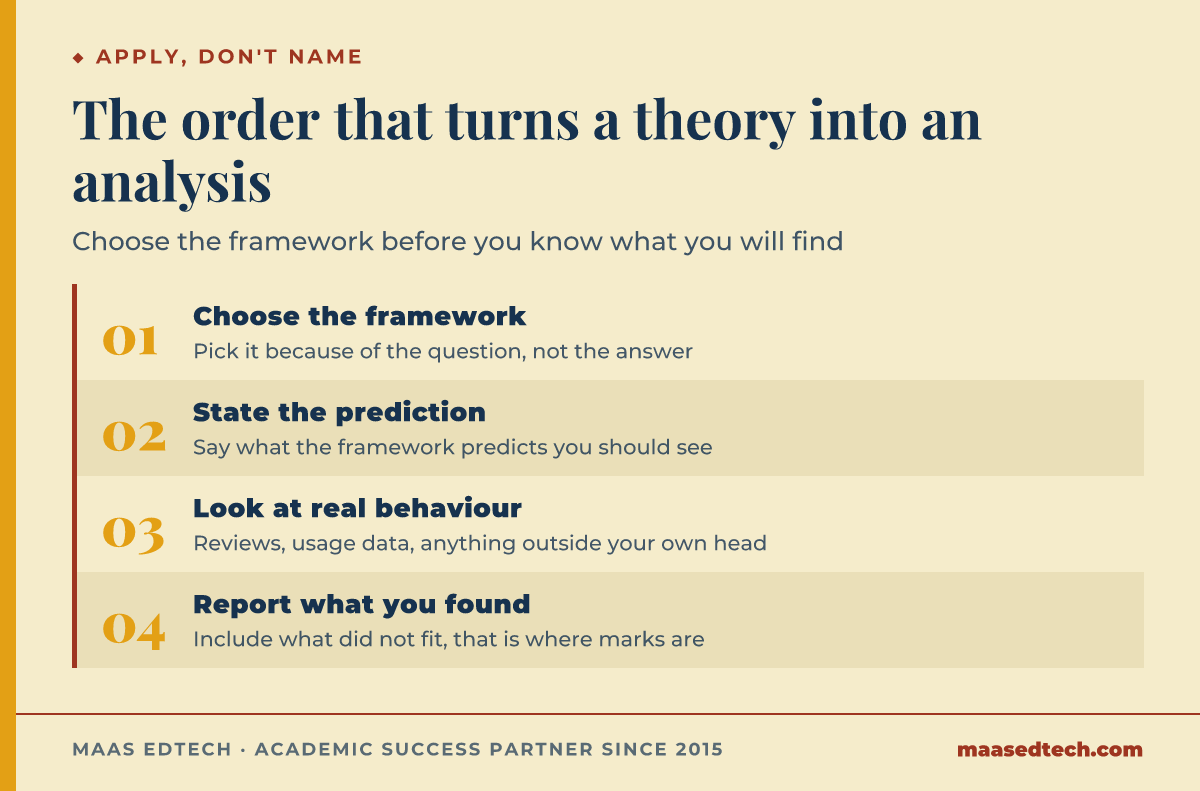
The failure mode is invisible from inside. A student reaches a conclusion from intuition, then finds a theory that fits and attaches it. The resulting paragraph mentions a real framework and demonstrates nothing, because the framework did no work. Markers detect this quickly, since the theory is always introduced after the claim.
The order that produces marks is the reverse.
- Choose the framework because of the question. Attitude change, perception, motivation and reference group influence answer different questions, and picking one commits you to looking for specific things.
- Say what the framework predicts you should observe. This step is what makes an analysis testable rather than decorative.
- Go and look at the actual behaviour. Reviews, observed usage, published market data, anything outside your own head.
- Report what you found, including what did not fit. The parts that resist the framework are usually where the marks are, because handling them requires judgment.
Evidence: Fishbein and Ajzen (1975) modelled this same discipline decades earlier in their Theory of Reasoned Action, predicting attitude and behaviour from stated beliefs before observing either. Bearden and Etzel (1982), publishing in the Journal of Consumer Research, provide a useful model of this discipline. Rather than asserting that groups influence purchases, they distinguished products by whether they were consumed publicly or privately and whether they were luxuries or necessities, then predicted where reference group influence should be strong and tested it. The framework told them what to measure before the results arrived, which is the move you are being taught to make.
What does the examination test that coursework does not?
Direct answer: Whether the understanding is yours, under conditions where nothing can help you produce it.
The handbook entry lists the examination as 2 hours and labels it observed for AI. That difference in labelling between the exam and the coursework is worth planning around from the first week rather than discovering it after 12 weeks of semester. A portfolio built with substantial tool assistance can be perfectly compliant and still leave you unable to reproduce the reasoning unaided.
The practical test during semester is simple. After completing any piece of coursework, close everything and write for 5 minutes on what the theory says and how it applied to your case. If that is difficult, the coursework mark and the exam mark will diverge, and there is still time to fix it.
A caution about study material. Consumer behaviour summaries circulate widely and are heavy on definitions, because definitions are easy to compile. The examinable difficulty is applying a framework to an unfamiliar scenario, which no definition list rehearses.
Where does the marketing student's writing usually go wrong?
Direct answer: In claiming more than the evidence supports, which in this unit is both a writing problem and a conceptual one.
Consumer behaviour invites overreach because the subject matter is human and the language is everyday. Consumers want authenticity is a sentence that sounds like a finding and asserts something about billions of people. The disciplined version names the consumers, the context and the basis: among the reviewers in this sample, references to the brand's origin appeared more often than references to price, which suggests.
For students writing in English as an additional language, the useful move is to lean on the qualifying phrases rather than avoid them. Suggests, is consistent with, in this context, the data do not show are short, reusable, and do more for a mark than complex sentence construction. A simple sentence with an accurate claim outperforms an elaborate one that overstates.
Hold the technical vocabulary apart, since this unit's terms are ordinary words with narrow meanings. Perception is not opinion, attitude is not preference, motivation is not intention, and a need is not a want. Using them loosely reads as a conceptual gap, because in this unit those distinctions are the content.
How MAAS mentors work on a unit like this
Our role is advisory, and here the questions are mostly about evidence. A mentor will ask where a claim came from and whether anything outside your own experience supports it; check that your framework was chosen before your conclusion rather than after; look for the observation that did not fit and ask what you did with it; and test whether you can restate your analysis without notes, since a portion of your mark depends on exactly that. The evidence gathering is yours, the analysis is yours, and what goes to the marker has your name on it because you wrote it.
Frequently asked questions
Which university is this about?
Macquarie University, located in North Ryde, Sydney, where MKTG1003 is Consumer Behaviour, a 10-credit-point unit in Macquarie Business School. Verify the title on your own enrolment, since similar codes elsewhere denote different subjects.
How is the unit assessed?
The 2026 handbook entry lists a portfolio worth 30%, a consumer behaviour analysis worth 30%, and a formal examination lasting 2 hours worth 40%. This unit's structure is set per year, so open the entry for your own year of enrolment before you build a plan on these numbers.
Can I use AI?
The 2026 entry labels the two coursework tasks as open for AI and the examination as observed. Follow the statement in your own unit guide, and remember that the exam covers the same material without those tools, so anything you skip understanding during semester is deferred rather than avoided.
Is this a psychology unit?
It draws on psychological concepts but assesses them for marketing decisions. The published description pairs internal psychological processes with external environmental factors such as culture and reference groups.
Do I need to run my own research?
The analysis task asks you to apply theory to real-world consumption behaviour, which means evidence from outside your own head. That can be published data, reviews or observation, and what matters is that the evidence exists independently of your argument.
Why do people find it deceptively hard?
Because familiarity with being a consumer feels like knowledge of consumer behaviour. The gap only becomes visible when an assessment asks for a mechanism rather than a description.
Related reading
- MKTG3003: marketing strategy
- MKTG2004 at ANU: why do two videos decide up to half your grade?
- MKTG1420: digital business development
- Academic support from MAAS mentors
Ask a MAAS mentor about your unit
References
Bearden, W. O., & Etzel, M. J. (1982). Reference group influence on product and brand purchase decisions. Journal of Consumer Research, 9(2), 183–194. https://doi.org/10.1086/208911
Fishbein, M., & Ajzen, I. (1975). Belief, attitude, intention, and behavior: An introduction to theory and research. Addison-Wesley.
Nisbett, R. E., & Wilson, T. D. (1977). Telling more than we can know: Verbal reports on mental processes. Psychological Review, 84(3), 231–259. https://doi.org/10.1037/0033-295X.84.3.231