
◆ Marketing
MKTG2004 Introduction to Marketing at ANU: two videos decide grades
Because the course no longer lets you write your way through it. Introduction to Marketing at the Australian National University now settles 45% to 50% of the grade on two videos you film and narrate yourself, and finishes with a closed-book paper written by hand. Students arriving from a semester of essays often plan for the wrong work, and the study notes circulating online describe a version of the course that has been retired.

◆ Section 1 / 8 · Which MKTG2004
Which MKTG2004 are you enrolled in?
Direct answer: This guide covers the Australian National University course, a 6-unit undergraduate course called Introduction to Marketing, taught by the Research School of Management. Macquarie University uses MKTG2004 for Integrated Marketing Communications, a 10 credit point unit, and Western Sydney University listed MKTG 2004 International Marketing Research in its 2024-25 handbook. Three different courses, one code.
Evidence: Course codes belong to the institution that issues them, not to the discipline, so a set of notes found under this code may describe a syllabus you will never sit. The three courses are not near-neighbours either. The ANU version is a second-year introduction built on reflection and video; the Macquarie unit is a communications specialisation; the Western Sydney subject is a research-methods course with a statistics prerequisite.
Example: A student revising Integrated Marketing Communications frameworks for an ANU exam would be preparing material the ANU course previews in one week of thirteen, and would arrive without having practised the problem-solving format the paper actually asks for.
◆ Section 2 / 8 · How it is assessed
How is MKTG2004 assessed at ANU in 2026?
Direct answer: Four tasks, and no written report among them. Second Semester 2026 carries a Minor Marketing Video at 20%, a Transdisciplinary Marketing Essay done in a group at 20%, a Major Marketing Reflection Video at 30%, and a closed-book Marketing Exam at 30%. Three of the four are individual work.
Evidence: The Australian National University (2026) publishes a class summary for class 8137, and it sets the due dates as 13 August, 29 September and 27 October 2026, with exam results due back on 9 December. The two videos together carry 50% in that semester, which is the single most important number for planning, because neither is a task you can produce in the two days before a deadline the way a rushed essay can be.
| Assessment task | Weight in Semester 2, 2026 | Weight in Semester 1, 2026 | Individual or group |
|---|---|---|---|
| Minor Marketing Video | 20% | 15% | Individual |
| Transdisciplinary Marketing Essay | 20% | 30% | Group |
| Major Marketing Reflection Video | 30% | 30% | Individual |
| Marketing Exam | 30% | 25% | Individual |
Example: One student treated the first video as a warm-up worth skipping effort on, because 20% sounded small beside an exam. The task is designed as the first half of a two-part sequence, so the feedback returned on 31 August was the only structured guidance available before the 30% video in October. Skipping the warm-up meant sitting the harder task without ever having been marked on the format.
◆ Section 3 / 8 · Weightings by semester
Do the weightings change between semesters?
Direct answer: Yes, and by enough to change how you plan. The same four tasks appear in both 2026 semesters, but class 2780 in Semester 1 weighted the group essay at 30% and the first video at 15%, while class 8137 in Semester 2 reversed the emphasis to 20% and 20% and lifted the exam from 25% to 30%.
How MKTG2004 was weighted in the ANU class summaries for Semester 2 and Semester 1, 2026
The yellow part is the Transdisciplinary Marketing Essay, the only group task. The chips switch between the two semesters.
Minor Marketing Video (individual)
20
% of the course mark
Transdisciplinary Marketing Essay (group)
20
% of the course mark
Major Marketing Reflection Video (individual)
30
% of the course mark
Marketing Exam (individual)
30
% of the course mark
Save this figure
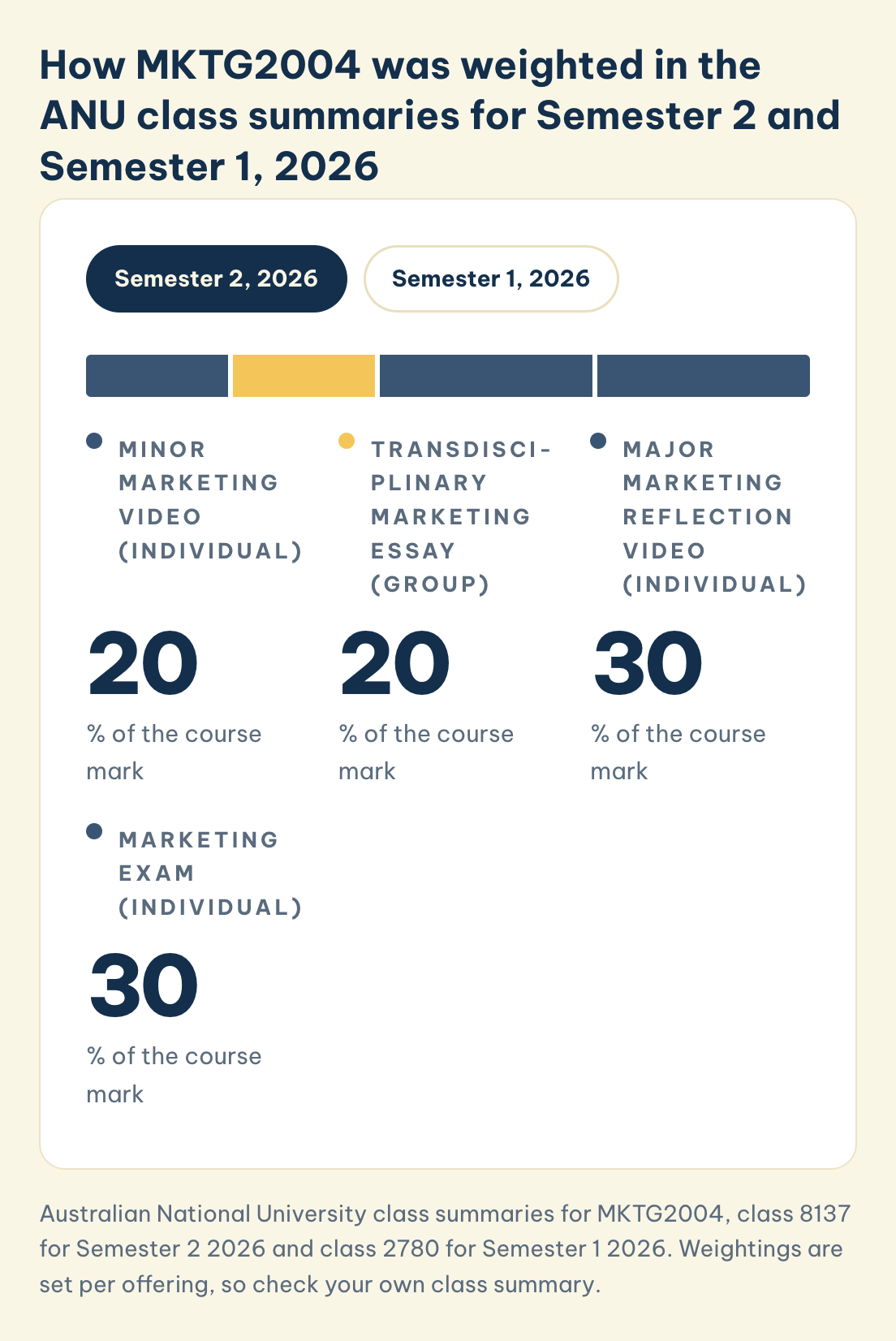
Evidence: The two class summaries, class 2780 and class 8137, are published separately for exactly this reason, and the gap between them is the strongest argument against studying from a friend's notes or a shared drive from last semester. The task names survive, the numbers do not. Two students describing "the 30% group essay" and "the 20% group essay" are both telling the truth about different semesters, and only one of them is describing yours.
Example: A student who inherited a study plan from the previous cohort allocated most of December's revision to the exam on the basis that it was worth a quarter of the course. In Semester 2 it is worth 30%, and it is closed-book, which changes the revision method rather than only the hours.
◆ Section 4 / 8 · The minor video
What does the minor marketing video actually ask for?
Direct answer: A reflection on one consumption experience you have had in the Australian Capital Territory, explained with marketing theory and your own observation, with references cited inside the video itself. There is a hard rule attached: work where over 25% of the content is filmed outside the ACT is recorded as not meeting the criteria and given a fail grade.
Evidence: Schultz and Quinn (2014) argued that student-produced video works as assessment when it pushes students into problem solving and direct experience rather than into presentation, and Campbell et al. (2022) reached a similar conclusion for online settings. The ANU task description reads the same way. It is explicit that the purpose is to benchmark your audiovisual skill and return actionable feedback, and that the emphasis falls on authentic human-created content that a marker can engage with. That framing tells you what the marking is not rewarding. Production polish is not the target; a verifiable, first-hand account that you can then read through theory is.
Example: Two students filmed the same coffee shop. The first assembled three minutes of attractive footage and a voiceover explaining the marketing mix in general terms. The second filmed less, spent the time on one specific moment at the counter where the service promise and the actual experience diverged, named the concept that moment illustrated, and cited the source she had taken the concept from. Only the second submission gave the marker something to assess against the criteria.
◆ Section 5 / 8 · The group essay
How is the group essay different from the video tasks?
Direct answer: The group essay is the one task that deliberately takes you outside marketing. A small team addresses a social problem and proposes two solutions, one drawn from a non-marketing discipline each member already knows, and one built from the marketing skills the course has taught. The comparison is the assessment.
Evidence: The course runs under the ANU Framework for Transdisciplinary Problem Solving, and this task is where that framework becomes assessable rather than decorative. The class summary is careful to say marketing could be a solution, not the solution, to commercial, non-profit and social problems. A submission that treats the non-marketing option as a straw man to be defeated has misread the task, because the point is to locate where marketing fits inside a wider response, and where it does not.
Example: A team working on a public health problem wrote three pages on a social marketing campaign and half a page dismissing the policy approach one member had studied in her law degree. The stronger version of that essay would have taken the policy option seriously enough to say precisely which part of the problem it solves better, and then shown what remains for marketing to do.
Note on logistics: Groups are formed during semester, and marking rubrics are published on Canvas at least 10 working days before submission. Both details are worth acting on. Ten working days is enough time to draft against the rubric rather than against a guess.
◆ Section 6 / 8 · The exam
What kind of exam does the course finish with?
Direct answer: A closed-book paper, written by hand, in an examination room, during the ANU examination period. It asks you to work through a marketing problem and outline how marketing theory could engage an audience or a set of stakeholders. In Semester 2, 2026 it carries 30% of the course, and results are scheduled for return on 9 December 2026.
Evidence: The course describes the exam as a workplace simulation in which you draw on internal knowledge, memory, lived experience and studied theory. Preparation is expected to come from weekly tutorial activity rather than from end-of-semester reading, and the tutorials are face-to-face, are not recorded, and have no online option. The course runs on a flipped model, so the theory arrives by video before the tutorial, and the tutorial is where it gets applied. A student who watches the videos but skips tutorials has consumed the content and skipped the rehearsal.
Example: Preparing for a closed-book applied paper by re-reading summaries is a well-documented mistake. Roediger and Karpicke (2006) showed that retrieval practice, in which you attempt a problem from memory before checking, produces better long-term retention than restudying the same material, and that the gap widens as the delay before the test grows.
◆ Section 7 / 8 · The textbook
What should you do with the prescribed textbook?
Direct answer: Use it, and note that it costs nothing. The required resource is Principles of Marketing, which Albrecht et al. (2023) published through OpenStax and made available free online. That removes the usual excuse for working from lecture slides alone, and it means every student in the cohort can open the same page at the same time.
Evidence: An openly licensed textbook changes what a reference inside a video assessment can look like. You can cite a chapter by name, and the marker can open the same page without a paywall between them and your claim. For a task that expects references in the body of the video, an accessible source is worth more than an impressive one.
Example: Citing "the textbook" in a voiceover tells a marker nothing. Naming the concept, the chapter it comes from and the authors takes four seconds and converts an assertion into a claim that can be checked.
◆ Section 8 / 8 · Where marks are lost
Where students lose marks that were available
Direct answer: In the gap between describing and evaluating. A video that narrates what a company did, or an essay that lists two solutions side by side, has answered a descriptive question in a task marked for judgement. All four MKTG2004 tasks ask you to take a position and defend it, so a complete but uncommitted submission reads as unfinished.
Evidence: Vlachopoulos and Makri (2024), reviewing the research on authentic assessment across higher education, found that tasks of this kind are designed to elicit the skills a graduate will actually use, which is why they reward a defended position over a complete survey. Ajjawi et al. (2024) push the point further. Reviewing three decades of the idea, they note that "current practice tends to foreground mimicking of work tasks" (Ajjawi et al., 2024, p. 499), and argue that authenticity belongs to the judgement a student is asked to exercise rather than to the format the task arrives in. A video is not automatically authentic. It becomes so when the person on screen has decided something and can say why.
Example: "The brand uses social media heavily" is description. "The brand's social media speaks to a segment its pricing excludes, and the experience in store resolves that contradiction in favour of the pricing" is a judgement, and it can be wrong, which is exactly what makes it markable.
Frequently asked questions
Which university does this guide describe?
The Australian National University, where MKTG2004 is Introduction to Marketing, a 6-unit undergraduate course. Macquarie University and Western Sydney University have used the same code for different courses, so check it against your own handbook before relying on shared notes.
Are there still an STP task and a marketing audit?
Not in the 2026 course. Those tasks belong to an earlier version, and most study-notes sites and AI answers still describe them. The current four tasks are two videos, a group essay and a closed-book exam.
How long should the videos be?
The class summary does not publish a duration, and neither should anyone else. Length requirements and rubrics are released on Canvas before each submission, and that is the only source to plan against.
Can I film the first video while I am home over the break?
No. Work with more than 25% of its content filmed outside the ACT is given a fail grade for that task.
Is the exam open-book?
No. It is closed-book and handwritten, sat during the ANU examination period.
Do I need video editing skills to do well?
The task is written around authentic, human-created content and a benchmark of your existing skill, with feedback built in. The first video exists so that you can be bad at it once, on purpose, for 20% rather than 30%.
Where this guidance comes from
The course facts above, the unit value, the four assessment tasks, their weightings in both 2026 semesters, the due dates, the ACT filming rule, the prescribed text and the exam conditions, come from the Australian National University's own published class summaries rather than from secondary summaries or study-notes sites. The claims about why students lose marks on video and reflective tasks draw on three separate literatures on student-produced video and authentic assessment. None of them studied MKTG2004, so they explain the pattern rather than prove it for this course. Weightings and rubrics can be revised between semesters, so treat every number here as the published shape of the course and confirm it against your own Canvas site.
Related reading
References
Ajjawi, R., Tai, J., Dollinger, M., Dawson, P., Boud, D., & Bearman, M. (2024). From authentic assessment to authenticity in assessment: Broadening perspectives. Assessment & Evaluation in Higher Education, 49(4), 499-510. https://doi.org/10.1080/02602938.2023.2271193
Albrecht, M. G., Green, M., & Hoffman, L. (2023). Principles of marketing. OpenStax. https://openstax.org/details/books/principles-marketing
Australian National University. (2026). MKTG2004: Introduction to marketing. https://programsandcourses.anu.edu.au/2026/course/MKTG2004
Campbell, L. O., Heller, S., & Pulse, L. (2022). Student-created video: An active learning approach in online environments. Interactive Learning Environments, 30(6), 1145-1154. https://doi.org/10.1080/10494820.2020.1711777
Roediger, H. L., & Karpicke, J. D. (2006). Test-enhanced learning: Taking memory tests improves long-term retention. Psychological Science, 17(3), 249-255. https://doi.org/10.1111/j.1467-9280.2006.01693.x
Schultz, P. L., & Quinn, A. S. (2014). Lights, camera, action! Learning about management with student-produced video assignments. Journal of Management Education, 38(2), 234-258. https://doi.org/10.1177/1052562913488371
Vlachopoulos, D., & Makri, A. (2024). A systematic literature review on authentic assessment in higher education: Best practices for the development of 21st century skills, and policy considerations. Studies in Educational Evaluation, 83, 101425. https://doi.org/10.1016/j.stueduc.2024.101425
A free 20-minute consultation is a conversation about where you are with MKTG2004.
Book a free consultation ▸