
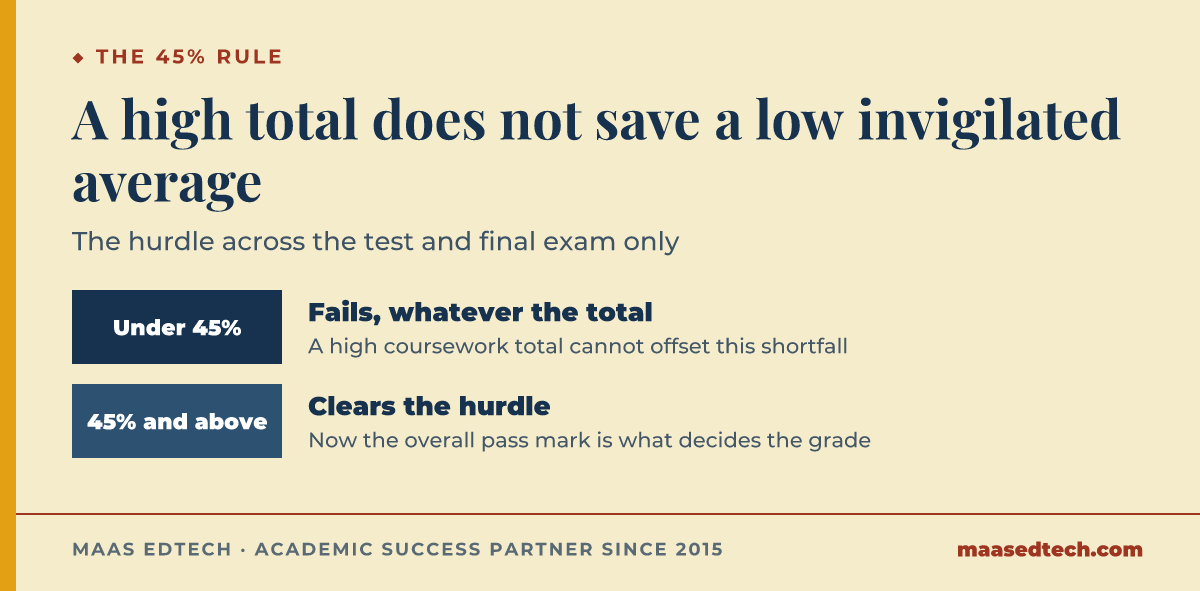
Yes, and it is the most important thing to understand about this course before planning a semester. Principles of Marketing at the University of Canterbury applies what it calls the 45% rule: students must reach a 45% weighted average across invigilated assessments, no matter how well they did elsewhere. Since the test and final examination carry most of that weight, a student strong at coursework but weak under exam conditions can build a comfortable total and still fail.
Author: MAAS Editorial Team
Last updated: 2026-08-10
Category: marketing

First, check which MKTG100 you are looking at
Direct answer: This guide covers the University of Canterbury course. MKTG100 has also been used at other institutions, including Australian Catholic University, where it carried the title Principles of Marketing but a different credit structure. Course codes belong to each university, so a study guide found under this code may describe a course you are not enrolled in.
Evidence: Canterbury publishes the course openly through its course information system, including the description, learning outcomes, restrictions and full assessment breakdown for each occurrence. That level of published detail is unusual and worth using, because it lets you plan against the real structure rather than a remembered one.
Example: Revising from notes found online, one student spent time on a topic her lecturer never covered. The notes were accurate for a different university's version of the course.
If your course is worth 15 points, runs at Canterbury and lists MGMT102 as an equivalent course, you are in the right place.
What is the course and how is it assessed?
Direct answer: MKTG100 Principles of Marketing is a 15-point first-year course at the University of Canterbury, offered in Semester One and Semester Two. Its published assessment for a recent Semester One occurrence was tutorial attendance at 10%, two case analyses at 12.5% each, a test at 25% and a final examination at 40%. It has MGMT102 listed as an equivalent course, so you cannot count both.
Evidence: This assessment breakdown comes from the university's own course information page for the occurrence, which also records the withdrawal dates and the coordinator. Note that assessment can be revised between occurrences, so treat these percentages as the published shape of the course and confirm the current version against your own course outline.
Example: One student planned the semester around the two case analyses because those felt like the real work, and left the test as something to revise for later. The two case analyses together were worth 25%. The test alone matched them, and the examination outweighed everything else combined.
What does the 45% rule actually mean for planning?
Direct answer: It converts the invigilated assessments from a large share of your grade into a condition on passing at all. Two students with identical totals can receive different outcomes if one of them fell below the threshold across the test and examination.
| How marks are earned | Weight in the published occurrence | What the 45% rule does to it |
|---|---|---|
| Tutorial attendance | 10% | Reliable marks, but they cannot rescue a low invigilated average |
| Case analyses | 12.5% each | Where careful work pays, and where the rule offers no protection |
| Test | 25% | Counts towards the invigilated average |
| Final examination | 40% | Counts towards the invigilated average and dominates it |
Evidence: Hurdle requirements of this kind exist because a course wants to certify that the individual student holds the knowledge, not that they assembled a total. Their practical effect is well documented in student outcomes: they concentrate risk in the timed components, which is precisely where students with strong coursework habits are least prepared.
Example: Sitting on a solid coursework record, one student went into the examination believing they needed a modest score to pass overall. They did, arithmetically. They also needed a very different number to clear the invigilated threshold, and nobody had explained the difference until it was too late to change how they had revised.
How should you approach the two case analyses?
Direct answer: Apply a small number of concepts precisely to the specific firm in the case, rather than surveying everything the course has covered. The learning outcome that matters here asks you to apply marketing concepts to specific business cases and situations, and application is a narrower activity than explanation.
Evidence: The published outcomes are worth reading in order, because they escalate. Understanding and explaining the 4 components of the marketing mix, product, price, place and promotion, comes first. Recognising marketing's role in strategic planning comes next. Linking the mix elements to the firm's overall strategy follows. Applying concepts to specific cases comes last, which is the level a case analysis is marked at. A submission that stops at explaining the mix has answered the first outcome in a task designed to assess the fourth.
Example: One case analysis described the company's product, price, place and promotion in four tidy paragraphs and concluded that the mix was well balanced. Asked which single element was inconsistent with the strategy the company claimed to be pursuing, the writer identified a premium positioning undercut by discount-led promotion. That inconsistency became the analysis, and the four descriptive paragraphs shrank to one.
What does the strategic-planning outcome expect?
Direct answer: That you can place marketing decisions inside the firm's wider planning rather than treating them as self-contained. The third outcome, linking mix elements to overall strategy, is the one first-year students most often skip, because it requires holding two levels in view at once.
Evidence: The connection between positioning and the mix is the oldest argument in the field for a reason: a mix decision that contradicts the intended position does not merely underperform, it actively confuses the market about what the brand is. Ries and Trout (2001) coined the term positioning in a three-part 1972 Advertising Age series to describe exactly this problem, and Kotler and Keller (2016) frame the mix as the implementation of a positioning decision rather than a menu of independent choices, which is why an analysis that evaluates each element in isolation cannot see the most common failure.
Example: One answer evaluated a firm's distribution choice as efficient because it reached the largest number of customers at the lowest cost. Set against a positioning built on exclusivity, the same choice was actively damaging. Neither reading is wrong on its own; only one of them answers the outcome. Sharp (2010) pushes back on some of the positioning orthodoxy from the buyer-behaviour side, arguing that mental and physical availability explain more of a brand's growth than a narrowly defended position, a genuine debate a first-year case answer is not expected to resolve but is expected to know exists.
Where do international students most often lose marks?
Direct answer: In the timed components, and for reasons that have little to do with marketing knowledge. Writing a case answer under examination conditions in a second language is a different task from writing one at home over a week, and it is the skill least likely to have been practised.
Evidence: Given the 45% rule, this is where preparation returns the most. The practical implication is that revision should be productive rather than receptive: write full answers to past-style questions under time, then compare them against the marking outcomes, rather than re-reading lecture material. Testing yourself produces substantially better retention than restudying the same content, even though re-reading feels more effective while you are doing it, and the advantage from testing shows up most clearly on a delayed test roughly 1 week later, not on an immediate one (Roediger & Karpicke, 2006). A large review of learning techniques rated practice testing and distributed practice as the two strategies with the strongest evidence behind them, and rated highlighting and re-reading, the two habits most students actually use, as the weakest (Dunlosky et al., 2013).
Example: Strong case analyses at home, thin answers in the examination, and an assumption that the problem was nerves. Her practice attempts showed something else: she spent the first 15 minutes writing background before reaching any application, a habit that costs nothing at home and costs a great deal in an examination.
A note on terminology: keep terms such as positioning, segmentation, targeting and differentiation exact. They have precise meanings that everyday Vietnamese translation blurs, and in a timed answer a blurred term produces a blurred argument. Kotler and Keller (2016) define each of these 4 terms separately for a reason: collapsing them into one loose idea of "marketing strategy" is itself a mark-losing habit, independent of the 45% rule.
What should a semester plan look like?
Direct answer: Treat the test as a diagnostic for the examination rather than as a hurdle you clear and forget, because it is the only advance signal you get about your performance under invigilated conditions.
A pattern that works: attend tutorials from week one, since attendance carries marks and the tutorial exercises are where application is practised rather than described. Prepare each case analysis by choosing your concepts before you start writing, not while writing. After the test, spend an hour separating marks lost through not knowing from marks lost through not retrieving in time, because those two have opposite remedies. In the final weeks, write timed answers rather than reviewing notes.
Evidence: The diagnostic step matters more than its cost suggests. With a threshold applied across invigilated assessments, the test tells you whether your current preparation method works under those conditions while there is still an examination left in which to act on the answer. Writing timed answers instead of re-reading notes is not a study preference, it follows a documented finding in memory research: "Testing has a powerful effect on long-term retention" (Roediger & Karpicke, 2006, p. 253). Their experiments found that students who were tested on material remembered more of it a week later than students who simply reread the same material the same number of times.
What do MAAS mentors actually do on this course?
MAAS works as an academic advisor. On a course with a hurdle requirement, the first useful conversation is about arithmetic: what your invigilated average currently looks like and what the examination therefore has to do. After that, the work is ordinary, meaning a read of your case analysis against the course outcomes, questions about whether your chosen concepts are doing analytical work, and practice at writing application under time. You write and submit your own work, and your own tutorial attendance and examinations remain yours.
Frequently asked questions
How many points is MKTG100 worth?
15 points at the University of Canterbury, taught as a first-year course in Semester One and Semester Two.
What is the 45% rule?
The university requires a 45% weighted average across the invigilated assessments in courses where the rule applies, and Canterbury lists it for this course. Meeting the overall pass mark is not sufficient on its own. Check your current course outline for how it applies to your occurrence.
Which assessments are invigilated?
In the published occurrence, the test and the final examination. Together they carried 65% of the course mark and dominate the invigilated average.
Can I take MKTG100 and MGMT102 together?
No. Canterbury lists MGMT102 as an equivalent course and as a restriction, so the two cannot both count towards your qualification.
Are there prerequisites?
The published course information for this occurrence lists a restriction rather than a prerequisite, which is one reason the course attracts students from a wide range of degrees.
Is this the same MKTG100 taught at other universities?
Not necessarily. The code has been used elsewhere, including at Australian Catholic University under the same title but within a different structure. A shared textbook such as Kotler and Keller (2016) does not mean a shared assessment structure, so verify against your own university's handbook before assuming the weighting matches.
Related reading
- MARK1107: principles and practice of marketing
- MKTG2004 at ANU: why do two videos decide up to half your grade?
- MKTG10001 at Melbourne: where do Principles of Marketing marks sit?
- How to revise for final exams effectively
- Exam support from MAAS mentors
Talk to a MAAS mentor about your course
References
Kotler, P., & Keller, K. L. (2016). Marketing management (15th ed.). Pearson.
Ries, A., & Trout, J. (2001). Positioning: The battle for your mind (20th anniversary ed.). McGraw-Hill.
Roediger, H. L., & Karpicke, J. D. (2006). Test-enhanced learning: Taking memory tests improves long-term retention. Psychological Science, 17(3), 249–255. https://doi.org/10.1111/j.1467-9280.2006.01693.x
Sharp, B. (2010). How brands grow: What marketers don't know. Oxford University Press.
Dunlosky, J., Rawson, K. A., Marsh, E. J., Nathan, M. J., & Willingham, D. T. (2013). Improving students' learning with effective learning techniques: Promising directions from cognitive and educational psychology. Psychological Science in the Public Interest, 14(1), 4–58. https://doi.org/10.1177/1529100612453266