
MKTG10001 Principles of Marketing: where do the marks sit?
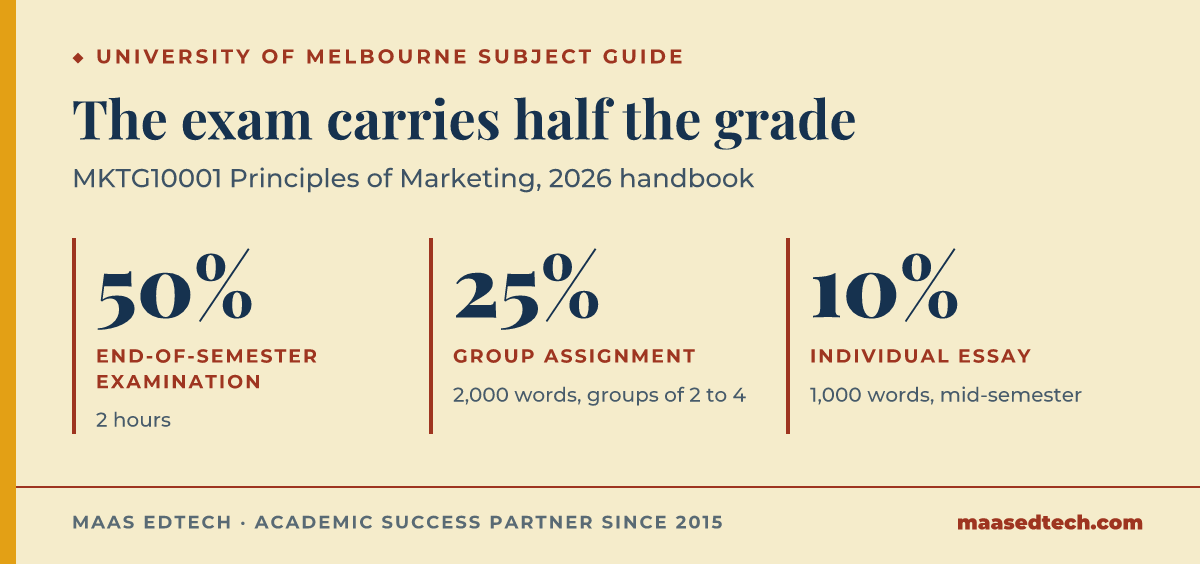
Half of them sit in a two-hour exam at the end of semester. The University of Melbourne's 2026 handbook gives the end-of-semester examination 50% of MKTG10001, while the 1,000-word individual essay, the subject most students worry about first, carries 10%. That balance should shape how you spend the semester, and it changes what the essay is really for.
Author: MAAS Editorial Team
Last updated: 2026-09-18
Category: marketing

Which MKTG10001 is this guide about?
Direct answer: This guide covers MKTG10001 Principles of Marketing at the University of Melbourne, a level 1 undergraduate subject worth 12.5 credit points, taught on campus at Parkville in Semester 1 and Semester 2. Other universities use similar titles under different codes, so check the code on your enrolment record before relying on any notes.
Evidence: The University of Melbourne (2026a) handbook lists two coordinators, one for each semester, and describes the subject as introducing "the basic theoretical framework of marketing, including segmentation, buyer behaviour, product management, market communications, channel management and pricing decisions". MAAS already has separate guides for MKTG100 and for MKTG2004 at ANU, and both are assessed very differently from this subject.
Example: A first-year commerce student who downloads a well-rated set of "principles of marketing" notes from another university may find that the assessment advice inside them describes case analyses that Melbourne does not set. The topic list overlaps, but the marks do not.
How is MKTG10001 assessed in 2026?
Direct answer: The 2026 handbook lists five components: pre-tutorial activity participation (10%), a 1,000-word individual essay due mid-semester (10%), a 2,000-word group assignment for groups of two to four, due between Week 11 and Week 12 (25%), learning about marketing research across the semester (5%), and a two-hour end-of-semester exam (50%).
| Assessment | Weight | Size or time | When |
|---|---|---|---|
| Pre-tutorial activity participation | 10% | 6 hours | Throughout semester |
| Individual essay | 10% | 1,000 words | Mid-semester |
| Group assignment (groups of 2 to 4) | 25% | 2,000 words | Weeks 11 to 12 |
| Learning about marketing research | 5% | 2 hours | Throughout semester |
| End-of-semester examination | 50% | 2 hours | Examination period |
Evidence: The University of Melbourne (2026b) assessment page, last updated on 14 September 2026, gives these weights, and the 2025 version of the same page lists an identical structure. The 5% research component links to a learning outcome that asks students to gain "first-hand knowledge of emerging marketing theories" by taking part in marketing research studies, a component many students will not have met in earlier study.
Example: Before Week 1 ends, add up the marks you can secure through steady effort: 10% for pre-tutorial work and 5% for research participation make 15% that depends on showing up and completing tasks, not on writing ability. Losing part of that 15% early is harder to recover than a weak essay.
If the essay is only 10%, why does it matter so much?
Direct answer: The essay is the first time your analysis is marked in writing, while there is still time to change how you write. Its feedback is worth more than its 10%, because the same skill, applying a theory to a real case and judging whether it fits, decides the 25% group assignment and much of the 50% exam.
Evidence: The handbook's second learning outcome asks students to "analyse and critically evaluate marketing practice and explain why some marketing activities are more successful than others", and the third asks them to apply major theories and models to marketing problems presented in case studies. Neither outcome is met by defining terms. Both require a verdict on why something worked or did not.
Example: Treat the essay as a rehearsal with a small penalty for mistakes. A student who receives a comment such as "describes the campaign well, but the analysis is thin" around mid-semester still has several weeks to fix that habit before the group assignment, and more before the exam.
How do you apply a marketing theory instead of just describing it?
Direct answer: Build each paragraph as a short argument: make a point about the company, name the concept that explains it, show the evidence from what the company actually did, then say what that evidence means for customers or for the firm. A paragraph that stops after the evidence is still description, however accurate it is.
Evidence: Value is a good test case, because introductory marketing leans on it heavily. Zeithaml (1988) describes perceived value as "the consumer's overall assessment of the utility of a product based on perceptions of what is received and what is given" (p. 14). That definition gives you two sides to examine, and a strong paragraph weighs both instead of listing product features. Vargo and Lusch (2004) push the idea further, arguing that value is determined by the customer in use, with the customer as a co-producer, rather than embedded in the product at the factory. Choosing between those two views is itself a piece of analysis.
Example: "The brand launched a loyalty app with personalised offers" is description. "The app raises what customers receive without raising the price they pay, which on Zeithaml's definition should increase perceived value, although heavy data collection may count as a cost that some customers weigh against the offers" applies the theory and tests it.
How should you handle segmentation, targeting and positioning?
Direct answer: Use segmentation, targeting and positioning as a chain of decisions, each justified by the one before it, not as three headings to fill. Explain which segments exist, why the firm chose the one it did, and whether its positioning actually speaks to that segment's needs.
Evidence: Smith (1956) introduced market segmentation as a strategy that adjusts products and marketing to differences in consumer demand, contrasting it with product differentiation, which tries to bend demand towards the product. The distinction still helps in an essay. A firm that changes its offer for a group of customers is segmenting, while a firm that advertises the same offer as different is differentiating, and students often label the second as the first.
Example: Writing "the target market is young professionals aged 25 to 35" names a segment. Stronger work asks what those customers need that other segments do not, whether the firm's price and channel choices fit that need, and where the fit breaks down.
How should a group of two to four divide a 2,000-word report?
Direct answer: Agree on one argument first, then split the work by section, and hold back time at the end for one person to edit the whole report into a single voice. A report assembled from four separately written parts usually repeats itself and contradicts itself, and markers read it as one document.
Evidence: At 25%, the group assignment is the largest piece of written work, and 2,000 words shared between four people is 500 words each, which leaves little room for duplicated introductions. Kohli and Jaworski (1990) define market orientation as the organisation-wide generation of market intelligence, its dissemination across departments and the organisation's responsiveness to it. The same three steps offer a practical model for a student group: gather evidence together, share it with everyone, then decide.
Example: A group that meets in Week 9 with a shared evidence document, agrees on the recommendation in one sentence, and assigns an editor for Week 12 tends to submit a coherent report. A group that splits the brief into four questions on day one often finds, too late, that its sections recommend different things.
How do you prepare for the exam that carries half the grade?
Direct answer: Revise by applying each week's concepts to a case you have not seen, not by rereading definitions. The exam rewards the same analysis as the essay and group report, but under time pressure, so the aim is to make that analysis fast.
Evidence: The handbook weights the exam at 50%, more than all the written assessments combined. Its first learning outcome asks for knowledge and comprehension of basic theories and models, which covers recall, but the second and third outcomes ask for evaluation and application, which recall alone cannot produce. Levitt (1960) warned that firms fail when they define their business by the product rather than by the customer need, and a case question often tests exactly that shift in perspective.
Example: Each week, pick one company in the news and write a short paragraph applying that week's concept to it, in ten minutes. By the end of semester you have a dozen practised answers and a habit of starting from the customer.
Where do students most often lose marks?
Direct answer: Marks are commonly lost in four places: defining concepts at length without applying them, describing a company's campaign without judging it, treating participation and research tasks as optional, and leaving exam preparation until the final fortnight. Each follows from misreading where the weight sits.
Evidence: The pattern follows from the assessment design. Participation and research together carry 15%, and the exam carries 50%, so 65% of the grade does not depend on the essays at all. Students from education systems where the final exam decides the grade may still underweight the steady weekly tasks, and students used to written coursework may underweight the exam.
Example: Many Vietnamese students arrive confident with marketing vocabulary from high school business subjects, then find that the vocabulary earns few marks unless it is attached to a judgement. The fix is to finish every paragraph with a "so what" sentence that states the consequence.
What do MAAS mentors do on this subject?
MAAS mentors work with you on your own drafts and ideas: talking through whether a theory fits the case you chose, questioning a paragraph that describes more than it analyses, or practising timed exam answers. Your analysis stays your own, which is also what the subject assesses.
Frequently asked questions
How many credit points is MKTG10001 worth?
12.5 points. It is a level 1 undergraduate subject at the University of Melbourne.
When is MKTG10001 offered?
The 2026 handbook lists Semester 1 and Semester 2, both on campus at Parkville.
How much is the MKTG10001 exam worth?
The end-of-semester examination is worth 50% in the 2026 handbook. It runs for two hours during the examination period.
How long is the individual essay?
1,000 words, due mid-semester and worth 10%. Check your subject guide for the question set in your semester.
What is the marketing research component?
It is worth 5% and involves taking part in, and learning about, marketing research studies across the semester, linked to a learning outcome on emerging marketing theories.
Ready to work through MKTG10001 with a mentor?
If your essay feedback says the analysis is thin, or your group cannot agree on one recommendation, a short conversation often shows where the argument should start. Book a free 15-minute consultation and bring your assessment brief. MAAS matches you with a subject mentor within 48 hours when the network already has a suitable person; otherwise a dedicated search usually takes around two weeks.
Explore one-to-one subject tutoring
Related guides
- MKTG1003: consumer behaviour
- MKTG100: can you pass on total marks and still fail?
- MKTG3120: building and managing brands
Talk to a MAAS mentor about your subject
References
Kohli, A. K., & Jaworski, B. J. (1990). Market orientation: The construct, research propositions, and managerial implications. Journal of Marketing, 54(2), 1-18. https://doi.org/10.1177/002224299005400201
Levitt, T. (1960). Marketing myopia. Harvard Business Review, 38(4), 45-56.
Smith, W. R. (1956). Product differentiation and market segmentation as alternative marketing strategies. Journal of Marketing, 21(1), 3-8. https://doi.org/10.1177/002224295602100102
University of Melbourne. (2026a). Principles of marketing (MKTG10001) [Handbook entry]. https://handbook.unimelb.edu.au/2026/subjects/mktg10001
University of Melbourne. (2026b). Principles of marketing (MKTG10001): Assessment [Handbook entry]. https://handbook.unimelb.edu.au/2026/subjects/mktg10001/assessment
Vargo, S. L., & Lusch, R. F. (2004). Evolving to a new dominant logic for marketing. Journal of Marketing, 68(1), 1-17. https://doi.org/10.1509/jmkg.68.1.1.24036
Zeithaml, V. A. (1988). Consumer perceptions of price, quality, and value: A means-end model and synthesis of evidence. Journal of Marketing, 52(3), 2-22. https://doi.org/10.1177/002224298805200302