
◆ Marketing
MKTG3114: why does killing your own product idea earn marks?
Most students arrive at New Products Marketing expecting the assignment to reward the best idea. It does not, or at least not primarily. The unit is built around a process where decision points let a project be stopped, and a student who carries a weak concept to launch has only shown they can follow a template. The uncomfortable skill this unit assesses is the willingness to find evidence against your own concept and say so in writing.

◆ Section 1 / 8 · The unit
How is the unit built?
Direct answer: MKTG3114 New Products Marketing is a 6 credit point undergraduate unit in the University of Sydney Business School, offered in Semester 2, with MKTG1001 or SIEN1000 as prerequisite. It teaches you to develop and market new products in both private and public sectors, through a product development assignment run via the go-or-kill checkpoints Cooper (2008) calls gates.
Evidence: The unit page lists five learning outcomes, and their sequence tells you what the unit values. You identify opportunities, generate concepts using creative and analytical techniques, evaluate a new product concept and prepare an overall assessment prior to a commercial commitment, develop an appropriate launch and management plan, and evaluate the market success of a launch from strategic, financial and competitive perspectives. The third of those is the one students underweight. The phrase "prior to a commercial commitment" describes a judgement made before money is spent, which is a different task from justifying a decision already taken.
Example: A student who had built an elegant launch plan for a subscription concept scored below expectation because the evaluation section read as a summary of the plan's strengths. She had written the assessment after committing to the concept, not before, and the marker could see the order.
Assessment weightings and task types are published in the unit outline roughly 2 weeks before teaching begins, and they are revised between offerings, so plan around the outcomes above rather than around any weighting you read second-hand.
◆ Section 2 / 8 · Kill decision
Why is the kill decision the graded moment?
Direct answer: Because the process the unit teaches is defined by its stopping points, not by its stages. Reproducing the stages describes the model. Making a defensible stop-or-continue call applies it, the distinction Cooper (2008) draws between a process diagram and a working gate.
Evidence: Cooper (2008) describes gates in the idea-to-launch system as quality-control and investment decision points, each carrying an explicit go or kill outcome, and his account of how firms had revised the model over the preceding decade is largely an account of making those gates harder to pass rather than easier. A gate that never kills anything is not a gate. When your assignment presents a concept that clears every checkpoint without friction, you have either found a genuinely exceptional opportunity or you have run the checkpoints as a formality, and the second is far more common in student work.
There is a well-documented reason this is hard, and it is not laziness. Staw (1976) writes: "Results showed that persons committed the greatest amount of resources to a previously chosen course of action when they were personally responsible for negative consequences" (Staw, 1976, p. 27), an effect he traced across role-played investment decisions. A student who chose their own concept in week 3 occupies exactly that position by week 10. The evidence that should trigger a narrower scope or a different segment arrives after the concept already feels like theirs, and the instinct is to defend rather than to revise. Knowing the effect has a name, escalating commitment, will not remove it, but it does tell you where to look: the place your report is least willing to go is usually the place the marks are.
Example: Two students submitted concepts of similar quality. The first wrote that market research supported the concept and moved on. The second identified the single result that most threatened her concept, a weak willingness-to-pay figure in her second segment, explained why it did not kill the project outright, and narrowed the target market in response. She was not more confident. She was more specific about where she might be wrong, the opposite of the escalation pattern Staw (1976) documented.
◆ Section 3 / 8 · Failure figure
What does the 80 per cent failure figure actually rest on?
Direct answer: Much less than students assume. The claim that most new products fail is repeated so widely in textbooks and consultancy material that it feels like settled fact, and citing it without checking is one of the fastest ways to signal uncritical reading in a third-year assignment, the gap Castellion and Markham (2013) spent their whole paper documenting.
Weak and stronger ways to use the new-product failure figure in a MKTG3114 report
Each row pairs one habit of the weak version with what the stronger version does about the same point.
What the weak version does
What the stronger version does
Opens with a dramatic failure statistic and no source
States a rate, names the study, and notes how failure was defined
Treats the figure as a reason the project is risky
Uses the figure to justify which specific checkpoint matters most
Cites a textbook quoting a consultancy quoting nobody
Cites the empirical work, including work that disputes the figure
Save this figure
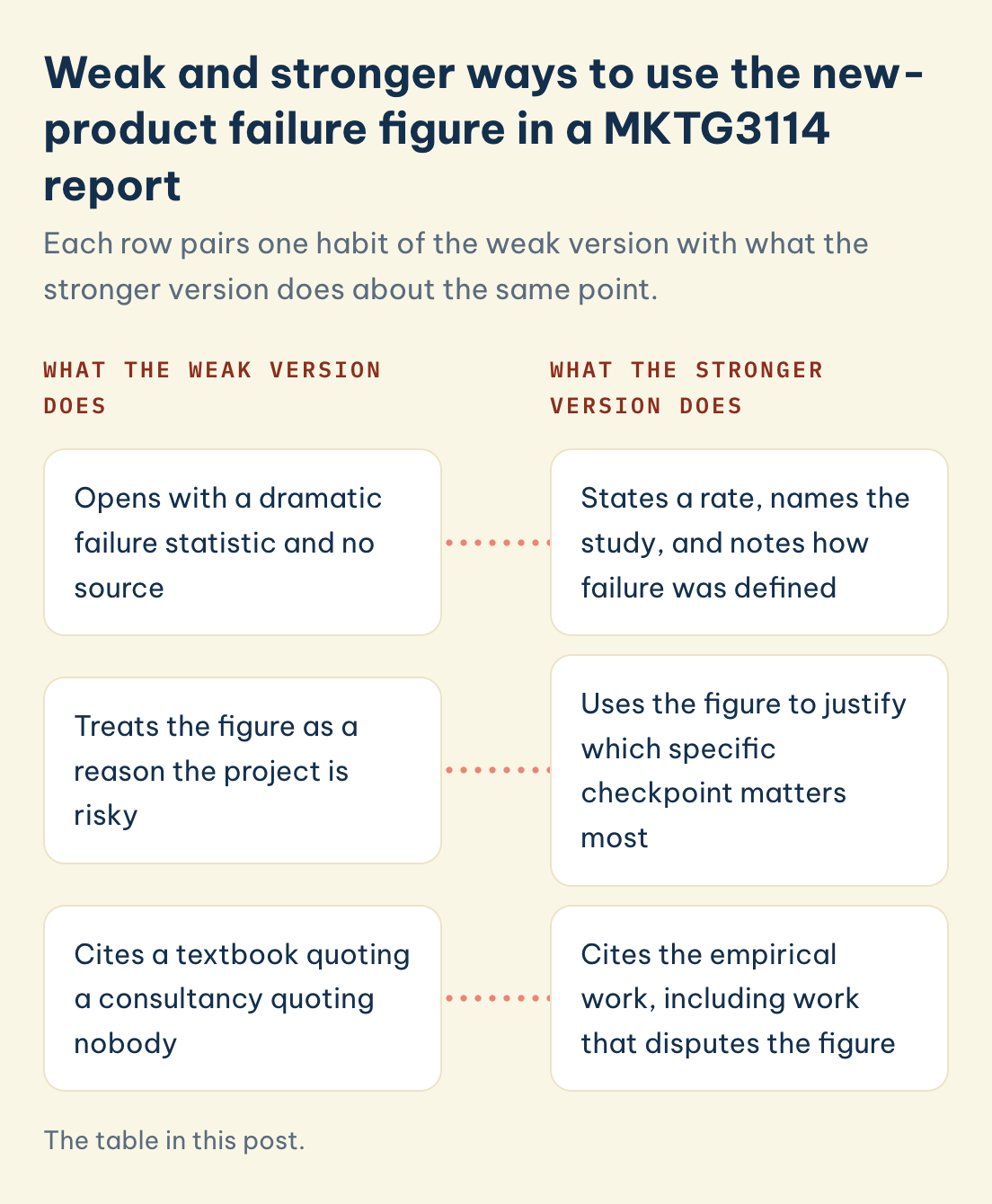
Evidence: Castellion and Markham (2013) traced the widely quoted figure of 80% or higher and found that it persists largely by repetition and by the interests of those repeating it, while empirical studies since 1977 put the rate at 40% or lower. Their argument is not that new products rarely fail. It is that a number reproduced because everyone reproduces it is not evidence, and that the gap between the popular figure and the measured one is large enough to change how a project should be framed (Castellion & Markham, 2013). If your rationale opens by claiming that most new products fail, a marker who knows this literature reads the opening as inherited rather than examined.
| What the weak version does | What the stronger version does |
|---|---|
| Opens with a dramatic failure statistic and no source | States a rate, names the study, and notes how failure was defined |
| Treats the figure as a reason the project is risky | Uses the figure to justify which specific checkpoint matters most |
| Cites a textbook quoting a consultancy quoting nobody | Cites the empirical work, including work that disputes the figure |
Example: A student replaced an unsourced claim that nine in ten launches fail with two sentences noting the disputed range and explaining that failure definitions differ between studies. The paragraph became shorter and the mark for critical engagement went up, because uncertainty stated precisely reads as command of the literature rather than hedging, the same standard Castellion and Markham (2013) hold the 80% figure to.
◆ Section 4 / 8 · Demand
Why does your concept test overstate demand?
Direct answer: Because people are systematically better at saying they would buy something than at buying it, and the size of that gap varies with the kind of product you are testing and the way you asked the question, per Morwitz, Steckel and Gupta (2007).
Evidence: Morwitz, Steckel and Gupta (2007) examined when stated purchase intentions actually predict sales across a wide range of study settings and found the strength of that relationship varies with product type and with how the intention data was collected. Their conclusion (Morwitz, Steckel and Gupta, 2007) matters directly for a concept test run on classmates. Asking a friendly sample about a novel product, in a format with no cost attached to an enthusiastic answer, sits close to the conditions under which intention data predicts least well. The finding does not mean concept testing is useless. It means the number needs a stated caveat rather than a confident extrapolation to market size, the caution Morwitz, Steckel and Gupta (2007) build into their own conclusion.
Example: A student surveyed 40 respondents, found 70% expressed interest, and projected revenue from that figure. The projection was the weakest paragraph in an otherwise strong report. Reporting the same 70% alongside a sentence on why intention data from a convenience sample of students overstates conversion, and then testing the plan against a far lower rate, would have shown the same evidence being handled well.
◆ Section 5 / 8 · Process
What separates a described process from an applied one?
Direct answer: Whether the framework changes anything in your report. If you could delete the framework section and the recommendation would stay the same, the framework was decoration, in the same way that a gate which never kills a project is not really a gate. In a report of 2,000 to 3,000 words, a framework section that survives that test earns its 3 or 4 paragraphs.
Evidence: The gap between a described process and an applied one is the standing distinction between descriptive and critical writing, and in a unit like this one it has a concrete test. The outcome about evaluating a concept prior to a commercial commitment cannot be demonstrated by explaining what evaluation criteria exist. It is demonstrated when a criterion is applied to your concept, produces a result you did not want, and you show what you did about it. Description tells the marker you have read the material. Application tells them you can use it when it is inconvenient.
Example: Two reports used the same screening criteria. The first listed the criteria, then presented the concept, then concluded it was viable. The second scored the concept against each criterion, failed one on manufacturing feasibility, and used that failure to justify a scaled-back first release. The second report was no longer, but it contained a decision the criteria had actually driven, the same defend-or-revise choice Staw (1976) frames as the harder path once a concept feels like your own.
◆ Section 6 / 8 · International students
Where do international students most often lose marks?
Direct answer: In the evaluation section, where writing conventions from other academic cultures push toward presenting a case rather than weighing one, and in hedging language that reads as vagueness rather than as calibrated caution.
Evidence: Australian marking rubrics at third-year level reward visible reasoning about the weaknesses of your own position, which can feel close to arguing against yourself if you were trained in a tradition where a recommendation is presented as settled. The practical effect is a report that reads as advocacy rather than evaluation. The second issue is narrower and easier to fix: phrases such as "it may possibly be somewhat likely" stack several layers of caution and end up conveying less than one precise layer. "The evidence is weak on this point because the sample was small" is more cautious in substance and stronger in effect, the same calibration Morwitz, Steckel and Gupta (2007) apply to their own intention-to-sales estimates.
Example: A student rewrote a concept evaluation by adding a single subsection headed "the strongest argument against this concept," then answering it. Nothing else in the report changed, and the evaluation mark moved a band, because the reasoning had become visible rather than assumed.
◆ Section 7 / 8 · MAAS mentors
What do MAAS mentors actually do on a unit like this?
MAAS mentors work with you on the reasoning, not on the submission. On a unit built around a product development assignment, that usually means three things: pressure-testing your concept before you commit to it, so the kill decision happens while it is still cheap; reading your evaluation section back to you and pointing out where a claim is carrying more weight than its evidence supports; and helping you distinguish the places where a caveat strengthens your case from the places where it just softens it. You write the assignment. A mentor asks the questions your marker will ask, early enough that you can still answer them.
If you want a second pair of eyes on a concept evaluation before you build the launch plan on top of it, tell us what you are working on.
◆ Section 8 / 8 · Sources
Four sources behind this guide
Direct answer: Four studies do the heavy lifting in this guide, and each is worth reading in full before you cite it secondhand.
- Cooper (2008), published in the Journal of Product Innovation Management, describes the Stage-Gate idea-to-launch process and how firms tightened its gates over the preceding decade.
- Staw (1976), published in Organizational Behavior and Human Performance, traced escalating commitment to a chosen course of action across role-played investment decisions.
- Castellion and Markham (2013), published in the Journal of Product Innovation Management, traced the 80% failure figure back to repetition rather than evidence.
- Morwitz, Steckel and Gupta (2007), published in the International Journal of Forecasting, examined when stated purchase intentions actually predict sales.
Example: A student who wanted to check a claim against the original source before citing it searched the author name plus the year on Google Scholar and found all four within minutes.
Frequently asked questions
Do I need to have taken MKTG1001 before MKTG3114?
The unit page lists MKTG1001 or SIEN1000 as the prerequisite. Check your own enrolment record and the handbook entry for your year of study on the University of Sydney unit page, since prerequisite structures are revised between offerings.
Is MKTG3114 available in Semester 1?
The published unit information lists Semester 2 delivery. Availability can change between years, so confirm against the current timetable on the University of Sydney unit page before planning your enrolment sequence.
Should my concept be a physical product or can it be a service?
The unit description covers both products and services, in both the private and public sectors. The evaluation logic does not change; what changes is which feasibility questions bite hardest, since service concepts usually fail on delivery capacity rather than on manufacturing.
How much primary research does a product development assignment need?
Enough that your evaluation rests on something other than assertion, and reported with its limitations stated. A small sample handled honestly is worth more than a larger one whose weaknesses go unmentioned, the caveat Morwitz, Steckel and Gupta (2007) build into their own findings.
Can I still recommend a concept that failed one of my own criteria?
Yes, and doing so well is one of the clearest ways to demonstrate the evaluation outcome. What the marker looks for is whether you named the failure, weighed it against the rest, and explained the judgement rather than passing over it.
Related reading
References
Castellion, G., & Markham, S. K. (2013). Perspective: New product failure rates: Influence of argumentum ad populum and self-interest. Journal of Product Innovation Management, 30(5), 976–979. https://doi.org/10.1111/j.1540-5885.2012.01009.x
Cooper, R. G. (2008). Perspective: The Stage-Gate idea-to-launch process: Update, what's new, and NexGen systems. Journal of Product Innovation Management, 25(3), 213–232. https://doi.org/10.1111/j.1540-5885.2008.00296.x
Morwitz, V. G., Steckel, J. H., & Gupta, A. (2007). When do purchase intentions predict sales? International Journal of Forecasting, 23(3), 347–364. https://doi.org/10.1016/j.ijforecast.2007.05.015
Staw, B. M. (1976). Knee-deep in the big muddy: A study of escalating commitment to a chosen course of action. Organizational Behavior and Human Performance, 16(1), 27–44. https://doi.org/10.1016/0030-5073(76)90005-2
Tools & resources
A free 20-minute consultation is a conversation about where you are with MKTG3114.
Book a free consultation ▸