
◆ Business & Management
BUSI1741 Entrepreneurship: how do you write the reflective statement?
BUSI1741 contains the most misread assessment design in the Greenwich curriculum: students pitch a business idea to investors in a Dragon's Den format, pour weeks of energy into it, and then discover the pitch itself carries no marks at all. The entire 100% sits in a 3,500-word reflective statement written afterwards, which means the module is assessing your capacity to think about what happened, not your performance while it happened.

◆ Question 1 / 7 · The module
What is BUSI1741 Fundamentals of Entrepreneurship and Innovation about?
Direct answer: BUSI1741 is a Level 5 module worth 30 credits in the Business, Operations and Strategy department at Greenwich Business School. It develops conceptual approaches to entrepreneurship and the innovation process, and how both relate to business growth, society and the economy, exploring the management implications that follow from linking the two fields.
Evidence: The five published learning outcomes are: evaluate core conceptual frameworks of entrepreneurship and innovation; understand strategic quality management goals and structures; assess the effectiveness of coaching skills in creating an innovative organisation; evaluate the impact of sustainable entrepreneurial approaches in managing customer experiences; and analyse entrepreneurial venture risks and conflicts. Two of those five use the verb "evaluate" and one uses "analyse", which is high demand for a Level 5 module and signals that description will not carry you.
Example: A Vietnamese student at Greenwich described BUSI1741 to his MAAS mentor as "the startup module where you present an idea". His mentor asked how many of the five outcomes his idea would demonstrate. Only the first, partially. Outcomes about quality management, coaching, sustainability and venture conflict all had to be evidenced elsewhere, which meant in the written statement, not in the pitch.
◆ Question 2 / 7 · Assessment
What assessment does BUSI1741 involve?
Direct answer: One summative component: a reflective statement worth 100% of the module, 3,500 words, with a 40% pass mark, assessed against all five learning outcomes. You are asked to provide a written reflection on the process of pitching a business idea and on the prospect of future entrepreneurship.
The pitch itself, delivered to investors in a Dragon's Den style format including responding to questions afterwards, is formative. It carries no marks. It exists to give you the raw material the reflective statement is built from. Confirm the exact brief and deadline in your own module handbook.
Evidence: Greenwich's published assessment section states plainly that the reflective statement is 100% and describes the pitch as formative assessment supporting student learning, serving as the basis for producing the reflective statement as the final coursework. The module is delivered in six-week block teaching, with an extension week and a separate summative assessment week, so the calendar is designed to give you time to reflect after the pitch rather than to prepare more pitching.
Example: A group in one MAAS session had rehearsed their pitch fourteen times and had not written a single note about what happened during it. After the pitch, none of them could remember which investor question had actually exposed the weakest part of their model. They had optimised for the unassessed component and lost the evidence the assessed one needed.
◆ Question 3 / 7 · Marking
How is BUSI1741 graded, what does the marking reward?
Direct answer: All five learning outcomes are assessed through one piece of writing, so coverage is not optional, and three of those outcomes demand evaluation or analysis rather than description. In a reflective statement, that means the marks are not in narrating what your group did. They are in explaining what the experience revealed, judging why it happened, and drawing a conclusion you can defend about entrepreneurship and about yourself as a potential entrepreneur.
Evidence: Reflective writing is frequently marked against a model such as Gibbs' (1988) reflective cycle, which moves from description through feelings, evaluation and analysis to conclusion and action plan. The instructive point is that description is only the first of six stages. A statement that stops after describing has completed one sixth of the expected reasoning, however well written it is.
Example: A MAAS mentor colour-coded a student's draft by Gibbs stage. 80% was description, 12% feelings, and the remainder was a brief conclusion. Analysis and evaluation, the two stages carrying the module's higher-order outcomes, were entirely absent. The student had written an honest account of a real experience and demonstrated almost none of the five outcomes.
◆ Question 4 / 7 · Frameworks
Which frameworks should you use in BUSI1741?
Direct answer: You need two kinds. A reflective model to structure the writing, and entrepreneurship theory to give the reflection analytical weight. The mistake is using only the first, which produces an honest diary, or only the second, which produces an essay that happens to mention a pitch.
| Framework | What it does for the statement | How to use it |
|---|---|---|
| Gibbs' reflective cycle | Structures the movement from event to insight | Use its stages as your section logic, not as headings you fill in mechanically |
| Effectuation vs causation (Sarasvathy) | Explains whether you planned toward a goal or built from available means | Diagnose which logic your group actually used, and whether it suited the uncertainty |
| Schumpeter on innovation (1934) and creative destruction (1942) | Positions your idea as genuinely novel or as an entrant into an existing market | Be honest about which one your idea was |
| Business model canvas (Osterwalder and Pigneur) | Exposes which part of the model the investors attacked | Map where questions landed, not just that they were asked |
Evidence: Gibbs' (1988) six-stage cycle itself builds on Kolb's (1984) Experiential Learning, published by Prentice Hall, which frames learning as a repeating cycle of concrete experience, reflective observation, abstract conceptualisation and active experimentation, so citing Gibbs alone without acknowledging that lineage is a common but avoidable gap. Schön's (1983) The Reflective Practitioner, published by Basic Books, adds a second useful distinction: reflection-in-action, the thinking you do while pitching, versus reflection-on-action, the thinking you do afterwards. A statement written after the event is necessarily the second kind, which is why it has to analyse a pitch now closed rather than narrate it as though still happening. Sarasvathy (2001), writing in the Academy of Management Review, defines the two processes precisely: "Effectuation processes take a set of means as given and focus on selecting between possible effects that can be created with that set of means" (Sarasvathy, 2001, p. 245), drawing the distinction that causation rests on a logic of prediction while effectuation rests on a logic of control, arguing that entrepreneurs facing genuine uncertainty begin from the means available to them and select among possible effects, rather than fixing a goal and acquiring means to reach it. That distinction gives you a precise analytical vocabulary for what your group did when a plan met an investor's objection, which is exactly the moment worth reflecting on. Schumpeter (1934) framed the entrepreneur, in a book published by Harvard University Press, as the agent who carries out new combinations of existing resources, and later described, in Capitalism, Socialism and Democracy, the creative destruction that follows when those combinations displace an incumbent way of doing things (Schumpeter, 1942); either lens tells you whether your idea was genuinely novel or a new entrant into a market that already worked the same way. The business model canvas, set out by Osterwalder and Pigneur (2010) in Business Model Generation, is most useful not as a diagram to fill in but as a map of which block, value proposition, channels, revenue, the investors actually attacked.
Example: A student wrote that her group "changed direction after the feedback". Her mentor asked her to name the logic behind the change. Working through Sarasvathy's distinction, she saw the group had abandoned a predictive market forecast and started from what its members could actually build with the resources on hand. Naming that as a shift from causation toward effectuation turned a sentence of narrative into a paragraph of analysis.
◆ Question 5 / 7 · Reflective statement
How should you structure the 3,500-word reflective statement?
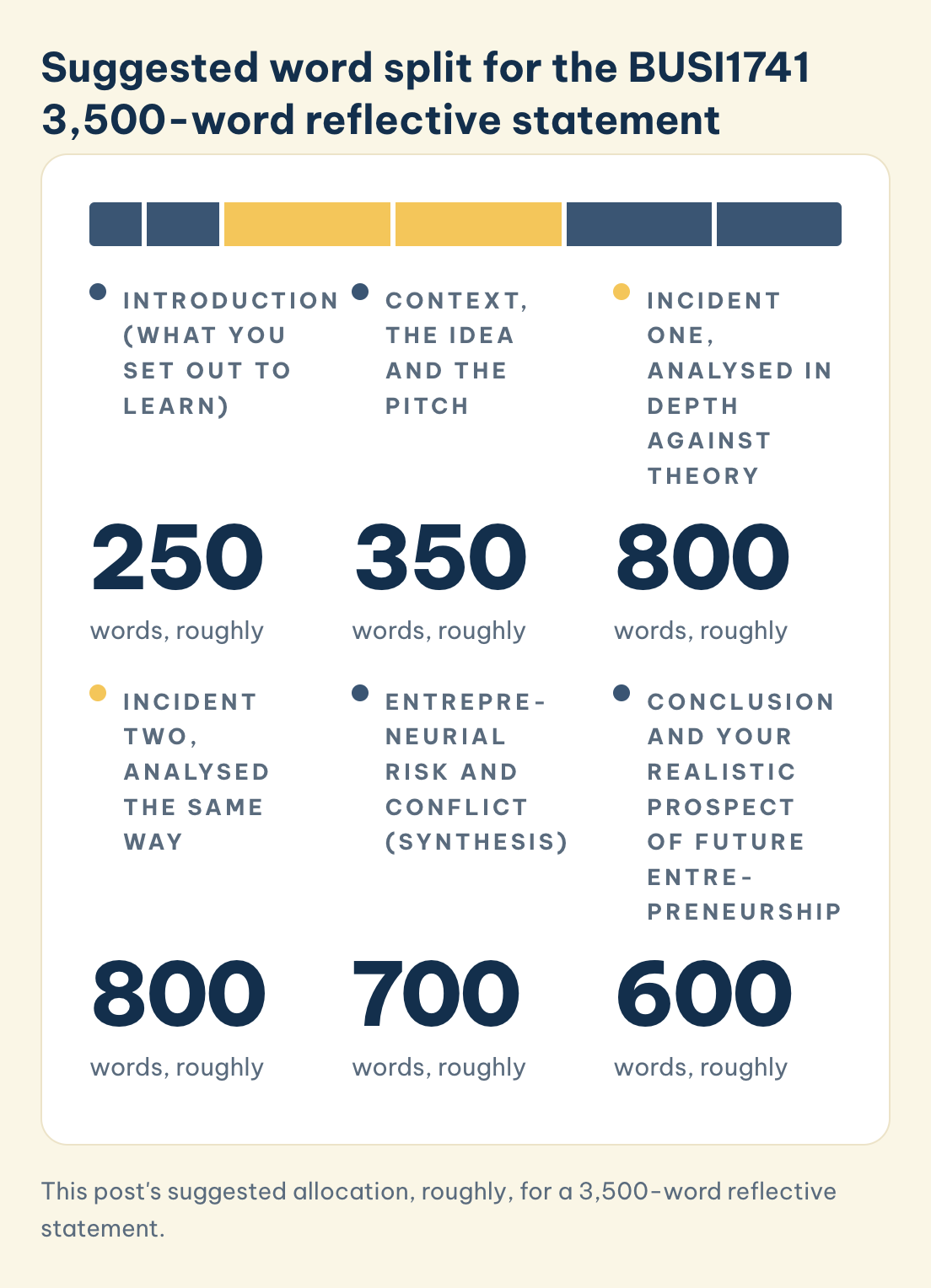
Direct answer: Build it around two or three critical incidents from the pitch process, not around a chronological account of the whole term. A structure that works: (1) brief introduction framing what you set out to learn, around 250 words; (2) context, the idea and the pitch, kept short at around 350 words; (3) incident one analysed in depth against theory, around 800 words; (4) incident two analysed the same way, around 800 words; (5) what this reveals about entrepreneurial risk and conflict, connecting to the venture outcomes, around 700 words; (6) conclusion and your realistic prospect of future entrepreneurship, around 600 words. Chronology is the enemy here, selection is the skill. Roughly, that split gives you 7% for the introduction, 10% for context, 46% across the two analysed incidents, 20% for the synthesis on risk and conflict, and 17% for the conclusion.
Suggested word split for the BUSI1741 3,500-word reflective statement
A suggested split from this post, roughly, across six sections. The yellow sections are the two analysed incidents.
Introduction (what you set out to learn)
250
words, roughly
Context, the idea and the pitch
350
words, roughly
Incident one, analysed in depth against theory
800
words, roughly
Incident two, analysed the same way
800
words, roughly
Entrepreneurial risk and conflict (synthesis)
700
words, roughly
Conclusion and your realistic prospect of future entrepreneurship
600
words, roughly
Save this figure
Evidence: The brief asks for reflection on the process of pitching and on the prospect of future entrepreneurship, which names two objects of reflection, the experience and your own trajectory. A statement that covers the first and neglects the second has answered half the task, and the second half is where outcome five, on risks and conflicts, and the forward-looking judgement naturally live.
Example: A student's 3,500 words marched week by week through a six-week block. Her mentor asked which three moments had actually changed her thinking. She named them in under a minute: the investor question she could not answer, the argument in her team about pricing, and the moment they realised their customer had never been asked anything. Rebuilding the statement around those three moments cut the word count problem and raised the analysis at the same time.
◆ Question 6 / 7 · Common mistakes
What are the most common mistakes that lose marks in BUSI1741?
Direct answer: Reflective assessments of this kind tend to fail for the same reasons.
| Mistake | Why it costs marks | The fix |
|---|---|---|
| Treating the pitch as the assessment | The pitch is formative; the statement is 100% | Take notes during and immediately after the pitch |
| Chronological narrative of the whole term | Description sits at the bottom of the reflective hierarchy | Select two or three critical incidents |
| No theory in a reflective piece | Outcomes demand evaluation and analysis | Diagnose each incident with a named framework |
| Only positive reflection | Conflict and risk are explicitly outcome five | Analyse what went wrong and why, without blaming teammates |
| Covering only entrepreneurship theory | Five outcomes include quality management and coaching | Check your draft against all five before submitting |
| Writing "I felt" without "which suggests" | Feelings are one stage, not the destination | Follow every reaction with an interpretation |
Evidence: Reflective writing is an unfamiliar genre for many students, and the common failure is not effort but register: it sits between the personal essay and the academic essay, and requires the first person alongside cited theory. Neither a diary nor a literature review will satisfy it.
Example: One student, worried that "I" was unacademic, wrote his entire reflective statement in the third person. The result read as a case study of a group he had apparently observed from outside. His mentor explained that in reflective writing the first person is not merely permitted, it is structurally necessary, because the object of analysis includes his own reasoning.
◆ Question 7 / 7 · Team conflict
How do you write honestly about team conflict without it backfiring?
Direct answer: Analyse the conflict, do not report the people. Describe the disagreement in terms of positions and pressures rather than personalities, explain what caused it structurally, unclear roles, an unresolved assumption, time pressure before the pitch, and evaluate how it was handled. Naming a teammate as difficult is a complaint. Explaining that the group never agreed who owned the financial model, so two people built incompatible versions, is analysis.
Evidence: Learning outcome five asks you to analyse entrepreneurial venture risks and conflicts, which makes conflict a required object of study rather than an awkward topic to avoid. Similarly, outcome three asks you to assess the effectiveness of coaching skills in creating an innovative organisation, which invites you to examine how the group was, or was not, guided.
Example: A Vietnamese student told her mentor she did not want to write about a serious disagreement in her group because it felt disloyal. Her mentor reframed it: she could omit every name and still analyse the structural cause, which was that the team had never decided how a final call would be made. Written that way, the section demonstrated outcome five and read as professional rather than personal.
Frequently asked questions
Is the Dragon's Den pitch really worth nothing?
It is formative, meaning it carries no marks directly. But treating it as unimportant is the trap, because it generates every piece of evidence your 100% assessment depends on. Prepare for it properly, and take notes throughout.
Can I use "I" in the reflective statement?
Yes. Reflective writing requires it. What it does not permit is stopping at "I felt". Each personal observation needs an interpretation and, where possible, a link to theory.
What if my group's idea was weak or the pitch went badly?
That is workable material, sometimes better material. The outcomes ask you to evaluate and analyse, not to report success. A clear-eyed analysis of why an idea failed to convince investors can demonstrate more than an account of one that did.
How much theory should a reflective statement contain?
Enough that each critical incident is diagnosed rather than merely narrated. A useful test: if you removed all citations, would the analysis still stand as analysis, or collapse into story?
Can MAAS help me with BUSI1741?
MAAS mentors work with you on selecting which incidents to reflect on, matching each to the right framework, and checking your draft covers all five learning outcomes. You remain the author of your statement; the mentor helps you see the analysis hiding inside your own experience.
What are BUSI1741's key numbers at a glance?
Delivered at the University of Greenwich, it is a Level 5 module under the UK's FHEQ, worth 30 credits, taught over 6 weeks of block teaching plus a separate extension week and a separate summative assessment week. The Dragon's Den pitch is formative and carries 0% of the grade directly; the entire mark sits in one reflective statement of 3,500 words, judged against a 40% pass mark and all five learning outcomes at once.
After the pitch, staring at 3,500 words
An impressive pitch counts for nothing on its own. What earns the mark is noticing what happened during it, picking the two or three moments that mattered, and explaining them with theory instead of retelling them. If you have finished the pitch and are staring at 3,500 words with only a story to tell, a MAAS mentor can help you find the analysis inside it.
Talk to a MAAS mentor about your module
Related guides
References
- Gibbs, G. (1988). Learning by doing: A guide to teaching and learning methods. Further Education Unit.
- Kolb, D. A. (1984). Experiential learning: Experience as the source of learning and development. Prentice Hall.
- Osterwalder, A., & Pigneur, Y. (2010). Business model generation: A handbook for visionaries, game changers, and challengers. Wiley.
- Sarasvathy, S. D. (2001). Causation and effectuation: Toward a theoretical shift from economic inevitability to entrepreneurial contingency. Academy of Management Review, 26(2), 243–263. https://doi.org/10.2307/259121
- Schön, D. A. (1983). The reflective practitioner: How professionals think in action. Basic Books.
- Schumpeter, J. A. (1934). The theory of economic development. Harvard University Press.
- Schumpeter, J. A. (1942). Capitalism, socialism and democracy. Harper & Brothers.
Tools & resources
- University of Greenwich. (n.d.). Module information [Module catalogue entry]. Retrieved July 29, 2026, from https://www.gre.ac.uk/modules/modules?crse=1741&subj=BUSI&term=205000
- University of Greenwich. (n.d.). Academic skills. Retrieved July 29, 2026, from https://www.gre.ac.uk/students/support/academic-skills
This article is part of the MAAS Journal series for Vietnamese international students. MAAS Assignment & Essay Support is an academic support partner; we coach students through the Outline, Draft, Final delivery model with developmental feedback from discipline-matched experts. We do not write or submit work on a student's behalf.
A free 20-minute consultation is a conversation about where you are with BUSI1741.
Book a free consultation ▸