
◆ Writing Tips
How do you write an argumentative essay with a counter-argument?
To write an argumentative essay with a counter-argument, state a clear claim, give your reasons with evidence, then name the strongest objection to your claim and answer it before you conclude. Wolfe, Britt, Petrovic, et al. (2009) found that US undergraduates rated brief arguments as stronger and their authors as more favourable when the same argument included a counter-argument and a rebuttal.
◆ Question 1 / 9 · Writing it
How do I write an argumentative essay?
Direct answer: Write an argumentative essay by building a case in four parts: a contention, reasons that support it, a fair treatment of the opposing view, and a conclusion that follows from all three. Deakin University (n.d.) lists these four elements and adds that the argument should flow logically from contention to conclusion.
Deakin University (n.d.) names the parts of an argument as "a contention (your main claim or 'thesis statement') that clearly states your argument", a series of claims supported by credible and relevant sources, consideration of counterarguments, and a logical flow from contention to conclusion. The third item is one students often drop. Wolfe, Britt, Petrovic, et al. (2009) open their report by observing that "many undergraduate authors fail to include counterarguments in their written essays", and Irish and Romkey (2025) report from a University of Toronto sample that many students succumb to myside bias, meaning they handle opposition only through dismissive or unsubstantiated statements of belief.
The rest of this guide treats the counter-argument as a planned section of the essay, not an afterthought. If you are still working out the wider shape of an essay, how to write a university essay covers the three-part structure that everything below sits inside.
◆ Question 2 / 9 · Steps
What are the steps of writing an argumentative essay?
Direct answer: A workable sequence has six steps: decode the question, draft a contention, collect reasons, collect objections, plan where the objections go, then write and revise. This is the sequence used in this guide, not a canonical list from any university, so adapt the order to your module brief.
No single source gives one official list of steps, and the university pages used here describe parts of an argument rather than a fixed number of steps. The sequence below is this guide's own, built from those parts.
- Decode the question. Identify the directive word and the position the question invites you to take.
- Draft a contention. Write one sentence that states your claim and could be disputed by a reasonable reader.
- Collect reasons. List the claims that support the contention, each tied to a credible source.
- Collect objections. Deakin University (n.d.) advises gathering arguments for and against your contention, because doing so refines your ideas and helps you develop better supporting claims.
- Plan the structure. Decide whether the counter-argument gets its own block or is threaded through each reason, using the models in the next sections. How to make an essay plan shows the planning formats.
- Write and revise. Draft the essay, then check that every objection you raised has an answer.
Federation University Australia (n.d.) offers a vocabulary that helps at steps 3 and 4: a statement in support of a contention is "a reason", a statement against it is "an objection", and a statement against an objection is "a rebuttal". That page is written for thesis writers, so treat its map as a thinking tool for essays rather than a required format.
◆ Question 3 / 9 · Starting
How do you start an argument essay?
Direct answer: Start by establishing the topic, giving context and presenting your thesis statement as your main conclusion. University of Edinburgh (n.d.) describes the introduction in exactly those three moves. The opening should also tell the reader which side of the debate you are on.
University of Edinburgh (n.d.) describes the first section of an argumentative essay as "Establish topic, provide context, present thesis statement (main conclusion)" (p. 2) in a four-page tutorial handout for a computing course. Applied to any subject, the order works because it moves from what everyone knows to what you claim. A reader should reach the end of the introduction knowing the topic, why it is contested and where you stand.
You can also signal the counter-argument at this early point. A thesis that begins with "although" or "while" shows the reader that you have seen the other side before you turn to your own reasons. For example: "Although remote lectures widen access for part-time students, universities should keep in-person seminars as the default, because discussion skills develop fastest face to face." The clause before the comma is the concession, the clause after it is the claim. For the full opening paragraph, see how to write an essay introduction, and for the very first sentence, how to start an essay.
◆ Question 4 / 9 · A good argument
How to write a good argument for an essay?
Direct answer: A good argument pairs a clear contention with reasons backed by credible sources, and uses cautious wording where the evidence is not conclusive. Deakin University (n.d.) contrasts "This research proves that..." with "This research suggests that...", and the second form is the one that survives a critical marker.
Strong reasons are specific. Instead of writing "technology helps learning", write which technology, for which learners, and cite the study that shows it. Deakin University (n.d.) says the supporting claims should rest on credible and relevant sources, and the same page cautions you to resist the temptation to ignore relevant counterarguments. Both pieces of advice point to the same habit: the essay earns trust by showing the reader the evidence on more than one side.
Careful wording matters most in the rebuttal. If your answer to an objection overreaches, the marker will treat the objection as unanswered. A claim such as "this evidence suggests the effect is smaller than critics assume" is easier to defend than "this evidence proves the critics wrong". Before moving on, check each paragraph against three questions: does it make one claim, does a source support the claim, and would a sceptical reader find the wording fair?
◆ Question 5 / 9 · Why counter-argue
Why does a counter-argument make an essay stronger?
Direct answer: A counter-argument shows the reader you have tested your own position. In the studies by Wolfe, Britt, Petrovic, et al. (2009), brief arguments that included counterarguments and rebuttals produced significantly higher agreement and better impressions of the author than the same arguments without them.
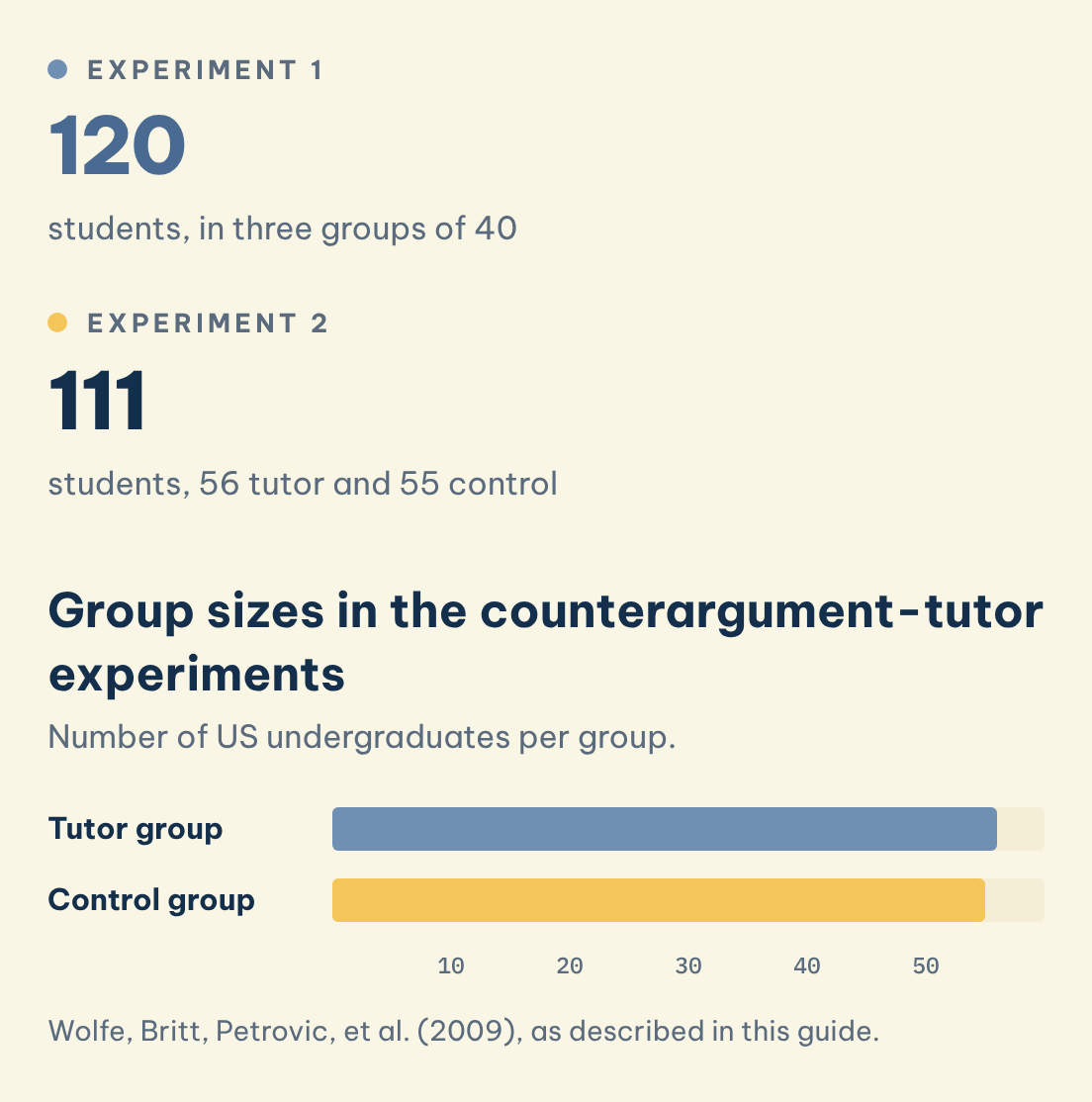
Wolfe, Britt, Petrovic, et al. (2009) report two experiments with native-English psychology undergraduates at a US university, so the findings come from US students, not UK or Australian ones. In the first, 120 students were split into three groups of 40. In the second, 111 students were split into a tutor group of 56 and a control group of 55. The authors found that "brief written arguments that include counterarguments and rebuttals produced significantly higher levels of agreement, higher ratings of argument strength, and better impressions of the author than the same arguments presented without counterarguments."
A second paper points the same way. Wolfe, Britt, and Butler (2009) describe the "myside" bias as "the tendency to ignore or exclude evidence against one's position", and report that rebuttal led to higher ratings of agreement and quality than the same arguments that left other-side information out. Irish and Romkey (2025) add that handling opposition has a positive effect on readers' perceptions of an argument, while a myside bias can weaken both the writer's ethos and the persuasiveness of the argument.
| Finding | Source | Sample |
|---|---|---|
| Arguments with counterarguments and rebuttals rated stronger | Wolfe, Britt, Petrovic, Albrecht and Kopp (2009) | US undergraduates |
| Rebuttal raised ratings of agreement and quality | Wolfe, Britt and Butler (2009) | Undergraduate writers (abstract only) |
| Myside bias can weaken ethos and persuasiveness | Irish and Romkey (2025) | Student writers (University of Toronto paper) |
Experiment 1
120
students, in three groups of 40
Experiment 2
111
students, 56 tutor and 55 control
Group sizes in the counterargument-tutor experiments
Number of US undergraduates per group.
Save this figure
◆ Question 6 / 9 · Block or point
Where should the counter-argument go: block or point-by-point?
Direct answer: Put it in one block after your own reasons, or answer an objection after each reason. University of Edinburgh (n.d.) sets out both models on page 2 of its tutorial: block organisation with a single counter-premise and refutation, and point-by-point organisation with a refutation for each counter-premise.
University of Edinburgh (n.d.) lays out the block model as an introduction, premises one and two, a "Counter-premise and Refutation", and a conclusion. Its second model, named "Point-by-point organisation", lists "Counter-premise I and Refutation" and "Counter-premise II and Refutation". The handout does not state which model suits which essay, so the choice below is this guide's reading, not the university's rule.
| Feature | Block | Point-by-point |
|---|---|---|
| Where the objection appears | One section after your reasons | After each reason |
| Best when | There is one main objection | Each reason faces its own objection |
| Risk | The objection can feel detached | The essay can lose its thread |
| Typical length of the section | About one paragraph | A short passage per reason |
For a short essay of about 1,000 words, a single block usually works because there is room for one strong objection. A longer essay with several reasons often reads better point by point. Whichever you choose, say so in the introduction so the reader knows what to expect.
◆ Question 7 / 9 · Concede or rebut
How do you respond to a counter-argument: concede, rebut or dismiss?
Direct answer: You can concede part of it, rebut it with evidence, or dismiss it as irrelevant. Wolfe, Britt, Petrovic, et al. (2009) describe the response types as an author who "conceded, rebutted, or dismissed the counterargument". RMIT Library (n.d.) adds a concession followed by a counter claim.
RMIT Library (n.d.) models the concession move in two sentences, the first granting that a proposed plan for overhauling the education system has benefits ("Admittedly, there are benefits ...") and the second turning with "However, they do not justify the costs that will be borne by taxpayers." The page names other moves as well, including refuting with evidence, acknowledging opposing views and identifying a lack of evidence. Federation University Australia (n.d.) frames the final step in its map as determining whether some objections can be rebutted.
| Move | What you do | Sentence frame |
|---|---|---|
| Concede | Accept the part of the objection that is true, then move on | "Admittedly, ... However, ..." |
| Rebut | Answer the objection with evidence | "This view overlooks ..., which shows ..." |
| Dismiss | Show the objection does not apply to your claim | "This objection concerns ..., not the question asked here." |
Choose the move that matches the strength of the objection. A strong objection usually deserves a concession plus a rebuttal, because dismissing it makes the essay look evasive. Irish and Romkey (2025) note that some students refute opposing arguments and even qualify their claims with a balanced approach, which is the pattern to copy.
◆ Question 8 / 9 · Ending
How do you end an argumentative essay?
Direct answer: Close by returning to your thesis, pulling the main reasons together and leaving the reader with one final thought. University of Edinburgh (n.d.) treats this as the last of its numbered sections. Avoid introducing a brand-new objection at this point.
Where Wolfe, Britt, Petrovic, et al. (2009) tested a tutor, University of Edinburgh (n.d.) simply lists the closing moves as "Restate thesis, summarise key points, offer a final insight or call to action" (p. 2). The conclusion should show that the counter-argument was handled, not forgotten. One sentence recalling the strongest objection and the reason it does not overturn your claim is enough. For fuller advice on endings, see how to write an essay conclusion.
◆ Question 9 / 9 · MAAS help
How can MAAS help with an argumentative essay?
Direct answer: MAAS works as a tutor and advisor. A MAAS expert can discuss your question, help you test your contention against the strongest objections and give feedback on your outline and draft, while the writing and the final academic decisions stay yours.
If your counter-argument section feels weak, essay and assignment support from MAAS follows an Outline, Draft, Final sequence with the guidance of a MAAS expert. Bring your question, your contention and the objections you have found, so the expert can point to the step where the reasoning loses force. The first conversation is free.
Frequently asked questions
How do I write an argumentative essay for beginners?
Begin with a one-sentence claim, list two or three reasons that support it, and find one objection a reasonable reader might raise. Deakin University (n.d.) lists the contention, supporting claims, counterarguments and logical flow as the core elements.
How do I write an argument essay introduction?
Establish the topic, give context and present your thesis as the main conclusion. University of Edinburgh (n.d.) describes the introduction in those three moves.
Can you give an example of an academic argument?
RMIT Library (n.d.) offers a concession-plus-counter example. It grants that a proposed plan has benefits with "Admittedly", then turns with "However, they do not justify the costs that will be borne by taxpayers." The plan and citation named on the RMIT page are illustrations.
Do I need a counter-argument in every argumentative essay?
Deakin University (n.d.) includes consideration of counterarguments among the elements of an argument, and advises you to resist the temptation to ignore relevant ones. Check your module brief for any difference.
Is there a step by step PDF I can follow?
This guide's six-step sequence is its own, not an official list. University of Edinburgh (n.d.) publishes a four-page tutorial PDF on argumentative essay structure that shows two models.
Does a counter-argument weaken my position?
It tends to do the opposite. Wolfe, Britt, Petrovic, et al. (2009) found that arguments with counterarguments and rebuttals received significantly higher agreement ratings, in studies with US undergraduates.
References
Deakin University. (n.d.). Developing an argument. https://www.deakin.edu.au/students/study-support/study-resources/study-support-guides/developing-an-argument
Federation University Australia. (n.d.). Mapping an argument. https://www.federation.edu.au/students/study-skills/study-resources/hdr-thesis/write-your-thesis/mapping-an-argument/
Irish, R. K., & Romkey, L. (2025). Counterclaims and refutations: An analysis of students' handling of opposing arguments. 2025 IEEE International Professional Communication Conference (ProComm). https://doi.org/10.1109/procomm64814.2025.00073
RMIT Library. (n.d.). Arguments and evidence. Learning Lab, RMIT University. https://learninglab.rmit.edu.au/university-essentials/critical-thinking-and-argument-analysis/argument-analysis/arguments-and-evidence/
University of Edinburgh. (n.d.). How to write a good argumentative essay [Tutorial 1, Informatics 2 SEPP]. https://opencourse.inf.ed.ac.uk/sites/default/files/https/opencourse.inf.ed.ac.uk/inf2-sepp/2026/tut-1.pdf
Wolfe, C. R., Britt, M. A., & Butler, J. A. (2009). Argumentation schema and the myside bias in written argumentation. Written Communication, 26(2), 183-209. https://doi.org/10.1177/0741088309333019
Wolfe, C. R., Britt, M. A., Petrovic, M., Albrecht, M., & Kopp, K. J. (2009). The efficacy of a Web-based counterargument tutor. Behavior Research Methods, 41(3), 691-698. https://doi.org/10.3758/brm.41.3.691
Not sure how this guide applies to your own case? Talk it through with MAAS in a free 20-minute consultation.
Book a free consultation ▸