
◆ Study skills
How do you write a case study assignment, step by step?
To write a case study assignment, first work out whether your brief is descriptive or problem-based, because that decision governs everything that follows: descriptive case studies ask you to describe and analyse what happened, while problem-based case studies ask you to identify issues, analyse solutions, and make recommendations. Either way, the graded work is the analysis that applies theory to the evidence in front of you, not a retelling of the case (University of the Sunshine Coast, 2026).
Both readings come from the same source: descriptive briefs ask you to describe and analyse what happened, while problem-based briefs ask you to identify issues, analyse possible solutions and make recommendations (University of the Sunshine Coast, 2026).
This guide walks through that analysis one stage at a time: reading the brief correctly, building the report-style structure, applying theory instead of describing the case, and checking the draft before submission. Every claim traces to a named university writing-centre guide, drawn from five independent institutions: RMIT University's Learning Lab, the University of the Sunshine Coast (2026), Sheffield Hallam University, the University of Southern California Libraries (2026a, 2026b), and the University of Arizona Global Campus Writing Center (2025); the full source list with retrieval dates sits at the end.

◆ Part 1 / 7 · What it is
What a case study assignment is, and what it is not
Direct answer: A case study assignment asks you to apply course theory to a real or hypothetical situation and reach a reasoned judgement or recommendation for a professional audience. It is not an essay, since it adds a report-style structure of headed sections, and not case study research, since its scenario is built mainly to test your reasoning.
A case study assignment and case study research
Each row sets the classroom assignment against the research method.
Case study assignment
Case study research
It is a problem-based teaching method built around a scenario.
It is a rigorous inquiry method.
The scenario may be simplified or partly invented to test your reasoning.
It must be grounded in reality and held to standards of intellectual honesty.
A case study assignment asks you to apply course theory to a specific situation, real or hypothetical, and reach a reasoned judgement or recommendation about it. RMIT University (n.d.-a) is direct about the demand: you must use theories to develop solutions to practical situations, and the case study is generally written for a professional audience, such as a client or manager, as well as your lecturer (RMIT University, n.d.-a). Assessment in this genre asks what is happening, why it is happening, and how the problem can be solved (RMIT University, n.d.-a).
The case study assignment is worth separating from two things it is often confused with. First, a case study assignment is not an essay: it borrows the essay's introduction-body-conclusion shape but adds a report-style structure of headed sections that contextualise the case and present the theory applied to it (University of the Sunshine Coast, 2026). If your brief calls for continuous argumentative prose instead, the university essay guide covers that genre. Second, a case study assignment is not case study research: case analysis is a problem-based teaching method built around a scenario that may be simplified or partly invented to test your reasoning, whereas case study research is a rigorous inquiry method that must be grounded in reality and held to standards of intellectual honesty (University of Southern California Libraries, 2026a, 2026b). The same library guide flags a pitfall worth knowing before you draft either genre: drawing on Flyvbjerg's analysis of the method, it lists five widely held misunderstandings about case study research, the first being the assumption that general, theoretical knowledge is always more valuable than the concrete, context-dependent knowledge a single case actually produces (University of Southern California Libraries, 2026b). University of Southern California Libraries (2026a) draws the same boundary from the other side, setting out twelve characteristics that separate the case-analysis paper from case-study research, spanning who each format is written for, what kind of scenario it is built on, and the standard of evidence each is held to. This guide is about the classroom assignment, not the dissertation-level research method. If your case study has to be submitted as a report, the university report format guide covers the layout.
◆ Part 2 / 7 · Read the brief
Read the brief before you touch the structure
Direct answer: Before drafting, extract the instruction words from your brief and turn them into a checklist, confirm against University of the Sunshine Coast (2026) guidance whether your case is descriptive or problem-based, then read the case material in two passes, skimming for the overall situation first and then reading closely for facts, stakeholders and problems to analyse.
No case study structure is universal; the version your course expects depends on the instructions in front of you. RMIT University (n.d.-b) recommends starting by identifying the instruction words in your brief, verbs such as "critically analyse", "develop" and "justify", and turning them into a checklist you write against and mark off before submission. The University of the Sunshine Coast (2026) frames the same first move as reviewing the task: examine the rubric and question closely, highlight the keywords, and confirm whether the expected output is short answers, an essay or a full report.
This first pass should also settle the descriptive-versus-problem-based question. A descriptive case study has you explore an event or issue to establish the key facts, what happened and who was involved (University of the Sunshine Coast, 2026); a problem-based case study goes further, asking you to name the issues, weigh possible solutions and recommend a course of action (University of the Sunshine Coast, 2026). Guessing at this distinction wastes the rest of the assignment, because the sections below only apply in full to the problem-based version.
Reading the case material itself calls for a different gear from reading the brief. RMIT University (n.d.-c) suggests skimming first for the general situation, scanning for the key facts and names, then deep reading the parts that matter with a questioning, critical eye and annotating as you go. University of Southern California Libraries (2026a) frames the same groundwork as six analytical procedures to work through before drafting: review the case for an overview, read it thoroughly, map the stakeholders and how they relate to one another, identify the core problems, explore alternative solutions, and decide on a final set of recommendations.
◆ Part 3 / 7 · The structure
The structure, section by section
Direct answer: Sheffield Hallam University (n.d.) sets a report structure: title page, table of contents, executive summary, introduction, background, analysis applying theory to evidence, identifying problems and evaluating alternatives, recommendations, and a conclusion with references and appendices, moving from establishing facts to interpreting them through a chosen framework.
The report-style structure of a case study assignment
Tap a section to see what it does.
Step 1 of 6
Introduction
Give a succinct overview of the main facts, issues and core problems, the theoretical framework you intend to apply, and how the paper is organised. It is sized at roughly 10% of the word count.
Step 2 of 6
Background
Establish the facts the analysis will draw on. For a case your lecturer supplies in full, the full text can move to an appendix, and this section gives a brief descriptive summary.
Step 3 of 6
Analysis
This is the section that carries the mark. Apply a theory or framework to the evidence in the case.
Step 4 of 6
Problems and alternatives
Distinguish symptoms from the core problem, differentiate problems by severity, then develop possible solutions and evaluate each one.
Step 5 of 6
Recommended action
Give a clear rationale for each recommendation, anticipate likely objections, and say how you would judge whether it succeeds.
Step 6 of 6
Conclusion
Synthesise the core problems and the recommended response, link the analysis back to course readings and discussion, and stay brief. It should not introduce new evidence.
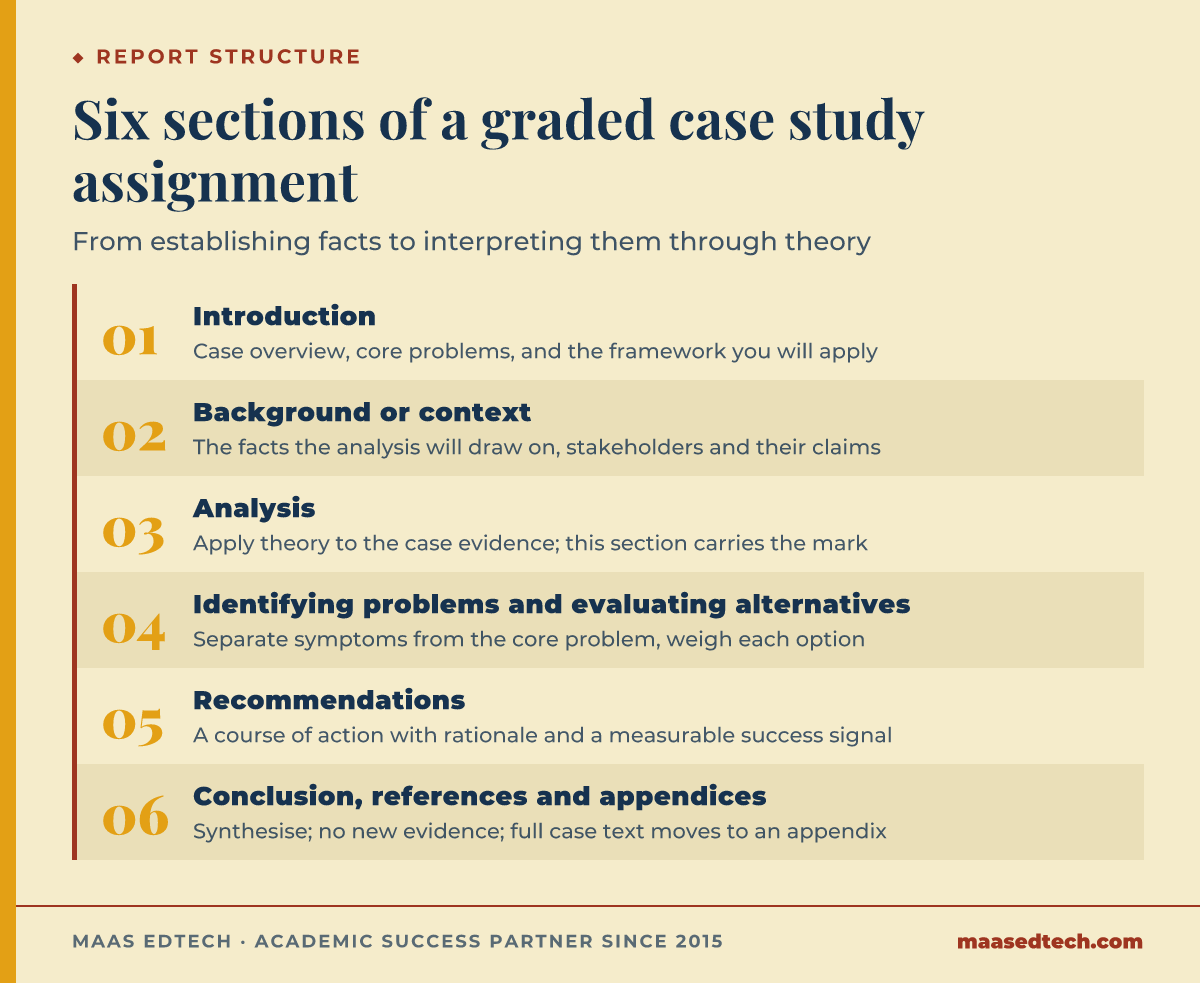
Case study assignments are typically built as report-style documents: a title page, table of contents, executive summary, introduction, discussion, conclusion and recommendations, and a reference list (RMIT University, n.d.-a). The University of Southern California Libraries (2026a) sets out a closely related five-part shape for the case analysis paper specifically, and the two map onto each other section for section.
Introduction
The introduction should answer why this case matters and what it contains: a succinct overview of the main facts, issues and core problems, the theoretical framework you intend to apply, and a short statement of how the rest of the paper is organised (University of Southern California Libraries, 2026a). Sheffield Hallam University's guidance sizes this section at roughly 10% of the word count and asks it to introduce the case, present the issue being addressed, and outline how the assignment is structured (Sheffield Hallam University, n.d.).
Background or context of the case
This section establishes the facts the analysis will draw on. For a case supplied in full by your lecturer, Sheffield Hallam University (n.d.) suggests moving the full text to an appendix and using this section for a brief descriptive summary that surfaces the key facts and figures you will develop later in the analysis. The University of Southern California Libraries (2026a) frames the equivalent step as background analysis: identifying stakeholder assumptions, the demands or claims different parties are making, and the issues or complaints on record, all grounded in specific evidence from the case rather than general impressions.
Analysis, applying a theory or framework
The analysis section is the one that carries the mark. Sheffield Hallam University (n.d.) advises outlining the model or theoretical approach you will apply before you analyse, and citing literature to show that the approach is informed by existing research rather than invented for the occasion. RMIT University (n.d.-d) makes the mechanism explicit: use a simple strategy, such as a table, to organise the evidence from the case and link each piece to the broader problem or issue, because integrating theory this way lets you establish how the theory relates to the actual problem and demonstrates your understanding of the course content.
Every unit of analysis combines three things
Tap a part to see what it is.
Case detail
The detail from the case that you are analysing.
Concept or theory
A concept or theory from the literature.
Your reasoning
Your own reasoning connecting the two.
Which framework belongs in that table depends on the discipline your brief sits in, and your unit outline is the authority on which one is expected: a marketing case commonly calls for a SWOT Analysis or the Ansoff Matrix, a strategy or management unit more often expects Porter's Five Forces or a PESTEL Analysis, and an operations case may call for a Root Cause Analysis built around a Fishbone Diagram. None of these substitutes for the reasoning RMIT University (n.d.-d) describes; the named framework only gives the evidence-to-theory table its column headings, and the analytical work still happens in the discussion around it.
The University of the Sunshine Coast puts the discipline in one line: "Don't just describe what happened, explain why it happened using the ideas you've learned" (University of the Sunshine Coast, 2026). Every unit of analysis should combine three things: the case detail, a concept or theory from the literature, and your own reasoning connecting the two (University of the Sunshine Coast, 2026). Sheffield Hallam University (n.d.) organises this at the paragraph level with a topic-evidence-discussion pattern: state your point in your own academic voice, support it with evidence and cited sources, then discuss what the evidence actually shows.
Identifying problems and evaluating alternatives
Where the brief asks you to solve a problem rather than only interpret an event, treat problem identification as its own step. The University of Southern California Libraries (2026a) recommends distinguishing symptoms of a core problem from the core problem itself, and differentiating problems by severity rather than treating every issue as equally significant. RMIT University (n.d.-e) then asks you to develop possible solutions using research, theory and industry practice, and to evaluate each one, because there is often more than one option and each carries its own advantages, disadvantages, costs and resource demands.
Recommendations
Recommendations translate the evaluated alternatives into a course of action. The University of Southern California Libraries (2026a) asks for a clear rationale for each recommendation, anticipation of likely objections, and a measurable way to judge whether the recommendation succeeds, along with awareness that any intervention can produce unintended consequences. RMIT University (n.d.-e) adds a formatting point that matters for readability: use headings and subheadings to lay out the advantages and disadvantages of each course of action rather than burying the comparison in a single paragraph.
Conclusion, references and appendices
The conclusion synthesises the core problems and the recommended response, links the analysis back to course readings and discussion, and stays brief; unlike a research paper's conclusion, it should not introduce new evidence (University of Southern California Libraries, 2026a). The reference list gives full publication details for every source cited in the discipline's required style; for the entry formats and the errors that recur most often, see referencing correctly in APA 7th and the broader guide to when a source needs citing. Supporting material that is not essential to the argument, including a case text supplied in full, belongs in an appendix rather than the main body (Sheffield Hallam University, n.d.).
◆ Part 4 / 7 · Sources at a glance
What each source contributes, at a glance
Direct answer: RMIT sets the report shape, Sheffield Hallam sizes the introduction and places the full case text in an appendix, University of Southern California Libraries supplies the case-analysis structure and distinguishes it from case study research, University of the Sunshine Coast defines the descriptive-versus-problem-based split, and University of Arizona Global Campus permits documented personal experience as evidence.
Since this guide synthesises five institutions rather than paraphrasing one, here is what each source specifically adds. RMIT University (n.d.-a) sets the report shape: title page, table of contents, executive summary, introduction, discussion, conclusion and recommendations, and a reference list. Sheffield Hallam University (n.d.) sets the introduction at 10% of the word count and puts a full case text supplied by the lecturer into an appendix rather than the main body. University of Southern California Libraries (2026a) sets out a five-part shape for the case analysis paper and, separately, twelve characteristics distinguishing that paper from case study research. University of Southern California Libraries (2026b) lists five misunderstandings about case study research, drawing on Flyvbjerg's analysis of the method. University of the Sunshine Coast (2026) splits the genre into two types, descriptive and problem-based, and supplies the sentence-level discipline of explaining why something happened rather than only describing it. University of Arizona Global Campus Writing Center (2025) allows one evidence type beyond course material and independent research: documented personal or professional experience, where the brief permits it.
◆ Part 5 / 7 · Staying descriptive
The common failure: staying descriptive
Direct answer: The most common failure is writing that narrates the case instead of analysing it, staying at description without adding a theoretical claim about what the facts mean. A related trap is overgeneralising from a single case, extending conclusions beyond what the evidence in front of you actually supports.
The single error every source above converges on is the same one: writing that narrates the case instead of analysing it. The University of Southern California Libraries (2026a) lists this directly among seven common problems in case analysis writing, alongside relying too much on opinion instead of evidence, failing to focus on the most important elements, an inadequately defined core problem, and recommendations that are either vague or unrealistic. The University of the Sunshine Coast (2026) states the fix as a discipline you apply sentence by sentence: do not just describe what happened, explain why it happened using the theory you have learned. A paragraph that ends where the facts end, without a theoretical claim about what those facts mean, has not yet done the work a case study assignment is graded on.
Overgeneralising from a single case is a related trap. The University of Southern California Libraries (2026b) warns against extending a conclusion beyond what the case itself supports, for instance attributing an outcome to a factor the case provides no documentary evidence for. Keep every claim tied to the evidence actually in front of you, and to the theory you have explicitly brought in to interpret it.
◆ Part 6 / 7 · Evidence
Evidence and referencing
Direct answer: Support every substantive claim with course material, independently researched literature, or documented facts from the case, adding personal or professional experience only where the brief explicitly allows it. There is no fixed number of required sources; cite consistently in your required style and keep every in-text citation matched to a reference-list entry.
Support every substantive claim with either course material, literature you found through your own research, or documented facts from the case; the University of Arizona Global Campus Writing Center (2025) also allows relevant personal or professional experience as supporting evidence where the brief permits it, provided the argument's spine is still built on cited sources. Sheffield Hallam University (n.d.) notes there is no fixed formula for how many sources a case study needs: the number should demonstrate that you have read adequately for the specific task, not hit an arbitrary count. Cite consistently in the style your course requires, and keep every in-text citation and every reference-list entry in one-to-one correspondence.
◆ Part 7 / 7 · Before you submit
Pre-submission check
Direct answer: Before submitting, recheck your draft against the instruction-word checklist you built from the brief, confirm every declarative statement is backed by evidence and the tone stays professional, and reread the analysis section specifically to verify each paragraph adds a theoretical claim rather than only restating the case.
Before you submit, verify the draft against the requirements you extracted from the brief at the start. RMIT University (n.d.-b) recommends keeping the checklist built from your brief's instruction words open at this stage, both while drafting and again once the draft is finished, to confirm nothing required has been missed. The University of Southern California Libraries (2026a) adds a content-level check: has every declarative statement been backed by evidence, is the tone detailed, persuasive and professional, and does the conclusion stay brief rather than introducing new material. Finally, re-read the analysis section specifically and ask whether each paragraph does more than restate the case: if a paragraph could be deleted without losing an argument, it is describing rather than analysing, and it needs a theoretical claim added before submission.
WHEN YOU WANT A SECOND PAIR OF EYES ON YOUR CASE STUDY
A mentor through academic support at MAAS reads your brief and case material with you, checks whether your planned structure separates description from analysis before you draft, and reviews whether each section applies theory to evidence rather than narrating events. The decisions and the writing remain yours.
A case study brief hides its hardest requirement in a single instruction word, "analyse", and it is easy to draft several pages of accurate description without ever meeting it. Through academic support at MAAS, an experienced mentor reads your brief and case material with you, checks whether your planned structure separates description from analysis before you draft, and reviews whether each section applies theory to evidence rather than narrating events. Your mentor questions, advises and gives structured feedback; the decisions and the writing remain your own.
Frequently asked questions
How do I do a case study assignment?
Read the brief first and decide whether it is descriptive or problem-based, then build a report-style document: title page, table of contents, executive summary, introduction, background, analysis applying a theory or framework to the case evidence, problem identification and evaluation of alternatives, recommendations, and a conclusion with references and appendices (Sheffield Hallam University, n.d.). The analysis section carries the mark, so spend your word count there rather than retelling the case.
What is the difference between a case study assignment and an essay?
A case study borrows the essay's introduction-body-conclusion shape but adds a report-style structure of separately headed sections, such as background, analysis and recommendations, that contextualise the case and present the theory applied to it (University of the Sunshine Coast, 2026). An essay is more often continuous argumentative prose without this section-by-section structure; if that is what your brief requires, see the university essay guide.
What is the difference between a descriptive and a problem-based case study?
A descriptive case study asks you to describe and analyse what happened, establishing the key facts, events and people involved. A problem-based case study goes further, asking you to identify issues, evaluate possible solutions and make recommendations (University of the Sunshine Coast, 2026). Confirm which type your brief expects before you plan the rest of the assignment.
Is a case study assignment the same as case study research?
No. Case analysis, the classroom assignment, is a problem-based teaching method built around a scenario that can be simplified or adapted to test your reasoning. Case study research is a method of in-depth, rigorous inquiry that must be grounded in reality and held to standards of intellectual honesty (University of Southern California Libraries, 2026a, 2026b). University of Southern California Libraries (2026a) sets out twelve characteristics separating the two, and University of Southern California Libraries (2026b) adds five common misunderstandings about case study research specifically, drawing on Flyvbjerg's analysis. This guide addresses the classroom assignment.
What part of a case study is actually being graded?
The analysis, specifically how well you apply a theory or framework to the evidence in the case, rather than how completely you describe the case itself (University of the Sunshine Coast, 2026). Writing that stays descriptive, without a theoretical claim about what the facts mean, is one of the most common weaknesses markers report (University of Southern California Libraries, 2026a).
How do I use theory without just listing it?
Integrate theory at the level of the paragraph: state your point in your own words, bring in a specific concept or source, and then discuss what the case evidence shows in light of it (Sheffield Hallam University, n.d.; University of the Sunshine Coast, 2026). RMIT University (n.d.-d) suggests organising this with a table that links each piece of case evidence to the theory that explains it before you start drafting full paragraphs.
How many sources should a case study cite?
There is no fixed formula. The number of sources should demonstrate that you have read adequately for the specific task, and it will vary with the assignment (Sheffield Hallam University, n.d.). Every citation should be doing real analytical work rather than padding a count.
What should I check before submitting a case study?
Re-check the draft against the instruction words from your original brief (RMIT University, n.d.-b), confirm every declarative claim is backed by evidence and the tone stays professional (University of Southern California Libraries, 2026a), and re-read the analysis section specifically to confirm each paragraph adds a theoretical claim rather than only restating the case.
References
- RMIT University. (n.d.-a). Case studies. Learning Lab. Retrieved July 4, 2026, from https://learninglab.rmit.edu.au/assessments/case-studies/
- RMIT University. (n.d.-b). Case studies: Analyse the task. Learning Lab. Retrieved July 4, 2026, from https://learninglab.rmit.edu.au/assessments/case-studies/stage-1-analyse-task/
- RMIT University. (n.d.-c). Case studies: Read the case. Learning Lab. Retrieved July 4, 2026, from https://learninglab.rmit.edu.au/assessments/case-studies/stage-1-analyse-task/read-case/
- RMIT University. (n.d.-d). Case studies: Research and link to theory. Learning Lab. Retrieved July 4, 2026, from https://learninglab.rmit.edu.au/assessments/case-studies/stage-2-research-and-link-theory/
- RMIT University. (n.d.-e). Case studies: Developing solutions. Learning Lab. Retrieved July 4, 2026, from https://learninglab.rmit.edu.au/assessments/case-studies/stage-3-developing-solutions/
- Sheffield Hallam University. (n.d.). Structuring your case study. Case studies. Retrieved July 4, 2026, from https://libguides.shu.ac.uk/casestudies/structure
- University of Arizona Global Campus Writing Center. (2025). Writing a case study analysis. Retrieved July 4, 2026, from https://writingcenter.uagc.edu/writing-case-study-analysis
- University of Southern California Libraries. (2026a). Organizing your social sciences research assignments: Writing a case analysis paper. Retrieved July 4, 2026, from https://libguides.usc.edu/writingguide/assignments/caseanalysis
- University of Southern California Libraries. (2026b). Organizing your social sciences research assignments: Writing a case study. Retrieved July 4, 2026, from https://libguides.usc.edu/writingguide/assignments/casestudy
- University of the Sunshine Coast. (2026). Case studies: Steps to analyse a case study. Retrieved July 4, 2026, from https://libguides.usc.edu.au/case-studies/steps
A free 20-minute consultation with a MAAS mentor, to talk through your brief, your case material and the structure of your case study.
Book Free Discovery ▸