
BUSM4821 Tourism and Hospitality Management Internship asks you to turn your workplace experience into evidence of professional learning, and the rubric rewards critical reflection over a diary of tasks. Students often describe what they did each week at the placement but never analyse what it taught them or connect it to theory. This guide answers the seven questions Vietnamese students at RMIT ask MAAS mentors most often before they start BUSM4821.
Author: MAAS Editorial Team
Last updated: 2026-07-22
Category: business-management

What is BUSM4821 Tourism and Hospitality Management Internship about?
Direct answer: BUSM4821 is an RMIT work-integrated learning (WIL) course (RMIT Melbourne and RMIT Vietnam) in which you complete a professional placement in the tourism or hospitality industry and are assessed on how well you learn from it. The course wants you to reflect critically on what you experienced, connect it to management theory, and show how it shaped your professional capabilities.
Evidence: WIL and internship courses are built on the idea that experience alone does not create learning; structured reflection does. Kolb's experiential learning cycle (1984) makes this explicit, arguing that a concrete experience only becomes learning when followed by reflective observation, abstract conceptualisation, and active experimentation. This is the reference point most BUSM4821 assessments expect you to reason from.
Example: A Vietnamese student at RMIT Vietnam came to MAAS with an internship report that read like a task log: "In week three I checked in guests and updated the booking system." Her MAAS mentor reframed it: the assessor does not want to know what you did, but what you learned and why it matters. Once she reflected on why a service-recovery moment changed how she saw customer experience, her report stopped narrating shifts and started demonstrating growth.
What assessment does the BUSM4821 assignment usually involve?
Direct answer: Internship courses at this level are typically assessed through a reflective report or reflective portfolio, often paired with a professional development plan and sometimes a supervisor evaluation. You are usually asked to reflect on specific incidents from your placement, link them to relevant theory, and set goals for your ongoing professional development. Always confirm the exact brief, weighting, and required components in your own Canvas shell, because assessment structure changes by semester and campus.
Evidence: RMIT WIL assessments are criterion-referenced, meaning marks are awarded against published rubric criteria rather than ranked against classmates. Reflective assessments in particular reward depth of insight and theoretical connection, not the volume of activities you can list.
Example: A Vietnamese RMIT student wrote a report that spent most of its length describing his host hotel's departments and his daily duties. His MAAS mentor cut the description to a short context paragraph and reallocated the words to reflecting on two or three critical incidents in depth. Same placement, same word count; the reflection-heavy version earned a far stronger mark.
How is the BUSM4821 assignment graded, and what does the rubric reward?
Direct answer: Reflective internship rubrics at this level reward four things, roughly in this order: (1) depth of critical reflection and self-insight, (2) explicit connection of experience to theory and professional standards, (3) a credible, specific professional development plan, and (4) academic writing and referencing. Describing what happened at the placement earns almost no marks on its own; the marks live in what it meant, why you reacted as you did, and what you will do differently. If you can replace a descriptive sentence with a reflective one, do it every time.
Evidence: RMIT rubrics use criterion bands (Pass, Credit, Distinction, High Distinction). In reflective assessment, the jump from Credit to Distinction is almost always defined by moving from description to analysis, examining why an experience unfolded as it did and linking it to literature, not by describing more incidents.
Example: A MAAS mentor colour-coded one Vietnamese student's draft sentence by sentence as "describe" or "reflect". The draft was roughly 85% describe. After a single restructuring pass that flipped the balance toward reflection, the same incidents and the same placement moved the mark up two full bands, because the assessor could finally see learning rather than a log.
Which reflective frameworks should you use in BUSM4821?
Direct answer: Anchor your reflection in one or two established models rather than name-dropping many. The most useful for BUSM4821 are: Gibbs' reflective cycle to structure a deep reflection on a specific incident, Kolb's experiential learning cycle to show how experience becomes learning, and Schön's reflection-in-action and reflection-on-action to distinguish thinking on your feet from thinking afterward. For the development-plan component, SMART goals turn your reflection into concrete, assessable actions. Pick the model that fits your task; do not force several in at once.
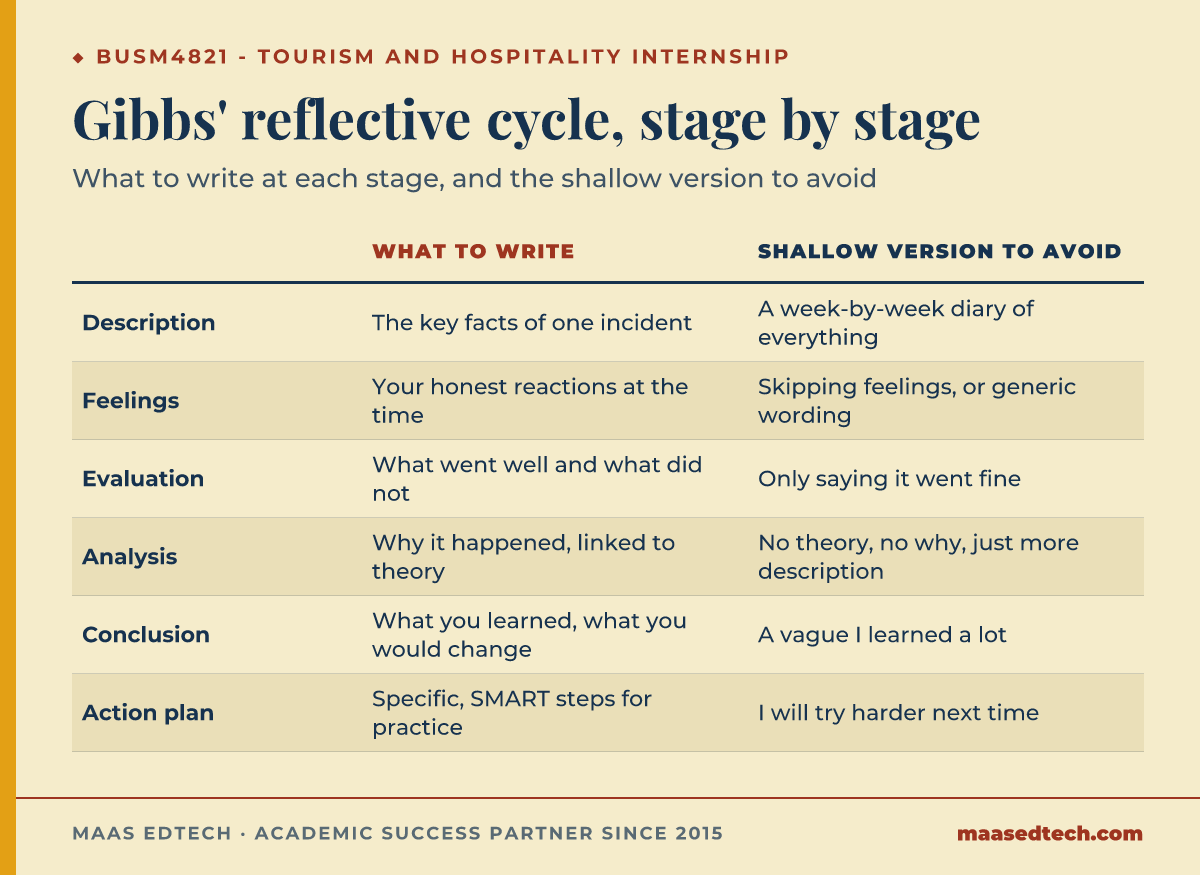
| Gibbs stage | What to write | Shallow version to avoid |
|---|---|---|
| Description | The key facts of one incident, briefly | A week-by-week diary of everything you did |
| Feelings | Your honest reactions at the time | Skipping feelings, or generic "I felt nervous" |
| Evaluation | What went well and what did not | Only saying it "went fine" |
| Analysis | Why it happened, linked to theory and literature | No theory, no "why", just more description |
| Conclusion | What you learned and would do differently | A vague "I learned a lot" |
| Action plan | Specific, SMART steps for future practice | "I will try harder next time" |
Evidence: Gibbs (1988) developed the six-stage reflective cycle that remains the standard structure for academic reflection; Kolb (1984) established the experiential learning cycle that underpins work-integrated learning; Schön (1983) introduced reflection-in-action and reflection-on-action, distinguishing the judgement professionals use during practice from the reflection they do afterward. These are foundational, examiner-recognised sources, not blog-level references. A peer-reviewed, open-access study of reflective practice in work-integrated learning puts the case plainly: "Notably, reflection is acknowledged in the literature as contributing to a range of learning outcomes that include enhanced learning and meta cognition" (Wingrove & Turner, 2015, p. 212).
Example: A Vietnamese RMIT student tried to apply four reflective models to one incident and produced a shallow, mechanical account. Her MAAS mentor cut it to one: Gibbs, worked through in real depth on a single service-failure incident, with the analysis stage genuinely linking to service-quality theory. One model, applied deeply, lifted the reflection from Credit to Distinction.
How should you structure the BUSM4821 reflective report?
Direct answer: Use a reflection-led structure: (1) a brief introduction and placement context (keep it under 10% of the word count), (2) reflection on two or three critical incidents using a model such as Gibbs, with the analysis stage doing the heavy lifting, (3) a synthesis of what the placement taught you about your professional capabilities, and (4) a specific professional development plan with SMART goals. The single biggest structural fix is shrinking the placement description and expanding the analysis and development-plan sections, where the marks concentrate.
Evidence: Criterion-referenced reflective rubrics weight "critical reflection and theoretical connection" and "professional development planning" far above "description of the placement". Structuring your word budget to match the rubric weighting is the most reliable way to lift a grade without new experiences to report.
Example: A Vietnamese RMIT student submitted a draft that was almost entirely a placement diary with a one-line "I want to improve my communication" at the end. His MAAS mentor cut the diary, developed two incidents through Gibbs, and built a development plan with three SMART goals tied to what the analysis revealed. The final report, same placement and same sources, moved from a borderline Credit to a clear Distinction.
What are the most common mistakes that lose marks in BUSM4821?
Direct answer: Three recurring mistakes show up across MAAS internship-coaching engagements. First, students describe their tasks instead of reflecting on their learning; the diary crowds out the insight. Second, students reflect without theory, giving personal feelings but never linking them to management or hospitality literature, which is where the analysis marks live. Third, the professional development plan is vague ("I will improve my skills") rather than specific, measurable, and grounded in the reflection. Fixing these three lifts most drafts by at least one rubric band.
Evidence: Because reflective assessment rewards the transformation of experience into learning, a report that stays at the description stage of Gibbs or Kolb never reaches the marks. Gibbs (1988) is explicit that the analysis stage, connecting the incident to theory and asking why, is where the learning happens; a report that skips it reads as a diary to an assessor.
Example: A Vietnamese student wrote a heartfelt but theory-free reflection about a difficult guest. His MAAS mentor asked, "which service or management concept explains what happened here?", and the revised version, which linked the incident to service-recovery theory, moved from describing an emotion to demonstrating professional learning.
How can Vietnamese students at RMIT do well in BUSM4821?
Direct answer: Choose two or three genuinely significant incidents rather than trying to cover the whole placement, reflect on them in depth with a single model such as Gibbs, and make sure every reflection reaches the analysis stage by linking to theory. Turn your insights into a professional development plan with SMART goals.
Confirm your referencing style (RMIT business and hospitality courses default to RMIT Harvard) and use RMIT's Easy Cite tool to keep entries consistent. If English academic writing is the barrier rather than the reflection itself, that is exactly where structured mentoring helps most.
Evidence: Reflective writing is conceptually demanding rather than technically hard; the marks reward honest self-analysis connected to theory, which is a writing-and-judgement task as much as an experiential one. Vietnamese students who read the rubric as asking "what did you learn and how do you know", rather than "what did you do", tend to close the gap to the top bands quickly.
Example: A Vietnamese RMIT Vietnam student worried her English would cap her mark. Her MAAS mentor showed her that the assessor was rewarding the depth of her reflection and its link to theory, not sentence polish, and coached her to end each reflection with what she learned and what she would change. Her clarity, and her mark, rose together.
Frequently asked questions
Is BUSM4821 a hard course?
It is conceptually demanding rather than technically hard; there is no maths, but reflective writing that connects experience to theory is a genuine skill. Students who treat it as "write up what I did at my internship" struggle; students who treat it as "analyse what I learned and how" do well.
How many incidents should I reflect on for BUSM4821?
Usually two or three, reflected on in real depth, beats covering your whole placement shallowly. A single well-analysed incident that links to theory scores higher than a week-by-week diary.
Do I have to use Gibbs' reflective cycle?
Not necessarily, but a recognised model such as Gibbs, Kolb, or Schön gives your reflection structure and shows the assessor you are reflecting systematically. Confirm any required model in your brief, and if none is specified, choose one and apply it consistently.
What referencing style does BUSM4821 use?
RMIT Harvard is the default for RMIT business and hospitality courses. Always confirm in your own brief, and use RMIT's Easy Cite tool to format entries consistently. Yes, a reflective report still needs references, because the analysis stage links your experience to literature.
Can I write in the first person for a reflective report?
Yes. Reflective writing is one of the few academic genres where the first person ("I") is expected, because you are analysing your own experience. Keep it analytical rather than casual, and still support your analysis with theory.
Can MAAS help me with BUSM4821?
Yes. MAAS Assignment & Essay Support coaches you through the assignment with the Outline to Draft to Final model, rubric decoding, reflective-model selection, draft feedback, and a pre-submission referencing audit, all with discipline-matched experts. We coach your work; we do not write it for you.
Ready to approach BUSM4821 with a clear strategy?
If you have the placement experience but not the reflection, that is exactly where a discipline-matched expert helps most. MAAS Assignment & Essay Support is an academic support partner; we work alongside you through Outline to Draft to Final so the reflection stays yours and the structure earns the marks.
Bring your BUSM4821 brief and we will match you to a Tourism and Hospitality mentor, 23% of our 100+ experts hold a PhD, within 48 hours when our network already covers that field. If it does not, MAAS opens a dedicated recruitment round for your case, which usually takes about two weeks.
Book a free 15-minute BUSM4821 consultation with MAAS Assignment & Essay Support →
Related guides
- BUSM4567 at RMIT: how do you approach Eco-tourism and Sustainable Hospitality?: sibling RMIT tourism and hospitality guide on evaluating sustainability
- OMGT2199 at RMIT: how do you approach Operations Management?: sibling RMIT guide on analysing and improving an operation
- How to write a reflection essay: a deeper guide to reflective writing technique
- How to write a methodology in an essay: for the analytical-rigour half of any report
- MAAS Academic Mentoring service: 1:1 coaching with PhD-level mentors in your discipline
- Tutoring service: 1:1 subject tutoring in 60- or 90-minute sessions with an expert matched on your course code, always inside your discipline
- Course-code assignment coaching: pillar guide on tackling any unit assignment with a MAAS mentor
References
- Gibbs, G. (1988). Learning by doing: A guide to teaching and learning methods. Further Education Unit.
- Kolb, D. A. (1984). Experiential learning: Experience as the source of learning and development. Prentice Hall.
- Schön, D. A. (1983). The reflective practitioner: How professionals think in action. Basic Books.
- Wingrove, D., & Turner, M. (2015). Where there is a WIL there is a way: Using a critical reflective approach to enhance work readiness. Asia-Pacific Journal of Cooperative Education, 16(3), 211–222.
Tools & resources
- RMIT University. (n.d.). Assessment and exams. Retrieved July 22, 2026, from https://www.rmit.edu.au/students/student-essentials/assessment-and-exams
- RMIT University. (n.d.). Easy Cite referencing tool. Retrieved July 22, 2026, from https://www.rmit.edu.au/library/study/referencing
This article is part of the MAAS Journal series for Vietnamese international students. MAAS Assignment & Essay Support is an academic support partner; we coach students through the Outline to Draft to Final delivery model with developmental feedback from discipline-matched experts. We do not write or submit work on a student's behalf.