
BUSM4567 Eco-tourism and Sustainable Hospitality Management asks you to judge whether a tourism or hospitality operation is sustainable or only marketed that way. Most students who struggle with this RMIT course are not short on effort; they summarise a resort's green initiatives but never evaluate whether those initiatives are material, credible, and balanced across environmental, social, and economic outcomes. This guide answers the seven questions Vietnamese students at RMIT ask MAAS mentors most often before they start BUSM4567.
Author: MAAS Editorial Team
Last updated: 2026-07-22
Category: business-management

What is BUSM4567 Eco-tourism and Sustainable Hospitality Management about?
Direct answer: BUSM4567 is an RMIT tourism and hospitality course (RMIT Melbourne and RMIT Vietnam) examining how tourism destinations, hotels, and eco-tourism operators can grow without eroding the environments and communities they depend on. Tourism creates jobs and income, yet the same visitor flows can degrade ecosystems and strain local culture. Your job is to analyse that trade-off, not celebrate the industry.
Evidence: The field is built on the idea that a destination has a carrying capacity, a limit beyond which more visitors reduce both environmental quality and the visitor experience. Butler's tourism area life cycle (1980) formalised this, describing how destinations move through exploration, involvement, development, consolidation, and stagnation, and how carrying capacity shapes whether they then decline or are rejuvenated. This is the reference point most BUSM4567 assessments expect you to reason from. As tourism researcher Erik Lundberg frames the concept underpinning Butler's model: "The notion of limits to how many visitors an area can cope with before degradation, i.e. negative impacts due to tourism, have been observed for a long time" (Lundberg, 2011, p. 39).
Example: A Vietnamese student at RMIT Vietnam came to MAAS treating BUSM4567 as "hotels doing eco-friendly things". Her MAAS mentor reframed it: the course is about whether a destination's growth is being managed within its limits, or whether it is quietly consuming the very asset that draws visitors. Once she read her case destination through carrying capacity and the life cycle, her draft stopped listing green features and started arguing about long-term viability.
What assessment does the BUSM4567 assignment usually involve?
Direct answer: Sustainability-focused tourism and hospitality courses at this level are typically assessed through an individual report or case analysis built around one destination, hotel, or eco-tourism operator, sometimes paired with a group project or reflective task. You are usually asked to assess a real operation's sustainability performance, identify where it falls short, and recommend evidence-based improvements. Always confirm the exact brief, weighting, and case organisation in your own Canvas shell, because assessment structure changes by semester and campus.
Evidence: RMIT business and hospitality assessments are criterion-referenced, meaning marks are awarded against published rubric criteria rather than ranked against classmates. This is set out in RMIT's assessment policy, and it is why decoding the rubric matters more than writing length.
Example: A Vietnamese RMIT student chose a well-known eco-resort and spent much of his word count praising its solar panels and recycling program. His MAAS mentor asked one question: what about the social and economic dimensions, who benefits locally, and at what cost? The revised report weighed all three dimensions and read as an evaluation rather than a brochure, moving the mark up a full band.
How is the BUSM4567 assignment graded, and what does the rubric reward?
Direct answer: Sustainable tourism rubrics at this level reward four things, roughly in this order: (1) depth of critical evaluation of sustainability claims, (2) correct and explicit use of sustainability frameworks, (3) practical, justified recommendations, and (4) academic writing and referencing. Describing what an operator does for the environment earns almost no marks on its own; the marks live in whether the effort is material, whether it is greenwashing, and whether it balances people, planet, and profit. If you can replace a descriptive sentence with an evaluative one, do it every time.
Evidence: RMIT rubrics use criterion bands (Pass, Credit, Distinction, High Distinction). The jump from Credit to Distinction is almost always defined by the word "critical", critical evaluation, critical application of theory, critical judgement, and not by adding more examples of green initiatives.
Example: A MAAS mentor colour-coded one Vietnamese student's draft sentence by sentence as "describe" or "evaluate". The draft was roughly 80% describe. After a single restructuring pass that flipped the balance toward evaluation, the same case and the same sources moved the mark up two full bands, because the examiner could finally see judgement about credibility, not a summary of claims.
Which sustainability frameworks should you use in BUSM4567?
Direct answer: Anchor your analysis in two or three established frameworks rather than name-dropping many. The most useful for BUSM4567 are: the triple bottom line (economic, social, and environmental sustainability) to structure a balanced evaluation, Butler's tourism area life cycle and carrying capacity to judge whether growth is sustainable over time, and the core criteria of ecotourism (nature-based, conservation contribution, community benefit, and education) to test whether an operation is genuinely eco-tourism or just nature-adjacent marketing. Pick the frameworks that fit your case operation; do not force all of them in.
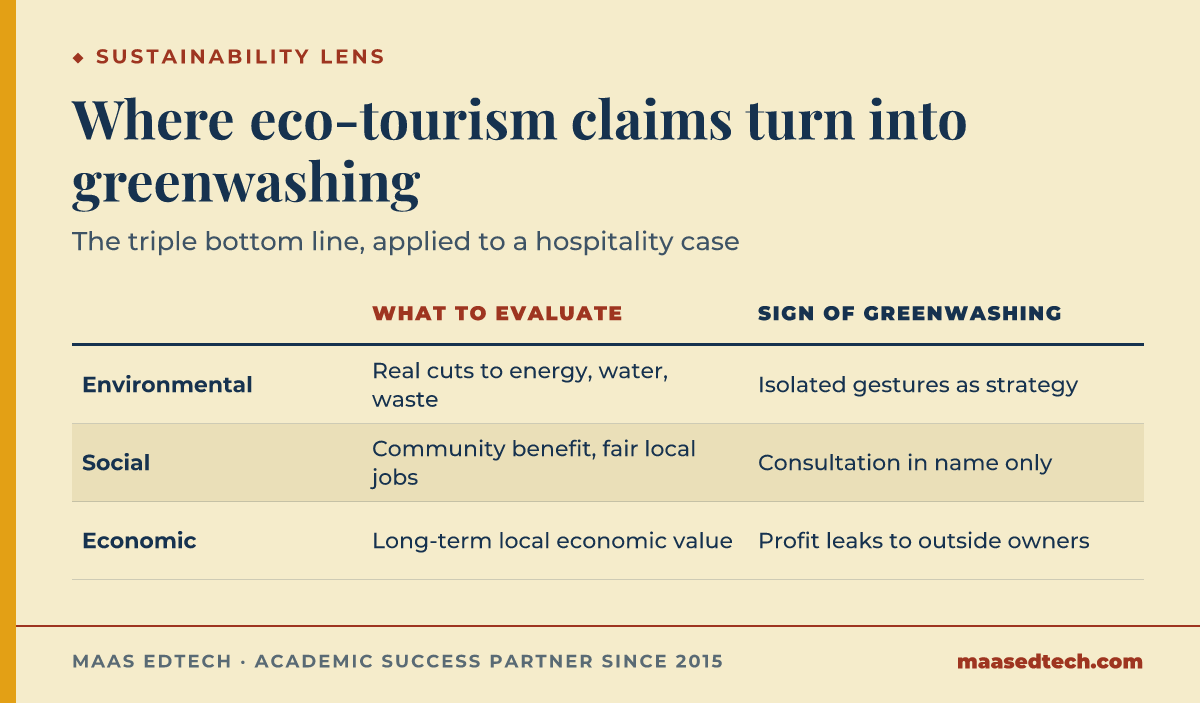
| Triple bottom line dimension | What to evaluate in a hospitality or tourism operation | Sign of a weak (greenwashed) claim |
|---|---|---|
| Environmental | Real reductions in energy, water, waste, and impact on ecosystems | Isolated gestures (a linen-reuse card) presented as a strategy |
| Social | Benefit to host communities, fair local employment, cultural respect | Community "engagement" that is consultation in name only |
| Economic | Long-term local economic value, not just operator profit | Profit that leaks out of the destination to external owners |
Evidence: Elkington (1997) introduced the triple bottom line, the requirement that sustainability be judged across economic, social, and environmental outcomes together, not one in isolation; Butler (1980) established the life cycle and carrying capacity logic; Fennell and Cooper (2020) frame sustainable tourism around the United Nations Sustainable Development Goals and the ethics of who bears the costs and gains the benefits. These are foundational, examiner-recognised sources, not blog-level references.
Example: A Vietnamese RMIT student analysing a coastal resort tried to apply five models and explained each shallowly. Her MAAS mentor cut it to two: the triple bottom line to show the resort's environmental claims were strong but its social record weak, and carrying capacity to argue the destination was nearing stagnation. Fewer frameworks, deeper application, higher mark.
How should you structure the BUSM4567 report?
Direct answer: Use an evaluation-led structure: (1) a brief introduction and case-operation context (keep it under 10% of the word count), (2) the sustainability challenge or claim you are testing, (3) evaluation of that claim across the triple bottom line and, where relevant, against carrying capacity or ecotourism criteria, (4) evidence-based recommendations, and (5) a conclusion. The single biggest structural fix is shrinking the description sections and expanding the evaluation and recommendation sections, where the marks concentrate.
Evidence: Criterion-referenced rubrics weight "critical evaluation and application" and "recommendations and justification" far above "context and background". Structuring your word budget to match the rubric weighting is the most reliable way to lift a grade without new research.
Example: A Vietnamese RMIT student submitted a draft with a long operator profile and a two-sentence recommendations section. His MAAS mentor inverted the ratio, cutting the profile and developing three specific recommendations tied to the weaknesses found in the evaluation. The final report, same case and same sources, moved from a borderline Credit to a clear Distinction because the recommendations were finally developed enough to be assessed.
What are the most common mistakes that lose marks in BUSM4567?
Direct answer: Three recurring mistakes show up across MAAS sustainability-coaching engagements. First, students describe an operator's green initiatives instead of evaluating whether they are material and credible; the brochure crowds out the argument. Second, students treat sustainability as environmental only, ignoring the social and economic legs of the triple bottom line. Third, recommendations are generic ("the resort should be more sustainable") rather than specific, prioritised, and tied to the evaluation. Fixing these three lifts most drafts by at least one rubric band.
Evidence: Because sustainability is defined across three interacting dimensions, an analysis that praises environmental effort while ignoring who profits or who is displaced reads as one-sided to an examiner. Fennell and Cooper (2020) stress that sustainable tourism is fundamentally about the distribution of costs and benefits, so a Distinction-level answer asks who gains, who pays, and whether that balance can hold.
Example: A Vietnamese student praised an eco-lodge's conservation program without noting that local residents had been excluded from the land it occupied. His MAAS mentor asked, "who carries the social and economic cost of this environmental gain?", and the revised version, which weighed conservation against community displacement, read as genuine sustainability judgement.
How can Vietnamese students at RMIT do well in BUSM4567?
Direct answer: Treat every green claim as something to test, not to repeat. Structure the evaluation with the triple bottom line so environmental, social, and economic outcomes each get scrutiny, use carrying capacity or the life cycle when the question is about a destination over time, and spend most of your word count on evaluation and recommendations.
Confirm your referencing style (RMIT business and hospitality courses default to RMIT Harvard) and use RMIT's Easy Cite tool to keep entries consistent. If English academic writing is the barrier rather than the sustainability content, that is exactly where structured mentoring helps most.
Evidence: Sustainable tourism is conceptually demanding rather than technically hard; the marks reward reasoning about trade-offs and credibility, which is a writing-and-judgement task as much as a subject-knowledge one. Vietnamese students who read the rubric as an argument brief, rather than a content checklist, tend to close the gap to the top bands quickly.
Example: A Vietnamese RMIT Vietnam student worried her English would cap her mark. Her MAAS mentor showed her that the examiner was rewarding the logic of her sustainability evaluation, not sentence polish, and coached her to lead each paragraph with a verdict and then defend it. Her clarity, and her mark, rose together.
Frequently asked questions
Is BUSM4567 a hard course?
It is conceptually demanding rather than technically hard; there is little heavy maths, but the course expects you to evaluate sustainability claims critically rather than memorise definitions. Students who treat it as "describe an eco-friendly hotel" struggle; students who treat it as "judge whether this operation is genuinely sustainable" do well.
Can I use a well-known resort or destination as my case for BUSM4567?
Yes, large, well-documented operations work well because there is enough public information to evaluate. The risk is spending too long on background and praise. Pick an operation with a sustainability claim or tension you can actually test, not just a famous eco-brand.
How many frameworks should I use in the assignment?
Two or three, applied deeply, beats five applied shallowly. Examiners reward critical application, using a framework to reach a judgement, not the number of models you can list.
What referencing style does BUSM4567 use?
RMIT Harvard is the default for RMIT business and hospitality courses. Always confirm in your own brief, and use RMIT's Easy Cite tool to format entries consistently.
Do I need to cover all three parts of the triple bottom line?
Usually yes, because a balanced evaluation is what distinguishes strong answers. Even if one dimension dominates your case, acknowledging the social and economic legs alongside the environmental one shows the examiner you understand sustainability as a whole, not just as being green.
Can MAAS help me with BUSM4567?
Yes. MAAS Assignment & Essay Support coaches you through the assignment with the Outline to Draft to Final model, rubric decoding, framework selection, draft feedback, and a pre-submission referencing audit, all with discipline-matched experts. We coach your work; we do not write it for you.
Ready to approach BUSM4567 with a clear strategy?
If you have the case operation but not the verdict, that is exactly where a discipline-matched expert helps most. MAAS Assignment & Essay Support is an academic support partner; we work alongside you through Outline to Draft to Final so the evaluation stays yours and the structure earns the marks.
Bring your BUSM4567 brief and we will match you to a Tourism and Hospitality mentor, 23% of our 100+ experts hold a PhD, within 48 hours when our network already covers that field. If it does not, MAAS opens a dedicated recruitment round for your case, which usually takes about two weeks.
Book a free 15-minute BUSM4567 consultation with MAAS Assignment & Essay Support →
Related guides
- BUSM4187 assignment: how do you approach International Human Resource Management?: sibling RMIT business guide on applying theory to a real organisation
- OMGT2199 at RMIT: how do you approach Operations Management?: sibling RMIT guide on analysing and improving an operation
- How to write a methodology in an essay: for the analytical-rigour half of any sustainability report
- How to write a theoretical framework: for applying sustainability frameworks with academic depth
- MAAS Academic Mentoring service: 1:1 coaching with PhD-level mentors in your discipline
- Tutoring service: 1:1 subject tutoring in 60- or 90-minute sessions with an expert matched on your course code, always inside your discipline
- Course-code assignment coaching: pillar guide on tackling any unit assignment with a MAAS mentor
References
- Butler, R. W. (1980). The concept of a tourist area cycle of evolution: Implications for management of resources. The Canadian Geographer, 24(1), 5–12.
- Elkington, J. (1997). Cannibals with forks: The triple bottom line of 21st century business. Capstone.
- Fennell, D. A., & Cooper, C. (2020). Sustainable tourism: Principles, contexts and practices. Channel View Publications.
- Lundberg, E. (2011). Evaluation of tourism impacts – A sustainable development perspective [Licentiate thesis, University of Gothenburg]. GUPEA. https://gupea.ub.gu.se/server/api/core/bitstreams/0e4f5972-e00b-42e8-a27d-71908d75e317/content
Tools & resources
- RMIT University. (n.d.). Assessment and exams. Retrieved July 22, 2026, from https://www.rmit.edu.au/students/student-essentials/assessment-and-exams
- RMIT University. (n.d.). Easy Cite referencing tool. Retrieved July 22, 2026, from https://www.rmit.edu.au/library/study/referencing
- UN Tourism. (n.d.). Sustainable development of tourism. Retrieved July 22, 2026, from https://www.unwto.org/sustainable-development
This article is part of the MAAS Journal series for Vietnamese international students. MAAS Assignment & Essay Support is an academic support partner; we coach students through the Outline to Draft to Final delivery model with developmental feedback from discipline-matched experts. We do not write or submit work on a student's behalf.