
◆ Business & Management
Business Model Canvas: how to complete it for a university assignment
The Business Model Canvas shows how an organisation creates, delivers and captures value on one page, and markers reward how well you justify each block. A strong answer fills the nine blocks with specific, evidenced entries, shows how they depend on one another, and says honestly where the tool stops being useful. This guide defines each block, works through a clearly hypothetical example, and sets out how to move from filling boxes to analysing a business model. Every claim traces to the Strategyzer site, an open textbook or a research source, listed under References.

◆ Question 1 / 6 · What is the Business Model
What is the Business Model Canvas, and what does an assignment want from it?
Direct answer: The Business Model Canvas is a one-page template that Alex Osterwalder and Yves Pigneur developed and published in their 2010 book Business Model Generation. An assignment usually wants a completed canvas plus an argument that explains and evaluates it, so the diagram alone is rarely enough.
Strategyzer (n.d.) describes the canvas as a way to describe how a business creates, delivers and captures value on one page, and says it should be filled in once for one business model, not for a whole company. A second Strategyzer page explains that Yves Pigneur and Alex Osterwalder set out in 2000 to find the most important elements of a business model, and that the nine building blocks were described in a PhD dissertation before becoming the canvas (Amarsy, 2014). The 2010 book is the version most courses cite (Osterwalder & Pigneur, 2010).
Dates help when you describe the tool's origins. Amarsy (2014) published the Strategyzer article on 21 August 2014, so cite it as a 2014 web source, and note that the work began in 2000, a decade before the 2010 book that Strategyzer (n.d.) names as the canvas's source.
If your search was for "business model canva", this is the tool you want, and the spelling matters in your written work: the term is Business Model Canvas, and you should cite it that way.
The canvas itself is only the evidence. Strategyzer (n.d.) says of the filled-in canvas: "Treat it as a claim, not a plan." That gives you the right attitude for an assignment. Each box is a claim you have to support, and the discussion is where the marks sit.
◆ Question 2 / 6 · What do the nine blocks
What do the nine blocks mean, and what does a worked example look like?
Direct answer: The canvas has nine blocks, running from customer segments and value propositions through channels and relationships to revenue, resources, activities, partners and costs (OpenStax, n.d.). Each block answers one specific question, and the table below applies all of them to an invented business called StudyBox.
OpenStax (n.d.) groups the blocks into four areas, which are customers, offering, infrastructure and financial viability, and lists the guiding questions for each block. The table pairs those questions with a hypothetical example, "StudyBox", an invented weekly lunch-box service for university students. StudyBox is not a real company, and its entries exist only to show the level of specificity a marker expects.
| Block | Question it answers (OpenStax, n.d.) | Hypothetical StudyBox entry |
|---|---|---|
| Customer segments | Who are our customers, and from whom are we creating value? | Undergraduates living off campus with little time and a tight budget |
| Value propositions | What problem are we solving, and what do we offer each segment? | Affordable, healthy lunches ordered a week ahead, so students skip daily decisions |
| Channels | How will we reach our customer segments, and which channels are most efficient? | A mobile ordering page and one campus pickup point |
| Customer relationships | What type of relationship does each segment want, and how costly is it? | Automated reminders and a simple feedback form, with no personal account manager |
| Revenue streams | What are customers willing to pay, and how do they pay? | Weekly subscription, with one-off orders for new users |
| Key resources | What resources do the value proposition, channels and relationships require? | A rented kitchen, an ordering tool, food-handling approval |
| Key activities | What activities do they require? | Sourcing, cooking, packing and handing over the boxes |
| Key partnerships | Who are our key partners and suppliers? | Local suppliers and a campus facilities office |
| Cost structure | What are the most important costs in the model? | Ingredients, kitchen labour and rent |
OpenStax (n.d.) also explains the range inside each block, which is useful vocabulary. Customer relationships can be personal assistance, self-service, automated service, user communities or cocreation. Revenue can come from asset sales, usage fees, subscription fees, licensing, brokerage fees or advertising. Key partnerships take four forms: strategic alliances between non-competitors, coopetition between competitors, joint ventures and buyer-supplier relationships. Using this vocabulary, you can name the type of each entry, which turns a list into an analysis.
Notice what makes the StudyBox entries usable. Each names a specific group, offer or resource, and none is a bare label such as "students" or "social media". Where you use a real company instead of an invented one, source every fact about it, because an unsupported claim about a real business is the quickest way to lose credibility.
◆ Question 3 / 6 · How do you go beyond filling
How do you go beyond filling the boxes?
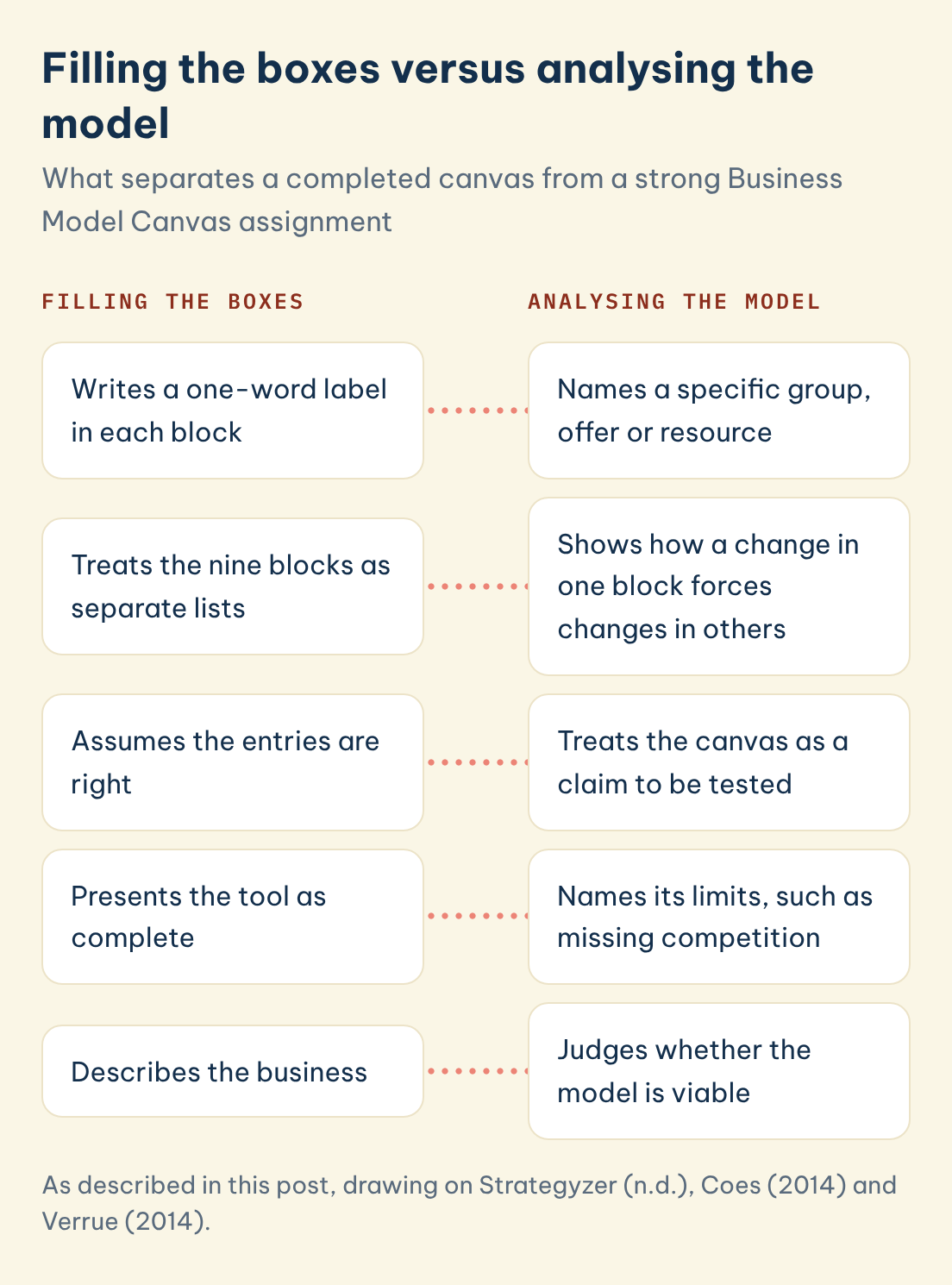
Direct answer: Link the blocks so that a change in one forces a change in another, support each entry with evidence, and finish with a judgement about whether the model is viable. Strategyzer (n.d.) says moving a customer segment forces the channels, activities and costs to move with it.
Filling the boxes versus analysing the model
What separates a completed canvas from a strong Business Model Canvas assignment
Filling the boxes
Analysing the model
Writes a one-word label in each block
Names a specific group, offer or resource
Treats the nine blocks as separate lists
Shows how a change in one block forces changes in others
Assumes the entries are right
Treats the canvas as a claim to be tested
Presents the tool as complete
Names its limits, such as missing competition
Describes the business
Judges whether the model is viable
Save this figure
Strategyzer (n.d.) describes the right side of the canvas as the market and the left side as what it takes to serve that market, with the value proposition sitting between them. It adds that cost structure and revenue streams only hold if the blocks above them are right. Amarsy (2014) makes the matching point that there is no revenue stream without a customer paying for a value proposition. Use these relationships as the skeleton of your analysis.
A chain of reasoning for StudyBox shows the idea. Because the segment is budget-conscious, the revenue stream has to be a low-priced subscription. A low price means the cost structure must stay lean, which is why the model leans on local suppliers and a single pickup point rather than home delivery. The pickup point also sets the channel and the type of relationship, since a student collecting a box does not need a personal account manager. Written out like this, the nine boxes become one argument, and the argument is what the marker reads for.
To evidence the entries:
- Cite for the segment and the value proposition. These are the claims a marker will test first. Use market data or published research on the group you describe, and say plainly when you are assuming.
- Justify choices between alternatives. If you chose automated service over personal assistance, say why, using the categories in OpenStax (n.d.).
- Keep the canvas dated and versioned. Strategyzer (n.d.) advises dating and versioning the canvas and redrawing it as evidence arrives. In an assignment, a sentence on which entries you are least sure of, and how you would test them, shows the right habit.
- Check the whole for coherence. Ask whether any block contradicts another, for example a premium value proposition aimed at a segment that cannot pay.
◆ Question 4 / 6 · How do you critique
How do you critique the Business Model Canvas itself?
Direct answer: Name two or three limitations, support them with research, and say how they affect your case. Published critiques, including Coes (2014) and Verrue (2014), point to the canvas leaving out external forces such as competition, to blocks that overlap, and to its snapshot nature.
Coes (2014), in a University of Twente master's thesis combining theoretical analysis, online review and interviews with experienced business model developers, found strengths in the canvas's visual simplicity and its focus on capturing and delivering value. He also identified as the main limitations the exclusion of external forces such as competition and market factors, and the narrowness of the value proposition. He adds that the focus on revenue excludes other purposes of organisations, such as non-profit and governmental ones (Coes, 2014).
Verrue (2014) applied the canvas to a single case and argued that it lacks consistency because of overlaps between blocks, and that its fixed architecture too easily leads to a filling-in exercise. That is a direct warning for your assignment, because a canvas completed mechanically is exactly what Verrue describes. Kupczyk et al. (2024), writing about start-ups, collect similar criticisms, including over-simplification, a lack of strategic depth such as competitive analysis, and a snapshot rather than a process view.
To turn these into critical writing, apply them to your example rather than reciting them. For StudyBox, the missing competitor view matters, because a student could buy lunch from existing food outlets. You would acknowledge that the canvas does not prompt that comparison and add a short competitor note beside it. You could also point out that the canvas shows a moment in time, so you would state which entries you would revisit first once real customers respond. Kupczyk et al. (2024) report that the canvas may need supplementary tools for complex or fast-changing businesses, so naming a complementary tool is a reasonable way to close.
The critiques come from different kinds of work, and saying so shows the marker you can weigh evidence. Coes (2014) is a 2014 master's thesis from the University of Twente, Verrue (2014) is a 2014 single-case study, and Kupczyk et al. (2024) appears in volume 27, issue 4 of the European Research Studies Journal, on pages 921 to 940.
Keep the balance honest. Coes (2014) found genuine strengths, so a critique that only attacks the tool reads as one-sided. A good paragraph credits what the canvas does well, then shows where your particular business model needs more than it offers.
◆ Question 5 / 6 · What mistakes lose marks
What mistakes lose marks in a Business Model Canvas assignment?
Direct answer: The costliest mistakes are one-word entries, blocks that contradict each other, no evidence for the customer claims, and no evaluation of the model. Each leaves the canvas as a diagram without an argument, which is why markers reward connected, evidenced entries and a judgement on viability.
- Labels instead of content. "Social media" under channels says nothing. Name which channel, for which segment and in what role.
- Several customer segments mixed together. OpenStax (n.d.) treats segments as groups with common characteristics, so one block for "everyone" removes the logic that connects the other eight.
- A value proposition that lists features. The block answers what problem is solved, not what the product is made of.
- Revenue and cost that do not follow from the rest. Strategyzer (n.d.) says these two blocks depend on the seven above, so a price or cost that ignores your segment will be noticed.
- Treating the canvas as the whole answer. If the brief asks for analysis or evaluation, the canvas is the appendix and the discussion is the essay.
- Unsourced facts about a real company. If you use a real firm, cite where each fact came from, or switch to a clearly labelled hypothetical.
- No limitations section. Even two sentences on what the canvas omits, supported by a source such as Coes (2014), show critical awareness.
The strongest assignments cite three kinds of source: the tool's own authors (Osterwalder & Pigneur, 2010), a textbook treatment such as OpenStax (n.d.), and critical research such as Coes (2014), Verrue (2014) or Kupczyk et al. (2024). That mix shows the marker that you can describe, apply and evaluate the canvas.
Our guides to writing a university report, writing a case study and APA 7th referencing help with structuring the written discussion and citing the sources above.
◆ Question 6 / 6 · How can MAAS help
How can MAAS help with a Business Model Canvas assignment?
Direct answer: A MAAS mentor in business and management can read your brief and rubric with you, work through Outline, Draft and Final stages, and give feedback on how well your blocks connect and how well you evaluate the model. You write and submit your own work.
MAAS's essay and assignment support uses Outline, Draft and Final with you involved at each stage, and the mentor acts as advisor and tutor rather than author. If your canvas belongs to a wider strategy unit, the guides to strategic marketing management and global strategy show how two universities frame business analysis tasks. A free 20-minute discovery call with MAAS, a Ho Chi Minh City company, is a way to talk through your brief with no obligation, and you can book one here.
Frequently asked questions
What are the nine blocks of the Business Model Canvas?
They are customer segments, value propositions, channels, customer relationships, revenue streams, key resources, key activities, key partnerships and cost structure (OpenStax, n.d.). OpenStax groups them into customers, offering, infrastructure and financial viability.
Which block should I fill in first?
Start with customer segments and the value proposition, because the other blocks depend on them. Strategyzer (n.d.) describes the value proposition as sitting between the market on the right and the means of serving it on the left, and says cost structure and revenue streams only hold if the earlier blocks are right.
Can I use an invented company for the assignment?
Check your brief first. Many briefs accept a hypothetical business, provided you label it clearly and make its entries specific. If the brief asks for a real company, every fact about it needs a source.
How do I critique the Business Model Canvas?
Choose two or three limitations from research, such as the omission of external forces (Coes, 2014), overlap between blocks (Verrue, 2014) or its snapshot nature (Kupczyk et al., 2024), and apply each to your own example. Credit its strengths as well.
Is the canvas the same as a business plan?
No. Strategyzer (n.d.) says the canvas describes a business model on one page and is a claim to be tested, not a plan. A business plan is a longer document covering objectives, tactics and finance, so the canvas can feed into a plan but does not replace it.
References
Amarsy, N. (2014, August 21). 5 questions you never dared to ask about the Business Model Canvas. Strategyzer. https://www.strategyzer.com/library/5-questions-business-mode-canvas
Coes, D. H. (2014). Critically assessing the strengths and limitations of the Business Model Canvas [Master's thesis, University of Twente]. https://essay.utwente.nl/fileshare/file/64749/Coes_MA_MB.pdf
Kupczyk, T., Dewalska-Opitek, A., Witczak, O., Budziński, M., & Kalita, D. (2024). Business Model Canvas application in start-up stage business developments: Constraints and challenges. European Research Studies Journal, 27(4), 921–940. https://doi.org/10.35808/ersj/3611
OpenStax. (n.d.). 19.3 Business Model Canvas. In Organizational behavior. Rice University. https://openstax.org/books/organizational-behavior/pages/19-3-business-model-canvas
Osterwalder, A., & Pigneur, Y. (2010). Business model generation: A handbook for visionaries, game changers, and challengers. John Wiley & Sons.
Strategyzer. (n.d.). The Business Model Canvas. https://www.strategyzer.com/library/the-business-model-canvas
Verrue, J. (2014). A critical investigation of the Osterwalder Business Model Canvas: An in-depth case study [Unpublished conference paper]. https://doi.org/10.13140/2.1.3088.4482
Not sure how this guide applies to your own case? Talk it through with MAAS in a free 20-minute consultation.
Book a free consultation ▸