
◆ Marketing
MKT300 assignment: how do you build marketing law into the strategy?
MKT300 Strategic Marketing Management at the International College of Management, Sydney (ICMS) asks for something most strategy subjects leave out: a growth plan that also survives Australian marketing law. Two of its six published learning outcomes point away from the usual toolkit, one towards mature and declining markets and one towards intellectual property, unfair selling practices and misuse of competitive power. This guide sets out how MAAS mentors read an MKT300 task.
Note on the code: this guide describes the ICMS subject. Arizona State University and several other institutions in the United States also run an MKT 300, with different content, so check the subject title on your own enrolment before reading further.
◆ Section 1 / 8 · The subject
What is MKT300 Strategic Marketing Management about?
Direct answer: MKT300 is the strategic marketing subject in the ICMS undergraduate degrees. It teaches you to develop, evaluate and implement marketing strategy, and it adds a layer many strategy subjects skip: the laws that govern advertising, promotion and competitive conduct. Your strategy is marked partly on whether a regulator could live with it.
Evidence: The ICMS subject page states the subject aim in three parts. The first is strategic thinking and practical tools to "develop, evaluate and implement innovative marketing strategies". The second covers theories and frameworks for strategic marketing activity. The third covers "the concept of Intellectual Property, unfair selling practices and misuse of competitive power and other laws governing marketing with a focus on the regulation of advertising and promotional activities." The page lists six learning outcomes and does not state a credit value or year level, so take both from your own course structure.
Example: Marketing strategy, at its broadest, is "an organization's integrated pattern of decisions that specify its crucial choices concerning products, markets, marketing activities and marketing resources" (Varadarajan, 2010, p. 119). The phrase to underline is integrated pattern. A strategy section that lists tactics without showing how they fit together describes activity, not strategy, and a draft built that way tends to stall however polished its individual tactics are.
◆ Section 2 / 8 · Assessment
How is MKT300 assessed, and what does each task reward?
Direct answer: Three components carry the mark: an individual assignment worth 25%, a group assignment worth 25% and a final exam worth 50%. Only the exam maps to all six learning outcomes, so the law outcome is assessed in the exam even if your assignment brief barely mentions it.
How the ICMS subject page weights the three MKT300 components
These are the weightings the ICMS subject page lists for MKT300, shown as a share of the mark.
Individual assignment
25
% of the mark
Group assignment
25
% of the mark
Final exam
50
% of the mark
Save this figure
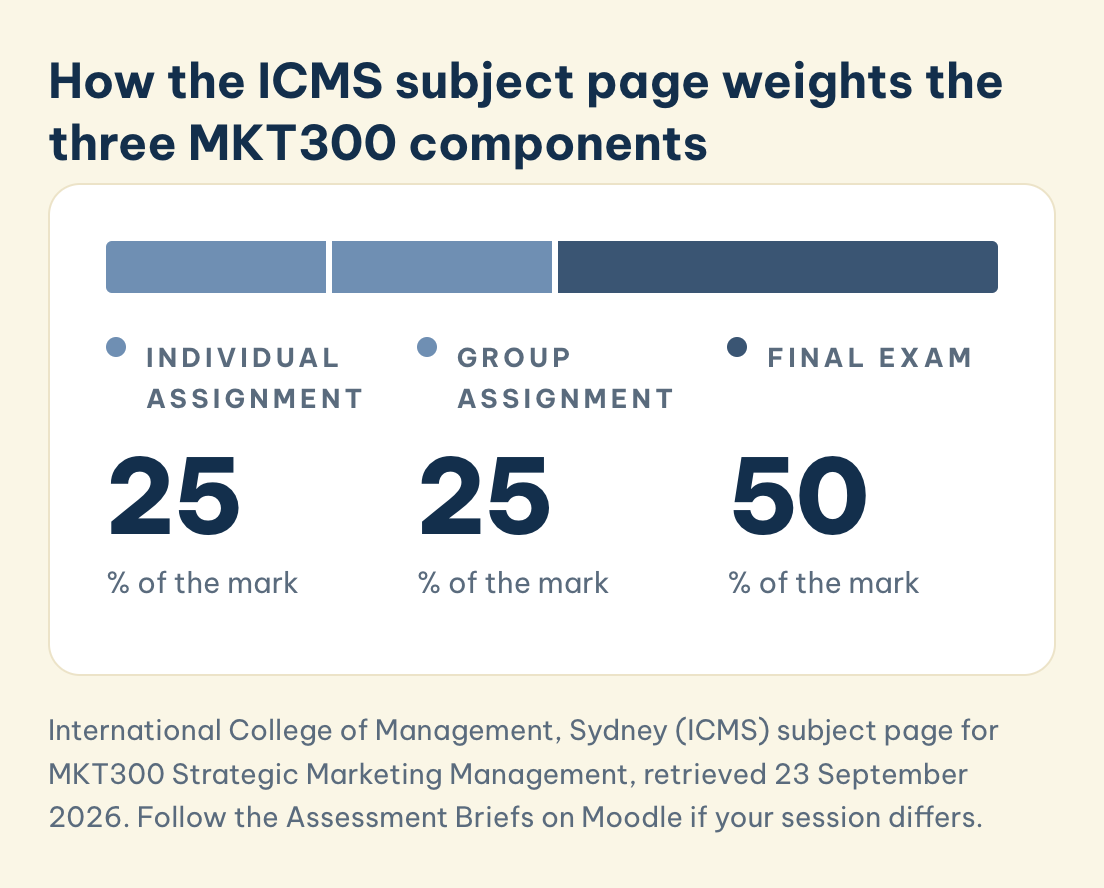
Evidence: The ICMS subject page lists the weightings and the outcomes each task covers. It also states that exams take place in weeks 12 and 13 and that full instructions sit in the Assessment Briefs on Moodle, which is the document to follow if anything here differs from your session.
| Task | Weighting | Learning outcomes it covers | What that mapping tells you |
|---|---|---|---|
| Individual assignment | 25% | 1, 2, 3 | Concepts, situation analysis, growth strategy choice |
| Group assignment | 25% | 1, 3, 4, 5 | Strategy development, including mature and declining markets |
| Final exam | 50% | 1, 2, 3, 4, 5, 6 | Everything, and the only task that carries outcome 6 on marketing law |
Example: Picture a student who revises Ansoff, SWOT and the marketing mix for a week and never opens the law material, because neither assignment needed it. Half the subject's weighting sits in the one task that tests outcome 6. The first question worth asking before revision starts is simply which outcome each exam topic belongs to.
◆ Section 3 / 8 · Situation analysis
How do you build a situation analysis the strategy actually uses?
Direct answer: Treat the situation analysis as a filter, not a survey. Every framework you run should end in a finding, and the findings should narrow to two or three strategic priorities that the rest of the report answers. If a finding never reappears in the strategy section, it was decoration.
Evidence: Outcome 2 asks you to "Research and critically evaluate a current business's situation analysis, in a changing marketing environment." Evaluate is the working verb. Morgan et al. (2019), reviewing marketing strategy research across the six most influential marketing journals from 1999 to 2017, treat marketing strategy as the construct at the centre of strategic marketing, which is why an evaluation should judge the firm's choices rather than list its circumstances.
Example: A typical weak draft runs PESTEL, Porter's five forces and SWOT at length and then recommends market development without citing any of them. A useful test is to write one sentence under each framework beginning "This means the firm should" and to delete any framework that cannot finish the sentence. What survives is what the strategy section can stand on.
◆ Section 4 / 8 · Mature and declining markets
Which growth options fit a mature or declining market?
Direct answer: Outcome 5 asks for strategy in mature and declining markets, where the usual growth grid is only half the answer. Ansoff's four directions assume demand is there to capture. When demand is falling, the real choice is how to play the end game: lead the shrinking industry, defend a niche, harvest cash or divest early.
Evidence: Ansoff (1957) set out product-market growth as four directions: market penetration, market development, product development and diversification. Harrigan and Porter (1983), studying 61 companies in eight declining industries, identified four end-game strategies and argued that the right one depends on the structure of the declining industry and the firm's own strength in it.
| End-game strategy | What the firm does | When it tends to fit |
|---|---|---|
| Leadership | Stays and aims to be one of the few remaining firms | Favourable industry structure, strong relative position |
| Niche | Defends a segment where demand holds up | Pockets of stable demand, strength in that pocket |
| Harvest | Cuts investment and takes cash from the business | Weaker position, demand declining predictably |
| Quick divestment | Sells early while the business still has value | Weak position, uncertain decline, buyers still exist |
Example: Suppose a group takes a DVD rental chain as its case and writes a market development plan into new suburbs. The plan may be tidy, but the first question is what demand in those suburbs will look like in a few years. On most evidence the defensible answer is a niche strategy aimed at collectors, which is exactly the kind of reasoning outcome 5 is built to reward.
◆ Section 5 / 8 · Marketing law
Where does Australian marketing law enter the strategy?
Direct answer: Inside each decision, not in a closing compliance paragraph. Pricing claims, comparative advertising, brand names, email campaigns and aggressive competitive moves each raise a specific legal question. Name the provision next to the tactic it constrains, and show how the tactic changes because of it.
Evidence: Outcome 6 asks you to demonstrate "a solid understanding of basic marketing law, in particular, IP, unfair selling practices and the misuse of competitive powers, when developing marketing strategy." The last four words matter. The law is meant to shape the strategy while it is being developed.
| Strategy decision | Legal question | Where to look |
|---|---|---|
| Headline price or "from" claims | Is the overall impression misleading? | Australian Consumer Law, s 18 and s 29 |
| Comparative or superiority claims | Can the claim be substantiated? | Australian Consumer Law, s 29 |
| New brand name or logo | Does it infringe a registered mark? | Trade Marks Act 1995 |
| Email or SMS campaign | Consent, sender identification, unsubscribe | Spam Act 2003 |
| Using customer data for promotion | Rules on direct marketing | Privacy Act 1988, Australian Privacy Principle 7 |
| Pricing or supply moves by a dominant firm | Does it substantially lessen competition? | Competition and Consumer Act 2010, s 46 |
The Australian Consumer Law sits in Schedule 2 of the Competition and Consumer Act 2010. The ACCC explains that having market power is lawful, and so is using it to out-compete rivals through better products or promotions. What s 46 prohibits is conduct by a firm with substantial market power that has "the purpose, effect or likely effect of substantially lessening competition."
Example: A recommendation that a market leader price below cost for a sustained period to push a new entrant out can be commercially coherent and legally careless at the same time. A stronger answer reads the ACCC's description of predatory pricing, rewrites the move as a sustainable efficiency-based price cut, and explains briefly why the original version would have exposed the client.
◆ Section 6 / 8 · The TPG case
What does the TPG case teach about headline claims?
Direct answer: That the fine print does not rescue a misleading headline. When most consumers only take in the dominant message of an advertisement, qualifications in smaller type or quick voiceover may not be enough to correct it. Any promotional tactic in your strategy should be tested against the impression it creates, not only against its literal words.
Evidence: In ACCC v TPG Internet, decided by the High Court of Australia on 12 December 2013, TPG's advertisements carried the dominant message "Unlimited ADSL2+ for $29.99 per month", as the trial judge found, while the offer also required a bundled home telephone line at $30 per month and a setup fee of $129.95. The trial judge imposed penalties of $2 million, the Full Court of the Federal Court reduced them to $50,000, and the High Court held at paragraph 8 that the Full Court had erred and that the $2 million penalty "should be restored". The High Court noted the Full Court's own acceptance that "many persons will only absorb the general thrust" of an advertisement.
Example: Take a promotion plan built on a "from $9" subscription headline with the real minimum monthly cost in a footnote. Applying the TPG reasoning means asking what a reader who only absorbs the headline would believe, and moving the minimum cost into the headline if the answer is wrong.
◆ Section 7 / 8 · Penalties
How much is at stake if a strategy breaks the law?
Direct answer: Enough that a strategy report should treat compliance as a financial risk, not a formality. For contraventions on or after 28 March 2026, the maximum penalty for a corporation under many provisions is the greater of $100,000,000 and either three times the benefit obtained or, if that cannot be valued, 30% of adjusted turnover.
Evidence: The ACCC's fines and penalties page sets out that test, the greater of $100,000,000 and either three times the reasonably attributable benefit or, where the court cannot determine that benefit, 30% of adjusted turnover during the breach period, for conduct on or after 28 March 2026 and for many breaches of the Competition and Consumer Act 2010 and the Australian Consumer Law, including Part IV conduct such as misuse of market power. It also notes that the value of a penalty unit rose from $330 to $364 on 1 July 2026, and that conduct before those dates is assessed under the penalties that applied at the time. Only a court sets the actual penalty.
Example: A risk section that lists "legal risk: medium" and nothing else leaves the marker to guess. Quantifying it against this test for the chosen firm's turnover turns one line into an argument, and a recommendation to drop an aggressive comparative claim then needs little further defence.
◆ Section 8 / 8 · Order of work
A practical order of work
Direct answer: Start from the learning outcomes your task maps to, run only the frameworks that produce findings, turn the findings into two or three priorities, choose the growth or end-game strategy that answers them, then test every tactic against the law before you write the control section. Legal risks then become monitoring items with owners.
Evidence: This order follows the outcome sequence on the ICMS page, from understanding and situation analysis through growth strategy, strategy development, mature and declining markets and finally marketing law. Working through it in that order means outcome 6 shapes the tactics rather than arriving as an appendix, and avoids a common structural weakness: a strong strategy followed by a compliance section that could have been attached to any report.
Example: A simple drafting habit helps: keep a two-column table while you write, tactic on the left and the legal question it raises on the right. By the conclusion, the compliance discussion is already written and spread through the strategy where it belongs.
Frequently asked questions
Which institution offers MKT300 Strategic Marketing Management?
The International College of Management, Sydney (ICMS), where it is available within the undergraduate degrees according to its subject page. Arizona State University and several other US institutions use the same code for different subjects, so confirm the title on your enrolment.
How is MKT300 weighted?
The ICMS subject page lists an individual assignment at 25%, a group assignment at 25% and a final exam at 50%, with exams in weeks 12 and 13. Follow the Assessment Briefs on Moodle if your session differs.
Do I need to know Australian law in detail?
You need a working understanding, not a lawyer's. Outcome 6 asks for basic marketing law, in particular intellectual property, unfair selling practices and misuse of competitive power, applied while developing strategy. Name the provision, explain the constraint and show how the tactic changes.
Is Ansoff enough for the growth strategy?
Not for outcome 5. Ansoff's matrix assumes demand exists to capture, while mature and declining markets call for end-game choices such as leadership, niche, harvest or divestment, as Harrigan and Porter set out in 1983.
Can I use a well-known Australian brand as my case?
Usually yes, if your brief allows it, and a real firm makes the legal analysis far more concrete. Use only public sources, and cite ACCC decisions or court judgments where they bear directly on your chosen firm or industry.
Does MAAS write the MKT300 assignment for me?
No. MAAS mentors give developmental feedback on your own outline and drafts through the Outline, Draft, Final model. The analysis, the strategy and the submission remain yours.
Related reading
- MKTG3003 Marketing Strategy: the same discipline at Macquarie, where an impromptu oral task changes what is assessed
- MKTG3114 New Products Marketing: the product development cell of Ansoff's matrix, taken in depth
- MKTG3120 Building and Managing Brands: useful background for the intellectual property side of outcome 6
Where MAAS fits
- Coursework and assignment support: developmental feedback on your own draft through the Outline, Draft, Final model with a discipline-matched expert
- Subject tutoring, one to one: 60 or 90 minute sessions with a tutor matched to your subject area. Tutoring is advisory, so it carries no grade target; if the tutor is not the right fit, you can ask to change expert
- Course-code assignment coaching: how MAAS mentors approach any unit assignment
References
- Ansoff, H. I. (1957). Strategies for diversification. Harvard Business Review, 35(5), 113–124.
- Harrigan, K. R., & Porter, M. E. (1983). End-game strategies for declining industries. Harvard Business Review, 61(4), 111–120.
- Morgan, N. A., Whitler, K. A., Feng, H., & Chari, S. (2019). Research in marketing strategy. Journal of the Academy of Marketing Science, 47(1), 4–29. https://doi.org/10.1007/s11747-018-0598-1
- Varadarajan, R. (2010). Strategic marketing and marketing strategy: Domain, definition, fundamental issues and foundational premises. Journal of the Academy of Marketing Science, 38(2), 119–140. https://doi.org/10.1007/s11747-009-0176-7
Tools & resources
- Australian Competition and Consumer Commission. (n.d.). Fines and penalties. Retrieved September 23, 2026, from https://www.accc.gov.au/business/compliance-and-enforcement/fines-and-penalties
- Australian Competition and Consumer Commission. (2026). Misuse of market power. Retrieved September 23, 2026, from https://www.accc.gov.au/business/competition-and-exemptions/misuse-of-market-power
- High Court of Australia. (2013). Australian Competition and Consumer Commission v TPG Internet Pty Ltd [2013] HCA 54. https://www.hcourt.gov.au/cases-and-judgments/judgments/judgments-1998-current/australian-competition-and-consumer-commission-v-tpg-internet-pty-ltd
- International College of Management, Sydney. (n.d.). Strategic marketing management (MKT300). Retrieved September 23, 2026, from https://www.icms.edu.au/courses/undergraduate/strategic-marketing-management/
This article is part of the MAAS Journal series for Vietnamese international students. MAAS Assignment & Essay Support is an academic support partner; we coach students through the Outline, Draft, Final delivery model with developmental feedback from discipline-matched experts. We do not write or submit work on a student's behalf.
A free 20-minute consultation is a conversation about where you are with MKT300.
Book a free consultation ▸