
◆ Business & Management
BUSI1271 Global Strategy: which four attributes should you assess?
BUSI1271 Global Strategy: Analysis and Practice is a Level 7 module, and two details in its assessment reshape how you should approach it. The pass mark rises to 50, not the 40 you met at undergraduate level. It asks you to assess four attributes of a chosen company, each with your own analytical review, inside a 3,000-word limit that leaves roughly 750 words per attribute and makes scope discipline the central skill.

◆ Question 1 / 7 · The module
What is BUSI1271 Global Strategy about?
Direct answer: BUSI1271 is a Level 7 module worth 15 credits in the Business, Operations and Strategy department at Greenwich Business School, introducing strategic management with emphasis on responses to globalisation. Johnson et al. (2020) define strategy as an organisation's long-term direction, and the module treats strategic management as the analyses, decisions and actions that create and sustain competitive advantage.
Evidence: The module's published aims argue that durable economic and organisational principles provide a secure foundation both for studying how firms compete and for making good strategic decisions. That is a deliberate signal about evidence: the module wants you reasoning from established theory, not from commentary about what a company did last quarter.
Example: A Vietnamese student on a Greenwich master's programme came to MAAS with a draft built almost entirely from recent news articles about her chosen company. Her mentor asked which theoretical claim each news item was evidence for. She could not answer for most of them. The material was current and accurate, but at Level 7 currency is not the same as analysis.
◆ Question 2 / 7 · Assessment
What assessment does BUSI1271 involve?
Direct answer: One report worth 100% of the module, 3,000 words maximum with a 10% tolerance, assessed against learning outcomes 1 to 4. The pass mark is 50. The published task requires you to assess four attributes of the chosen company, providing your own understanding and analytical review of the conclusions reached. Confirm which four attributes your cohort's brief specifies, along with the deadline, in your own module handbook, since briefs are reissued each academic year.
Evidence: Two features of this design deserve attention. First, the word limit is a maximum rather than a target, so there is no reward for filling space. Second, the phrase "their own understanding and analytical review of the conclusions reached" asks for a second-order judgement: not just conclusions, but your assessment of how sound those conclusions are. Students routinely deliver the first and omit the second.
Example: A student submitted a draft that analysed his company competently and stopped. His mentor pointed at the brief's final clause and asked how confident he was in each conclusion, and on what evidence. Adding a short critical paragraph after each attribute, stating what would need to be true for the conclusion to hold, addressed a requirement his draft had simply not noticed.
◆ Question 3 / 7 · Marking
How is BUSI1271 graded, what does the marking reward?
Direct answer: Learning outcomes 1 to 4 carry the assessment: understanding strategic direction, decisions and delivery; understanding how globalisation affects the strategy of international firms; conducting research and applying analytical concepts and frameworks to real-world strategy choices; and enhancing critical and analytical skills to formally analyse and assess the extent to which firms achieve strategic success. Outcome 4 contains the phrase that decides your band, the extent to which firms achieve strategic success. That is a question of degree, and answering it requires a standard.
Evidence: At Level 7 the pass mark rises to 50, which reflects an expectation of critical engagement rather than competent reproduction. Outcome 3 asks you to apply frameworks to real-world strategy choices, and outcome 4 asks you to assess success against them. Together they describe a movement from framework to judgement that a purely descriptive report never makes.
Example: A MAAS mentor asked a student what "strategic success" meant in her report. She said the company was profitable. He asked whether profitability proved the strategy worked, or whether the firm was profitable despite it, given the industry was buoyant. Defining success explicitly, and against a comparator, turned an assertion into an assessable judgement.
◆ Question 4 / 7 · Frameworks
Which frameworks should you use in BUSI1271?
Direct answer: The module's indicative content maps a clear sequence: industry analysis, internal analysis covering CSR and innovation, external analysis covering foreign direct investment and global collaboration, then strategic positioning, corporate strategies including diversification and international growth, then organisational structure. Choose frameworks that sit on that path rather than importing models the module never taught.
| Framework | The question it answers | Where it fits the module |
|---|---|---|
| Porter's (1980) five forces | Is this industry structurally attractive? | Industry and its strategy, early in the module |
| Resource-based view (Barney) | Which internal resources are genuinely hard to imitate? | Internal environmental analysis |
| Bartlett and Ghoshal's integration-responsiveness | Should the firm standardise globally or adapt locally? | Strategies for international growth |
| Corporate parenting and diversification logic | Does the group add value to its businesses? | Managing a group of businesses |
Evidence: Barney's (1991) resource-based view appeared across pages 99 to 120 of Journal of Management, volume 17. Porter (1980) built the five forces model around a single question, how much of an industry's potential profit gets competed away by rivalry, buyer power, supplier power, new entrants and substitutes, which is why the module places it early: it sets the competitive baseline before you diagnose why one firm does better than that baseline predicts. Barney (1991) set out four empirical indicators for whether a resource can sustain competitive advantage, value, rareness, imitability and substitutability, which gives you a disciplined test rather than a list of company strengths: "resources are valuable when they enable a firm to conceive of or implement strategies that improve its efficiency and effectiveness" (Barney, 1991, p. 106). Bartlett and Ghoshal (1989) formalised the tension between global integration and local responsiveness into four strategy types, international, multinational, global and transnational, which is directly relevant to a module built around globalisation's effect on strategy.
Example: A student listed her company's "strong brand, skilled staff and good technology" as sources of competitive advantage. Her mentor ran each through Barney's four tests. Skilled staff failed on imitability, since competitors hired from the same pool. Applying the test rather than the label removed two of her three claimed advantages and made the surviving one far more convincing.
◆ Question 5 / 7 · Report structure
How should you structure the 3,000-word report?
Direct answer: Let the four attributes give you your structure. A workable allocation: a short introduction naming the company and the four attributes you will assess, around 250 words; then roughly 600 words on each attribute, each ending with your critical review of how firm that conclusion is; then a conclusion that synthesises across the four and answers the extent-of-success question, around 350 words. Company background belongs in one paragraph, not one section.
Evidence: The brief names four attributes and one overall analytical review. A structure that mirrors the brief makes it straightforward for a marker to locate evidence against each outcome, and at a 3,000-word maximum it also protects you from the commonest failure at this level, which is spending 900 words on the first attribute and 300 on the fourth.
Example: A student's draft gave the first attribute a rich, well-referenced 1,100 words and the last two attributes a paragraph each, because he had written in order and run out of room. His mentor had him draft the fourth attribute first the next time. The imbalance disappeared, and the weakest section in the original became one of the strongest.
◆ Question 6 / 7 · Common mistakes
What are the most common mistakes that lose marks in BUSI1271?
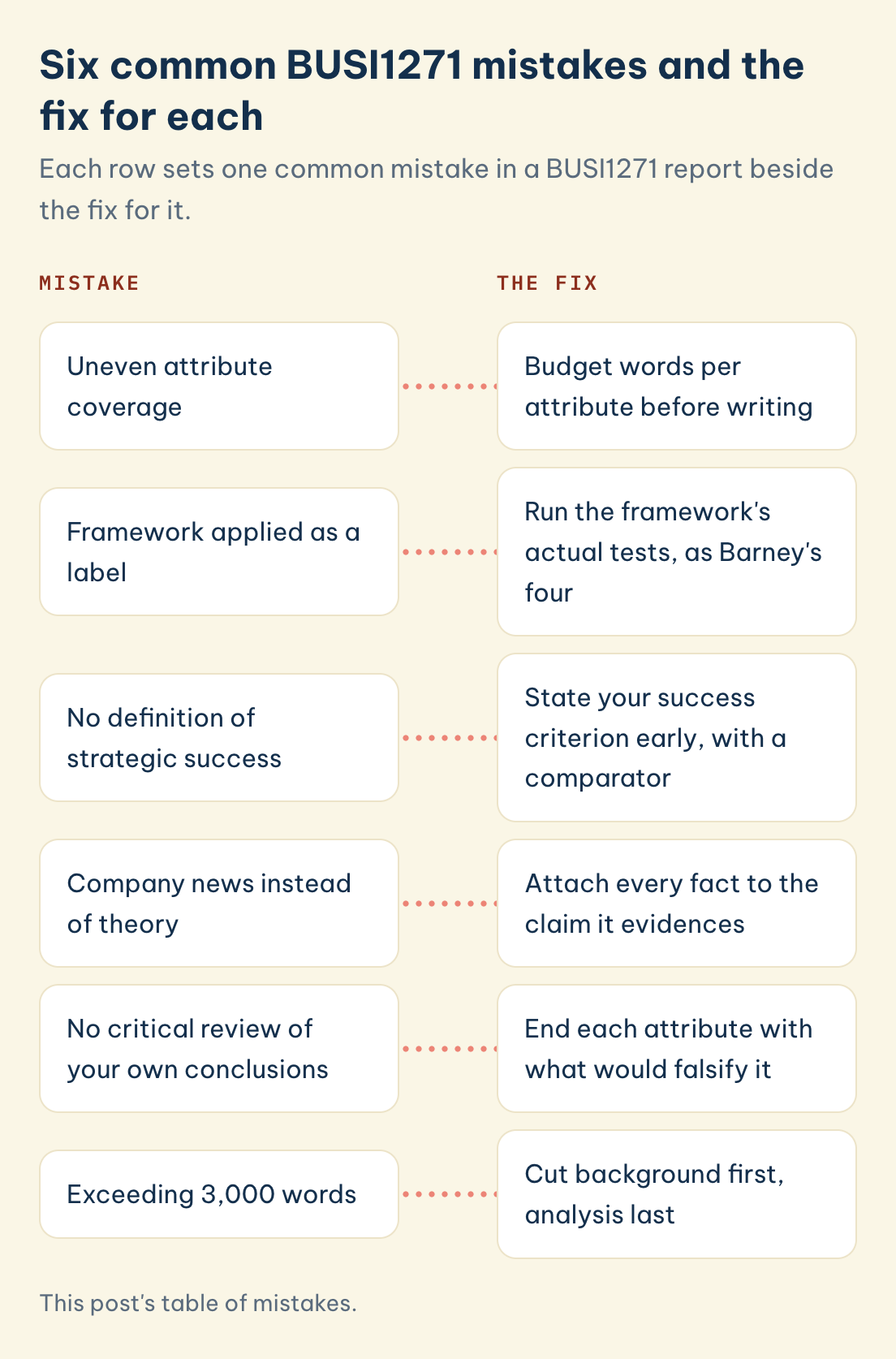
Direct answer: Level 7 strategy reports lose marks in a fairly narrow set of places.
Six common BUSI1271 mistakes and the fix for each
Each row sets one common mistake in a BUSI1271 report beside the fix for it.
Mistake
The fix
Uneven attribute coverage
Budget words per attribute before writing
Framework applied as a label
Run the framework's actual tests, as Barney's four
No definition of strategic success
State your success criterion early, with a comparator
Company news instead of theory
Attach every fact to the claim it evidences
No critical review of your own conclusions
End each attribute with what would falsify it
Exceeding 3,000 words
Cut background first, analysis last
Save this figure
| Mistake | Why it costs marks | The fix |
|---|---|---|
| Uneven attribute coverage | The brief weights them equally | Budget words per attribute before writing |
| Framework applied as a label | Outcome 3 asks for application, not naming | Run the framework's actual tests, as Barney's four |
| No definition of strategic success | Outcome 4 asks about extent, which needs a standard | State your success criterion early, with a comparator |
| Company news instead of theory | Level 7 expects theoretical grounding | Attach every fact to the claim it evidences |
| No critical review of your own conclusions | The brief asks for it explicitly | End each attribute with what would falsify it |
| Exceeding 3,000 words | It is a maximum, not a target | Cut background first, analysis last |
Evidence: The step from Level 6 to Level 7 is less about volume of knowledge than about the expectation that you will interrogate your own reasoning. A report that reaches confident conclusions without examining their fragility reads as undergraduate work at postgraduate length.
Example: One student concluded that her company's international expansion strategy was successful. Her mentor asked what evidence would have made her conclude the opposite. She realised she had never looked for it, only for support. Adding one paragraph on the contrary evidence, and explaining why she still found her conclusion stronger, changed the register of the whole report.
◆ Question 7 / 7 · Teamwork
How does teamwork fit in when the assessment is an individual report?
Direct answer: Learning outcome 5 asks you to work effectively in teams, but the summative assessment is an individual report covering outcomes 1 to 4. Teamwork is developed through the weekly two-hour tutorials, which are case-study based. Treat those case discussions as rehearsal: they are where you can test an interpretation against people who read the same case differently, at no cost to your mark.
Evidence: The module runs 1 hour of lecture and 2 hours of tutorial across 12 weeks, with 114 hours of self-directed learning. That ratio, tutorials at twice the lecture time, and the indicative content listing a case study alongside almost every lecture, tells you the case discussion is the module's core learning mechanism rather than an optional extra. The arithmetic also checks out against the sector-wide credit convention: 1 credit is typically defined as 10 notional hours of learning, so a 15 credit module should total around 150 hours, and 36 hours of scheduled teaching plus 114 hours of self-directed work adds up to exactly that (Quality Assurance Agency for Higher Education, 2021).
Example: A student who attended lectures but skipped tutorials arrived at the report with a technically correct framework application and no sense of which interpretations were contestable. A classmate who had argued weekly over cases wrote with far more awareness of alternative readings, and that awareness is precisely what outcome 4 rewards.
Frequently asked questions
Why is the pass mark 50 and not 40?
Because this is a Level 7 postgraduate module. The higher threshold reflects the expectation that you engage critically with theory rather than reproduce it accurately, which is what a Level 4 or 5 pass mark accommodates.
Which four attributes should I assess?
Your cohort's brief specifies them, so check your module handbook rather than assuming. What generalises is the discipline: whatever the four are, budget your words evenly and give each one a critical review.
Can I choose any company?
Usually within the brief's constraints. Choose one whose international strategy has been genuinely tested, by an entry that struggled, a retreat from a market, or a structural reorganisation. A company where nothing has gone wrong gives you little to assess.
Is 3,000 words a target or a limit?
The published brief states a 3,000-word maximum with 10% tolerance. Writing to 2,800 well-used words is safer than writing to 3,300.
Can MAAS help me with BUSI1271?
MAAS mentors work with you on choosing a company, defining what strategic success would mean for it, and testing whether your framework application survives scrutiny. You remain the author of your report; a mentor stress-tests the reasoning before an examiner has to.
Choosing what "success" will mean
The reports that do well here rarely stand out for covering the most frameworks. What they share is that they that define what success would look like, apply a small number of frameworks properly, distribute attention evenly across the four attributes, and then turn a critical eye on their own conclusions. If you have chosen your company but cannot yet see the standard you are judging it against, a MAAS mentor can work through it with you before you write.
Talk to a MAAS mentor about your module
Related guides
References
- Barney, J. (1991). Firm resources and sustained competitive advantage. Journal of Management, 17(1), 99–120. https://doi.org/10.1177/014920639101700108
- Bartlett, C. A., & Ghoshal, S. (1989). Managing across borders: The transnational solution. Harvard Business School Press.
- Johnson, G., Whittington, R., Regnér, P., Angwin, D., & Scholes, K. (2020). Exploring strategy: Text and cases (12th ed.). Pearson.
- Porter, M. E. (1980). Competitive strategy: Techniques for analyzing industries and competitors. Free Press.
- Quality Assurance Agency for Higher Education. (2021). Higher education credit framework for England: Advice on academic credit arrangements (2nd ed.). Retrieved August 21, 2026, from https://www.qaa.ac.uk/docs/qaa/quality-code/higher-education-credit-framework-for-england.pdf
Tools & resources
- University of Greenwich. (n.d.). Module information [Module catalogue entry]. Retrieved July 29, 2026, from https://www.gre.ac.uk/modules/modules?crse=1271&subj=BUSI&term=205000
- University of Greenwich. (n.d.). Academic skills. Retrieved July 29, 2026, from https://www.gre.ac.uk/students/support/academic-skills
This article is part of the MAAS Journal series for Vietnamese international students. MAAS Assignment & Essay Support is an academic support partner; we coach students through the Outline, Draft, Final delivery model with developmental feedback from discipline-matched experts. We do not write or submit work on a student's behalf.
A free 20-minute consultation is a conversation about where you are with BUSI1271.
Book a free consultation ▸