
AC7024 Dissertation Project sits at the centre of Northumbria's Master of Public Health, and unlike some masters dissertations it does not hand students a single template. The decision between the two available structures is not a formality, because it shapes everything that follows: timeline, ethics paperwork, risk profile, and the skills a graduate can point to afterwards. This guide answers the questions Vietnamese MPH students bring to MAAS mentors while that choice is still open.
Author: MAAS Editorial Team
Last updated: 2026-08-06
Category: health-education

What is AC7024 and how does it differ from a business dissertation?
Direct answer: AC7024 Dissertation Project is a core 60 credit module, meaning every MPH student takes it. Northumbria runs it across the Master of Public Health and its variants, including the Palliative and End-of-Life Care route and the Kaplan Singapore delivery. You may structure it as a systematic review or as empirical research.
Northumbria itself gained university status in 1992, under the same wave of legislation that converted a number of former polytechnics, and its MPH sits within a Faculty of Health and Life Sciences built on that comparatively recent foundation.
Evidence: The published module description lists what the module revisits with you: worldviews and research paradigms, research design, working with literature and theory, developing ethical codes, collecting robust research evidence, quality assurance within your research work, and writing and disseminating the dissertation. It also confirms two support structures, a series of research seminars and a named supervisor for one to one supervision.
Public health as a defined discipline is itself younger than most students expect, the World Health Organization was founded in 1948 and its constitution is what fixed the field's now-standard definition of health as more than the absence of disease, and a dissertation that never engages that broader definition often reads as a narrower clinical project wearing a public health label.
Example: A Vietnamese MPH student told her MAAS mentor she had "already decided to do interviews" in week two, before she had a research question. Her mentor asked what the question was. She did not have one yet. Method had come before question, which is the wrong order, and it took her 3 weeks to unwind that decision after she found the participants she needed were unreachable.
Which route should you choose, systematic review or empirical research?
Direct answer: Choose a systematic review if your question is about what the existing evidence shows, if your access to participants is uncertain, or if you want a transferable skill that public health employers recognise immediately. Choose empirical research if your question cannot be answered from published studies, if you have realistic access to data or participants, and if you have enough runway for ethics approval before collection begins.
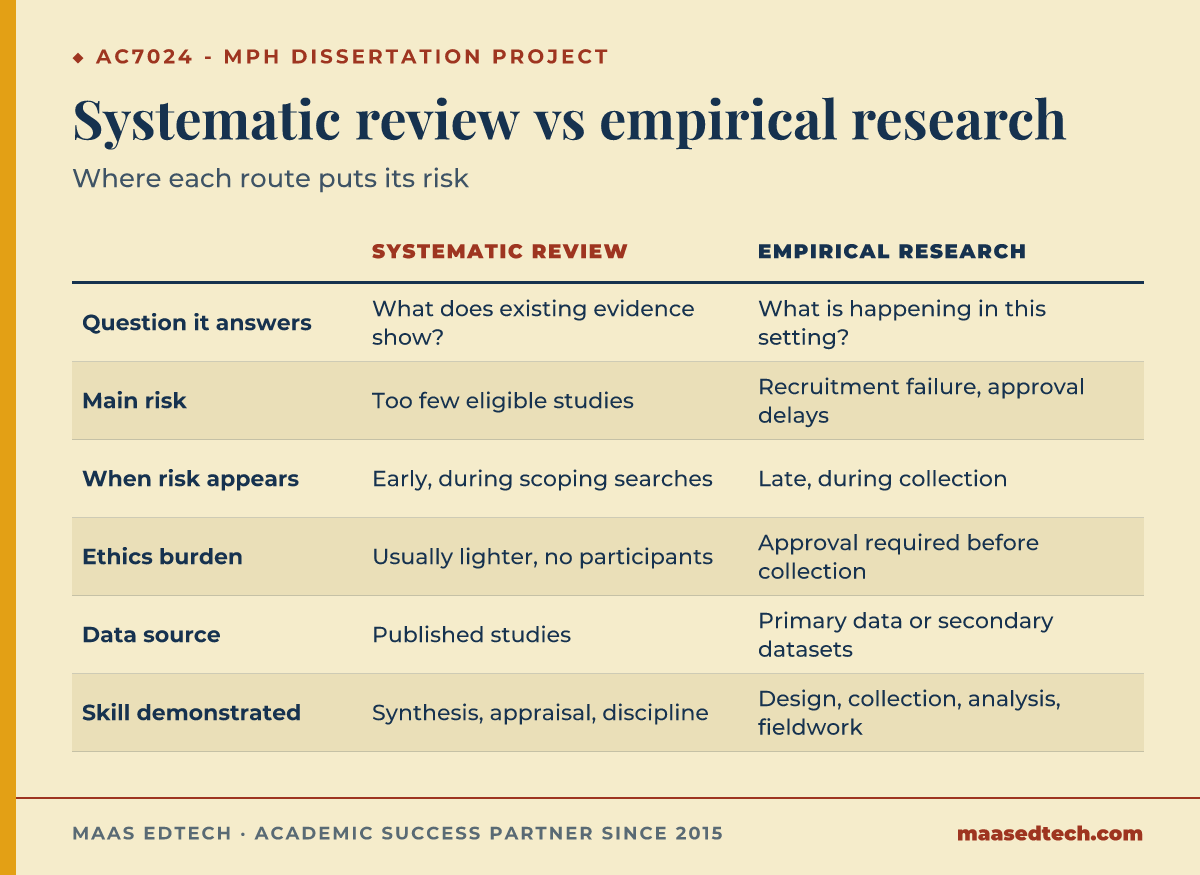
Evidence: The two routes carry different risks in different places. A systematic review front-loads its risk: if the search returns too few eligible studies, you discover this early and can adjust the question. Empirical research back-loads its risk: recruitment failure or delayed approval surfaces late, when there is little time to change course. Reid-Hector et al. (2021) found that graduate completion slows specifically at the dissertation phase rather than during taught modules, which is exactly where a late failure hurts most.
| Systematic review | Empirical research | |
|---|---|---|
| Question it answers | What does existing evidence show? | What is happening in this specific setting? |
| Main risk | Too few eligible studies | Recruitment failure, late ethics approval |
| When risk appears | Early, during scoping searches | Late, during collection |
| Ethics burden | Usually lighter, no human participants | Approval required before any collection |
| Data source | Published studies | Primary data, or existing secondary datasets |
| Skill demonstrated | Evidence synthesis, appraisal, protocol discipline | Design, collection, analysis, fieldwork judgement |
Example: Two MAAS mentees started AC7024 the same month. One chose a systematic review on smoking cessation interventions; the other planned interviews with community health workers. The reviewer hit a problem in week three, only nine eligible studies, and widened her inclusion criteria with her supervisor's agreement. The interviewer hit her problem in week eleven, when only four of twenty invited participants responded. Same size problem, very different amounts of time left to solve it.
What does "systematic" actually require of you?
Direct answer: A systematic review is not a longer literature review. It is a review conducted to a protocol written before you start, with a specified search strategy across named databases, explicit inclusion and exclusion criteria, a documented screening process, structured quality appraisal of included studies, and transparent reporting of how many records were found, screened, excluded and why.
Evidence: The reporting expectations here are codified. The PRISMA 2020 statement (Page et al., 2021) sets out the items reviewers are expected to report, including the flow of records through identification, screening and inclusion, and its checklist runs to 27 items across 7 sections, from the title page to the funding statement. Page et al. state that "the PRISMA 2020 statement replaces the 2009 statement and includes new reporting guidance that reflects advances in methods to identify, select, appraise, and synthesise studies" (Page et al., 2021). The Cochrane Handbook (Higgins et al., 2019) sets out the same expectation from the methods side rather than the reporting side, covering how the protocol, search and appraisal should actually be run before there is anything to report. If your question is genuinely broad and the aim is mapping the field rather than answering it, the relevant extension is PRISMA-ScR for scoping reviews, published in 2018, rather than the standard systematic review checklist, and naming the wrong variant on the title page is one of the fastest ways to signal that the method was chosen after the writing started rather than before it. PRISMA itself is now on its second major version, the original 2009 statement gave way to the 2020 update already cited above, and a search strategy or a reference list built against the older checklist will visibly miss items a current marker is trained to look for. Markers in public health recognise this structure immediately, which cuts both ways: the framework makes a good review easy to follow, and it makes an incomplete one easy to spot.
Example: A student's first draft described her search as "I searched PubMed and Google Scholar for relevant articles". Her MAAS mentor pointed out that no reader could reproduce that. The rewritten version named the databases, gave the exact search string with Boolean operators, stated the date range, and reported that 412 records were identified and 14 retained. The evidence had not changed at all; the review had become checkable.
What does the ethics requirement mean in practice for AC7024?
Direct answer: If your empirical route involves human participants, including interviews, focus groups and surveys, you need faculty ethics approval before you collect anything. Approval is not a formality you attach afterwards. Data collected before approval may not be usable, which can force a redesign at the worst possible point in the timeline.
Evidence: The module description explicitly includes "developing ethical codes" among the topics it revisits with you, which signals that ethics is treated as part of the research design rather than as administrative overhead. In public health this matters more than in most disciplines, because research populations often include people who are unwell, bereaved or otherwise vulnerable, and the approval process scales with that sensitivity. Where a project touches NHS patients or NHS data, university approval alone is not enough, the Health Research Authority, established in 2011 to streamline UK health and social care research approvals, has its own separate process that runs on its own timeline. The underlying principles both bodies apply trace back to the Declaration of Helsinki, first adopted by the World Medical Association in 1964 and revised repeatedly since, which is why informed consent and the protection of vulnerable participants are non-negotiable rather than optional extras a busy student can defer.
Example: A student on the palliative care route planned to interview bereaved family members. Her MAAS mentor flagged early that this population would attract a longer ethics review than she had budgeted for. She kept the topic but moved to interviewing the professionals who supported those families, which answered a closely related question and cleared approval in a fraction of the time.
Can secondary data give you a full empirical dissertation?
Direct answer: Yes. The module description explicitly allows empirical research "based on primary data analysis or secondary sources". For public health this route is often underrated, because large, well-documented datasets are publicly available and the analysis you perform on them is genuinely your own work.
Evidence: Secondary analysis removes the recruitment risk that sinks many empirical dissertations while keeping the analytical demand intact. The intellectual work moves from collecting data to framing a question the existing data can answer, choosing appropriate variables, and being honest about what the dataset cannot tell you. That last part, the limitations discussion, is assessed rather than optional.
Example: A Vietnamese MPH student wanted to study maternal health service use but had no route to patient contact. She built her dissertation on a publicly available national survey dataset instead. She never recruited a single participant and still produced a fully empirical study, because the analysis, the variable selection and the interpretation were all hers.
How should you use your named supervisor?
Direct answer: Treat supervision as a resource you manage rather than a service you receive. Send shorter extracts with specific questions attached, agree what "ready for feedback" means early, and bring a decision to each meeting rather than a status update.
Evidence: Supervision quality is a measurable predictor of postgraduate progression. Malunda et al. (2021) found that the supervisor and supervisee relationship, supervisor guidance and the promptness of feedback were all significant antecedents of graduate student progression. Neupane Bastola and Hu (2021), analysing supervisory comments on 97 masters thesis drafts, found feedback often failed to match student expectations, particularly for students writing in English as an additional language.
Example: A student sent her supervisor an entire methods chapter and received two lines back. Her MAAS mentor suggested a different approach: a 1-page extract with the question "is my inclusion criteria too narrow, given I retained only 14 studies?" attached at the top. The reply came within days and was substantive, because it had something specific to answer.
For general dissertation planning that applies across both routes, see how to plan a dissertation timeline and dissertation chapter word count breakdown. If you are still narrowing the question itself, choosing a dissertation topic with enough literature covers the scoping search that should precede either route.
What are the most common mistakes in AC7024 dissertations?
Direct answer: Four recur. Choosing the method before the question. Writing a narrative review and calling it systematic. Starting recruitment before ethics approval. And treating limitations as a confession at the end rather than as part of the analysis.
Evidence: The method-before-question error is the most expensive because it is the hardest to reverse. By the time a student discovers that their chosen method cannot answer their question, they have usually invested weeks in it. The systematic review label is the second most costly, because a marker who expects a protocol, a documented search and a screening flow will notice their absence immediately.
Example: A MAAS mentee submitted a draft titled "A systematic review of..." that contained no search strategy, no inclusion criteria and no record counts. Her mentor gave her two honest options: rebuild it as a genuine systematic review, or retitle it accurately as a critical narrative review. She chose to rebuild, and the search she then ran surfaced six studies she had missed entirely.
Frequently asked questions
Is AC7024 compulsory on the Northumbria MPH?
Yes. Northumbria lists AC7024 Dissertation Project as a core 60 credit module across the Master of Public Health and its variants. Confirm the structure of your own route in your programme handbook, since delivery differs between campuses and partners.
Can I switch from empirical research to a systematic review partway through?
It is sometimes possible, but it becomes harder the later you leave it, since a systematic review needs its protocol and search strategy defined before screening begins. Raise any doubt with your supervisor early rather than waiting to see whether recruitment improves.
Do I need ethics approval for a systematic review?
Reviews of already published studies usually carry a lighter ethics burden because they involve no human participants, but you should still confirm your faculty's requirements. Never assume, because process differs by faculty and by project.
Is secondary data analysis considered less rigorous?
No. The module description explicitly permits empirical research based on secondary sources. Rigour is judged on how well the question, the dataset and the analysis fit together, not on whether you collected the data yourself.
Can I write my AC7024 dissertation about Vietnam?
Yes, and a Vietnamese context can strengthen the work by giving you access and background knowledge others lack. The requirements are that your evidence base is current and your method is defensible, not that your setting is in the UK.
Ready to choose your AC7024 route with confidence?
MAAS mentors work with Northumbria MPH students through the whole dissertation, starting with the question most students skip: which route actually fits the question you want to answer. You do the research and write the dissertation; a mentor helps you stress test the design before the timeline makes it expensive to change.
Our academic mentoring service runs phase by phase, which suits a 60 credit module that stretches across months. If you are weighing the two AC7024 routes right now, an initial conversation costs nothing and is best had before you commit.
Related guides
- How to plan a dissertation timeline
- Dissertation chapter word count breakdown
- Choosing a dissertation topic with enough literature
- How to write a dissertation proposal
- Academic mentoring at MAAS
References
Malunda, P. N., Atwebembeire, J., & Ssentamu, P. N. (2021). Research supervision as an antecedent to graduate student progression in the public higher institutions of learning in Uganda. International Journal of Learning, Teaching and Educational Research, 20(5). https://doi.org/10.26803/ijlter.20.5.5
Neupane Bastola, M., & Hu, G. (2021). Supervisory feedback across disciplines: Does it meet students' expectations? Assessment & Evaluation in Higher Education, 46(3), 407–423.
Page, M. J., McKenzie, J. E., Bossuyt, P. M., Boutron, I., Hoffmann, T. C., Mulrow, C. D., Shamseer, L., Tetzlaff, J. M., Akl, E. A., Brennan, S. E., Chou, R., Glanville, J., Grimshaw, J. M., Hróbjartsson, A., Lalu, M. M., Li, T., Loder, E. W., Mayo-Wilson, E., McDonald, S., … Moher, D. (2021). The PRISMA 2020 statement: An updated guideline for reporting systematic reviews. BMJ, 372, n71. https://doi.org/10.1136/bmj.n71
Higgins, J. P. T., Thomas, J., Chandler, J., Cumpston, M., Li, T., Page, M. J., & Welch, V. A. (Eds.). (2019). Cochrane handbook for systematic reviews of interventions (2nd ed.). Wiley-Blackwell.
Reid-Hector, J., Heuer, A. J., Prestholdt, F. J., & Parrott, J. S. (2021). Evaluation of factors influencing capstone project and degree completion: A model for graduate student success. Journal on Excellence in College Teaching, 32(1), 25–46.
Tools & resources
- Northumbria University course pages, for the current AC7024 module description and MPH programme structure
- The PRISMA 2020 statement and its flow diagram, for reporting a systematic review
- Your faculty ethics committee guidance, for approval requirements and timelines before any data collection