
◆ Dissertation
Method vs methodology vs design: what is research methodology?
Direct answer: Research methodology is the reasoning behind your study: the strategy that explains why you chose your methods and how they connect to your question. Crotty (1998) separates it from methods, which are the techniques for gathering and analysing data. Research design is the plan joining the two. Crotty (1998, p. 3) lists four elements: epistemology, theoretical perspective, methodology and methods.
◆ Question 1 / 8 · What is research
What is research methodology, and how is it different from a method?
Direct answer: A method is a practical tool for collecting or analysing evidence, such as an interview, an observation or a questionnaire. A methodology is the argument for using that tool in this particular study. The method is what you did and the methodology explains why it suits your research question, which is the split Crotty (1998, p. 3) draws.
Crotty (1998) gives the clearest wording when he describes methodology as "the strategy, plan of action, process or design lying behind the choice and use of particular methods and linking the choice and use of methods to the desired outcomes" (p. 3). Carter and Little (2007) compress the same idea into one line: methodology justifies method, which produces data and analyses. In everyday terms, the method answers the question of what you did, and the methodology answers the question of why that was a sensible thing to do for this question. Crotty (1998) also warns that the terminology is far from consistent across research literature and social science texts, so a single word may carry slightly different meanings from one textbook to the next. Carter and Little (2007) say the same: method, methodology and epistemology are defined in conflicting ways in the literature. When your supervisor and your textbook seem to disagree, this inconsistency is usually the reason, and the safest habit is to state which definition you are following.
◆ Question 2 / 8 · What is the difference
What is the difference between method, methodology, research design and paradigm?
Direct answer: Method is the technique, methodology is the reasoning, research design is the blueprint, and paradigm is the worldview underneath all three. The table below sets out all 4 terms in the words of their sources. Sources disagree, so treat the boundaries as conventions not fixed rules. Scotland (2012) ties the paradigm to ontology, the assumptions about what constitutes reality.
The four terms are easy to blur because different guides slot them into different places. Salmons (2024) suggests it is useful to separate the why, which is methodology, from the how, which is the methods used to conduct the inquiry, and describes the research design as the master plan or blueprint for the study. Sheffield Hallam University (n.d.) frames the same relationship from the student's side: your methodology guides the methods you choose and gives a rationale for the design of your research. Treat the table as a map of the usual meanings, and check your own course handbook for local conventions.
| Term | What it answers | Typical wording in the sources | Example |
|---|---|---|---|
| Method | What did you do? | The techniques and procedures used to collect data (Sheffield Hallam University, n.d.) | Semi-structured interview, questionnaire |
| Methodology | Why did you do it this way? | The philosophies and systems of thinking that justify the methods (Salmons, 2024) | Ethnography, grounded theory |
| Research design | How is the whole study planned? | The master plan or blueprint for the study (Salmons, 2024) | Case study, action research |
| Paradigm | What worldview sits underneath? | MAAS shorthand for the ontological and epistemological assumptions behind the study | Positivism, interpretivism |
The overlap is real. Sheffield Hallam University (n.d.) describes methods, not methodologies, as either quantitative or qualitative, while Salmons (2024) notes that methodologies may also be called research paradigms, types or genres. DeBose (2025) offers the shortest version: a research design is a plan to answer your research question, and a research method is a strategy used to implement that plan. The practical lesson is that you should not hunt for one correct label. Pick the definitions your department uses, apply them consistently across the whole project, and mention in a sentence or two that other authors draw the boundaries slightly differently. That small act of transparency shows a marker that you understand the debate rather than having copied a single textbook definition, and it protects you if an examiner prefers a different convention.
◆ Question 3 / 8 · What do ontology
What do ontology and epistemology mean for your project?
Direct answer: Ontology is your assumption about what reality is, and epistemology is your assumption about what counts as knowledge of it. Scotland (2012) writes that ontological assumptions concern what constitutes reality. Together, these two assumptions shape which questions make sense to ask and which kinds of evidence will answer them.
These two words sit at the foundation of the terms above, which is why supervisors ask about them. Scotland (2012) explains that ontology and epistemology are the starting points from which a researcher's methodology and methods follow. A researcher who treats reality as fixed and measurable will usually reach for different tools than one who treats reality as shaped by people's interpretations. Saunders and Tosey (2013) put it plainly: "How a researcher views the world, her or his taken-for-granted assumptions about human knowledge and about the nature of the realities encountered, inevitably shape how a research question is understood and the associated research design" (p. 58). Bianchi (2021) adds a warning from education research, saying that without thoughtful reflection about who we are as researchers and our research frame, we risk making superficial choices about methods. For a student, this means that a short statement of your assumptions is not decoration. It is the reason your later choices look consistent rather than arbitrary.
◆ Question 4 / 8 · What are Crotty's four
What are Crotty's four elements of research?
Direct answer: Crotty (1998) describes four linked elements: epistemology, theoretical perspective, methodology and methods. Each one informs the next, so a choice made at the top shapes what is sensible at the bottom. Reading the four together lets you check that your belief about knowledge and your chosen techniques actually agree.
Crotty's four elements, from belief to technique
Tap an element to see how Crotty (1998) places it in the chain.
Element 1 of 4
Epistemology
Your assumption about what counts as knowledge, which Crotty (1998) places first.
Element 2 of 4
Theoretical perspective
The stance that follows from your epistemology, such as positivism or interpretivism.
Element 3 of 4
Methodology
The strategy, plan of action, process or design lying behind the choice and use of particular methods (Crotty, 1998, p. 3).
Element 4 of 4
Methods
The techniques or procedures used to gather and analyse data (Crotty, 1998, p. 3).
Save this figure
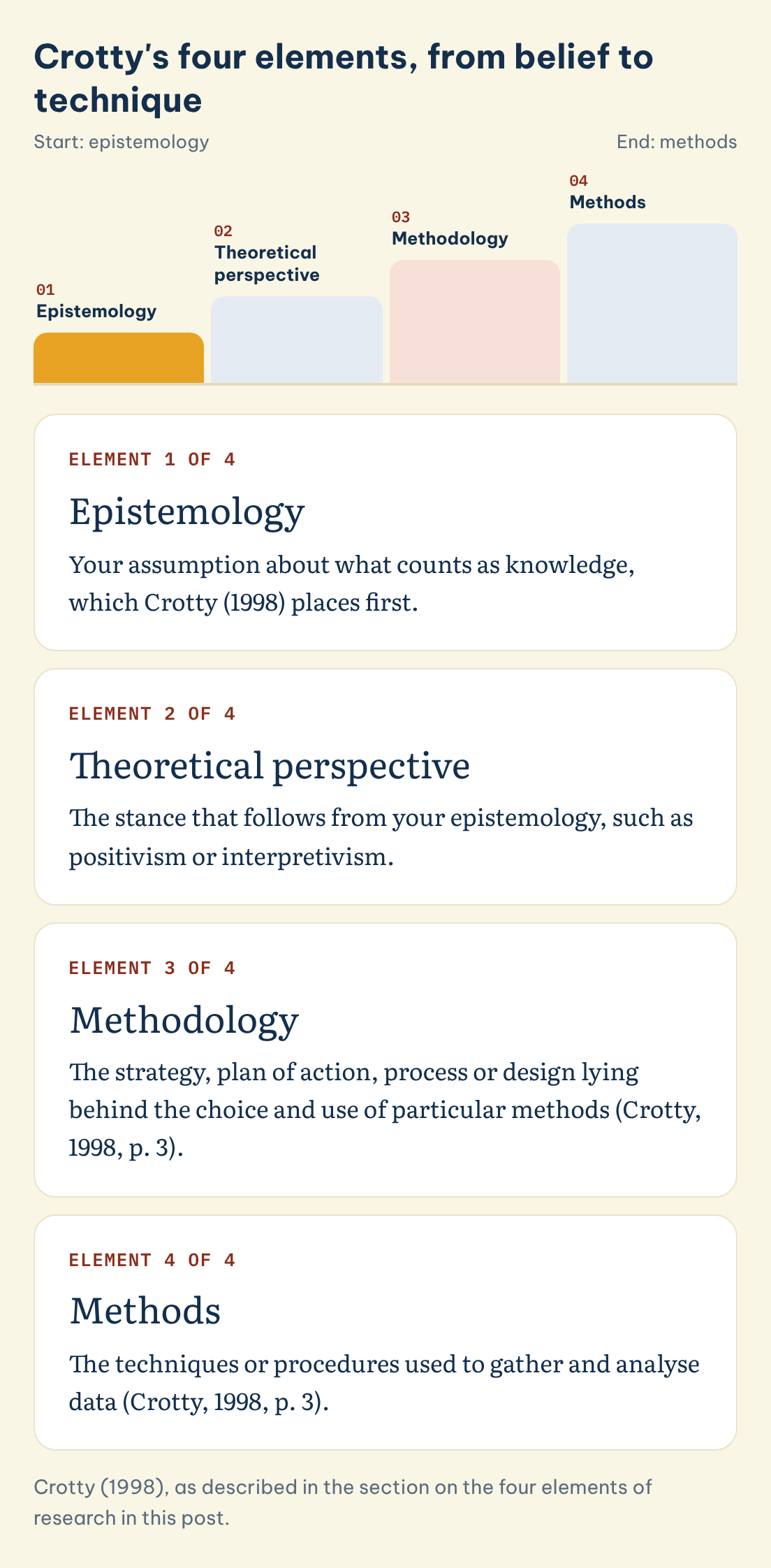
Crotty (1998) arranges the elements as a ladder. Epistemology comes first, the theoretical perspective follows, the methodology is the strategy that governs the choice of methods, and the methods are the techniques for gathering and analysing data. Carter and Little (2007) work with the same three-way hierarchy of epistemology, methodology and method, and describe it as a way of justifying knowledge, justifying method and taking action. The practical value is that you can test your own project from top to bottom. If your epistemology says that knowledge comes from participants' meanings, then a methodology such as ethnography and methods such as interviews and observation follow naturally. If the top and bottom of your ladder pull in opposite directions, a marker will notice, and your methodology section is where you should reconcile them. Our guide on how to write a methodology shows how to put that reasoning on the page.
◆ Question 5 / 8 · What is the research onion
What is the research onion?
Direct answer: The research onion is a layered diagram that shows research choices from the outside in: philosophy, then methodological choice and strategies, then time horizon, then techniques and procedures. Saunders and Tosey (2013) use it to show that outer assumptions set the boundaries for inner decisions.
Saunders and Tosey (2013) describe the layers of research design in a short article in Rapport, and their central point is that the outer layers frame the inner ones. In their words, "It is the researcher's understandings and associated decisions in relation to these outer layers that provide the context and boundaries within which data collection techniques and analysis procedures will be selected" (p. 58). They also note that strategies are not tied to a single philosophy: the experiment and the survey are normally associated with positivism, but they are also used by realist and pragmatist researchers (p. 59), and ethnography is associated with both realism and interpretivism (p. 59). Salmons (2024) reminds readers that no one study would include the entire onion, so you pick one option per layer rather than ticking every box. Bianchi (2021) describes using the onion to relate research philosophy to research practice in education research. Treat it as a checklist for coherence, since the layers help you see whether your choices fit together.
◆ Question 6 / 8 · What is the difference
What is the difference between a deductive and an inductive approach?
Direct answer: A deductive approach tests a theory against evidence, and an inductive approach builds a theory from observations. Bianchi (2021) describes deduction as reasoning where a conclusion is tested in reality, and induction as drawing conclusions from specific observations. Most projects lean one way, and a few combine both in sequence.
Bianchi (2021) defines the two directions as deductive, "the process of reasoning where a conclusion is tested in reality – theory testing" (p. 33), and inductive, where conclusions are derived from specific observations, which she labels theory building. In plain terms, a deductive study starts with a hypothesis and checks whether the data support it, while an inductive study starts with data and looks for patterns that might become a theory. Many textbook versions of the onion place this choice in its own layer, so check the version your course uses before you label your approach. The choice of direction is usually tied to your wider design, and our overview of qualitative, quantitative and mixed methods explains how each direction tends to connect with the type of data you collect.
◆ Question 7 / 8 · Which methodologies will you
Which methodologies will you meet in your reading?
Direct answer: The names you will meet most often are grounded theory, ethnography, case study, action research and phenomenology. Carter and Little (2007) list these as examples of qualitative methodologies, and each one carries its own view of how knowledge should be produced.
Each of these names is a methodology in Carter and Little's (2007) scheme because it comes with a justification for particular methods. Ethnography, for example, is a methodology that guides a researcher in choosing and using methods, as Crotty (1998) points out, and Saunders and Tosey (2013) add that it is associated with both realism and interpretivism. Carter and Little (2007) also note that these terms are defined in conflicting ways, which is a reminder that sources label the same thing differently, so quote the term your supervisor uses and define it once. When you move from definitions to the practical writing of a methods description, the guide on the methods section of a research paper covers the technical detail of reporting what you did.
◆ Question 8 / 8 · How can MAAS help you work
How can MAAS help you work out your methodology?
Direct answer: MAAS works as a mentor and advisor. A MAAS expert talks through the terms with you, asks questions about your assumptions, and points you to the right reading, while the decisions, the writing and the submission stay with you. The first conversation is free and focuses on your question.
If the vocabulary above still feels tangled, thesis and dissertation mentoring from MAAS is built around exactly this stage. A mentor reads your research question, helps you see which of your choices sit at the level of method and which sit at the level of methodology, and explains where your supervisor's expectations may differ from a textbook. The mentor guides and reviews, and you write the chapter yourself. The first conversation is free, so many students bring their draft research question and ask for a quick check of how the pieces fit together. A typical session might compare your research question with your chosen methods, ask what assumptions about reality and knowledge sit behind them, and suggest sources that explain the vocabulary your discipline favours.
Frequently asked questions
What is the difference between methodology and methods?
Crotty (1998) defines methods as the techniques or procedures used to gather and analyse data, and methodology as the strategy or plan of action lying behind their choice. Methods are what you do, and methodology is why.
Is a case study a method, a methodology or a design?
It depends on the source. Carter and Little (2007) list case study among qualitative methodologies, while other guides treat it as a research design. Name it once and say which role it plays in your project.
Do I need to state my ontology and epistemology?
Many courses expect it. Saunders and Tosey (2013) argue that a researcher's assumptions about the nature of reality and knowledge shape the research design, so stating them shows your reasoning. Scotland (2012) makes the same link between ontology, epistemology and methodology. Check your handbook for the expected level of detail.
What is the research onion used for?
Saunders and Tosey (2013) use it to show how outer layers such as philosophy set the context for inner layers such as techniques. Salmons (2024) notes that no single study would include the entire onion.
Is deductive or inductive research better?
Neither is better in general. Bianchi (2021) describes deductive work as theory testing and inductive work as theory building, so the right choice depends on whether you are testing an existing idea or exploring a new pattern.
Why do my textbooks define these terms differently?
Crotty (1998) observes that the terminology is far from consistent in research literature, and Carter and Little (2007) say the same about method, methodology and epistemology. State which definition you follow.
References
Bianchi, L. (2021). Exploring ways of defining the relationship between research philosophy and research practice. Journal of Emergent Science, 20, 32-37. https://www.ase.org.uk/system/files/Bianchi.pdf
Carter, S. M., & Little, M. (2007). Justifying knowledge, justifying method, taking action: Epistemologies, methodologies, and methods in qualitative research. Qualitative Health Research, 17(10), 1316-1328. https://doi.org/10.1177/1049732307306927
Crotty, M. (1998). The foundations of social research: Meaning and perspective in the research process. SAGE Publications.
DeBose, K. (2025, September 26). Research design and method. Virginia Tech University Libraries. https://guides.lib.vt.edu/researchmethods/design-method
Salmons, J. (2024, February 5). Topics, problems, and methodologies. Sage Research Methods Community. https://researchmethodscommunity.sagepub.com/blog/topics-problems-methodologies
Saunders, M., & Tosey, P. (2013). The layers of research design. Rapport, Winter 2012/2013, 58-59.
Scotland, J. (2012). Exploring the philosophical underpinnings of research: Relating ontology and epistemology to the methodology and methods of the scientific, interpretive, and critical research paradigms. English Language Teaching, 5(9), 9-16. https://doi.org/10.5539/elt.v5n9p9
Sheffield Hallam University. (n.d.). Methodology and methods. Dissertations and research projects, Library. https://libguides.shu.ac.uk/researchprojects/methodolgy-methods
Not sure how this guide applies to your own case? Talk it through with MAAS in a free 20-minute consultation.
Book a free consultation ▸