
TOUR50193 Social Media and Content Planning asks you to build a real social media plan that answers a business challenge, not a tour of platforms. Most students who struggle with this Staffordshire module are not short on effort. They describe what each platform does and list content ideas, but rarely anchor the plan in objectives and measurable KPIs. This guide answers the seven questions Vietnamese students at Staffordshire and British University Vietnam ask MAAS mentors most often.
Author: MAAS Editorial Team
Last updated: 2026-07-22
Category: health-education

What is TOUR50193 Social Media and Content Planning about?
Direct answer: TOUR50193 is a Level 5 module awarded by the University of Staffordshire and also delivered at British University Vietnam. It teaches you to plan and manage social media as a marketing function: choosing platforms, developing content aligned to business objectives, setting KPIs, and comparing content-management tools. The assignment is a practical plan, not an essay.
Evidence: The module's learning outcomes are explicit that you must evaluate platforms against audiences, develop a content plan tied to objectives, and build KPIs to measure it. This is planning work, which is why a recognised planning framework matters more than a description of each platform's features.
Example: A Vietnamese student at British University Vietnam came to MAAS treating TOUR50193 as "explain Facebook, Instagram, TikTok". Her MAAS mentor reframed it: the module wants a plan that starts from a business problem and a target audience, then chooses platforms and content to solve it. Once she led with the objective rather than the platform, her draft stopped reading like a platform guide and started reading like a marketing plan.
What assessment does the TOUR50193 assignment usually involve?
Direct answer: The module is assessed by a single report of around 2,500 words that develops a social media plan in response to a business challenge, weighted at 100% and covering all the learning outcomes. You are usually asked to analyse the business and its audience, set objectives and KPIs, choose platforms and content, and explain how you would manage and measure the campaign. Always confirm the exact brief, business case, and word count in your own module handbook, because assessment details change by cohort.
Evidence: Because the assessment is a plan for a real business challenge, the marks reward decisions that are justified against the situation and objectives, not the volume of content ideas. A plan graded at 100% on the plan itself lives or dies on its strategic logic.
Example: A Vietnamese Staffordshire student produced a report that listed dozens of post ideas across every platform. His MAAS mentor asked which business objective each idea served and which audience it reached; most could not be answered. Cutting the list and tying a focused set of content to two clear objectives turned a scattered brief into a coherent plan and lifted the mark.
How is the TOUR50193 assignment graded, and what does the rubric reward?
Direct answer: Social media planning rubrics at this level reward four things, roughly in this order: (1) a plan justified by situation and objectives rather than platform features, (2) correct use of a planning framework and social media concepts, (3) realistic, measurable KPIs tied to the objectives, and (4) professional writing and referencing.
Describing what a platform can do earns limited marks; the marks live in why you chose it for this audience and this objective, and how you will measure success. If you can replace a descriptive sentence with a justified decision, do it every time.
Evidence: Level 5 criteria distinguish a plan that "describes tools and platforms" from one that "applies a framework to justify strategic choices". The difference is rarely more content; it is whether each choice in the plan is anchored to an objective and a measure.
Example: A MAAS mentor colour-coded one Vietnamese student's draft as "describe" or "justify". The plan was mostly description of platforms. After one restructuring pass that ran the same material through a planning framework, so each choice pointed back to an objective, the mark moved up a clear band because the plan now showed reasoning, not features.
Which frameworks should you use in TOUR50193?
Direct answer: Anchor the plan in a recognised planning framework and one or two social media concepts rather than name-dropping many. The most useful for TOUR50193 are: PR Smith's SOSTAC to structure the whole plan, Tuten and Solomon's four zones of social media marketing to organise your content choices, and Kietzmann and colleagues' honeycomb of seven functional building blocks to match a platform to your objective (Kietzmann et al., 2011). SMART objectives and clear KPIs run through all of them. Use the frameworks that fit your business challenge; do not force all of them in.
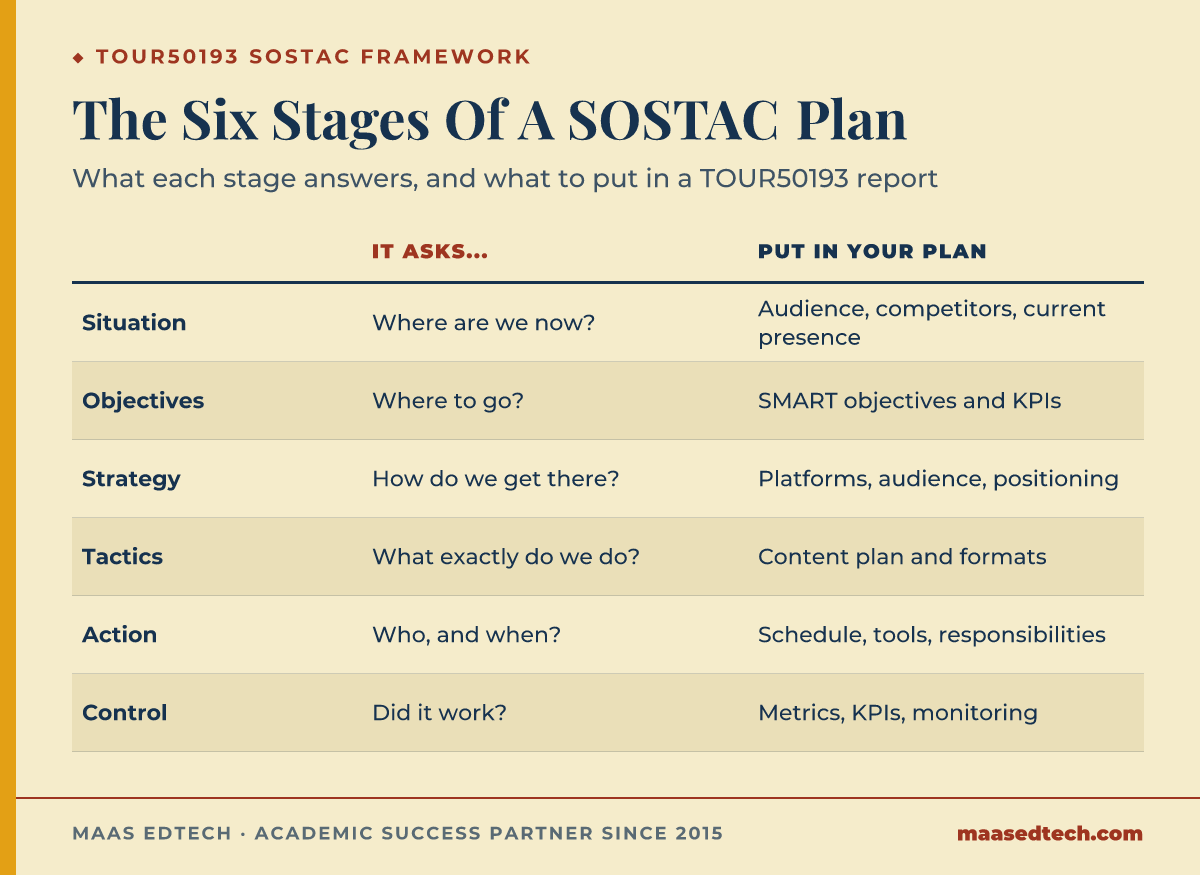
| SOSTAC stage | Question it answers | What to put in your TOUR50193 plan |
|---|---|---|
| Situation | Where are we now? | Business context, audience analysis, competitors, current social presence |
| Objectives | Where do we want to be? | SMART objectives and the KPIs that measure them |
| Strategy | How do we get there? | Target audience, positioning, which platforms and why |
| Tactics | What exactly do we do? | Content plan, formats, posting approach across the chosen platforms |
| Action | Who does what, when? | Schedule, tools, responsibilities, resources |
| Control | How do we know it worked? | Metrics, KPIs, monitoring, and how you would adjust |
Evidence: Smith (2011) developed SOSTAC as a planning methodology that moves logically from situation to control, making it a natural spine for a social media plan; Tuten and Solomon (2018) organise social media marketing into four zones (social community, publishing, entertainment, and commerce) that help you decide what kind of content fits your goal. Kietzmann and colleagues state their model directly: "we present a framework that defines social media by using seven functional building blocks: identity, conversations, sharing, presence, relationships, reputation, and groups" (Kietzmann et al., 2011, p. 241), which is what lets you choose platforms whose strengths match your objective. These are recognised, examiner-friendly sources, not blog-level references.
Example: A Vietnamese Staffordshire student tried to apply several models loosely and produced a vague plan. Her MAAS mentor cut it to two: SOSTAC as the backbone so every section had a purpose, and the honeycomb to justify why one platform suited a community-building objective better than another. Fewer frameworks, applied properly, a stronger and clearer plan.
How should you structure the TOUR50193 report?
Direct answer: Use a planning-led structure, and SOSTAC gives you one directly: (1) situation analysis of the business and its audience, (2) objectives and KPIs, (3) strategy including platform choice and target audience, (4) tactics and content plan, (5) action including tools and schedule, and (6) control and measurement. Keep the situation analysis focused and put detailed research in an appendix. The single biggest structural fix is making sure every tactic in the plan traces back to an objective set earlier, which is where the marks concentrate.
Evidence: Because the assessment is a plan graded as a whole, a structure that mirrors a planning framework signals to the marker that your choices are systematic rather than ad hoc. A plan that jumps straight to content ideas without situation and objectives reads as incomplete.
Example: A Vietnamese Staffordshire student submitted a draft that opened with content ideas and never set objectives. His MAAS mentor restructured it around SOSTAC, adding a situation analysis and two SMART objectives at the front, so the later content plan finally had something to serve. Same ideas, same business; the reordered plan moved up a full band.
What are the most common mistakes that lose marks in TOUR50193?
Direct answer: Three recurring mistakes show up across MAAS social media coaching engagements. First, students describe platforms instead of justifying choices; the plan reads like a platform tour rather than a strategy. Second, students jump to tactics (content ideas) without a situation analysis or objectives, so nothing in the plan is anchored. Third, KPIs are vague or missing ("get more followers") rather than specific and measurable, which loses the marks tied directly to measurement. Fixing these three lifts most plans by at least one band.
Evidence: Because one of the learning outcomes is specifically about developing KPIs to measure effectiveness, a plan with weak or absent metrics forfeits marks that are explicitly available. Smith's SOSTAC places control and measurement as a core stage, not an afterthought, precisely because a plan you cannot measure is a plan you cannot defend.
Example: A Vietnamese student set the objective "become popular on social media". His MAAS mentor asked how he would know he had succeeded; the objective became "increase Instagram engagement rate from 1.5% to 3% within three months", with the metric named. The specific, measurable version turned a weak objective into an assessable one.
How can Vietnamese students do well in TOUR50193?
Direct answer: Lead with the business objective and the audience, not the platform. Use SOSTAC as your backbone so every section has a purpose, choose platforms and content because they fit the objective, and make every KPI specific and measurable. Treat the report as a professional plan a real business could act on. Confirm your referencing style in your module handbook and cite the standard social media marketing texts. If English academic writing is the barrier rather than the planning itself, that is exactly where structured mentoring helps most.
Evidence: Social media planning rewards a shift from describing tools to justifying decisions against objectives, which is a strategic-thinking habit as much as subject knowledge. Students who read the brief as "solve this business challenge with a measurable plan", rather than "explain social media", tend to reach the higher bands sooner.
Example: A Vietnamese student at British University Vietnam worried her English would cap her mark. Her MAAS mentor showed her that the marker was rewarding whether her plan's choices were justified and measurable, not sentence polish, and coached her to follow every decision with "in order to..." plus the objective. Her clarity, and her mark, rose together.
Frequently asked questions
Is TOUR50193 a hard module?
It is practical rather than technically hard, but building a plan that is genuinely strategic and measurable is a real skill. Students who treat it as "describe social media platforms" struggle to reach the higher bands; students who treat it as "build a measurable plan for a business challenge" do well.
Do I need real KPIs for the TOUR50193 plan?
Yes. One of the learning outcomes is specifically about developing KPIs, so vague goals like "get more engagement" lose marks. Make each KPI specific and measurable, such as a target engagement rate or reach figure within a set time.
Which planning framework should I use?
SOSTAC works well because it structures a whole plan from situation to control, but confirm any framework required in your brief. Whatever you choose, apply it consistently so every choice in the plan is justified.
What referencing style does TOUR50193 use?
Staffordshire modules typically use a Harvard referencing style, but always confirm the exact version in your module handbook. Cite the standard social media marketing texts (such as Tuten and Solomon, 2018, and Chaffey and Ellis-Chadwick, 2022) rather than only websites.
Can I use a real business for the plan?
Usually yes, and a real or realistic business challenge makes the plan stronger because your situation analysis has something concrete to work with. Confirm any restrictions in your brief, and keep the audience and objectives specific to that business.
Can MAAS help me with TOUR50193?
Yes. MAAS Assignment & Essay Support coaches you through the assignment with the Outline to Draft to Final model, rubric decoding, framework selection, draft feedback, and a pre-submission referencing audit, all with discipline-matched experts. We coach your work; we do not write it for you.
Ready to approach TOUR50193 with a clear strategy?
If you have the business challenge but not the plan, that is exactly where a discipline-matched expert helps most. MAAS Assignment & Essay Support is an academic support partner; we work alongside you through Outline to Draft to Final so the plan stays yours and the structure earns the marks.
Bring your TOUR50193 brief and we will match you to a Digital Marketing mentor, 23% of our 100+ experts hold a PhD, within 48 hours when our network already covers that field. If it does not, MAAS opens a dedicated recruitment round for your case, which usually takes about two weeks.
Book a free 15-minute TOUR50193 consultation with MAAS Assignment & Essay Support →
Related guides
- TOUR40129 at Staffordshire: how do you approach Global Visitor Economy?: sibling Staffordshire tourism guide on the visitor economy
- BUSM4567 at RMIT: how do you approach Eco-tourism and Sustainable Hospitality?: sibling tourism and hospitality guide on evaluating sustainability
- How to write a methodology in an essay: for the analytical-rigour half of any report
- How to write a theoretical framework: for applying planning frameworks with academic depth
- MAAS Academic Mentoring service: 1:1 coaching with PhD-level mentors in your discipline
- Tutoring service: 1:1 subject tutoring in 60- or 90-minute sessions with an expert matched on your course code, always inside your discipline
- Course-code assignment coaching: pillar guide on tackling any unit assignment with a MAAS mentor
References
- Chaffey, D., & Ellis-Chadwick, F. (2022). Digital marketing: Strategy, implementation and practice (8th ed.). Pearson.
- Kietzmann, J. H., Hermkens, K., McCarthy, I. P., & Silvestre, B. S. (2011). Social media? Get serious! Understanding the functional building blocks of social media. Business Horizons, 54(3), 241–251.
- Smith, P. R. (2011). The SOSTAC guide to your perfect digital marketing plan. PR Smith Marketing.
- Tuten, T. L., & Solomon, M. R. (2018). Social media marketing (3rd ed.). SAGE.
Tools & resources
- University of Staffordshire. (n.d.). Module descriptor: TOUR50193 Social Media and Content Planning. Retrieved July 22, 2026, from https://evision.staffs.ac.uk/module_descriptors/TOUR50193.html
- University of Staffordshire. (n.d.). Referencing and academic skills. Retrieved July 22, 2026, from https://www.staffs.ac.uk/students/study-support
This article is part of the MAAS Journal series for Vietnamese international students. MAAS Assignment & Essay Support is an academic support partner; we coach students through the Outline to Draft to Final delivery model with developmental feedback from discipline-matched experts. We do not write or submit work on a student's behalf.