
TOUR40129 Global Visitor Economy asks you to see tourism and events as one connected system, and even at first year the marks reward analysis over description. Most students struggling with this University of Staffordshire module describe a destination well but never analyse its impacts. This guide answers the questions Vietnamese students ask MAAS mentors before starting TOUR40129.
Author: MAAS Editorial Team
Last updated: 2026-07-22
Category: health-education

What is TOUR40129 Global Visitor Economy about?
Direct answer: TOUR40129 is a Level 4 module on the University of Staffordshire's Business Management (Tourism) degree, corresponding to first year under the FHEQ. It splits into tourism, covering industry structure and demand, and events, covering event types and business tourism such as conferences, both tracked internationally by the UNWTO. It wants you to see these as one connected global visitor economy.
Evidence: The foundational way to see this connectedness is Leiper's tourism system (1979), published in Annals of Tourism Research, which models tourism as five linked elements: tourists, a generating region, a transit route, a destination region, and the tourist industry that operates across all three. As Leiper (1979, p. 403) put it when he first proposed the model: "The elements of the system are tourists, generating regions, transit routes, destination regions and a tourist industry." Level 4 corresponds to the first year of a UK bachelor's degree under the Framework for Higher Education Qualifications (FHEQ), and the World Tourism Organization (UNWTO) tracks the same origin-to-destination movement at a global scale, which is why arrivals passed one billion for the first time in 2012.
Example: A Vietnamese first-year student at Staffordshire came to MAAS treating TOUR40129 as "memorising tourism definitions". Her MAAS mentor reframed it: the module is about seeing the connections, how a visitor's home region, the route they travel, and the destination they reach all shape the industry and its impacts. Once she read her chosen destination through Leiper's system (1979), her draft stopped listing facts and started explaining relationships.
What assessment does the TOUR40129 assignment usually involve?
Direct answer: First-year visitor-economy modules like this are typically assessed through an individual report or case analysis of a destination, an event, or a sector, sometimes paired with a shorter task or presentation. You are usually asked to apply tourism and events concepts to a real example, analysing its structure, its market, or its impacts rather than simply describing it. Always confirm the exact brief, weighting, and chosen case in your own module handbook or Blackboard shell, because assessment structure changes by cohort.
Evidence: University assessments at Level 4 are criterion-referenced, meaning marks are awarded against published learning outcomes and rubric criteria rather than ranked against classmates. Even at first-year level, the outcomes reward applying concepts to an example, not reciting them, which is why decoding the criteria matters more than writing length. The UK's Quality Assurance Agency for Higher Education (QAA) publishes a subject benchmark statement for events, hospitality, leisure, sport and tourism degrees, and Level 4 outcomes like these are built to align with that shared national benchmark.
Example: A Vietnamese Staffordshire student chose a famous festival as his case and spent most of his word count describing its history and programme. His MAAS mentor cut the description to a short context paragraph and reallocated the words to analysing the festival's economic and socio-cultural impacts on its host destination. Same event, same word count, the analysis-led version earned a far stronger mark.
How is the TOUR40129 assignment graded, and what does the rubric reward?
Direct answer: Level 4 tourism and events rubrics reward four things, roughly in this order: (1) applying concepts and frameworks to a real example, (2) analysis of structure, market, or impacts rather than description, (3) use of credible sources, and (4) academic writing and referencing. Describing what a destination or event is earns limited marks; the marks live in how it works within the system and what effects it has. If you can replace a descriptive sentence with an analytical one, do it every time.
Evidence: Level 4 criteria typically distinguish a bare pass ("describes relevant concepts") from a strong mark ("applies and analyses concepts in context"). The difference is rarely more content; it is whether you use a concept as a tool to explain your example, rather than defining it and moving on.
Example: A MAAS mentor colour-coded one Vietnamese student's draft sentence by sentence as "describe" or "analyse". The draft was roughly 80% describe, which is common and expected at first year. After one restructuring pass that applied Leiper's system and an impacts framework to the same example, the mark moved up a clear band, because the student was now using concepts rather than just naming them.
Which tourism and events frameworks should you use in TOUR40129?
Direct answer: Anchor your analysis in two or three established concepts rather than name-dropping many. The most useful for TOUR40129 are: Leiper's tourism system to map how your destination connects to its markets and transit routes, the tourism impacts framework (economic, socio-cultural, and environmental effects) to evaluate a destination or event, and Getz's event tourism concept to analyse how events attract visitors and shape a destination's image. Pick the concepts that fit your chosen example; do not force all of them in.
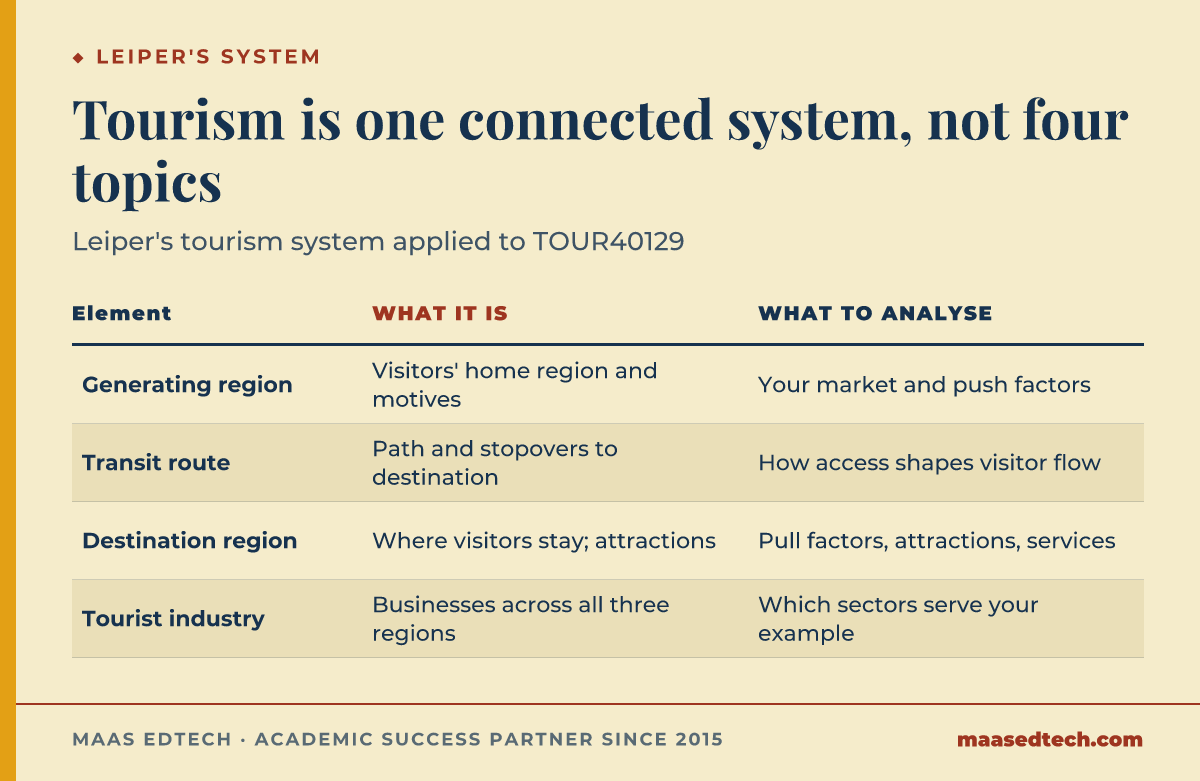
| Leiper's tourism system element | What it is | What to analyse in your example |
|---|---|---|
| Tourist generating region | The visitors' home region and what motivates them to travel | Who your destination's market is, and the push factors sending them |
| Transit route | The path and stopovers between home and destination | How access and transport shape visitor flows to your destination |
| Tourist destination region | The place visitors stay and its attractions | The pull factors, attractions, and services at your destination |
| Tourist industry | The businesses operating across all three regions | Which sectors serve your example, and how they connect |
Evidence: Leiper (1979) modelled tourism as a connected system of five elements, providing the "global" and systemic view the module is built around; Getz (2008), published in Tourism Management, established event tourism as a field, showing how planned events extend seasons, raise a destination's image, and drive visitor demand; Fletcher, Fyall, Gilbert and Wanhill's Tourism: Principles and Practice is the standard textbook for these foundations. These are recognised, examiner-friendly sources, not blog-level references.
Example: A Vietnamese Staffordshire student analysing a coastal resort tried to apply several models and explained each shallowly. Her MAAS mentor cut it to two: Leiper's system to show the resort depended heavily on one generating region and a single transit route, and the impacts framework to weigh its economic benefit against seasonal strain. Fewer concepts, applied properly, higher mark.
How should you structure the TOUR40129 report?
Direct answer: Use an application-led structure: (1) a brief introduction and context for your chosen destination or event (keep it under 15% of the word count at first-year level), (2) analysis of its place in the tourism system using Leiper's elements, (3) analysis of its impacts across economic, socio-cultural, and environmental dimensions, or its role as event tourism, and (4) a short conclusion. The single biggest structural fix is shrinking the description and expanding the sections where you apply concepts, which is where the marks concentrate.
Evidence: Criterion-referenced rubrics weight "application and analysis of concepts" above "description and background". Structuring your word budget to match the criteria is the most reliable way to lift a first-year grade without more research.
Example: A Vietnamese Staffordshire student submitted a draft with a long destination profile and a two-sentence impacts section. His MAAS mentor inverted the ratio, cutting the profile and developing the economic and socio-cultural impacts with evidence. The final report, same case and same sources, moved up a full band because the analysis was finally substantial enough to assess.
What are the most common mistakes that lose marks in TOUR40129?
Direct answer: Three recurring mistakes show up across MAAS tourism-coaching engagements. First, students describe a destination or event instead of analysing it; the travel-guide summary crowds out the argument. Second, students define concepts (they explain what a tourism system is) but never apply them to their example. Third, impacts are treated as only economic, ignoring the socio-cultural and environmental dimensions that a balanced analysis needs. Fixing these three lifts most first-year drafts by at least one band.
Evidence: Because Level 4 outcomes reward application, a report that defines Leiper's system without using it to explain a real destination reads as incomplete to a marker. Getz (2008) similarly frames events by their effects on destinations, so an events analysis that stops at describing the programme misses where the marks are, a point Getz and Page (2020) reinforce in their later textbook.
Example: A Vietnamese student described a city's tourism offer in detail but never linked it to any concept. His MAAS mentor asked, "which element of the tourism system does each of these facts belong to, and what does that tell us?", and the revised version, which organised the same facts through Leiper's system, turned a description into an analysis.
How can Vietnamese students at Staffordshire do well in TOUR40129?
Direct answer: Choose one clear destination or event, then use two or three concepts as tools to analyse it rather than listing facts about it. Apply Leiper's system to map its connections, use the impacts framework to evaluate it, and keep description brief. Confirm your referencing style (Staffordshire typically uses a Harvard style; check your module handbook) and reference the standard tourism and events textbooks. If English academic writing is the barrier rather than the tourism content, that is exactly where structured mentoring helps most, especially in your first year.
Evidence: First-year tourism study is conceptually accessible but rewards a shift from describing to applying, which is a writing-and-thinking habit as much as subject knowledge. Vietnamese students who read the brief as "use these concepts to analyse an example", rather than "explain these concepts", tend to reach the higher bands sooner.
Example: A Vietnamese first-year student at Staffordshire worried her English would cap her mark. Her MAAS mentor showed her that the marker was rewarding whether she applied concepts, not sentence polish, and coached her to follow every fact with "which tells us that...". Her clarity, and her mark, rose together.
Frequently asked questions
Is TOUR40129 a hard module?
It is a first-year module, so the concepts are accessible, but the marks reward applying them to a real example rather than memorising definitions. Students who treat it as "describe a destination" struggle to reach the higher bands; students who treat it as "analyse a destination using tourism concepts" do well.
Can I choose any destination or event for the TOUR40129 assignment?
Usually you can, as long as there is enough credible information to analyse it. Confirm any restrictions in your brief. Pick an example you can find data on, and one with a clear market, impact, or event angle you can actually analyse.
How many frameworks should I use in the assignment?
Two or three, applied properly, beats listing many. At first year, using Leiper's tourism system and an impacts framework well is usually enough. Markers reward using a concept to explain your example, not the number of models you can name.
What referencing style does TOUR40129 use?
Staffordshire modules typically use a Harvard referencing style, but always confirm the exact version in your module handbook. Reference the standard tourism and events textbooks (such as Fletcher et al., 2018; Getz & Page, 2020) rather than only websites.
Do I need to cover both tourism and events?
Check your brief. The module covers both themes, but a specific assignment may focus on one. If it does, choose the theme your example fits best and analyse it in depth rather than covering both shallowly.
Can MAAS help me with TOUR40129?
Yes. MAAS Assignment & Essay Support coaches you through the assignment with the Outline to Draft to Final model, rubric decoding, concept selection, draft feedback, and a pre-submission referencing audit, all with discipline-matched experts. We coach your work; we do not write it for you.
Ready to approach TOUR40129 with a clear strategy?
If you have the destination or event but not the analysis, that is exactly where a discipline-matched expert helps most, especially in your first year. MAAS Assignment & Essay Support is an academic support partner; we work alongside you through Outline to Draft to Final so the analysis stays yours and the structure earns the marks.
Bring your TOUR40129 brief and we will match you to a Tourism and Events mentor, 23% of our 100+ experts hold a PhD, within 48 hours when our network already covers that field. If it does not, MAAS opens a dedicated recruitment round for your case, which usually takes about two weeks.
Book a free 15-minute TOUR40129 consultation with MAAS Assignment & Essay Support →
Related guides
- BUSM4567 at RMIT: how do you approach Eco-tourism and Sustainable Hospitality?: sibling tourism and hospitality guide on evaluating sustainability
- BUSM4821 at RMIT: how do you approach the Tourism and Hospitality Internship?: sibling guide on reflective internship reports in tourism and hospitality
- How to write a methodology in an essay: for the analytical-rigour half of any report
- How to write a theoretical framework: for applying tourism frameworks with academic depth
- MAAS Academic Mentoring service: 1:1 coaching with PhD-level mentors in your discipline
- Tutoring service: 1:1 subject tutoring in 60- or 90-minute sessions with an expert matched on your course code, always inside your discipline
- Course-code assignment coaching: pillar guide on tackling any unit assignment with a MAAS mentor
References
- Fletcher, J., Fyall, A., Gilbert, D., & Wanhill, S. (2018). Tourism: Principles and practice (6th ed.). Pearson Education.
- Getz, D. (2008). Event tourism: Definition, evolution, and research. Tourism Management, 29(3), 403–428.
- Getz, D., & Page, S. J. (2020). Event studies: Theory, research and policy for planned events (4th ed.). Routledge.
- Leiper, N. (1979). The framework of tourism: Towards a definition of tourism, tourist, and the tourist industry. Annals of Tourism Research, 6(4), 390–407.
Tools & resources
- University of Staffordshire. (n.d.). Module descriptor: TOUR40129 Global Visitor Economy. Retrieved July 22, 2026, from https://evision.staffs.ac.uk/module_descriptors/TOUR40129.html
- University of Staffordshire. (n.d.). Business Management (Tourism) BSc (Hons). Retrieved July 22, 2026, from https://www.staffs.ac.uk/course/business-management-tourism-bsc
This article is part of the MAAS Journal series for Vietnamese international students. MAAS Assignment & Essay Support is an academic support partner; we coach students through the Outline to Draft to Final delivery model with developmental feedback from discipline-matched experts. We do not write or submit work on a student's behalf.