
◆ Business & Management
SM9532 Strategic Frameworks and Cultural Contexts: how do they link?
SM9532 Strategic Frameworks and Cultural Contexts in International Management is a second-year module at Newcastle Business School, Northumbria University, which has held AACSB accreditation since 2014, a status fewer than 1% of business schools worldwide carry. The title contains the whole difficulty: not a strategy module with a culture chapter bolted on, nor a culture module that mentions strategy, but the interface between the two. Treating them as separate topics is the module's most common trap.

◆ Question 1 / 7 · About the module
What is SM9532 about?
Direct answer: SM9532 Strategic Frameworks and Cultural Contexts in International Management is a Level 5, Year Two module at Northumbria's Newcastle Business School, worth 20 credits and core on some routes, optional on others. It covers cultural paradigms, the CAGE framework, Porter's national diamond, and ethics in international business. A single individual assessment worth 100% of the module decides the whole grade.
Evidence: Read the content list carefully and you will see it alternates deliberately: a strategy tool, then a cultural topic, then a strategy tool again. Market entry sits next to communicating across cultures; the national diamond sits next to managing mobile employees. That alternation is the module's argument, that a strategic choice which ignores its cultural setting is not actually a complete strategic choice.
Example: A Vietnamese student at Northumbria structured her first draft as two halves: strategy frameworks, then cultural issues. Her mentor asked what changed in the first half because of the second. Nothing did. The two halves were accurate and unconnected, which is the exact failure the module title warns against.
◆ Question 2 / 7 · National diamond
What is Porter's national diamond, and why is it here?
Direct answer: The national diamond explains why particular countries become competitive bases for particular industries, rather than why particular firms beat their rivals. Porter (1990) built the model from a study that ran for 4 years across 10 leading trading nations, including Japan, Germany, Britain, and the United States, and argued that national competitive advantage in an industry rests on four interacting conditions: factor conditions such as skills and infrastructure, demand conditions in the home market, related and supporting industries, and firm strategy, structure and rivalry. It belongs in this module because it is the framework that treats a country as a strategic variable rather than as a backdrop.
Evidence: Note how this differs from the tool most students reach for. Porter's five forces analyses an industry's structure; the national diamond analyses a country's capacity to host a competitive industry. Confusing them is the commonest error in this module, and it is easy to spot in a draft because the analysis suddenly stops being about the country at all.
Example: A student analysing why a Vietnamese furniture exporter competed successfully in Europe wrote a five forces analysis of the furniture industry. Her mentor asked what in Vietnam specifically made that possible. Switching to the diamond, she found the answer in related and supporting industries, an established timber processing and logistics cluster, which the five forces analysis had no place for.
◆ Question 3 / 7 · Culture and stereotype
How do you use culture without turning it into stereotype?
Direct answer: Treat cultural frameworks as generating hypotheses about a context, never conclusions about a person. Hofstede's (2001) dimensions, built from a survey of roughly 117,000 IBM employees that had grown to cover more than 50 countries by the 2001 edition, describe central tendencies in large national samples; they do not predict the behaviour of the individual manager sitting across the table. In your writing, the safe and more analytical formulation is that a cultural pattern makes a particular misunderstanding more likely, and then to show what a firm did about it.
Evidence: The module lists cultural paradigms alongside communicating across cultures and international business protocol, which are practical, situational topics. That pairing signals that culture is being taught as something a manager must navigate in specific encounters, not as a taxonomy to be recited. Trompenaars and Hampden-Turner (2012), whose model rests on survey responses from more than 46,000 managers across 40 countries, similarly frame cultural difference across seven dimensions as dilemmas to be reconciled rather than as fixed national traits.
Example: A student wrote that a negotiation failed "because Vietnamese culture is collectivist and the German partner was individualist". Her mentor asked what actually happened in the room. The German side had expected a decision at the meeting; the Vietnamese side needed to consult absent stakeholders first. Describing that concrete mismatch, and then naming the cultural pattern that made it likely, was both more accurate and far better analysis.
◆ Question 4 / 7 · Frameworks
Which frameworks should you use, and for what?
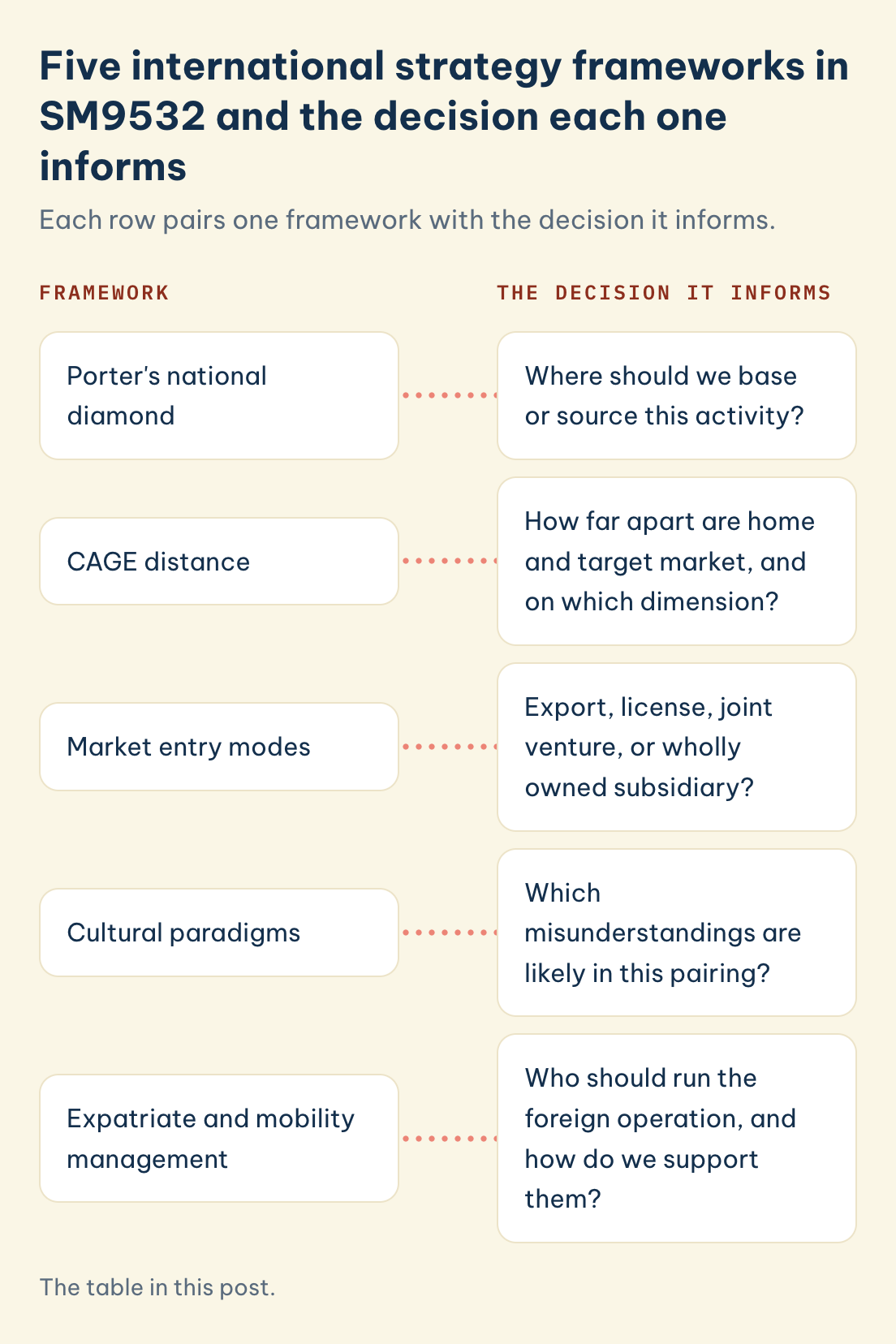
Direct answer: Match the framework to the decision. The module gives you a toolkit, and the marks come from choosing correctly rather than from applying everything.
Five international strategy frameworks in SM9532 and the decision each one informs
Each row pairs one framework with the decision it informs.
Framework
The decision it informs
Porter's national diamond
Where should we base or source this activity?
CAGE distance
How far apart are home and target market, and on which dimension?
Market entry modes
Export, license, joint venture, or wholly owned subsidiary?
Cultural paradigms
Which misunderstandings are likely in this pairing?
Expatriate and mobility management
Who should run the foreign operation, and how do we support them?
Save this figure
| Framework | The decision it informs | Do not use it for |
|---|---|---|
| Porter's national diamond | Where should we base or source this activity? | Analysing rivalry within an industry |
| CAGE distance | How far apart are home and target market, and on which dimension? | Judging whether an individual will adapt |
| Market entry modes | Export, license, joint venture, or wholly owned subsidiary? | Explaining post-entry management problems |
| Cultural paradigms | Which misunderstandings are likely in this pairing? | Predicting one person's behaviour |
| Expatriate and mobility management | Who should run the foreign operation, and how do we support them? | Substituting for entry-mode analysis |
Evidence: Ghemawat (2001) traced the problem to the tool managers reach for first: standard country portfolio analysis "places all the emphasis on potential sales. It ignores the costs and risks of doing business in a new market" (Ghemawat, 2001, p. 137), a gap CAGE was built to close by splitting that distance into cultural, administrative, geographic and economic components. Used properly, CAGE tells you which kind of distance binds, which in turn shapes both the entry mode and the staffing decision, and that chain is exactly the interface the module is about. The underlying tension has an older label: Bartlett and Ghoshal (1989) described multinationals as pulled between local responsiveness and global integration, and a market entry choice that ignores local responsiveness is the classic way a diamond-and-CAGE analysis can look correct on paper and still misjudge the culture it lands in.
Example: A student recommended a joint venture for a market entry and, separately, recommended sending home-country managers to run it. Her mentor pointed out the tension: a joint venture is often chosen precisely because the partner supplies local knowledge, so staffing it with home-country managers discards the reason for choosing it. Connecting the two decisions turned two competent sections into one coherent argument.
◆ Question 5 / 7 · Structure
How should you structure the work?
Direct answer: Organise by decision, not by framework. Northumbria's published brief for the module's individual assessment (100% of the mark, capped at 3,000 words in recent years) asks you to build a cultural profile of one designated country, then run a basic CAGE analysis contrasting it against a second country, often the United Kingdom.
A structure that forces the interface within that word limit: (1) the firm and the specific international decision it faces; (2) the strategic analysis, which country, which entry mode, using the diamond and CAGE; (3) the cultural conditions that this particular choice creates, communication, protocol, staffing; (4) how those conditions should change the way the strategy is implemented; (5) the ethical and responsible-business dimension in the localised context; (6) a conclusion that states what the firm should do and what it should watch. Section four is the one that earns the module's marks, and with 3,000 words split six ways, that averages out to roughly 500 words a section, so description of either country has to stay tight.
Evidence: The module's content explicitly names "Ethics and Responsible Business in context of growth, localised contexts of international markets", which makes ethics a named component rather than optional. Treating it in one closing sentence leaves a listed topic essentially unaddressed.
Example: A student's ethics paragraph said the firm should "act responsibly in all markets". Her mentor asked what responsible meant in the specific market she had chosen, where local supplier labour standards differed from the home country's. Naming the actual dilemma, and the trade-off the firm faced, turned a platitude into the localised analysis the module asks for.
◆ Question 6 / 7 · Common mistakes
What are the most common mistakes in SM9532?
Direct answer: A handful of habits account for most of the lost marks.
| Mistake | Why it costs marks | The fix |
|---|---|---|
| Strategy and culture as separate halves | The module is about the interface | Show what culture changes about the strategic choice |
| National diamond used as five forces | They answer different questions | Ask whether you are analysing a country or an industry |
| Hofstede as a stereotype generator | Describes tendencies, not individuals | Say a misunderstanding is more likely, then show what happened |
| Entry mode chosen without staffing logic | The two decisions constrain each other | Decide who runs it as part of choosing the mode |
| Ethics as a closing sentence | It is named content | Analyse a specific localised dilemma |
| Culture treated only as an obstacle | It also creates advantage and access | Note where cultural knowledge is a resource |
Evidence: Level 5 sits between the entry-level Level 4 and the finishing Level 6 in the UK's Framework for Higher Education Qualifications, the middle year of a typical three-year bachelor's degree (Quality Assurance Agency for Higher Education, 2024), and at this stage the assessment is testing whether you can hold two analytical lenses at once rather than switching between them. A draft that could be cut in half, with each half surviving independently, has not demonstrated that capability, however accurate each half is.
Example: One student wrote a strong CAGE analysis and a strong section on cross-cultural communication. Her mentor suggested she split the draft in two, and that showed her that neither half referred to the other even once. Adding three sentences that carried a CAGE finding into the communication section is a small edit that changed what the work demonstrated.
◆ Question 7 / 7 · Mobile employees
How do you write about managing internationally mobile employees?
Direct answer: Treat it as a strategic staffing decision with cultural consequences, not as an HR footnote. The questions worth answering are: who should run this operation and why, what support do they need before and during the assignment, how will their performance be judged given they are operating in an unfamiliar setting, and what happens when they return.
Each of those has a cost, and each connects back to the entry mode chosen, echoing Johanson and Vahlne's (1977) Uppsala model of internationalisation, where firms commit resources to a foreign market in incremental steps as their experiential knowledge of it grows.
Evidence: The module places managing internationally mobile employees alongside international business protocol and communicating across cultures. That grouping frames mobility as part of how strategy actually gets executed on the ground, which is why an entry-mode recommendation with no staffing implication reads as incomplete.
Example: A Vietnamese student writing about a European firm's operation in Southeast Asia recommended sending an experienced home-country director. Her mentor asked what preparation the person would need and what the firm would lose if the assignment failed early. Costing the assignment realistically, including preparation and the risk of early return, made her recommendation noticeably more credible than an unqualified one.
Frequently asked questions
Is SM9532 a strategy module or a culture module?
Neither on its own. It is about the interface, and the assessment rewards work that shows one changing the other. If your draft reads as two separate essays, that is the signal to revise.
Can I use my own cultural background as material?
Yes, and it can be a genuine advantage, provided you analyse it rather than assert it. Describe a specific business situation and what made it hard, then bring the framework in to explain why that difficulty was predictable.
Is Hofstede outdated?
It remains widely taught and widely criticised, particularly for treating nations as culturally uniform. McSweeney (2002) is the best-known critique, arguing that a single national score cannot plausibly stand in for the values of everyone inside that country. Noting that limitation and using the model carefully is stronger than either ignoring the criticism or dismissing the model entirely.
How many frameworks should I use?
Two or three, chosen because the decision requires them. The national diamond and CAGE cover most country-level analysis; add one cultural framework that fits the specific encounter you are analysing.
Can MAAS help me with SM9532?
MAAS mentors work with you on choosing a firm and a decision that make the interface visible, matching frameworks to the right questions, and checking that your cultural analysis is changing your strategic recommendation rather than sitting beside it. You remain the author of your work; the mentor looks for the places where your two halves fail to meet.
Finding the joins
Framework coverage is not what earns the higher bands here. The work that lands is work where a cultural finding visibly changes a strategic recommendation, and where the ethics section names a real dilemma in a real market. If your draft currently reads as strategy first and culture second, a MAAS mentor can help you find the joins.
Talk to a MAAS mentor about your module
Related guides
References
- Bartlett, C. A., & Ghoshal, S. (1989). Managing across borders: The transnational solution. Harvard Business School Press.
- Ghemawat, P. (2001). Distance still matters: The hard reality of global expansion. Harvard Business Review, 79(8), 137–147.
- Hofstede, G. (2001). Culture's consequences: Comparing values, behaviors, institutions and organizations across nations (2nd ed.). SAGE.
- Johanson, J., & Vahlne, J.-E. (1977). The internationalization process of the firm: A model of knowledge development and increasing foreign market commitments. Journal of International Business Studies, 8(1), 23–32. https://doi.org/10.1057/palgrave.jibs.8490676
- McSweeney, B. (2002). Hofstede's model of national cultural differences and their consequences: A triumph of faith, a failure of analysis. Human Relations, 55(1), 89–118. https://doi.org/10.1177/0018726702551004
- Porter, M. E. (1990). The competitive advantage of nations. Free Press.
- Quality Assurance Agency for Higher Education. (2024). The frameworks for higher education qualifications of UK degree-awarding bodies. https://www.qaa.ac.uk/docs/qaa/quality-code/the-frameworks-for-higher-education-qualifications-of-uk-degree-awarding-bodies-2024.pdf
- Trompenaars, F., & Hampden-Turner, C. (2012). Riding the waves of culture: Understanding diversity in global business (3rd ed.). Nicholas Brealey.
Tools & resources
- Northumbria University. (n.d.). Business Management BA (Hons). Retrieved July 29, 2026, from https://www.northumbria.ac.uk/study-at-northumbria/courses/ba-hons-business-management-uusbnb1/
- Northumbria University. (n.d.). Skills Plus. Retrieved July 29, 2026, from https://www.northumbria.ac.uk/about-us/university-services/library/skills-plus/
This article is part of the MAAS Journal series for Vietnamese international students. MAAS Assignment & Essay Support is an academic support partner; we coach students through the Outline, Draft, Final delivery model with developmental feedback from discipline-matched experts. We do not write or submit work on a student's behalf.
A free 20-minute consultation is a conversation about where you are with SM9532.
Book a free consultation ▸