
◆ Business & Management
NX9624 Management Enquiry: how do you plan a 40-credit capstone?
NX9624 is a 40-credit final-year module at Newcastle Business School, Northumbria University, which makes it worth twice a standard 20-credit module and roughly a third of your final year's 120 credits. It requires you to go out and talk to a real practitioner, then collect and analyse live data from real people. That is not a library project. It means ethics, access and timing become part of your grade long before your writing does.

◆ Question 1 / 7 · About the module
What is NX9624 Management Enquiry about?
Direct answer: NX9624 is a Year Three module worth 40 credits, listed by Northumbria as core on some Business Management routes and optional on others. It is a capstone requiring a substantial individual project with authentic engagement with professionals in your discipline, using an experiential, problem-based approach that develops transferable skills including time management, project management and communication.
Evidence: Under the UK credit framework, 1 credit represents 10 notional hours of study, so a 40-credit module carries roughly 400 hours across the year, against the 360 credits that make up a full three-year honours degree overall. The word "capstone" is doing real work here. A capstone is designed to make you draw together what the degree has taught you and apply it to a problem nobody has pre-packaged for you. The module description pairs that with "authentic engagement with professionals", which means the problem has to come from practice rather than from a textbook, and someone in the field has to actually be involved.
Example: A Vietnamese student at Northumbria told her MAAS mentor she had picked a topic from a lecture she enjoyed. Her mentor asked which practitioner she would interview about it and what live data she could realistically gather. Neither question had an answer. The topic was academically interesting and operationally impossible, and she found that out in week two rather than week ten.
◆ Question 2 / 7 · Assessment
How is NX9624 assessed?
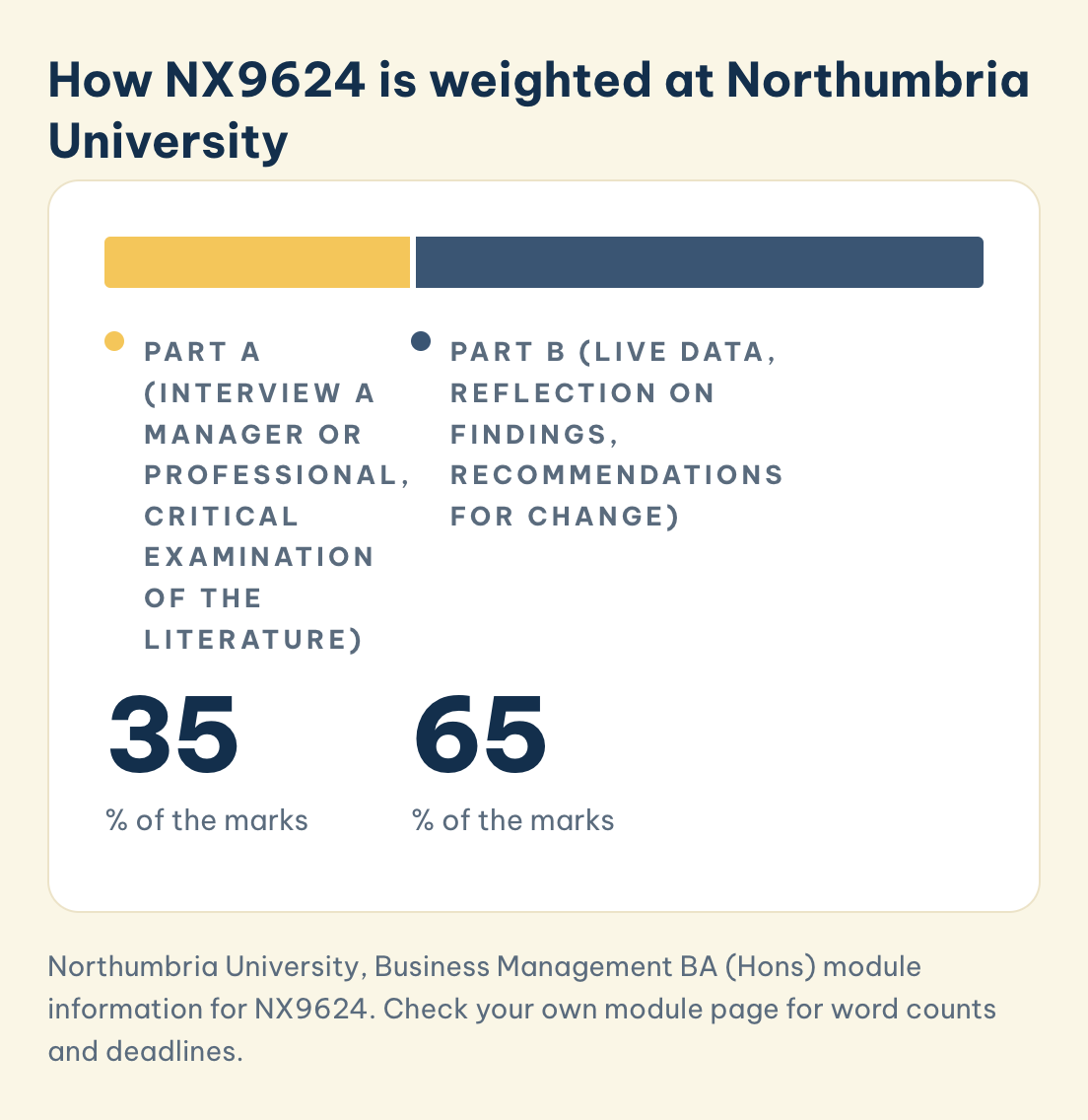
Direct answer: In two parts. Part A is worth 35% and involves interviewing a manager or professional to explore a key issue in your discipline, alongside a critical examination of the relevant literature. Part B is worth 65% and requires authentic engagement with the problem you identified: collecting and analysing live data using ethically considered research methods, then reflecting on your findings and providing clear, prioritised, well-justified, practical and actionable recommendations for change. Most UK universities apply a word-count tolerance of around 10% either side of the stated limit, but confirm the exact word counts and deadlines on your own module page.
How NX9624 is weighted at Northumbria University
The two parts are sequentially dependent, so Part B builds on the problem identified in Part A.
Part A (interview a manager or professional, critical examination of the literature)
35
% of the marks
Part B (live data, reflection on findings, recommendations for change)
65
% of the marks
Save this figure
Evidence: Read that list of adjectives attached to the recommendations again: prioritised, well-justified, practical, actionable. That is a marking rubric written as a sentence. Each word is a separate test. Prioritised means ranked, not listed. Well-justified means traced to your data. Practical means the organisation could actually do it. Actionable means someone could start on Monday, the same practical test Saunders, Lewis and Thornhill (2019) apply to business research recommendations generally.
Example: A student's final recommendations read: improve communication, invest in training, enhance culture. His mentor applied the four adjectives one at a time. They were not prioritised, not traced to any finding, not costed against the organisation's constraints, and not actionable by any named role. Rewriting three vague aspirations into two specific, ranked, evidenced actions lifted the section from the bottom band to a strong one.
◆ Question 3 / 7 · Part A and Part B
How do Part A and Part B fit together?
Direct answer: Part A finds and frames the problem; Part B investigates it and recommends change. The interview in Part A is not a warm-up exercise, it is how you discover a problem worth 65% of the module. Choose that interview badly and everything downstream is built on sand.
Evidence: The module is problem-based and experiential, and Part B refers to "the identified problem", meaning the problem identified in Part A. The two parts are sequentially dependent by design. This is why the weighting is not an accurate guide to where your effort should go early: Part A is 35% of the marks but close to 100% of the risk.
Example: A student interviewed a family friend who managed a small retail store, because access was easy. The issue that emerged was staff scheduling, and he could not gather live data on it without the owner's cooperation, which was never granted. His mentor's advice for next time was blunt: before you choose your interviewee, ask whether their organisation would let you collect data there too, ideally confirmed in writing within the first 2 weeks of the module.
◆ Question 4 / 7 · Live data
What counts as live data, and how do you get it ethically?
Direct answer: Live data means data you generate yourself from real participants during the project, typically interviews, a short survey, or structured observation, rather than data someone else already published. Ethically considered means you have thought about consent, anonymity, storage, and the participant's right to withdraw, and that you have followed your programme's ethics approval process before you collect anything.
Approval takes time. At most UK universities, straightforward, low-risk ethics applications take 2 to 4 weeks to clear, longer if the committee requests amendments, so build that lead time into your plan rather than discovering it in week six.
Evidence: The module specifies collecting and analysing live data using ethically considered research methods, which makes research ethics part of the assessed methodology rather than an administrative hurdle. Saunders, Lewis and Thornhill (2019) treat the ethics approval step as part of the research design itself, not a formality that happens after the design is finished, precisely because a method that cannot pass approval has to be redesigned rather than merely delayed. A project whose data was gathered before approval, or without recorded consent, has a methodological defect that no amount of good analysis repairs, a point Brinkmann and Kvale (2014) make forcefully about interview research specifically.
Example: A student planned to record interviews on her phone and transcribe them later. Her mentor asked where the recordings would be stored and what she had told participants about it. She had not addressed either. Adding a one-page consent sheet and a clear statement on storage and deletion took her an afternoon, and it later formed part of her methodology section rather than a gap in it. What she had not budgeted for was transcription time: a rough industry rule of thumb is 4 to 6 hours of transcription for every 1 hour of recorded interview, and eight interviews at 45 minutes each add up fast once that ratio is applied.
◆ Question 5 / 7 · Project structure
How should you structure the project?
Direct answer: Work backwards from Part B's deliverable, the prioritised recommendations, because everything must feed it. A workable shape: Part A opens with the practice issue as your interviewee described it, then sets it against what the literature already says, and closes by naming the specific question your data will answer.
Part B then covers method and ethics, findings from your live data, analysis of what those findings mean against the literature, and finally the recommendations, ranked with justification. Give the analysis and recommendation sections the space they deserve; they carry Part B's weight.
Evidence: The module asks you to reflect on findings and then provide recommendations, which places reflection between analysis and recommendation as a distinct step. Gibbs (1988) frames reflection as a cycle rather than a single pass: description, feelings, evaluation, analysis, conclusion and action plan, and the last two stages of that cycle map almost exactly onto what NX9624 calls recommendations. Brinkmann and Kvale (2014) describe a comparable seven-stage arc for the whole enquiry, from thematizing the question through designing, interviewing, transcribing, analysing and verifying, to reporting, which is a useful checklist against your own Part A and Part B timeline. That step is where you decide which findings actually matter enough to act on, and skipping it is why weak recommendations feel disconnected from the data that preceded them.
Example: A student presented six findings and then six recommendations, one per finding, in the same order. Her mentor asked which two mattered most to the organisation and why. Once she ranked them by impact and feasibility, two recommendations carried the report and four became secondary observations. The word "prioritised" in the brief had been asking for exactly that.
◆ Question 6 / 7 · Common mistakes
What are the most common mistakes in a capstone like this?
Direct answer: Most of what goes wrong here is a planning failure rather than a writing failure, the same conclusion Saunders, Lewis and Thornhill (2019) reach about undergraduate research projects generally.
| Mistake | Why it costs marks | The fix |
|---|---|---|
| Choosing a topic before checking access | Part B needs live data from somewhere | Confirm access before you commit to the problem |
| Treating ethics approval as paperwork | The brief names ethically considered methods | Start approval early; write ethics into methodology |
| Interviewing whoever is easiest to reach | Part A frames the whole project | Choose for relevance and for data access |
| Recommendations as a wish list | Four adjectives in the brief say otherwise | Rank them, cost them, name who acts |
| Findings reported, not analysed | Reflection is a named step | Say what each finding means, then what follows |
| Leaving Part B until Part A is marked | The parts are sequential but the clock is not | Begin data planning while Part A is in progress |
Evidence: A 40-credit module compresses a research process into one academic year alongside other modules, and the steps that depend on other people, access, approval, participant availability, are the only ones you cannot fix by working harder. Those are the steps that need float in the plan, the same scheduling risk Saunders, Lewis and Thornhill (2019) flag for any project depending on gatekeeper access.
Example: A student budgeted two weeks for interviews and got three of his eight participants in that window because it fell over a holiday period. His mentor's lesson for the next student was to schedule participant-dependent work first and writing second, since writing can compress and people cannot.
◆ Question 7 / 7 · Qualitative analysis
How do you analyse qualitative data without overcomplicating it?
Direct answer: For most undergraduate projects at this level, thematic analysis is the appropriate and defensible choice. Braun and Clarke (2006) set it out as six phases: familiarising yourself with the data, generating initial codes, searching for themes, reviewing themes, defining and naming themes, and producing the report. Working through those six in order, rather than jumping straight from transcript to theme, is what separates an analysis from an impression. What matters for marks is that you describe the process you actually followed, including how you handled data that did not fit.
Evidence: Thematic analysis "offers an accessible and theoretically flexible approach to analysing qualitative data" (Braun & Clarke, 2006, p. 77), and the pair go on to provide clear guidelines for conducting it rigorously and to identify the common pitfalls, most notably presenting a collection of extracts as though it were an analysis. Brinkmann and Kvale (2014) similarly treat interviewing as a craft with epistemological and ethical commitments rather than as a neutral data-collection technique.
Example: A student's findings section consisted of eight quotations with a sentence of paraphrase after each. Her mentor asked what the pattern across them was and whether any participant had said the opposite. Identifying one dissenting account and explaining it turned a quotation list into an analysis, and it was the dissenting case that made the eventual recommendation credible.
Frequently asked questions
Why is NX9624 worth 40 credits?
Because it is a capstone that asks you to run a full enquiry, from framing a practice problem through primary data collection to recommendations. It carries double the weight of a standard module worth 20 credits, and correspondingly more of your final-year mark.
Do I need a large sample?
No. At undergraduate level a small, well-justified sample analysed carefully is expected and appropriate. Guest, Bunce and Johnson (2006) found that thematic saturation in interview-based research typically emerged within the first 12 interviews, well below what most students assume they need. What is assessed is whether your method suits your question and whether you are honest about what your data can and cannot show.
What if my interviewee's organisation will not let me collect data?
Then you need a different problem or a different site, and it is much cheaper to discover that in Part A than in Part B. This is precisely why access should be confirmed before the problem is fixed.
Can I study the organisation where I work or have worked?
Often yes, and it can help with access, but check your programme's ethics guidance carefully. Existing relationships raise consent and confidentiality questions that your methodology will need to address openly, exactly the dual-role concern Brinkmann and Kvale (2014) flag for insider research.
Can MAAS help me with NX9624?
MAAS mentors work with you across the phased research process: testing whether a problem is researchable, preparing interview questions, planning for ethics approval, and pressure-testing whether your recommendations meet all four of the brief's adjectives. You remain the researcher and the author; a mentor pressure-tests feasibility while changing course is still cheap.
Test feasibility before you fall in love with a topic
The capstones that go well rarely stand out for the most ambitious question. What they share is that access was confirmed before the topic was fixed, ethics approval started early, and the recommendations were ranked and evidenced rather than listed. If you have an idea but no clear route to data, a MAAS mentor can work through the feasibility with you before you commit.
Talk to a MAAS mentor about your module
Related guides
References
- Braun, V., & Clarke, V. (2006). Using thematic analysis in psychology. Qualitative Research in Psychology, 3(2), 77–101. https://doi.org/10.1191/1478088706qp063oa
- Brinkmann, S., & Kvale, S. (2014). InterViews: Learning the craft of qualitative research interviewing (3rd ed.). SAGE.
- Gibbs, G. (1988). Learning by doing: A guide to teaching and learning methods. Further Education Unit.
- Guest, G., Bunce, A., & Johnson, L. (2006). How many interviews are enough? An experiment with data saturation and variability. Field Methods, 18(1), 59–82. https://doi.org/10.1177/1525822X05279903
- Saunders, M., Lewis, P., & Thornhill, A. (2019). Research methods for business students (8th ed.). Pearson.
Tools & resources
- Northumbria University. (n.d.). Business Management BA (Hons). Retrieved July 29, 2026, from https://www.northumbria.ac.uk/study-at-northumbria/courses/ba-hons-business-management-uusbnb1/
- Northumbria University. (n.d.). Business Management BA (Hons): module information [Module overview listing NX9624 assessment split]. Retrieved July 29, 2026, from https://www.northumbria.ac.uk/study-at-northumbria/courses/ba-hons-business-management-i2i-sports-dufbni1/
- Northumbria University. (n.d.). Skills Plus. Retrieved July 29, 2026, from https://www.northumbria.ac.uk/about-us/university-services/library/skills-plus/
This article is part of the MAAS Journal series for Vietnamese international students. MAAS Assignment & Essay Support is an academic support partner; we coach students through the phased research process with developmental feedback from discipline-matched experts. We do not write or submit work on a student's behalf.
A free 20-minute consultation is a conversation about where you are with NX9624.
Book a free consultation ▸