
◆ Business & Management
BUSI1359 International Business Project: how do you plan 10,000 words?
BUSI1359 is a master's dissertation module, and most of its risk sits earlier than students expect. Before the 10,000-word dissertation, worth 100% at a pass mark of 50, there is one formative task: a 1,000-word extended outline, graded only Pass or Fail. Greenwich calls it a road map for the entire project, and that description matters: a dissertation that drifts usually drifts because its outline was written carelessly.

◆ Question 1 / 7 · The module
What is BUSI1359 International Business Project about?
Direct answer: BUSI1359 is a Level 7 module worth 30 credits, run by the Executive Business Centre at Greenwich Business School. It requires a substantial piece of written work of about 10,000 words, professionally structured and argued against relevant theories and evidence. You study independently, applying theoretical perspectives to a real-world business question and building in-depth knowledge of the literature.
Evidence: The published aims use three words that define the standard: structured, argued and verified. Verified is the demanding one. It means your claims must be traceable to data and evidence you have identified and used appropriately, rather than asserted from reading. The aims also ask you to follow a logical flow of thoughts to draw conclusions, and possibly recommendations, from evidence.
Example: A Vietnamese student on a Greenwich master's told her MAAS mentor she had "chosen a topic": the impact of digital transformation on business. Her mentor asked what evidence would settle the question and where she would find it. Neither had an answer, which meant she had chosen a subject area, not a research question. The distinction cost her nothing to fix in week two and would have cost her the dissertation in month four.
◆ Question 2 / 7 · Assessment
What assessment does BUSI1359 involve?
Direct answer: One summative component, a dissertation of 10,000 words worth 100%, graded numerically with a pass mark of 50, assessed against all five learning outcomes. The formative component is a 1,000-word extended outline marked Pass or Fail. Teaching runs as weekly one-hour sessions through the second term, after which you move to individual supervision sessions with your supervisor until submission. Confirm your submission date and any programme-specific requirements in your own module handbook.
Evidence: The structure of the module tells you where the risk sits. Group teaching stops partway; supervision is individual and depends on you initiating and preparing for it. A student who arrives at supervision without written work to discuss converts a supervision slot into a conversation, and conversations do not accumulate into 10,000 words.
Example: Two students had the same supervisor. One sent 1,500 words before each meeting and left with specific corrections. The other came to talk through ideas and left with encouragement. By month three the first had a rough full draft to improve and the second had a refined plan and no chapters.
◆ Question 3 / 7 · Marking
How is BUSI1359 graded, what does the marking reward?
Direct answer: The five learning outcomes are: perform a literature review; apply appropriate economic and international business or management principles to the selected topic; know how to identify, locate and use appropriate data and evidence; present conclusions and analysis that are based on evidence; and complete a substantial piece of written work of about 10,000 words. Outcome 4 is the one that separates bands. Conclusions "based on evidence" means the reader can trace each claim back to something you gathered, not to something you believe.
Evidence: Notice that outcome 1 says perform a literature review, not summarise the literature. A literature review at master's level is an argument about the state of knowledge that ends by identifying the gap your study addresses. It is the chapter that justifies your research question's existence, which is why a descriptive one undermines everything downstream. Boote and Beile (2005), writing across pages 3 to 15 of Educational Researcher, argue that a thorough, sophisticated literature review is the foundation of substantial research, and propose criteria for judging the quality of that chapter in its own right; Hart (2018) treats the review as an act of imagination and argument rather than of cataloguing.
Example: A MAAS mentor read a student's literature review and asked what it concluded. The student said it "covered the main theories". The mentor asked which theory the student found most convincing and why, and what none of them explained. Those two questions became the review's final section, and that section was what made the research question look necessary rather than arbitrary.
◆ Question 4 / 7 · Extended outline
How do you write the 1,000-word extended outline?
Direct answer: Treat it as the architecture of the whole project, because that is its stated purpose. In 1,000 words, cover: the research question stated as a question, roughly 100 words; why it matters and what gap it addresses, roughly 200 words; the theoretical perspective you will apply, roughly 200 words; your method, what data, from where, and how analysed, roughly 300 words; and a chapter plan with indicative word counts, roughly 200 words. If you cannot write the method section concretely, you do not yet have a feasible project, and that is exactly what the outline exists to reveal.
Evidence: The module's indicative content covers the relationship between method, data and research design, sampling problems and variable identification, quantitative versus qualitative data, and designing case studies. Saunders, Lewis and Thornhill (2019) set out the same dependency between research philosophy, design, method and data that the module teaches. Those topics are taught early precisely because the outline requires decisions on all of them, and decisions made badly there propagate through 10,000 words.
Example: A student's outline proposed interviewing 30 senior executives across 5 multinationals in 8 weeks. His mentor asked how he would obtain access. He had not considered it. Redesigning around publicly available annual reports and a documentary analysis method kept the same question and made the project deliverable. The outline caught it while a redesign was still cheap.
◆ Question 5 / 7 · Dissertation structure
How should you structure the 10,000-word dissertation?
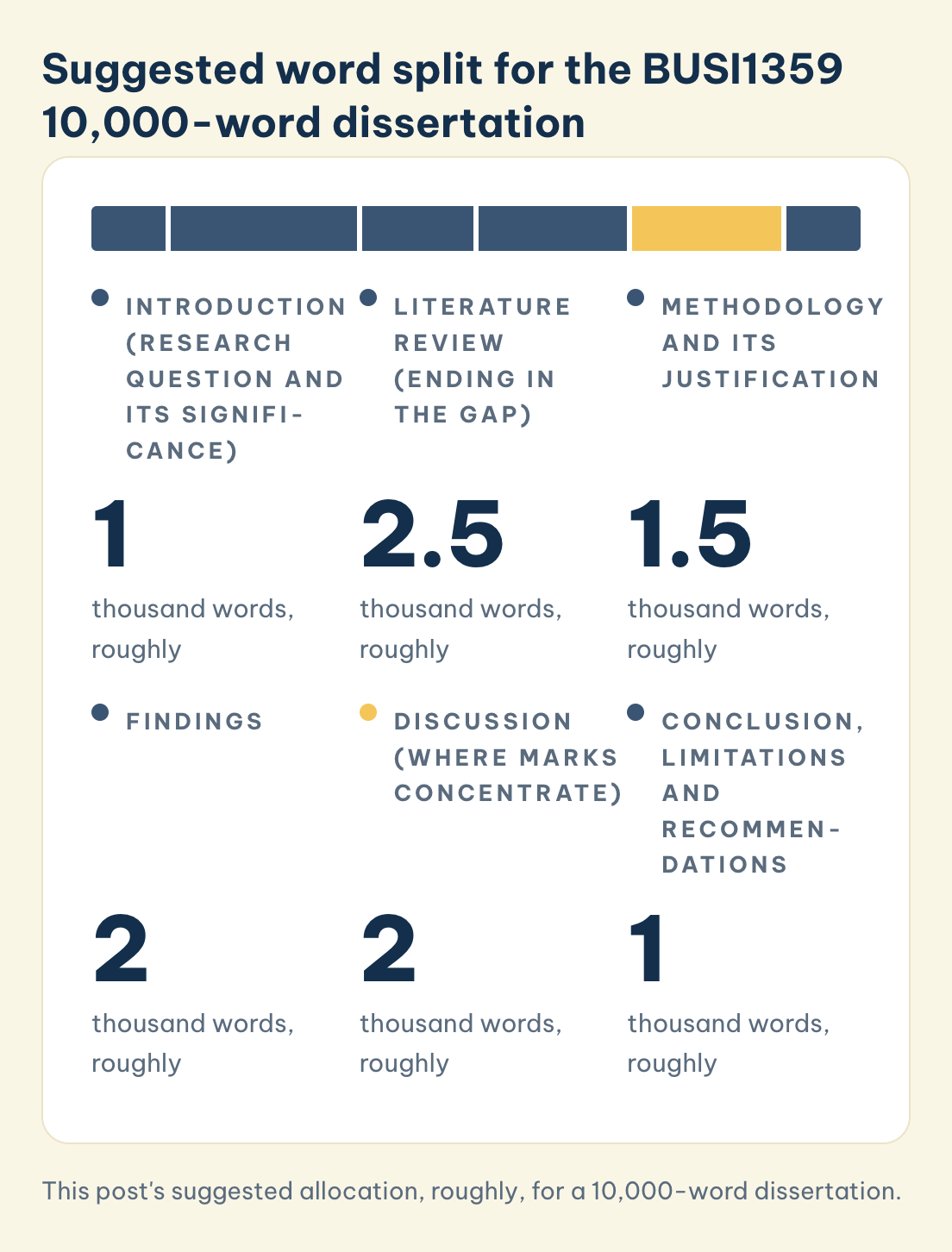
Direct answer: The conventional structure works, and at this length deviating from it costs you clarity rather than gaining you originality. A workable allocation: introduction, including the research question and its significance, around 1,000 words; literature review ending in the gap, around 2,500 words; methodology and its justification, around 1,500 words; findings, around 2,000 words; discussion linking findings back to the literature, around 2,000 words; conclusion, limitations and recommendations, around 1,000 words. The discussion chapter is where marks concentrate and where rushed dissertations are thinnest.
Suggested word split for the BUSI1359 10,000-word dissertation
A suggested split from this post, roughly, across six chapters. The yellow chapter is the discussion.
Introduction (research question and its significance)
1
thousand words, roughly
Literature review (ending in the gap)
2.5
thousand words, roughly
Methodology and its justification
1.5
thousand words, roughly
Findings
2
thousand words, roughly
Discussion (where marks concentrate)
2
thousand words, roughly
Conclusion, limitations and recommendations
1
thousand words, roughly
Save this figure
Evidence: The aims require you to follow a logical flow of thoughts to draw conclusions from evidence, which is precisely what the discussion chapter does: it takes findings, returns them to the literature reviewed earlier, and explains what has changed in our understanding. A dissertation whose findings chapter is followed immediately by a conclusion has skipped the reasoning step the aims describe.
Example: A student allocated 4,000 words to her literature review and 900 to her discussion because the review was easier to write. Her mentor pointed out that the review demonstrates outcome 1 while the discussion demonstrates outcomes 2 and 4 together. Rebalancing towards the discussion, even by cutting good material from the review, raised the work against two outcomes instead of over-serving one.
◆ Question 6 / 7 · Common mistakes
What are the most common mistakes that lose marks in BUSI1359?
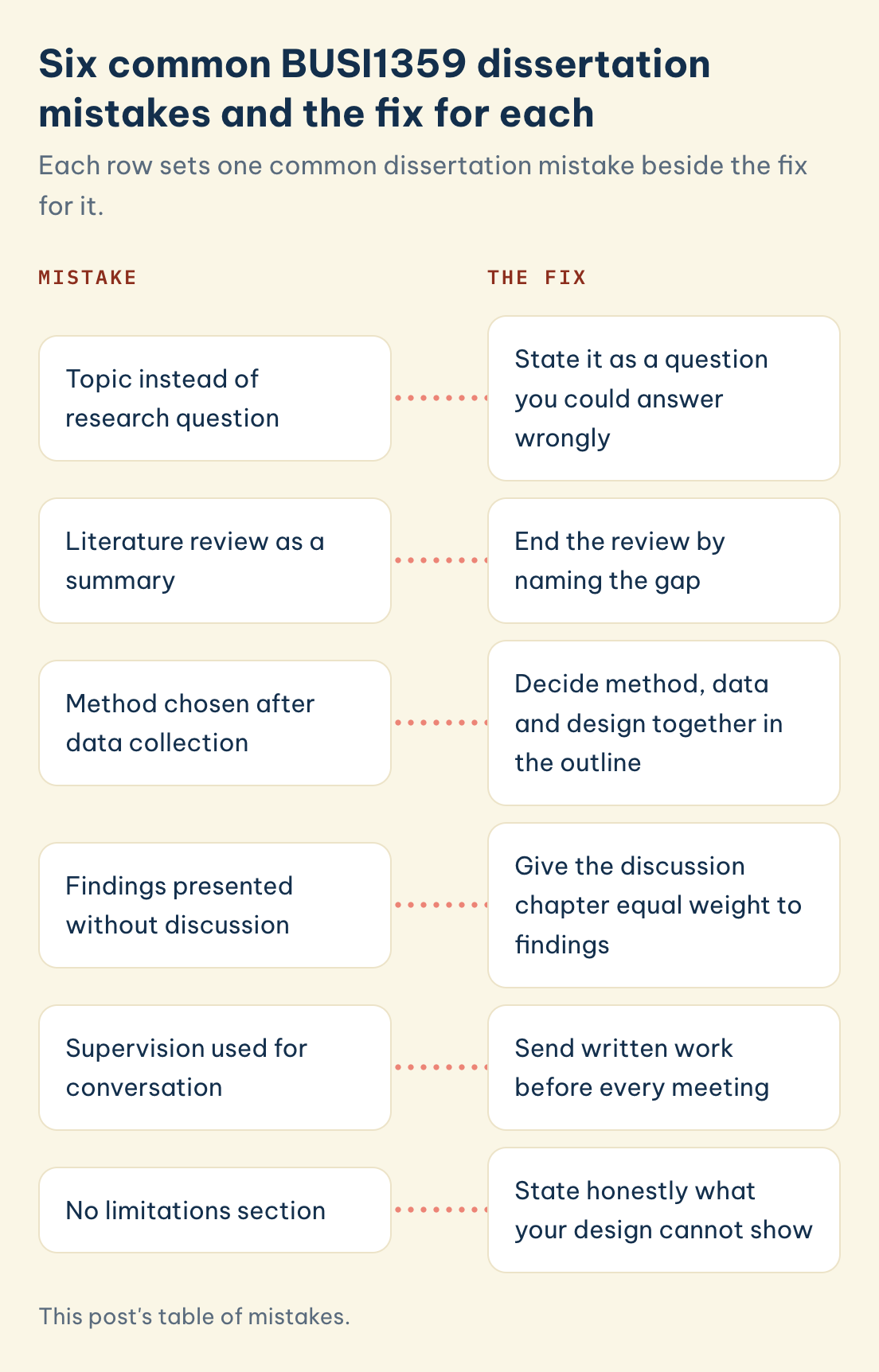
Direct answer: Master's dissertations of this type run into the same obstacles repeatedly.
Six common BUSI1359 dissertation mistakes and the fix for each
Each row sets one common dissertation mistake beside the fix for it.
Mistake
The fix
Topic instead of research question
State it as a question you could answer wrongly
Literature review as a summary
End the review by naming the gap
Method chosen after data collection
Decide method, data and design together in the outline
Findings presented without discussion
Give the discussion chapter equal weight to findings
Supervision used for conversation
Send written work before every meeting
No limitations section
State honestly what your design cannot show
Save this figure
| Mistake | Why it costs marks | The fix |
|---|---|---|
| Topic instead of research question | Nothing can be verified against a topic | State it as a question you could answer wrongly |
| Literature review as a summary | Outcome 1 asks you to perform a review, not report reading | End the review by naming the gap |
| Method chosen after data collection | Reverses the design logic the module teaches | Decide method, data and design together in the outline |
| Findings presented without discussion | Skips the reasoning that outcome 4 rewards | Give the discussion chapter equal weight to findings |
| Supervision used for conversation | Feedback needs text to attach to | Send written work before every meeting |
| No limitations section | Reads as unaware rather than confident | State honestly what your design cannot show |
Evidence: The module's aims explicitly require awareness of the state of the art in your chosen area. Awareness includes knowing the boundaries of your own contribution. A limitations section is not an apology; it is evidence that you understand what your method can and cannot establish.
Example: A student worried that admitting her sample was small would cost marks. Her mentor explained the opposite: an unacknowledged small sample looks like an oversight, while a discussed one looks like methodological awareness. Bryman, Bell and Harley (2019) treat the honest statement of limitations as part of methodological rigour rather than as a concession. She kept the finding, framed it as indicative rather than generalisable, and the chapter grew stronger.
◆ Question 7 / 7 · Managing the project
How do you manage a 10,000-word project alongside other modules?
Direct answer: Work backwards from the submission date in chapters, not in words. Give yourself a date for the outline, the literature review draft, the method chapter, data collection complete, findings drafted, full draft, and revision. The full draft date should sit at least 3 weeks before submission, because the discussion chapter almost always needs rewriting once you see your findings whole, and that rewrite is where the marks are.
Evidence: The module is explicitly designed around independent study, with the published aims naming responsibility for going through the successive steps of the research process with a view to meeting a deadline. Time management is not an incidental skill here; it appears in the aims themselves. The sector convention behind that workload is stated plainly in the regulator's own glossary: "one credit is typically described as being equal to 10 hours of notional learning" (Quality Assurance Agency for Higher Education, 2021, p. 2). At 30 credits, that puts BUSI1359 at around 300 hours of work, the great majority of it unscheduled, which is exactly why the module rewards a written plan rather than good intentions.
Example: A Vietnamese student planned to write 500 words a day and finish comfortably. She had not budgeted for the 2 weeks lost waiting for access to a dataset. Her mentor had her build float into the plan around the data-dependent steps specifically, since those are the only ones she could not control by working harder.
Frequently asked questions
Does the 1,000-word outline count towards my mark?
No, it is Pass or Fail. But it determines the shape of the 10,000 words that carry 100%, which is why the specification calls it a road map requiring a great deal of care.
Can I do a purely literature-based dissertation?
That depends on your programme's requirements, so check your handbook. What is fixed is outcome 3: you must identify, locate and use appropriate data and evidence, and documentary or secondary data can satisfy that when primary access is not feasible.
How many sources should the literature review contain?
Enough to establish the state of the art in your specific question, which is a judgement, not a number. A review with 40 sources that never reaches a position is weaker than one with 25 sources that does.
What if my findings contradict what I expected?
That is a good dissertation, not a failed one. Outcome 4 asks for conclusions based on evidence. Evidence that surprises you is more valuable than evidence that confirms you, provided you discuss why the difference arose.
Can MAAS help me with BUSI1359?
MAAS mentors work with you through the phased research process, from framing a feasible question and outline, to structuring the literature review as an argument, to preparing for supervision. You remain the author and the researcher; the mentor's role is to test your reasoning and show you where an examiner would push back.
From subject area to answerable question
The dissertations that go well rarely stand out for with the most ambitious topics. What they share is that they where the question is narrow enough to answer, the method is feasible before it is elegant, and the outline was written as if it mattered. If you have a subject area but not yet a question you could answer wrongly, a MAAS mentor can work through the framing with you before the outline is due.
Talk to a MAAS mentor about your module
Related guides
References
- Boote, D. N., & Beile, P. (2005). Scholars before researchers: On the centrality of the dissertation literature review in research preparation. Educational Researcher, 34(6), 3–15. https://doi.org/10.3102/0013189X034006003
- Bryman, A., Bell, E., & Harley, B. (2019). Business research methods (5th ed.). Oxford University Press.
- Hart, C. (2018). Doing a literature review: Releasing the research imagination (2nd ed.). SAGE.
- Quality Assurance Agency for Higher Education. (2021). Higher education credit framework for England: Advice on academic credit arrangements (2nd ed.). Retrieved August 21, 2026, from https://www.qaa.ac.uk/docs/qaa/quality-code/higher-education-credit-framework-for-england.pdf
- Saunders, M., Lewis, P., & Thornhill, A. (2019). Research methods for business students (8th ed.). Pearson.
Tools & resources
- University of Greenwich. (n.d.). Module information [Module catalogue entry]. Retrieved July 29, 2026, from https://www.gre.ac.uk/modules/modules?crse=1359&subj=BUSI&term=205000
- University of Greenwich. (n.d.). Academic skills. Retrieved July 29, 2026, from https://www.gre.ac.uk/students/support/academic-skills
This article is part of the MAAS Journal series for Vietnamese international students. MAAS Assignment & Essay Support is an academic support partner; we coach students through the phased research process with developmental feedback from discipline-matched experts. We do not write or submit work on a student's behalf.
A free 20-minute consultation is a conversation about where you are with BUSI1359.
Book a free consultation ▸