
◆ Business & Management
SM4022 Globalisation, Innovation, Sustainability: what's the argument?
SM4022 is a core master's module at Newcastle Business School, Northumbria University, and its framing catches students out. Most arrive expecting sustainability to appear as a chapter on corporate responsibility, something a firm does alongside its strategy. The module argues the opposite: it develops critical thinking about sustainable strategic alternatives for international organisations pursuing competitive advantage through innovation, where sustainability is a route to advantage rather than a cost. Getting that inversion right is most of the work.

◆ Question 1 / 7 · About the module
What is SM4022 about?
Direct answer: SM4022 is a core module worth 20 credits on Northumbria's MSc International Business Management and related programmes. It examines the contemporary economic landscape following global recession and develops critical thinking about sustainable strategy. Content is structured around five pillars: post-recession conditions, international growth, innovation, global leadership, and corporate social responsibility.
Evidence: The five pillars are not five separate topics. Read in order they form a chain: the economic conditions constrain the growth strategies available, growth requires innovation, innovation has to be led inside a global structure, and CSR is where the firm's choices meet public expectation. A submission that treats them as five headings has taken the syllabus and missed the argument.
Example: A Vietnamese student on the MSc told her MAAS mentor she planned to write "one section per pillar". Her mentor asked what her conclusion would be. She did not have one, because five parallel descriptions do not produce a position. Rebuilding around a single firm facing a single growth decision made all five pillars relevant to one argument rather than to five.
◆ Question 2 / 7 · Global recession
Why does the module start from the global recession?
Direct answer: Because it sets the constraint. Starting from post-recession conditions frames international growth as something firms pursue under pressure, with tighter capital, more cautious consumers, greater political scrutiny and less tolerance for waste. That framing is what makes sustainability strategically interesting rather than merely virtuous: in a constrained environment, resource efficiency and legitimacy become competitive variables.
Hart (1995) made the underlying strategic case well before this framing became standard teaching, arguing that pollution prevention, product stewardship and sustainable development give firms a resource-based advantage rivals cannot easily copy, which is the theoretical foundation the module's opening move draws on.
Evidence: The module description explicitly links the contemporary economic landscape to the search for sustainable strategic alternatives. That link is the module's central move. It positions sustainability as a response to real economic conditions rather than as an ethical preference layered on top of a strategy that was already decided.
Example: A student argued that his case firm should "invest in sustainability because it is the right thing to do". His mentor asked what the firm's board would say if the investment reduced returns. He had no answer. Reframing the same investment as a hedge against input-price volatility and regulatory tightening gave the board a reason and gave his argument its analytical footing.
◆ Question 3 / 7 · Sustainability and CSR
How is sustainability different from CSR in this module?
Direct answer: CSR is one of the five pillars, not the whole subject. In practice the useful distinction is that CSR describes what a firm does with its profits and its conduct, while sustainability in the strategic sense asks whether the firm's business model can keep working under future resource, regulatory and social conditions.
A firm can have an admired CSR programme and an unsustainable business model at the same time, and saying so precisely is the kind of judgement this module rewards. It helps to know what shared value was written against: Friedman (1970) argued in his New York Times Magazine essay that a firm's only social responsibility is to increase its profits within the rules of the game, and Porter and Kramer's later framework is best read as a direct answer to that position rather than as a free-standing idea.
Evidence: The module lists corporate social responsibility initiatives as one pillar alongside innovation frameworks and international growth strategies, which places CSR as a component of the strategic picture rather than as its conclusion. Elkington (1997) popularised the triple bottom line of economic, social and environmental performance, and in a 2018 Harvard Business Review essay marking the concept's 25th anniversary, Elkington (2018) reflected that it had too often been reduced to an accounting exercise rather than the systemic rethink of capitalism he originally intended, a caution that is directly useful when you assess a firm's reporting.
Example: A student's analysis praised a fast-fashion retailer's recycling initiative at length. Her mentor asked what proportion of the firm's environmental impact the initiative addressed, and whether the underlying model depended on volume. Once she looked, the initiative turned out to be marginal to a model built on throughput. That gap between the programme and the model became the strongest paragraph in her work.
◆ Question 4 / 7 · Frameworks
Which frameworks should you use in SM4022?
Direct answer: Choose frameworks that let you argue about advantage, not just describe good behaviour.
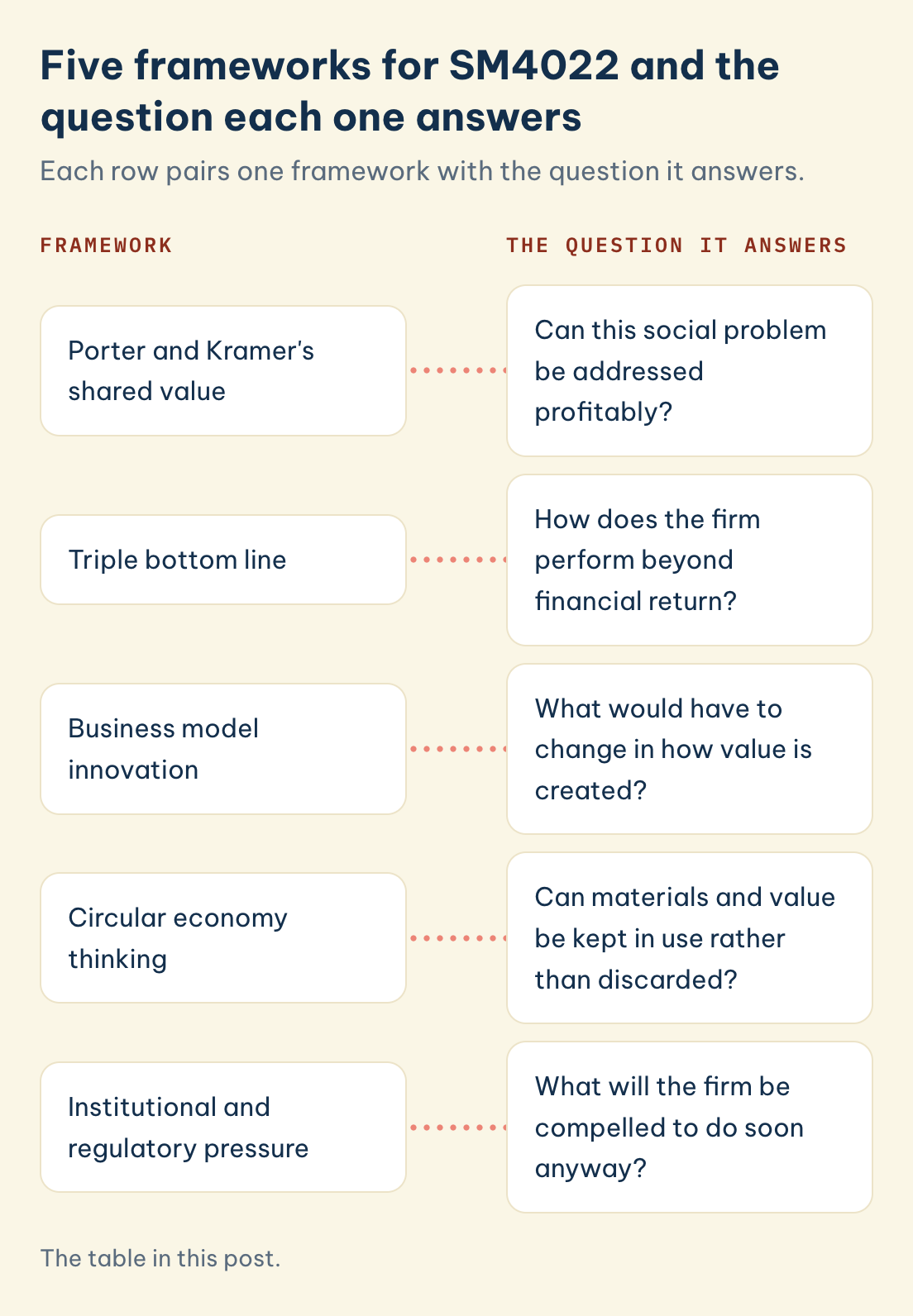
Five frameworks for SM4022 and the question each one answers
Each row pairs one framework with the question it answers.
Framework
The question it answers
Porter and Kramer's shared value
Can this social problem be addressed profitably?
Triple bottom line
How does the firm perform beyond financial return?
Business model innovation
What would have to change in how value is created?
Circular economy thinking
Can materials and value be kept in use rather than discarded?
Institutional and regulatory pressure
What will the firm be compelled to do soon anyway?
Save this figure
| Framework | The question it answers | Where students go wrong |
|---|---|---|
| Porter and Kramer's shared value | Can this social problem be addressed profitably? | Using it to relabel ordinary philanthropy |
| Triple bottom line | How does the firm perform beyond financial return? | Treating it as a reporting template |
| Business model innovation | What would have to change in how value is created? | Confusing product innovation with model change |
| Circular economy thinking | Can materials and value be kept in use rather than discarded? | Describing recycling instead of redesign |
| Institutional and regulatory pressure | What will the firm be compelled to do soon anyway? | Ignoring anticipated regulation entirely |
Evidence: Porter and Kramer opened their argument by naming the legitimacy problem directly, "Companies are widely perceived to be prospering at the expense of the broader community" (Porter and Kramer, 2011), and argued that firms create shared value when they address societal needs in ways that also generate economic value, explicitly distinguishing this from corporate social responsibility conceived as redistribution. That distinction gives you a precise test to apply: does the initiative you are analysing create value for the firm and for society through the same activity, or does it simply spend some of the firm's profit on a social outcome? Teece (2010) supplies the framework-level reason a good idea can still fail commercially: a business model articulates the logic by which a firm creates, delivers and captures value, and innovation that changes what is offered without changing that logic often lets competitors or customers capture the value instead of the innovating firm. Geissdoerfer et al. (2017) make the equivalent point for circular economy proposals, cautioning that the term is used to mean genuinely different things across the literature, so a submission that cites "the circular economy" without specifying which relationship to sustainability it means has not yet made an argument. DiMaggio and Powell (1983) give the institutional-pressure row its theoretical basis, showing that organisations in the same field converge on similar practices under coercive, mimetic and normative pressure, which is why anticipated regulation is a strategic variable rather than background noise.
Example: A student analysing a beverage company's water stewardship programme initially classified it as CSR. Applying the shared value test, she found the programme secured the firm's own water supply in a stressed catchment while improving local access. It was not philanthropy; it was risk management that happened to benefit both parties. Naming it correctly changed her whole assessment of the firm's strategy.
◆ Question 5 / 7 · Structure
How should you structure the work?
Direct answer: Structure around a decision under constraint. A shape that serves the module's chain: (1) the firm and the growth decision it faces, plus the economic conditions constraining it; (2) the strategic alternatives realistically available; (3) the innovation required for the sustainable alternative, at product, process or business-model level; (4) what leading that change demands inside a global structure; (5) how the firm's CSR position either supports or contradicts the strategy; (6) a recommendation with the trade-off stated honestly. Step five is where the sharpest analysis usually sits, because that is where stated commitments meet actual choices.
Evidence: The module asks for critical thinking about sustainable strategic alternatives, which is a comparative task. An answer that examines one option cannot demonstrate the comparison the word implies. At least two realistic alternatives, assessed against the same criteria, is the minimum the framing requires. Teece (2010) is useful again at step three: an innovation that changes the product without changing how the firm creates, delivers and captures value has not actually changed the business model, however it is labelled.
Example: A student recommended that his case firm shift to a circular model and devoted 2,000 words to why it was desirable. His mentor asked what the firm would do instead if it did not, and what that cheaper path would cost it over 5 years. Adding the comparison made the recommendation persuasive for the first time, because it now had something to be better than.
◆ Question 6 / 7 · Common mistakes
What are the most common mistakes in SM4022?
Direct answer: Modules of this type draw the same errors year after year.
| Mistake | Why it costs marks | The fix |
|---|---|---|
| One section per pillar | Produces description, not an argument | Build around one decision the pillars all bear on |
| Sustainability argued morally | The module frames it as competitive advantage | Give the board a commercial reason as well |
| Only one alternative considered | "Alternatives" is comparative by definition | Assess at least two against the same criteria |
| Recycling presented as innovation | Confuses an initiative with a model change | Ask what changed in how value is created |
| CSR report quoted as evidence | It is the firm's own account of itself | Test claims against the model and the numbers |
| No trade-off acknowledged | Reads as advocacy rather than analysis | State what the recommendation costs and who bears it |
Evidence: At Level 7 the assessment is testing judgement under uncertainty rather than knowledge of frameworks. Sustainability topics are especially prone to advocacy writing, where the student argues for an outcome they personally favour and treats the costs as an inconvenience. Naming the trade-off is what converts advocacy into analysis, and its absence is exactly what Elkington (2018) later criticised in how his own triple bottom line concept had come to be used, reduced to a reporting exercise that named no real cost to anyone.
Example: One student's recommendation would have required her case firm to exit its most profitable product line. Her mentor did not tell her to change the recommendation; he asked her to say so plainly and explain why the long-run case still held. The honest version was far more convincing than the version that had quietly omitted the cost.
◆ Question 7 / 7 · Sustainability reports
How do you use company sustainability reports without being captured by them?
Direct answer: Treat them as evidence of what the firm wants to be seen doing, which is genuinely useful information, but not as evidence that it is happening. Cross-check three things: whether the claims are measured or merely described, whether the boundary of the reporting covers the supply chain or only owned operations, and whether the targets are near enough to hold anyone accountable.
Evidence: The module places CSR initiatives inside a strategic analysis rather than treating them as the object of study, which invites exactly this critical distance. A firm's own report is a primary source about its positioning, and reading it as a positioning document rather than as a factual record is the more analytically defensible stance.
Example: A Vietnamese student analysing a manufacturer found an impressive emissions reduction figure. Her mentor asked which scope it covered. It covered the firm's own facilities, while the great majority of the sector's emissions sit in the supply chain. Noting the boundary did not disprove the achievement, but it changed what the achievement meant, and that observation demonstrated more than any summary of the report could have.
The theory this module draws on, in brief:
- Hart (1995) proposed that pollution prevention, product stewardship and sustainable development give a firm a resource-based advantage.
- Porter and Kramer (2011) argued that shared value is created when a firm addresses a societal need in a way that also generates economic value.
- Friedman (1970) set out the opposing classical position, that a firm's only responsibility is to increase its profits within the rules of the game.
- Elkington (1997) coined the triple bottom line of economic, social and environmental performance, then Elkington (2018) publicly reconsidered how the phrase had been used.
- Teece (2010) distinguished a business model, the logic by which a firm creates, delivers and captures value, from the strategy layered on top of it.
- Geissdoerfer et al. (2017) found the term "circular economy" used to mean genuinely different things across the literature it reviewed.
- DiMaggio and Powell (1983) showed that organisations in the same field converge under coercive, mimetic and normative pressure.
Frequently asked questions
Is SM4022 a CSR module?
No. CSR is one of five pillars. The module is about strategic alternatives under post-recession conditions, with sustainability treated as a potential source of competitive advantage through innovation.
Can I choose any company?
Usually within the brief. Choose one facing a genuine tension, where the sustainable option costs something real. A firm with no conflict between profitability and sustainability gives you nothing to analyse.
Do I need environmental science knowledge?
No. The analysis is strategic. What you need is the discipline to check whether a claim is measured, bounded and accountable, rather than technical expertise in emissions accounting, the same boundary-checking habit Hart (1995) built into his pollution-prevention and product-stewardship strategies.
Is it acceptable to conclude that a firm should not pursue the sustainable option?
Yes, if the analysis supports it and you state the long-run risk you are accepting. A defensible negative conclusion beats an undefended positive one.
Can MAAS help me with SM4022?
MAAS mentors work with you on choosing a firm with a real tension, building the comparison between alternatives against the institutional and regulatory pressures DiMaggio and Powell (1983) describe, and testing whether your recommendation survives its own trade-offs. You remain the author of your work; the mentor asks what your recommendation costs, and who pays.
Turning advocacy into analysis
Caring about the topic is not the same as analysing it. The submissions that land identify a real constraint, compare realistic alternatives against the same criteria, and say honestly what the recommended path costs and who pays for it, the discipline Friedman (1970) demanded of any claimed social benefit and Porter and Kramer (2011) demanded of any claimed shared value alike. If your draft currently reads as advocacy, a MAAS mentor can help you find the analysis underneath it.
Talk to a MAAS mentor about your module
Related guides
References
- DiMaggio, P. J., & Powell, W. W. (1983). The iron cage revisited: Institutional isomorphism and collective rationality in organizational fields. American Sociological Review, 48(2), 147–160. https://doi.org/10.2307/2095101
- Elkington, J. (1997). Cannibals with forks: The triple bottom line of 21st century business. Capstone.
- Elkington, J. (2018). 25 years ago I coined the phrase "triple bottom line." Here's why I'm giving up on it. Harvard Business Review. https://hbr.org/2018/06/25-years-ago-i-coined-the-phrase-triple-bottom-line-heres-why-im-giving-up-on-it
- Friedman, M. (1970). The social responsibility of business is to increase its profits. The New York Times Magazine.
- Geissdoerfer, M., Savaget, P., Bocken, N. M. P., & Hultink, E. J. (2017). The circular economy: A new sustainability paradigm? Journal of Cleaner Production, 143, 757–768. https://doi.org/10.1016/j.jclepro.2016.12.048
- Hart, S. L. (1995). A natural-resource-based view of the firm. Academy of Management Review, 20(4), 986–1014. https://doi.org/10.5465/amr.1995.9512280033
- Porter, M. E., & Kramer, M. R. (2011). Creating shared value. Harvard Business Review, 89(1-2), 62–77.
- Teece, D. J. (2010). Business models, business strategy and innovation. Long Range Planning, 43(2-3), 172–194. https://doi.org/10.1016/j.lrp.2009.07.003
Tools & resources
- Northumbria University. (n.d.). International Business Management MSc. Retrieved July 29, 2026, from https://www.northumbria.ac.uk/study-at-northumbria/courses/international-business-management-dtfinb6/
- Northumbria University. (n.d.). Skills Plus. Retrieved July 29, 2026, from https://www.northumbria.ac.uk/about-us/university-services/library/skills-plus/
This article is part of the MAAS Journal series for Vietnamese international students. MAAS Assignment & Essay Support is an academic support partner; we coach students through the Outline, Draft, Final delivery model with developmental feedback from discipline-matched experts. We do not write or submit work on a student's behalf.
A free 20-minute consultation is a conversation about where you are with SM4022.
Book a free consultation ▸