
◆ Research Methods
How do you write a research hypothesis, with examples?
A research hypothesis is a testable prediction about how two or more variables relate, written before you collect data. Praharaj and Ameen (2025) describe it as a statement that flows directly from the research question, and university guides in Australia and the United States add that it must be specific enough for evidence to prove it wrong.
This guide shows how to write one in six steps, gives worked examples from psychology, business, education, health and environmental science, and explains which "types" of hypothesis you actually need to know. If you are still shaping the question your hypothesis answers, start with how to write research questions and objectives.
◆ Question 1 / 8 · Definition
What is a research hypothesis?
Direct answer: A research hypothesis is a clear, specific and testable statement that predicts the relationship between variables in your study. Praharaj and Ameen (2025) add that it is always generated before the research is carried out, so a prediction written after you have seen the results does not count as a hypothesis.
Praharaj and Ameen (2025) put the definition in one line: "A research hypothesis is a predictive statement about the expected relationship between two or more variables" (Praharaj & Ameen, 2025, p. 86). The Texas A&M University Writing Center (n.d.) draws the line between a question and a hypothesis on the basis of prior knowledge. A research question can be posed with no idea of what the data might show, whereas a hypothesis is formed from what you already know about the topic, so it predicts the outcome rather than asking about it. McCombes (2022) makes the same point from the student side: a hypothesis is a tentative answer to your research question, and it should rest on existing theory and earlier studies rather than on a hunch.
Not every project needs one. The University of Melbourne, Academic Skills (n.d.) states plainly that not all research has a hypothesis, and that whether you need one depends on your discipline and topic. Praharaj and Ameen (2025) give the usual exception, descriptive studies that only observe and record the characteristics of a population, which can work with an aim, research questions and objectives alone.
◆ Question 2 / 8 · A good sentence
What makes a good hypothesis sentence?
Direct answer: A good hypothesis sentence is a statement, not a question, that names the variables, the group being studied and the predicted outcome. It must be falsifiable, meaning a possible result could show it is wrong, and it should avoid conditional words such as should, might or could (Texas A&M University Writing Center, n.d.).
The University of Melbourne, Academic Skills (n.d.) reduces the standard to three tests. A hypothesis should be in the form of a statement, it should be disprovable, and it should be clear and specific in scope. Its model example reads: "Undergraduate students who participate in a stress-reduction seminar will report an increase in their well-being after six weeks." That sentence names one group, one intervention, one outcome and one time frame, so a pre and post survey could support it or refute it.
Cuttler (2017), writing for psychology students, explains why testability matters. A hypothesis is a specific prediction about what should be observed if a particular theory is accurate, which is why theories and hypotheses share an if-then relationship. The Texas A&M University Writing Center (n.d.) shows the opposite case: a moral or ethical question, such as whether students should follow an honour code, cannot become a hypothesis, because no observation could test it. The practical fix is to establish variables that can be observed or measured inside the sentence itself.
| Weak version | Problem | Stronger version |
|---|---|---|
| Does social media affect students? | A question, with no prediction | Time spent on social media is negatively correlated with attention span in under-16s |
| Flexible hours might improve satisfaction | Conditional word, no comparison group | Employees with flexible hours report greater job satisfaction than employees on fixed hours |
| Students should follow the honour code | Value judgement, not testable | Students who complete an integrity module submit fewer flagged assignments than students who do not |
| Exercise and diet improve health | Two relationships in one sentence | Split into one hypothesis for exercise and one for diet |
The first two stronger versions in the table come from the worked examples in McCombes (2022). The third and fourth are illustrations written for this guide.
◆ Question 3 / 8 · Step by step
How do you write your hypothesis step by step?
Direct answer: Start from a focused research question, read the theory and previous studies, write an initial answer, refine it until it names the variables, the group and the predicted outcome, phrase it in a standard form, and add a null hypothesis if you will test it statistically. McCombes (2022) sets out these six steps.
Writing a research hypothesis in six steps
Tap a step to see what it adds to the hypothesis.
Step 1 of 6
Ask
Start from a focused research question, such as whether students who attend more lectures get better exam results.
Step 2 of 6
Read
Do preliminary research on theory and previous studies so the answer rests on evidence, not a hunch.
Step 3 of 6
Answer
Write an initial answer: attending more lectures leads to better exam results.
Step 4 of 6
Refine
Add the variables, the specific group and the predicted outcome, such as first-year students and exam scores.
Step 5 of 6
Phrase
Choose a form: if-then, an effect or correlation statement, or a comparison between groups.
Step 6 of 6
Null
Write the null hypothesis H0 beside the alternative H1 if you will test it statistically.
Save this figure
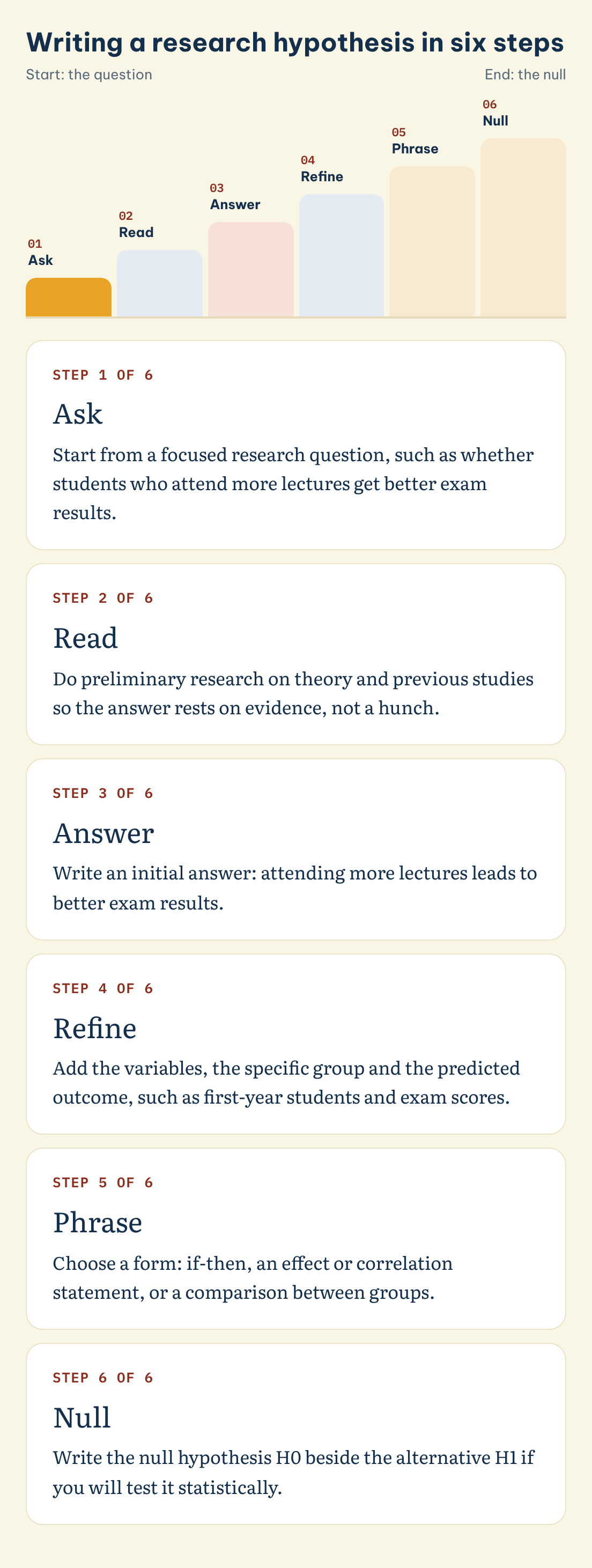
McCombes (2022) uses one running example that shows each step at work. The research question asks whether students who attend more lectures get better exam results. Preliminary reading suggests attendance and performance are linked, so the initial answer becomes "attending more lectures leads to better exam results". Refining it means adding the relevant variables, the specific group being studied and the predicted outcome, which narrows the population to first-year students and the outcome to exam scores.
The fifth step is choosing a sentence form, and McCombes (2022) offers three. The if-then form states the independent variable first and the dependent variable second: "If a first-year student starts attending more lectures, then their exam scores will improve." The effect form, which is more common in academic writing, states the relationship directly: "The number of lectures attended by first-year students has a positive effect on their exam scores." The comparison form states the difference you expect between two groups. The sixth step adds the null hypothesis, the default position of no association, written H0, alongside the alternative hypothesis H1 or Ha. Our guide to writing a dissertation proposal shows where these statements sit in the proposal itself.
◆ Question 4 / 8 · Examples by discipline
What are some hypothesis examples in research?
Direct answer: Good examples follow the same pattern across disciplines: a defined group, an independent variable, a dependent variable and a predicted direction. The table below gives one example per discipline, drawn from university guides, a journal article and Scribbr, so you can copy the structure rather than the topic.
| Discipline | Example hypothesis | Source |
|---|---|---|
| Psychology | If drive theory is correct, cockroaches run a straight runway faster when other cockroaches are present | Cuttler (2017) |
| Clinical psychology | At eight weeks, adults receiving cognitive behavioural therapy will show a significantly greater reduction in depression symptoms than adults receiving behavioural activation | Praharaj and Ameen (2025) |
| Business and management | Employees who have flexible working hours will report greater job satisfaction than employees who work fixed hours | McCombes (2022) |
| Education | Undergraduate students who participate in a stress-reduction seminar will report an increase in their well-being after six weeks | University of Melbourne, Academic Skills (n.d.) |
| Health | Increasing apple consumption in over-60s will result in decreasing frequency of doctor's visits | McCombes (2022) |
| Agriculture | When cattle are fed a steady diet of Antibiotic X, traces of Antibiotic X remain in beef produced for consumers | Texas A&M University Writing Center (n.d.) |
Two patterns stand out when the rows are read together. Each example names who is studied, what changes and what is measured, which is exactly the refinement step in McCombes (2022). Each one could also fail, because a result showing no difference, or a difference in the other direction, would count against it. An environmental science student might write, as an illustration, that "urban sites with more than 30% tree canopy record lower summer surface temperatures than sites with less than 10%". That sentence follows the same pattern, and the thresholds would come from the student's own literature review.
◆ Question 5 / 8 · Psychology
Which hypothesis examples work for psychology?
Direct answer: Psychology hypotheses are usually derived from a named theory and tested in an experiment or survey, so the strongest ones state what the theory predicts in a specific situation. Cuttler (2017) notes that the very best hypotheses distinguish between competing theories, because one result supports one theory and undermines the other.
Cuttler (2017) gives an example from expressive writing research. If habituation theory is correct, writing about positive experiences should not improve health in the way writing about traumatic experiences does, because it would not cause people to habituate to negative thoughts and feelings. A student hypothesis built on that logic might predict fewer signs of emotional distress with each new writing session. Cuttler (2017) also describes a study by Schwarz and colleagues that asked people to recall either 6 or 12 occasions when they were assertive, which tested whether people judge themselves by the number of examples they recall or by how easily the examples come to mind. A psychology hypothesis written in that spirit names the theory, the manipulation and the measure in one sentence.
◆ Question 6 / 8 · Types
What are the 7 types of hypothesis?
Direct answer: There is no single official list of seven. Lists online mix categories, such as simple, complex, directional, non-directional, null, alternative and associative, that overlap. For a thesis, the distinctions that matter are null versus alternative, directional versus non-directional, and primary versus secondary (Praharaj & Ameen, 2025).
Praharaj and Ameen (2025) describe the pair most methods chapters need. The null hypothesis asserts no difference or relationship between the variables, typically written as "there will be no difference between...", while the alternative hypothesis is a positive or directional statement, such as "there will be a greater reduction in mean scores". They also note that a study may state secondary hypotheses alongside the primary one, mentioned only when they are relevant. Dissertations often include both the null and the alternative form, even though many journal papers state only the alternative.
| Distinction | What it means | Example wording |
|---|---|---|
| Null (H0) | No difference or relationship | There will be no difference in exam scores between the two groups |
| Alternative (H1 or Ha) | A difference or relationship exists | Students who attend most lectures will have higher exam scores |
| Directional | Predicts which way the effect goes | Higher attendance leads to higher scores |
| Non-directional | Predicts a difference without saying which way | Exam scores differ between high and low attendance groups |
| Primary and secondary | The main prediction and any supporting ones | Illustration: primary, symptom reduction; secondary, relapse rates |
Directional and non-directional hypotheses link to one-tailed and two-tailed tests. Praharaj and Ameen (2025) report that two-tailed tests are preferred in practice, and that one-tailed tests are rarely carried out. If you need the statistical side of the null and alternative pair in more depth, read our guide on choosing the right statistical test.
◆ Question 7 / 8 · Mistakes
What mistakes should you avoid when writing a hypothesis?
Direct answer: The most common mistakes are writing the hypothesis as a question, hedging with should or might, combining two relationships in one sentence, and writing the hypothesis after seeing the results. Kerr (1998) named that last habit HARKing, short for hypothesizing after the results are known.
Kerr (1998) describes HARKing as presenting a hypothesis that was formed after looking at the data as if it had been stated in advance. It removes the point of the test, because the prediction is no longer independent of the evidence used to check it, and it contradicts the requirement in Praharaj and Ameen (2025) that a hypothesis is generated a priori. The Texas A&M University Writing Center (n.d.) adds a reporting rule that prevents a related error: when you write up results, state that H0 was rejected in favour of the alternative, rather than claiming the alternative was proved. Keeping one relationship per hypothesis also keeps each statistical test answering exactly one question, which makes your research methodology chapter easier to justify.
◆ Question 8 / 8 · Getting a review
Can a mentor review your hypothesis before you submit a proposal?
Many students write their hypotheses alone, and the skill is worth building yourself. A second reader can still help with the parts that are hard to see from inside a project: whether a variable is defined clearly enough to measure, whether two relationships are hiding in one sentence, and whether the hypothesis matches the design you plan to use. Through research proposal support at MAAS, you write the proposal and the hypotheses, and an expert in your field reviews your drafts and comments on how they connect to your question and method. Bring your research question, your reading list and your supervisor's feedback to the first conversation so the comments respond to your actual project.
Frequently asked questions
What is a good sentence for a hypothesis?
A good hypothesis sentence names the group, the independent variable, the dependent variable and the predicted direction. For example, "Employees who have flexible working hours will report greater job satisfaction than employees who work fixed hours" (McCombes, 2022). It is a statement, not a question, and it avoids words such as might or could (Texas A&M University Writing Center, n.d.).
Does every research project need a hypothesis?
No. The University of Melbourne, Academic Skills (n.d.) states that not all research has a hypothesis, and Praharaj and Ameen (2025) note that descriptive studies typically work with an aim, questions and objectives instead. Many qualitative projects follow the same pattern, so check your department's proposal template.
What is the difference between a hypothesis and a research question?
A research question asks what you want to find out, while a hypothesis predicts the answer. The Texas A&M University Writing Center (n.d.) explains that a hypothesis is formed from existing knowledge about the topic, whereas a question can be posed without any idea of what the data might show.
Can a hypothesis be written as an if-then statement?
Yes. McCombes (2022) recommends the if-then form as a way to identify your variables, with the independent variable in the first half and the dependent variable in the second. Academic papers more often state the relationship directly, as an effect or a correlation.
How many hypotheses should a dissertation have?
There is no fixed number. Praharaj and Ameen (2025) describe one primary hypothesis with secondary hypotheses added only when they are relevant, and each hypothesis should test one relationship. Your department's template may set its own expectations.
What happens if my results do not support my hypothesis?
An unsupported hypothesis is still a valid result. The Texas A&M University Writing Center (n.d.) notes that even a rejected hypothesis can inform a new one or help narrow down causes, and you report that the null hypothesis was not rejected rather than hiding the finding.
References
Cuttler, C. (2017, August 21). 2.4 Developing a hypothesis. In Research methods in psychology. Washington State University. https://opentext.wsu.edu/carriecuttler/chapter/developing-a-hypothesis/
Kerr, N. L. (1998). HARKing: Hypothesizing after the results are known. Personality and Social Psychology Review, 2(3), 196–217. https://doi.org/10.1207/s15327957pspr0203_4
McCombes, S. (2022, May 6). How to write a strong hypothesis. Scribbr. https://www.scribbr.co.uk/research-methods/hypothesis-writing/
Praharaj, S. K., & Ameen, S. (2025). Aim, research questions, objectives, and hypotheses: Which one and how to write in a manuscript? Kerala Journal of Psychiatry, 38(1), 84–88. https://doi.org/10.30834/kjp.38.1.2025.549
Texas A&M University Writing Center. (n.d.). Hypotheses. https://writingcenter.tamu.edu/guides/resources/hypotheses.html
University of Melbourne, Academic Skills. (n.d.). Shaping the research question and hypothesis. https://students.unimelb.edu.au/academic-skills/graduate-research-services/writing-thesis-sections-part-2/shaping-the-research-question-and-hypothesis
Not sure how this guide applies to your own case? Talk it through with MAAS in a free 20-minute consultation.
Book a free consultation ▸