
NX0480 is the one module on your Newcastle Business School masters where the university stops telling you what to do. That single word, optional, changes the question you should be asking. Before you ask how to write it, you have to decide whether to take it at all, a decision most students never stop to weigh. This guide answers the questions Vietnamese students at Northumbria bring to MAAS mentors before that choice closes.
Author: MAAS Editorial Team
Last updated: 2026-08-06
Category: thesis-dissertation
What is NX0480 and why does the word "optional" matter?
Direct answer: NX0480 is The Newcastle Business School Masters Dissertation, a 60 credit module ending in a 15,000 word dissertation. Northumbria lists it as optional across NBS masters programmes, including MSc International Business Management, MSc Business Analytics, and MSc Finance, plus their Advanced Practice variants. Because it is optional, taking it is a decision you make, not inherit.
Evidence: The module description published on Northumbria's own course pages sets out what the dissertation must demonstrate: justification for the choice of topic; critical analysis of existing and up to date literature evidenced by a comprehensive, well referenced literature review; selection, justification and application of an appropriately rigorous methodology including the limitations of the approach selected; a clear statement of findings; critical analysis of those findings; explicit links between the analysis and the conclusions supported by critical argument; and evidence of original work or thought.
Example: A Vietnamese MSc student at NBS came to MAAS asking for help "writing the dissertation faster". Her mentor asked a prior question she had not considered: had she chosen NX0480 deliberately, or drifted into it because her classmates did? She had drifted. Once she looked at the seven assessed elements against her own research experience, she still chose the dissertation, but she chose it knowing what she was buying, and that changed how she planned the summer.
Who genuinely benefits from the dissertation route?
Direct answer: The dissertation route suits you if you intend to apply for a PhD, if you want evidence of independent research for a role in analysis, consulting or policy, or if you already have a research question you cannot stop thinking about. It suits you less if your goal is a practice oriented career, if your programme offers a consultancy or applied alternative that matches your target job better, or if your personal circumstances over the dissertation period are genuinely unstable.
Evidence: Research on postgraduate progression consistently finds that completion is shaped less by ability than by conditions. Mudzi et al. (2022), surveying Master of Nursing students in Gauteng province, South Africa, found that masters students studying full time reported significantly better research writing support than part time students, and that work and life balance was a recurring difficulty even among students who otherwise felt well supported. Reid-Hector et al. (2021), writing in the Journal on Excellence in College Teaching, similarly found that graduate degree completion often slows specifically during the capstone or thesis phase rather than during taught modules, the same phase this 60 credit module occupies on an NBS masters.
Example: A student working 25 hours a week in a Newcastle restaurant asked MAAS whether he could "just push through" NX0480. His mentor did not tell him yes or no. They mapped his actual free hours against the 60 credit workload, which is a full third of a 180 credit masters. He chose the dissertation anyway, but he renegotiated his shifts first. The decision held because it was made with the arithmetic in front of him.
What do the seven assessed elements actually ask for?
Direct answer: The seven elements are not seven boxes; they are one argument told in sequence. Topic justification explains why the question is worth asking. The literature review shows what is already known and where the gap sits. Methodology explains how you will answer the question and why that method is defensible. Findings report what you found. Critical analysis interprets it. Conclusions connect interpretation back to the question. Originality is what emerges when the other six hold together.
Evidence: Note the two words the descriptor uses about literature: "up to date". A review built mainly on sources from a decade ago will read as a summary of a settled field rather than an argument about a live one. Note also that methodology must include "limitations of the approach selected", which means limitations are an assessed component, not an apology tacked on at the end.
Example: A MAAS mentee's first NX0480 draft had a strong literature review and a weak methodology chapter of barely 900 words. Her mentor asked one question repeatedly: "why this method and not the obvious alternative?" She rewrote the chapter around that comparison. The word count roughly doubled, but more importantly the chapter started defending a choice rather than describing a procedure.
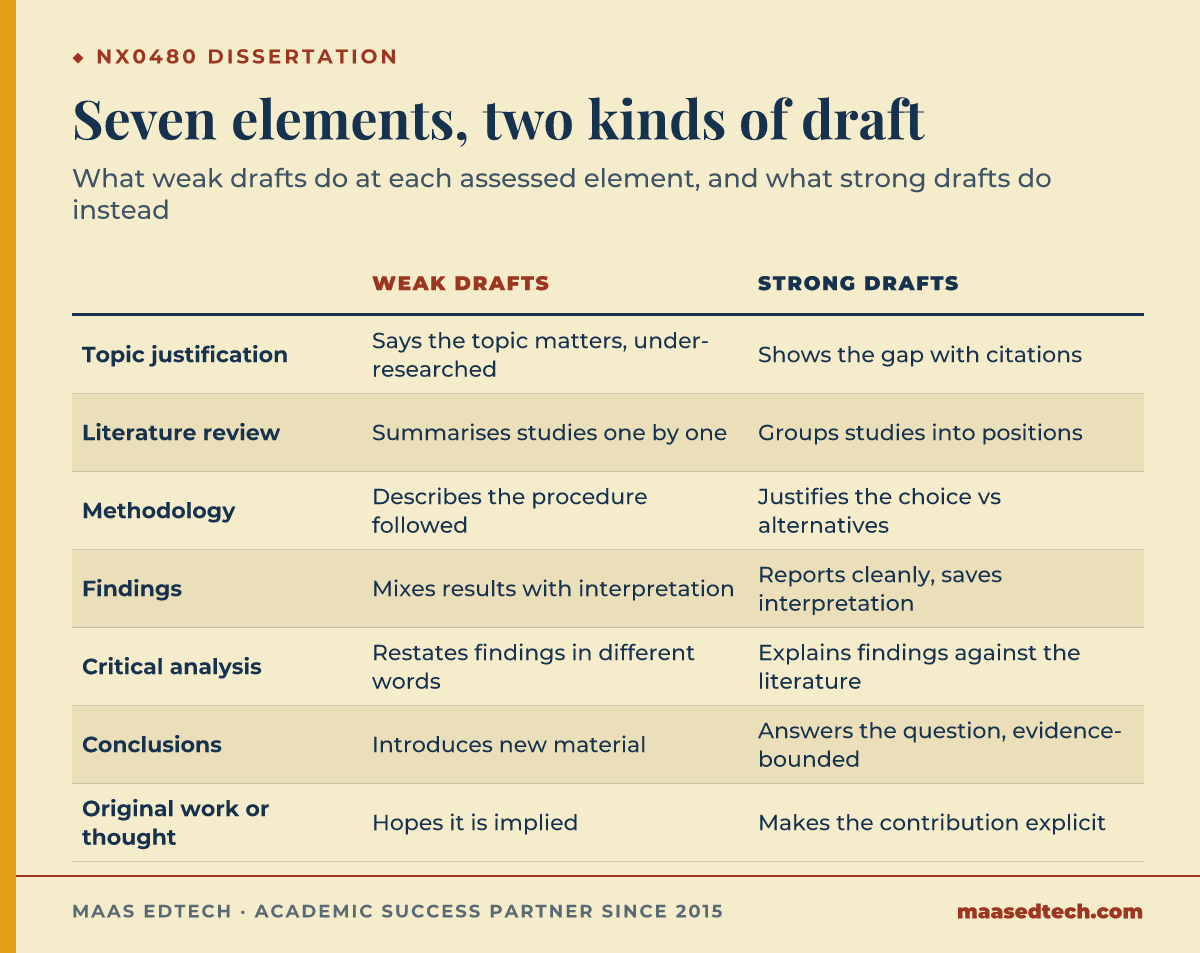
| Assessed element | What weak drafts do | What strong drafts do |
|---|---|---|
| Topic justification | State the topic is "important" and "under researched" | Show the gap with citations, then argue why closing it matters |
| Literature review | Summarise studies one by one | Group studies into positions, then locate your question between them |
| Methodology | Describe the procedure followed | Justify the choice against alternatives, including its limitations |
| Findings | Mix results with interpretation | Report cleanly, leaving interpretation for the next chapter |
| Critical analysis | Restate findings in different words | Explain what the findings mean against the literature reviewed |
| Conclusions | Introduce new material | Answer the research question explicitly, bounded by the evidence |
| Original work or thought | Hope it is implied | Make the contribution explicit, however modest |
How does the 60 credit weighting change your risk?
Direct answer: NX0480 is one third of a 180 credit masters concentrated into a single assessment with no second component to balance a weak performance. In a taught module, a poor essay can be offset by an exam. Here there is nothing to offset. That concentration is the real reason the module deserves a deliberate decision rather than a default one.
Evidence: Because the dissertation is a single extended piece, the supervisory relationship carries unusual weight. Malunda et al. (2021), studying public higher education institutions in Uganda, state this plainly in their abstract: "the supervisor-supervisee relationship, supervisor guidance and feedback are significant antecedents of the graduate students' progression" (Malunda et al., 2021, p. 73). Neupane Bastola and Hu (2021), studying supervisory comments on 97 masters thesis drafts, found that feedback frequently did not match what students expected or needed, particularly for students writing in English as an additional language. Hyldegård (2023) found that thesis writers who could compare notes with peers in group supervision arrived at their own drafts with clearer expectations of what feedback should look like, which is one reason a well framed extract gets a better response than a vague one.
Example: A Vietnamese student sent her supervisor a 4,000 word chapter and waited 3 weeks for a reply. When it came, the feedback was two lines. Her MAAS mentor helped her change what she sent rather than complain about what she received: shorter extracts, each with two specific questions attached. The supervisor's replies became detailed within 2 weeks, because the request had become answerable.
What does "original work or thought" mean at masters level?
Direct answer: "Original work or thought" does not mean discovering something nobody has ever known. At masters level, originality usually means applying an established framework to a context where it has not been tested, using a dataset that has not been examined this way, or bringing two literatures into contact that normally sit apart. The bar is contribution, not novelty for its own sake.
Evidence: The descriptor itself frames originality generously, offering three routes: "the form or context of the data collected, analytical process or application of findings". Each of those is achievable inside 15,000 words. A student who reads the word "original" as "unprecedented" tends to freeze; a student who reads it as "not simply a repetition" tends to start.
Example: One MAAS mentee tested a supply chain resilience framework developed for European manufacturers against three Vietnamese exporters. The framework was not hers and the firms were not famous. The contribution was the mismatch she documented between the framework's assumptions about supplier substitutability and what her interviews showed. That mismatch was the original thought, and it was enough.
How do you choose a topic that survives 15,000 words?
Direct answer: Choose a question narrow enough that you can read most of what has been written about it, and open enough that reasonable people disagree about the answer. Test any candidate topic against three practical constraints before committing: can you access the data, can you finish within the submission window, and is there enough recent literature to build a review that reads as current?
Evidence: Access is the constraint students underestimate most often. A question that depends on interviewing senior managers at firms where you have no contacts is not a research design; it is a hope. Ethical approval timelines matter here too, since human participant research at NBS requires clearance before data collection begins, and that approval sits on the critical path of your timeline.
Example: A student wanted to study merger integration at a listed Vietnamese bank. His mentor asked who would grant the interviews. Nobody, as it turned out. They reshaped the question around disclosures in published annual reports, which were freely available. The topic stayed in the same field, the method became feasible, and he began collecting data 6 weeks earlier than his original plan would have allowed.
For a fuller treatment of narrowing a question against the available literature, see our guide on choosing a dissertation topic with enough literature. If you have not yet drafted a proposal, how to write a dissertation proposal covers the structure NBS supervisors expect to see first.
What are the most common mistakes in NX0480 dissertations?
Direct answer: Five recur. Writing the literature review as an annotated bibliography rather than an argument. Treating methodology as description instead of justification. Blending findings and interpretation into one undifferentiated chapter. Introducing new claims in the conclusion. And starting data collection before ethical approval, which can invalidate the data entirely.
Evidence: The descriptor's phrase "explicit links between the analysis and the conclusions supported by critical argument" exists precisely because this link is where masters dissertations most often fail. A conclusion that could have been written without reading the findings is a conclusion that has not done its work.
Example: A MAAS mentee's conclusion recommended that Vietnamese SMEs "invest in digital transformation". Her findings, however, showed that her three case firms had all invested and then stalled at adoption. Her mentor pointed out that her own evidence contradicted her recommendation. The rewritten conclusion argued for adoption support rather than investment, which was both more useful and, unlike the first version, actually grounded in what she had found.
Planning how the 15,000 words distribute across chapters is a separate problem worth solving early; see dissertation chapter word count breakdown and how to plan a dissertation timeline.
Frequently asked questions
Is NX0480 compulsory on my Northumbria masters?
On most NBS masters programmes it is listed as optional, but module availability varies by programme and by intake. Confirm the status of NX0480 on your own programme handbook and with your programme leader before assuming either way.
How long is the NX0480 dissertation?
The module description specifies a 15,000 word masters dissertation. Confirm the exact word count and any tolerance band in your current assessment brief, since these details can change between intakes.
Do I need ethical approval for my NX0480 dissertation?
If your research involves human participants, including interviews and surveys, you will need approval before you begin collecting data. Build this into your timeline early, because approval sits ahead of data collection on the critical path.
What if my supervisor is slow to respond?
Change what you send rather than only escalating. Shorter extracts with two or three specific questions attached are far easier for a supervisor to answer quickly than a full chapter with no guidance about what you want reviewed. A second reader from your own cohort can also absorb part of that load, which is the peer feedback activity Hyldegård (2023) documents in group supervision settings.
Can I choose a Vietnam based topic for a UK dissertation?
Yes, and it is often an advantage, because it gives you access and context that other students lack. The requirement is that the literature you engage with is current and that your methodology is defensible, not that your case sits in Britain.
Ready to approach NX0480 with a clear plan?
MAAS mentors work alongside Northumbria students through the dissertation, from testing whether the topic is answerable to reviewing methodology chapters and preparing for supervisory meetings. You write your dissertation; a mentor helps you see what your draft is actually arguing, and where the examiner will look first.
Our academic mentoring service runs by phase rather than by wordcount, which suits a 60 credit module that stretches across months. If you are weighing NX0480 against an alternative route, a kick off conversation costs nothing and may save you a term.
Related guides
- Choosing a dissertation topic with enough literature
- How to write a dissertation proposal
- Dissertation chapter word count breakdown
- How to plan a dissertation timeline
- Academic mentoring at MAAS
References
Hyldegård, J. S. (2023). The implied peer: Thesis writers' feedback activities and experiences in group supervision. Studies in Higher Education, 48(11). https://doi.org/10.1080/03075079.2023.2212273
Malunda, P. N., Atwebembeire, J., & Ssentamu, P. N. (2021). Research supervision as an antecedent to graduate student progression in the public higher institutions of learning in Uganda. International Journal of Learning, Teaching and Educational Research, 20(5). https://doi.org/10.26803/ijlter.20.5.5
Mudzi, P. Y., Jiyane, P. M., & Sepeng, N. (2022). Factors that Master of Nursing students associate with study progress in higher education institutions in Gauteng province. Health SA Gesondheid, 27, a1671. https://doi.org/10.4102/hsag.v27i0.1671
Neupane Bastola, M., & Hu, G. (2021). Supervisory feedback across disciplines: Does it meet students' expectations? Assessment & Evaluation in Higher Education, 46(3), 407–423.
Reid-Hector, J., Heuer, A. J., Prestholdt, F. J., & Parrott, J. S. (2021). Evaluation of factors influencing capstone project and degree completion: A model for graduate student success. Journal on Excellence in College Teaching, 32(1), 25–46.
Tools & resources
- Northumbria University course pages, for the current NX0480 module description and programme structure
- Your NBS programme handbook, for the definitive statement of whether NX0480 is optional on your route
- Your faculty ethics committee guidance, for approval timelines before data collection