
◆ Marketing
MKT20031 Marketing and Innovation: a portfolio is one argument
Most of the mark in this unit sits in an individual portfolio, and that word changes what students are asked to produce. A folder holds twelve pieces of work. A portfolio holds one line of thinking that gets better across all twelve. Students who treat the brief as a folder finish tasks and are surprised by the mark; those who treat it as a portfolio revise a position, and the revisions become the evidence.
The distinction is the one Cooper (2008) draws when describing iterative development moving through gates, and the trap Cooper (2008) warns against is treating those gates as reporting checkpoints.

◆ Question 1 / 8 · The unit
What is the unit, and where does it sit?
Direct answer: At Swinburne University of Technology, MKT20031 is Marketing and Innovation, a 12.5 credit point undergraduate unit that sits at second year. The published prerequisite is MKT10009, listed as Marketing and the Consumer Experience or Marketing Theory and Practice depending on your enrolment year, with AVA10004 Aviation Marketing accepted as an alternative.
Evidence: The Marketing and the Consumer Experience prerequisite is worth pausing on, because it tells you what the unit assumes you already have. You arrive holding a vocabulary about consumer experience, and the unit asks you to point that vocabulary at something that does not exist yet. Everything you learned about analysing a market applies to a product that is already in it. Innovation work asks you to reason about demand that has not been demonstrated, which is a different logical situation and the source of most of the errors below.
Warning on the code: Marketing and Innovation is not unique to Swinburne University of Technology. Study material and unit outlines circulate under this code from other institutions, some of them for units with a different focus entirely. Check that anything you find matches the Swinburne unit description before you build a week of work on it.
◆ Question 2 / 8 · Assessment shape
Why does the assessment shape matter more than usual here?
Direct answer: Because the weightings are wide, and the widest band belongs to the individual portfolio. Swinburne publishes the structure as online quizzes at 10 to 20%, an individual portfolio at 40 to 60%, and a group report and presentation at 30 to 40%. Your unit outline fixes the exact figures for your teaching period.
Evidence: Two things follow from the 40 to 60% weighting. The first is that the single largest component is individual, so a strong group cannot rescue you and a weak group cannot sink you. The second is that a portfolio is cumulative by construction, which means the marker sees your earlier thinking alongside your later thinking. In a conventional essay unit, a first draft is private and only the final position is assessed. Here the trajectory is visible, and a visible trajectory is either your best evidence or your worst.
Example: A pattern MAAS Academic Support mentors see often: a student submitted a portfolio in which the week three concept and the week eleven concept were identical, with better formatting. Nothing in it was wrong. It scored in the middle band, because a portfolio that does not move gives the marker no evidence of the one thing a portfolio is designed to show.
◆ Question 3 / 8 · Innovation decision
What does the unit mean by an innovation decision?
Direct answer: Using the stage-gate framework that Cooper (2008) sets out, a decision that could have gone the other way, made under stated conditions, with the reasoning attached. The learning outcome asks you to apply knowledge of new product and service development processes, together with digital technology, to formulate strategic, operational and tactical product or service innovation decisions. The verb is formulate, and it is applied to decisions, not to descriptions.
Evidence: Cooper (2008), published in the Journal of Product Innovation Management, sets out the stage-gate idea-to-launch process and is explicit that the value of the model lies in the gates rather than the stages. A gate is a point at which a project is allowed to continue, is sent back, or is stopped, judged against criteria set in advance. His later account of the system stresses adaptive and spiral development precisely because rigid gate sequences were being applied as reporting checkpoints rather than as decision points. That distinction is the whole difference between a portfolio that describes a process and one that runs it.
Example: In a stage-gate write-up modelled on Cooper (2008), asked to justify a launch decision, a weaker answer listed the stages the concept had passed through. A stronger one named the criterion applied at each gate, said which criterion the concept nearly failed, and explained what evidence would have caused a stop. The second answer was shorter and carried a much higher mark, because it showed a decision being made rather than a process being narrated.
◆ Question 4 / 8 · What evidence supports
What can your evidence actually support?
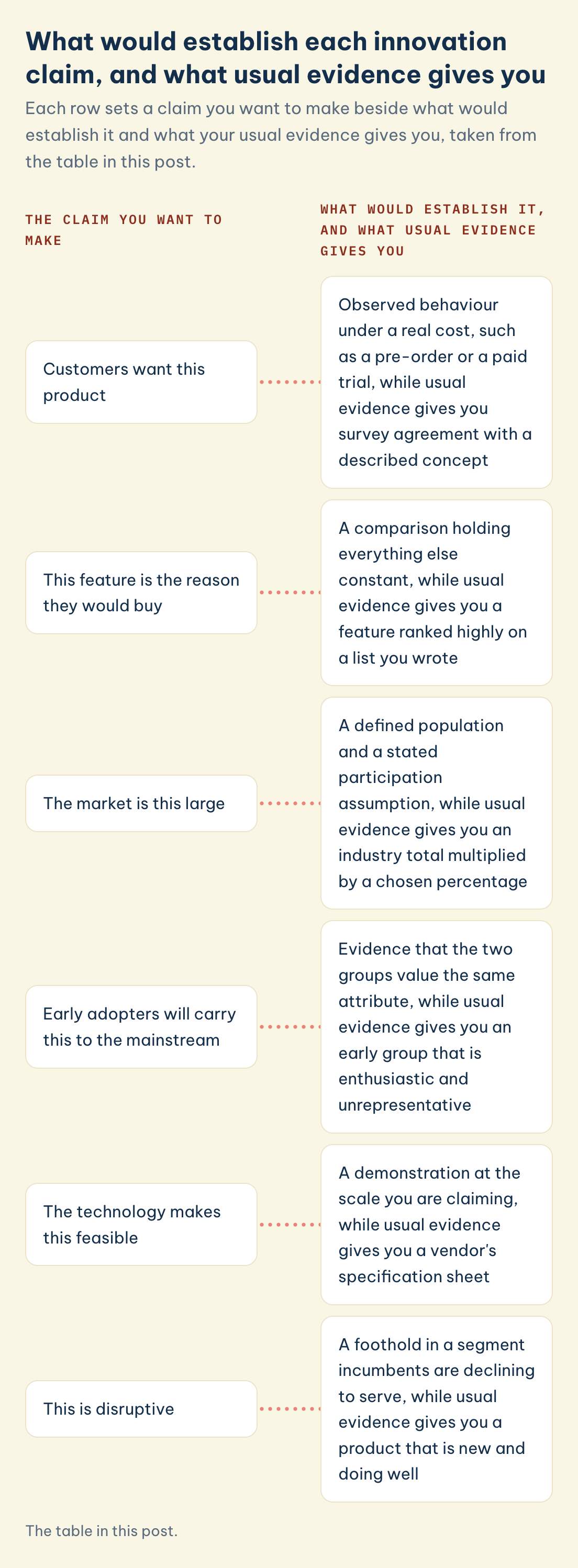
Sorting claims by what would be needed to establish them, the way Rogers (2003) and Von Hippel (1986) both frame the adopter-versus-lead-user distinction, is the fastest way to stop an innovation assignment overclaiming.
What would establish each innovation claim, and what usual evidence gives you
Each row sets a claim you want to make beside what would establish it and what your usual evidence gives you, taken from the table in this post.
The claim you want to make
What would establish it, and what usual evidence gives you
Customers want this product
Observed behaviour under a real cost, such as a pre-order or a paid trial, while usual evidence gives you survey agreement with a described concept
This feature is the reason they would buy
A comparison holding everything else constant, while usual evidence gives you a feature ranked highly on a list you wrote
The market is this large
A defined population and a stated participation assumption, while usual evidence gives you an industry total multiplied by a chosen percentage
Early adopters will carry this to the mainstream
Evidence that the two groups value the same attribute, while usual evidence gives you an early group that is enthusiastic and unrepresentative
The technology makes this feasible
A demonstration at the scale you are claiming, while usual evidence gives you a vendor's specification sheet
This is disruptive
A foothold in a segment incumbents are declining to serve, while usual evidence gives you a product that is new and doing well
Save this figure
| The claim you want to make | What would establish it | What your usual evidence gives you |
|---|---|---|
| Customers want this product | Observed behaviour under a real cost, such as a pre-order or a paid trial | Survey agreement with a described concept |
| This feature is the reason they would buy | A comparison holding everything else constant | A feature ranked highly on a list you wrote |
| The market is this large | A defined population and a stated participation assumption | An industry total multiplied by a chosen percentage |
| Early adopters will carry this to the mainstream | Evidence that the two groups value the same attribute | An early group that is enthusiastic and unrepresentative |
| The technology makes this feasible | A demonstration at the scale you are claiming | A vendor's specification sheet |
| This is disruptive | A foothold in a segment incumbents are declining to serve | A product that is new and doing well |
◆ Question 5 / 8 · Concept tests
Why do concept tests overstate demand so reliably?
Direct answer: Because agreeing with a described concept costs nothing, and buying costs money, a gap Rogers (2003) traces to how adopter categories differ. The gap is not noise around a true figure. It is a systematic bias in one direction, and it is present even when the research is competently run.
Evidence: The mechanism is easier to see through the diffusion literature, which Rogers (2003) synthesised from decades of prior adoption research. Rogers (2003) describes adoption as spreading through categories of adopter who differ in what they are willing to tolerate, with innovators and early adopters accepting incompleteness that the early majority will not. A concept test typically reaches people who volunteer to think about new products, which is close to a definition of the early categories. The enthusiasm you measure is real. The population it belongs to is not the population you are forecasting.
Evidence, second layer: Von Hippel (1986), published in Management Science, makes the point from the other direction with the lead user argument, that users at the leading edge of a trend are a valuable source of concepts precisely because their needs are unrepresentative of the current market. Von Hippel (1986) opens the paper with the definition that anchors this argument: "Lead users are users whose present strong needs will become general in a marketplace months or years in the future" (von Hippel, 1986). That value is real, and it is a reason to seek them out for ideas rather than for demand estimates. Using the same group for both purposes is the error, and it is common.
Example: A group forecast adoption from a survey where 71% said they would probably use the service. The figure was reported accurately. What it measured was the share of a self-selected sample willing to express approval of a paragraph. A short paragraph naming that limitation, and proposing what a paid trial would have shown instead, would have converted a marked-down claim into a demonstration of judgement.
◆ Question 6 / 8 · Ethics outcome
What does the ethics outcome actually ask for?
Direct answer: More than a compliance paragraph, and more than the rule-breaking account Brenkert (2009) sets out. The unit names the application of ethical principles in new product development as a distinct learning outcome, which is unusual to see stated separately at second-year level, and it signals that ethics is expected inside the decisions rather than appended after them.
Evidence: Brenkert (2009), published in the Journal of Business Venturing, argues that rule breaking is a recurring feature of entrepreneurial activity and develops a virtue-based account in which some instances of it, though morally wrong, are ethically defensible as part of the creative destruction entrepreneurs bring to economic and moral norms. Whether or not you accept the conclusion, the paper is useful in an assignment because it refuses the two easy positions. Innovation is not automatically virtuous because it is new, and it is not automatically suspect because it disrupts. The argument has to be made case by case, which is exactly what a portfolio can carry and a single essay often cannot.
Example: Two portfolios, both engaging with the Brenkert (2009) framing, addressed the same data-collection feature. One added a closing section confirming compliance with privacy legislation. The other identified the point in the development process where the feature was chosen, named who bore the cost of that choice, and set out what a defensible version would have looked like. Only the second engaged the outcome as written.
◆ Question 7 / 8 · Where marks are lost
Where do international students most often lose marks?
Direct answer: In the gap between a well-organised document and a defended one, a pattern MAAS Academic Support mentors see regularly on Marketing and Innovation. The writing is usually not the problem. The problem is that a decision appears on the page without the reasoning that produced it, because the reasoning felt obvious while it was being done.
Evidence: That gap between a well-organised document and a defended one is partly a structural habit rather than a language one, and it holds regardless of prior study at Marketing and the Consumer Experience or Marketing Theory and Practice. Where a writing tradition places the strongest claim at the end as a conclusion the reader arrives at, second-year Australian marking expects the claim early and the support behind it. A portfolio makes the mismatch more expensive than usual, since each entry is short, and a claim that only becomes clear in the last two sentences of a short entry may not register at all.
Example: In one Academic Support session on Marketing and Innovation, a student's portfolio entries each ended with a strong, specific position. Moving those closing sentences to the front of each entry, and letting the evidence follow, changed no content whatsoever. The next round of feedback described the same work as noticeably clearer.
◆ Question 8 / 8 · MAAS mentors
What do MAAS mentors actually do on a unit like this?
On portfolio-weighted units like Marketing and Innovation, the most useful intervention is early and structural rather than late and cosmetic. A mentor will usually read your first two or three entries together rather than separately, and ask a single question of the set: what position is this portfolio developing? If the answer takes more than a sentence, the portfolio does not yet have a spine, and adding entries will not give it one. That conversation costs an hour in week four and saves a great deal in week twelve.
The second common intervention is a claims pass over the group report and presentation, worth 30 to 40% of the unit, taking each number in it and asking what it measures, who defined it, and whether the sentence built on it is doing more work than the evidence allows. Students frequently find their innovation thinking was sound and their reporting was overconfident, which is a cheap problem to fix before submission and an expensive one to discover after.
Frequently asked questions
Which institution does this unit belong to?
Swinburne University of Technology, where Marketing and Innovation is a 12.5 credit point undergraduate unit at second year. The code appears elsewhere as well, so confirm the unit description matches Swinburne before trusting any material you find under it.
What do I need to have passed first?
The Swinburne University of Technology unit page lists the prerequisite as either Marketing and the Consumer Experience or Marketing Theory and Practice, with AVA10004 Aviation Marketing accepted as an alternative. Prerequisites are restated each year, so check the page for your own year of enrolment rather than an archived handbook.
What are the assessment tasks and weightings?
Swinburne University of Technology publishes bands rather than fixed figures: quizzes 10 to 20%, individual portfolio 40 to 60%, group report and presentation 30 to 40%. Your unit outline sets the exact weightings for your teaching period, and weightings circulating on student-notes sites are frequently out of date.
How long should a portfolio entry be?
Short enough that the position is visible in the first two sentences. Length is a matter for your Swinburne University of Technology unit outline, but legibility is what the marker rewards. Length is set by your outline, but the constraint that matters is legibility, since a marker reading twelve entries will not excavate a claim that is buried.
Does the portfolio have to show that I changed my mind?
It has to show reasoning that responded to something, in the spirit of the adaptive development Cooper (2008) describes. Changing position is one form of that. Holding a position against a genuine challenge, and saying what the challenge was and why it did not move you, is equally good evidence and is often stronger.
Can I use a survey as my main demand evidence?
You can use it, and you should say what it is, given the gap Rogers (2003) and Von Hippel (1986) both point to between stated interest and real demand. Presenting stated intention as measured demand is the most common overclaim in innovation assignments, and naming the limitation is usually rewarded rather than penalised.
Related reading
Where MAAS fits
MAAS mentors work alongside students on units like Marketing and Innovation rather than in place of them. On a portfolio-weighted unit the highest-value session is usually the earliest one, spent deciding what the portfolio is arguing before there is much of it to argue with. After that, the work is mostly asking harder questions of your own evidence than the deadline encourages you to ask. The work stays yours. If that is useful, our academic support service and our tutoring service are the two places to start.
References
Brenkert, G. G. (2009). Innovation, rule breaking and the ethics of entrepreneurship. Journal of Business Venturing, 24(5), 448–464. https://doi.org/10.1016/j.jbusvent.2008.04.004
Cooper, R. G. (2008). Perspective: The stage-gate idea-to-launch process, update, what's new, and NexGen systems. Journal of Product Innovation Management, 25(3), 213–232. https://doi.org/10.1111/j.1540-5885.2008.00296.x
Rogers, E. M. (2003). Diffusion of innovations (5th ed.). Free Press.
von Hippel, E. (1986). Lead users: A source of novel product concepts. Management Science, 32(7), 791–805. https://doi.org/10.1287/mnsc.32.7.791
Tools & resources
Swinburne University of Technology. (2026). MKT20031 Marketing and Innovation. https://www.swinburne.edu.au/course/unit/m/mkt20031/
Swinburne University of Technology. (2026). Unit outlines. https://www.swinburne.edu.au/current-students/study-support/unit-outlines/
A free 20-minute consultation is a conversation about where you are with MKT20031.
Book a free consultation ▸