
◆ Research Methods
Literature review vs systematic review: which does your thesis need?
A literature review and a systematic review both read published research, but they answer different kinds of question with very different amounts of method. Grant and Booth (2009) treat "literature review" as a generic label for any examination of recent or current literature, while a systematic review searches, appraises and synthesises evidence by an explicit, systematic method (Page et al., 2021).
Undergraduate and master's students are more often asked for a literature review, sometimes one that borrows systematic search techniques, while a full systematic review is usually carried out by a team (University of Bradford Library, n.d.). This guide sets out the differences, explains where scoping and narrative reviews fit, and helps you decide which one your brief is actually asking for. Our step-by-step guide to writing a literature review covers the chapter itself.
◆ Question 1 / 6 · The difference
Is there a difference between a review and a systematic review?
Direct answer: Yes. PRISMA 2020 defines a systematic review as a review that uses explicit, systematic methods to collate and synthesise findings of studies addressing a clearly formulated question (Page et al., 2021). A general literature review has no such fixed method: its searching may or may not be comprehensive, and quality appraisal is optional (Grant & Booth, 2009).
Grant and Booth (2009) compared 14 review types by four features: search, appraisal, synthesis and analysis. Their table describes the literature review as a generic term whose synthesis is typically narrative. The systematic review, by contrast, aims for exhaustive, comprehensive searching, and quality assessment may determine which studies are included.
Snyder (2019) puts the weakness of the unplanned version bluntly: "Traditional literature reviews often lack thoroughness and rigor and are conducted ad hoc, rather than following a specific methodology" (Snyder, 2019, p. 333). In our reading, that criticism targets unplanned reviews rather than the genre itself, and a well-argued literature review is still the standard way to position your own study in a dissertation.
| Feature | Literature review | Systematic review |
|---|---|---|
| Question | Broad topic or problem | One clearly formulated question |
| Search | May or may not be comprehensive | Exhaustive and documented |
| Selection | Chosen by the reviewer | Pre-set inclusion and exclusion criteria |
| Quality appraisal | Optional | Formal, and can decide inclusion |
| Synthesis | Typically narrative | Systematic synthesis, sometimes meta-analysis |
| Protocol | Not required | Written in advance, and may be registered (for example on PROSPERO) |
| Typical team | Often one student | Usually three or more researchers |
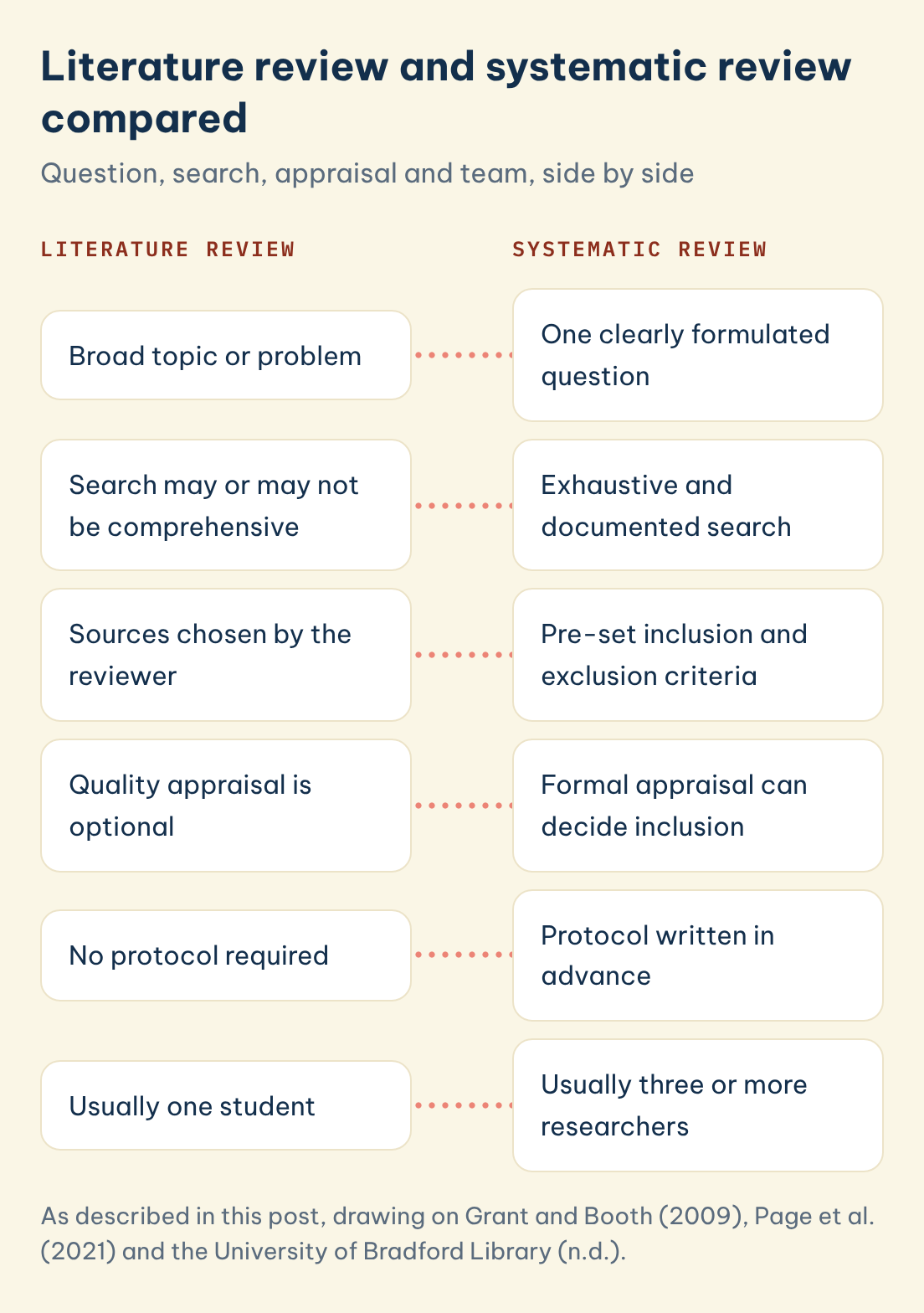
The table summarises Grant and Booth (2009), Page et al. (2021) and the University of Bradford Library (n.d.).
Literature review and systematic review compared
Question, search, appraisal and team, side by side
Literature review
Systematic review
Broad topic or problem
One clearly formulated question
Search may or may not be comprehensive
Exhaustive and documented search
Sources chosen by the reviewer
Pre-set inclusion and exclusion criteria
Quality appraisal is optional
Formal appraisal can decide inclusion
No protocol required
Protocol written in advance
Usually one student
Usually three or more researchers
Save this figure
◆ Question 2 / 6 · Borrowing systematic methods
Can I use systematic review methods in a literature review?
Direct answer: Yes, and some programmes ask for exactly this. The University of Bradford Library (n.d.) says undergraduates and master's students may be asked to carry out a literature review using systematic review techniques, which "will not be a full systematic review". You document your databases and search terms without claiming to have found all evidence.
The Bradford guide lists two differences that keep such work short of a systematic review. It does not aim to find all relevant published and unpublished evidence on the topic, and it will not follow the rigorous processes of a systematic review, although it may be carefully planned and comprehensive (University of Bradford Library, n.d.). In our experience, good practice is to report your search strings, the databases you used and the date of each search, and you explain your selection, but you do not need independent double screening or a registered protocol.
Labelling matters here. If your chapter calls itself a systematic review, a marker will check it against systematic review standards such as PRISMA, and a single-person search of two databases will look weak against that yardstick. Calling it a structured or systematically searched literature review describes the same work honestly and sets the right expectations.
◆ Question 3 / 6 · Main steps
What are the main steps of a systematic review?
Direct answer: There is no single official five-step list, but a common summary of the stages is: define one focused question, write a protocol, search comprehensively, screen and appraise studies against pre-set criteria, then synthesise and report transparently. PRISMA 2020 governs how each stage is reported (Page et al., 2021).
Snyder (2019) describes the method as a process for identifying and critically appraising research and then collecting and analysing data from it: "A systematic review can be explained as a research method and process for identifying and critically appraising relevant research, as well as for collecting and analyzing data from said research" (Snyder, 2019, p. 334). The University of Bradford Library (n.d.) adds that systematic reviews follow an explicit protocol, assess the quality of studies, and synthesise the findings in an unbiased way.
The workload is the part students underestimate. Borah et al. (2017) analysed 195 completed reviews registered on PROSPERO and found a mean of 67.3 weeks from registration to publication, with a mean of 5 authors per review. Literature searches in those reviews returned between 27 and 92,020 records, and the mean yield of included studies was only 2.94%. If your dissertation is due in one semester, those figures explain why a full systematic review is rarely the expected format. For the health sciences version in detail, see our guide to designing a systematic review.
◆ Question 4 / 6 · Scoping and narrative reviews
How do scoping and narrative reviews differ from a systematic review?
Direct answer: A narrative review is the traditional literature review, with a typically narrative synthesis. A scoping review maps the available evidence on a topic and generally does not assess risk of bias. A systematic review answers one precise question with critical appraisal of every included study (Grant & Booth, 2009; Munn et al., 2018).
Munn et al. (2018) give the clearest decision rule. If authors want to answer a question about the feasibility, appropriateness, meaningfulness or effectiveness of a treatment or practice, a systematic review is likely the most valid approach. If they want to identify types of evidence, clarify concepts, examine how research is conducted or identify knowledge gaps, a scoping review is the better choice. Munn et al. (2018) also note that scoping reviews generally do not assess risk of bias in the included studies, which is the main methodological gap between the two.
Snyder (2019) adds a middle path: the semi-systematic review, suited to topics that different groups of researchers have conceptualised differently across disciplines. A meta-analysis is a further step again: it is a statistical technique that combines the results of quantitative studies (Grant & Booth, 2009). Our meta-analysis guide for first-time researchers explains when pooling makes sense.
◆ Question 5 / 6 · Naming
Is a "review of literature" different from a "literature review"?
Direct answer: In most usage, no. "Review of literature" and "literature review" are generally used as two names for the same thing. The distinction that matters is the method, not the wording: whether the review follows an explicit, reproducible protocol (a systematic review) or a reviewer-led narrative approach.
The same applies to "systematic literature review" and "systematic review". Both describe a review conducted by explicit, pre-specified methods, and in our observation the longer name appears more often outside health research. What a marker will look for is evidence of the method: a stated question, documented search, explicit eligibility criteria, appraisal of included studies, and a flow of records from search to final inclusion. If your module handbook uses one of these terms, follow its definition, and ask your supervisor whenever the brief and the module guide seem to describe different things.
◆ Question 6 / 6 · Choosing for your dissertation
Which review should your dissertation use?
Direct answer: Let the brief and the question decide. Snyder (2019) argues that the research question and the purpose of the review always determine the right strategy. A narrow question about effect, a supervisor who asks for PRISMA, and time for a team suggest a systematic review; a broad topic for one student in one semester suggests a literature review.
Three checks usually settle it. First, read the marking criteria for words such as "protocol", "PRISMA" or "systematic search". Second, test your question: if it compares outcomes of a defined intervention in a defined population, it has systematic review shape, whereas a question about how a concept has been theorised does not. Third, count the time and people available, using the Borah et al. (2017) figures as a benchmark.
When the choice is still unclear, a mentor can help you read the brief and test the question before you commit to a method. Through thesis and dissertation mentoring at MAAS, the student does the searching, reading and writing, while a mentor guides the review design and gives feedback on the drafts you produce. Mentoring does not set a grade target or promise a result; if a mentor is not the right fit, you can ask to change mentor. Bring your brief and your draft question to the first session. Before you search, also read our note on grey literature, which systematic reviewers often search for.
Frequently asked questions
Is a systematic review better than a literature review?
Not in general. A systematic review is more rigorous for a narrow question about effect, but a literature review suits broad topics and theory building. Snyder (2019) argues that the purpose of the review decides which approach is appropriate.
Can a master's dissertation be a systematic review?
Sometimes, if the programme allows it and the question is narrow enough. The University of Bradford Library (n.d.) notes that a full systematic review can take 18 months or longer and is usually carried out by three or more researchers, so check your handbook first.
How long does a systematic review take?
Borah et al. (2017) found a mean of 67.3 weeks from PROSPERO registration to publication across 195 reviews. A student version with a tight scope can be shorter, but plan in months, not weeks.
Does a literature review need a search strategy?
It is good practice. A literature review does not aim to find all relevant evidence (University of Bradford Library, n.d.), but reporting your databases, search terms and dates still lets a marker see how you searched.
What is the difference between a systematic review and a meta-analysis?
A systematic review is the whole process of finding, appraising and synthesising studies. A meta-analysis is the statistical technique that combines quantitative results, and it may or may not be part of a systematic review (Grant & Booth, 2009).
When should I choose a scoping review instead?
Choose a scoping review when you need to map the types of evidence, clarify concepts or identify gaps, rather than answer a precise question about effectiveness (Munn et al., 2018).
References
Borah, R., Brown, A. W., Capers, P. L., & Kaiser, K. A. (2017). Analysis of the time and workers needed to conduct systematic reviews of medical interventions using data from the PROSPERO registry. BMJ Open, 7(2), Article e012545. https://doi.org/10.1136/bmjopen-2016-012545
Grant, M. J., & Booth, A. (2009). A typology of reviews: An analysis of 14 review types and associated methodologies. Health Information and Libraries Journal, 26(2), 91–108. https://doi.org/10.1111/j.1471-1842.2009.00848.x
Munn, Z., Peters, M. D. J., Stern, C., Tufanaru, C., McArthur, A., & Aromataris, E. (2018). Systematic review or scoping review? Guidance for authors when choosing between a systematic or scoping review approach. BMC Medical Research Methodology, 18, Article 143. https://doi.org/10.1186/s12874-018-0611-x
Page, M. J., McKenzie, J. E., Bossuyt, P. M., Boutron, I., Hoffmann, T. C., Mulrow, C. D., Shamseer, L., Tetzlaff, J. M., Akl, E. A., Brennan, S. E., Chou, R., Glanville, J., Grimshaw, J. M., Hróbjartsson, A., Lalu, M. M., Li, T., Loder, E. W., Mayo-Wilson, E., McDonald, S., … Moher, D. (2021). The PRISMA 2020 statement: An updated guideline for reporting systematic reviews. BMJ, 372, Article n71. https://doi.org/10.1136/bmj.n71
Snyder, H. (2019). Literature review as a research methodology: An overview and guidelines. Journal of Business Research, 104, 333–339. https://doi.org/10.1016/j.jbusres.2019.07.039
University of Bradford Library. (n.d.). Literature reviews and systematic reviews. University of Bradford. https://www.bradford.ac.uk/library/services/literature-reviews-and-systematic-reviews
Tools & resources
Not sure how this guide applies to your own case? Talk it through with MAAS in a free 20-minute consultation.
Book a free consultation ▸