
◆ Law
LAWS2014 Corporations Law at Sydney: what does an open-book exam actually test?
Both assessed components of LAWS2014 Corporations Law at the University of Sydney are open book, and both prohibit AI. Students hear the first half of that and relax. The second half should shape how you work, because together those two rules describe what the unit intends to measure: not what you can find, but what you can do with it in 90 minutes while holding a problem in your head.

◆ Section 1 / 9 · The right LAWS2014
First, make sure you have the right LAWS2014
Direct answer: Two Australian universities use this code for different units. At the University of Sydney, LAWS2014 is Corporations Law, a 6 credit point undergraduate unit in Sydney Law School. At Southern Cross University, LAWS2014 is Local Government and Planning Law, covering local government planning in New South Wales. Check which institution any material was written for before relying on it.
Evidence: The Sydney unit sits behind prerequisites in the LLB sequence and lists a commercial law unit as assumed knowledge, which places it firmly inside a law degree. The Southern Cross unit sits in environmental and planning law: it is a larger 12 credit point offering, assessed by two fact-scenario tasks weighted 60% and 40%, and it requires a legal-research unit plus one of two introductory law units before enrolment, delivered through 1 hour of online workshops and 2 hours of tutorials a week across two teaching terms (Southern Cross University, 2025). Search results for the bare code mix the two freely, and material sold as LAWS2014 notes is frequently neither labelled nor sorted.
Example: A Vietnamese student preparing for the Sydney unit worked through a set of purchased notes for two weeks before someone noticed the cases were all about development consents. She had been studying planning law. The notes were not wrong; they were for a different university, and nothing on the cover said so. This guide covers the Sydney unit.
◆ Section 2 / 9 · The Sydney unit
What does the Sydney unit cover, and what does it assume?
Direct answer: LAWS2014 examines the legal structure of the corporation as an organisational form, for both public and proprietary companies, covering the implications of the company as a separate legal entity, the power to bind the company, the duties of directors, and shareholder rights and remedies. It carries 6 credit points, requires LAWS1015 or LAWS1026 as a prerequisite, lists LAWS2012 as assumed knowledge, and cannot be taken together with its postgraduate equivalent, LAWS5014 (The University of Sydney, n.d.).
Evidence: Assumed knowledge is not the same as a corequisite, and the difference matters if you are planning your semester. There is no formal corequisite. What the unit is telling you is that it will proceed as though you already have the commercial law background, without checking. If you do not, that is a gap to close in your own time rather than a barrier to enrolment.
Example: A student who had come into the LLB through a non-standard pathway assumed the listed background was compulsory and delayed the unit by a semester waiting to complete it. Nothing had required that. A five-minute reading of the enrolment rules would have saved a semester, and the story is worth telling because the same misreading happens every year in both directions.
◆ Section 3 / 9 · Assessment
What is the assessment, exactly?
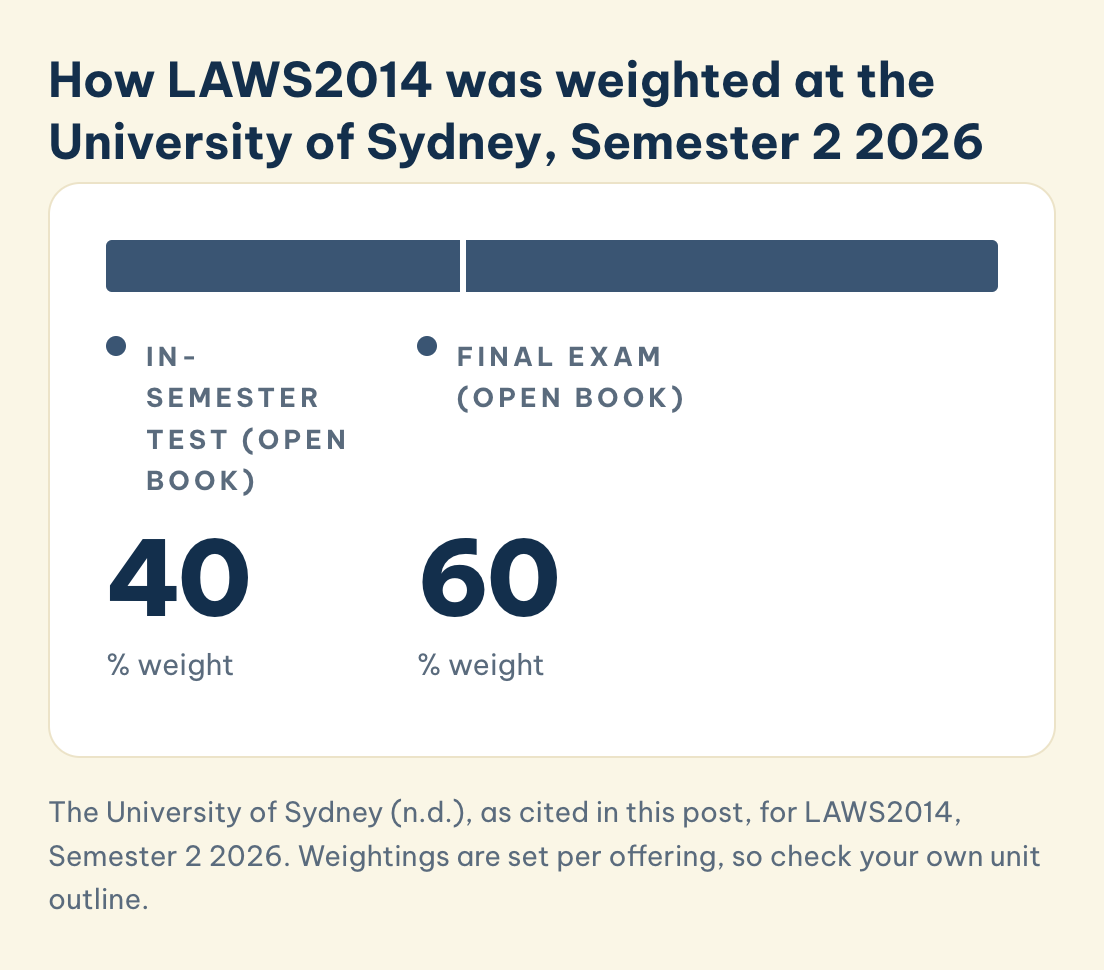
Direct answer: For Semester 2 2026 the unit is assessed by an in-semester test worth 40% and a final exam worth 60%, with a diagnostic Early Feedback Task worth 0%. Both marked components are compulsory, both are open book, and AI is prohibited in both. There is also an attendance requirement of 70% of non-lecture classes.
How LAWS2014 was weighted at the University of Sydney, Semester 2 2026
The diagnostic Early Feedback Task is worth 0%, so it is not drawn here.
In-semester test (open book)
40
% weight
Final exam (open book)
60
% weight
Save this figure
Confirm all of this in your own unit outline, because the structure has moved: the 2025 offering carried a substantial group-work component that no longer exists, and earlier years carried a class participation mark. The University of Sydney publishes each semester's outline 2 weeks before teaching starts, so check the current version rather than relying on a friend's copy from an earlier semester (The University of Sydney, n.d.).
| Component | Weight | Format | Scope |
|---|---|---|---|
| Early Feedback Task | 0% | 10 multiple-choice questions, 25 minutes | Foundational concepts from the first two weeks |
| In-semester test | 40% | One problem question, open book, 1.5 hours plus reading time | Material from the first six lectures |
| Final exam | 60% | Two problem questions, open book, 2.5 hours plus reading time | All topics |
Evidence: The shape of that table tells you what to practise. The 0% Early Feedback Task is 10 multiple-choice questions sat in 25 minutes on the first 2 weeks of material; the in-semester test is one problem question worth 40% and sat in 1.5 hours plus reading time on the first 6 lectures; and the final exam is two problem questions worth 60% and sat in 2.5 hours plus reading time across the whole unit. Every mark in the unit comes from problem questions, none from an essay or a research task. A student who prepares by writing summaries is preparing for an assessment this unit does not set.
Example: A student asked whether it was worth attempting the Early Feedback Task given it carries no marks. The arithmetic runs in its favour: it is the only point in the semester where you can discover that your problem-question technique is off at a cost of zero, and the unit expects a genuine attempt at every task in any case. He sat it, scored poorly, and had six weeks to fix what it exposed.
◆ Section 4 / 9 · Open book
What does open book change, and what does it not?
Direct answer: It removes recall from the assessment and leaves everything else. You will not lose marks for failing to remember a section number, because you can look it up. You will lose marks for spending four minutes looking it up. Open book converts the exam into a test of navigation and judgement under time pressure, which is harder to fake than memorisation and considerably harder to cram. The materials help only to the extent you have organised them before you walk in.
Evidence: With one problem question in 90 minutes and two in 150 minutes, the arithmetic leaves little room for searching. Students who arrive with an indexed set of materials and a rehearsed structure for answering spend their time reasoning. Students who arrive with a complete but unsorted folder spend it reading, and the folder that felt like insurance becomes the thing that costs them the marks.
Example: Two students brought materials of similar quality to a practice sitting. One had a one-page map at the front pointing to where each duty, defence and remedy lived. The other had 400 well-written pages and no map. The second student wrote a better first answer and did not finish the second.
◆ Section 5 / 9 · AI prohibition
Why does the AI prohibition matter for how you prepare?
Direct answer: Because it removes the tool most students now use to close the gap between understanding something and being able to produce it. Both marked components prohibit AI, while the diagnostic task allows it. That split is a deliberate signal: the unit is content for you to use assistance while learning and expects you to perform without it when it counts.
If your preparation consists of asking a model to explain problems and finding its answers persuasive, you have been rehearsing recognition rather than production, and recognition is not what either component asks for.
Evidence: The distinction between recognising a correct analysis and generating one is well established in learning research, and actively retrieving knowledge produces markedly better long-term retention than rereading it. As Roediger and Karpicke put it, "testing is a powerful means of improving learning, not just assessing it" (Roediger & Karpicke, 2006, p. 249). Roediger and Karpicke's (2006) central claim is exactly the distinction an open-book, AI-free problem question is built to expose. Everything that would let you recognise a good answer is permitted in the room. Producing one is the assessed act.
Example: A student reported that he understood every worked problem he read and froze on every problem he attempted. Nothing was wrong with his knowledge. He had spent the semester consuming solutions and had never once written an answer from a blank page under time, which is the only activity the unit actually rewards.
◆ Section 6 / 9 · Separate legal entity
What is the separate legal entity rule really being tested on?
Direct answer: Not whether you know it. Almost everyone knows it. What is tested is whether you can trace its consequences through a set of facts and recognise when a court will and will not look behind it. The rule is easy to state and genuinely hard to apply, because its whole function is to produce results that feel unfair in individual cases while remaining defensible as a system.
Evidence: The doctrine has been foundational in Anglo-Australian corporate law since Salomon v A Salomon & Co Ltd [1897] AC 22 held that a company is a legal person distinct from its members, and Australian courts have consistently declined to develop any general discretion to disregard it (Ramsay & Noakes, 2001). Ramsay and Noakes (2001) reviewed the reported Australian veil-piercing decisions and found the courts allowing it only within narrow, specific categories rather than under a broad fairness power, and answers that reach for fairness as an argument usually reveal that the student has not understood why the rule exists.
Example: One answer to a problem about a group of companies concluded that the parent should be liable because the arrangement was clearly designed to shield assets. Pressed on which specific statutory or general law route produced that result, the student had none. Structuring a group to limit exposure is, in itself, lawful, and the answer had substituted an instinct for an argument.
◆ Section 7 / 9 · Directors' duties
How do directors' duties questions differ from contract problem questions?
Direct answer: They usually require you to run two systems at once. The statutory side sits in sections 180 to 183 of the Corporations Act 2001 (Cth): section 180 codifies the duty of care and diligence, section 181 the duty to act in good faith and for a proper purpose, section 182 the duty not to misuse position, and section 183 the duty not to misuse information. A single set of facts can raise both a general law duty and one of these four statutory duties covering similar ground, with different tests, different defences and different consequences. Students who learned problem technique in contract often pick one route and follow it cleanly to the end, which reads as tidy and loses the marks attached to the other route.
Evidence: Australian directors' duties operate through overlapping general law and statutory regimes, and the regulator's civil penalty pathway sits alongside remedies available to the company itself (Harris et al., 2021). The overlap is deliberate, which is why examiners construct facts that engage more than one. Note that the business judgment rule in section 180(2) of the Corporations Act 2001 (Cth) is expressly framed to apply both to the statutory duty of care and to the equivalent duties at common law and in equity, so it is not a way of escaping one regime while remaining exposed on the other. The Full Federal Court confirmed exactly this reading in Cassimatis v Australian Securities and Investments Commission [2020] FCAFC 52, upholding a finding that two Storm Financial directors had breached section 180(1) and holding that the section 180(2) safe harbour cannot rescue a decision that was never a business judgment in the first place. Getting that relationship right is itself a mark-bearing observation.
Example: Two answers addressed the same board decision that went badly. One produced a clean general law negligence analysis. The other did the same, then identified the statutory duty, applied the business judgment rule across both, and worked through whether its conditions were met on these facts. The second took an extra six minutes and moved a full band.
◆ Section 8 / 9 · Strong answers
What separates a strong problem answer from a competent one?
Direct answer: Short on statement of law, long on the contested step. The examiner already knows the rule; what is being measured is whether you can locate the single point on which the answer turns and give it your reasoning. Most weak answers spend the first half of their time proving they have read the topic, then run out before reaching the part that would have earned the marks. Allocating time by mark value rather than by how much you have to say is the whole skill.
Evidence: A timed problem question is a triage task before it is a knowledge task. Coverage failures dominate outcomes far more than accuracy failures, and coverage is a function of planning discipline rather than of how much has been learned. This is why one timed attempt is diagnostically worth more than another pass through the textbook. The same triage habit carries across the Sydney law program, and it is the point made at length in the LAWS2010 administrative law essay guide, where the scarce resource is argument rather than time.
Example: One practice script was thorough, and it was also 1,100 words on a question carrying 15 marks next to 400 words on a question carrying 30 marks. Nobody had told the student that the marks were printed on the paper for a reason. Rewriting the same script to the mark allocation, without learning anything new, produced a script that would have passed comfortably where the original would not have.
◆ Section 9 / 9 · Ethics and context
How should Vietnamese students prepare for the ethics and context outcomes?
Direct answer: Treat them as examinable rather than as background. The unit asks students to critically analyse corporations law principles in context, to evaluate ethical issues and professional responsibilities, and to communicate advice to legal and non-legal audiences. A problem question can engage any of these. Prepare a short position on why the main rules exist, whose interests they protect, and where they are criticised, so that a question inviting evaluation does not find you with only description available.
Evidence: Corporate law is an actively contested area of commercial regulation, with long-running debate about whether directors owe consideration to interests beyond shareholders and about the adequacy of enforcement. A student who can state one criticism and one response to it has enough to construct an evaluative paragraph, which is more than most exam scripts contain.
Example: One answer described the content of directors' duties accurately and stopped there. Asked what a critic of the current position would say and what the standard reply is, the student produced both in under a minute. Those two sentences turned a descriptive answer into an evaluative one, using knowledge already in hand.
Frequently asked questions
Is LAWS2014 a hard unit?
It is demanding for a different reason than most students expect. The doctrine is manageable; the pressure comes from problem questions that deliberately engage several overlapping duties at once, sat under time with no recall component to reward preparation you can do passively.
Does open book mean I need less preparation?
No, it means different preparation. Recall stops mattering and organisation starts mattering a great deal, because the clock does not care whether the answer was findable. Build a map of your materials, not a bigger pile.
Should I bother with the Early Feedback Task if it is worth nothing?
Yes. It is a free diagnostic taken early in semester, and the unit expects a genuine attempt at all tasks in any event. A poor result there is information; a poor result in the in-semester test is 40% of the unit.
How much case detail do I need to know?
Enough to state what each leading case decided and why it matters. Under open-book conditions the facts are available to you, so what earns marks is knowing which proposition you need and where to find it, not reciting parties.
Can MAAS help me with LAWS2014?
Yes. MAAS Academic Support coaches you through the unit with the Outline → Draft → Final model, including issue mapping across overlapping duties, organising open-book materials, and feedback on timed practice answers with mentors from a corporate law background. We coach your work; we do not write it for you.
Ready to prepare for LAWS2014 the way the exams are actually built?
If you know the doctrine and still run out of time, the problem is technique rather than knowledge, and technique is coachable. MAAS Academic Support works alongside you through Outline → Draft → Final so the legal reasoning stays yours while the exam craft catches up to it. Every engagement sets a three-tier target grade with you at the start (Pass, Merit or Distinction) and 45 days of follow-up support after submission.
Bring your LAWS2014 unit outline and we will match you to a corporate law expert within 48 hours, drawn from a network of 100+ experts in which 23% hold a PhD.
Book a free 20-minute LAWS2014 consultation with MAAS Academic Support →
Related guides
- LAWS2012 Property and Commercial Law assignment guide: the assumed-knowledge unit for this one
- BLAW2012 Applied Contract Law assignment guide: advisory writing in a contract unit, where a memo rather than an exam carries the weight
- LAWS403 Legal Theory assignment guide: for the evaluative and critical side of a law degree
- MAAS Academic Mentoring service: 1:1 coaching with PhD-level mentors in your discipline
- Course-code assignment coaching: pillar guide on tackling any unit assignment with a MAAS mentor
References
- Harris, J., Hargovan, A., & Adams, M. (2021). Australian corporate law (7th ed.). LexisNexis Butterworths.
- Ramsay, I., & Noakes, D. (2001). Piercing the corporate veil in Australia. Company and Securities Law Journal, 19(4), 250–271.
- Roediger, H. L., & Karpicke, J. D. (2006). Test-enhanced learning: Taking memory tests improves long-term retention. Psychological Science, 17(3), 249–255. https://doi.org/10.1111/j.1467-9280.2006.01693.x
- Southern Cross University. (2025). Local government and planning law (LAWS2014): Unit and course handbook. Retrieved August 21, 2026, from https://handbook.scu.edu.au/study/units/laws2014/2025
- The University of Sydney. (n.d.). LAWS2014 Corporations Law. Retrieved August 19, 2026, from https://www.sydney.edu.au/units/LAWS2014
Tools & resources
- Australasian Legal Information Institute. (n.d.). Corporations Act 2001 (Cth). Retrieved August 19, 2026, from https://www.austlii.edu.au/au/legis/cth/consol_act/ca2001172
- The University of Sydney Library. (n.d.). Library home. Retrieved August 19, 2026, from https://www.library.sydney.edu.au
This article is part of the MAAS Journal series for Vietnamese international students. MAAS Academic Support is an advisory partner; we coach students through the Outline → Draft → Final delivery model with developmental feedback from discipline-matched experts. We do not write or submit work on a student's behalf.
A free 20-minute consultation is a conversation about where you are with LAWS2014.
Book a free consultation ▸