
Count what this unit covers: cryptography, network security, web application security, access control, incident response, mobile and IoT security, cloud security, and the legal and ethical layer spanning the Australian Privacy Act and the GDPR, echoing the control families of ISO/IEC 27001 and the five functions of the NIST Cybersecurity Framework.
Fifteen published learning outcomes span attacks and defences, artificial intelligence and security, software and platform security, systems and infrastructure security, and the human, organisational and regulatory dimension. No one masters that list in 13 weeks, and the teaching staff know it.
Author: MAAS Editorial Team
Last updated: 2026-08-11
Category: it-data

What the unit is, and who is sitting next to you
Direct answer: INFO5995 Introduction to Cybersecurity is a 6-credit-point postgraduate unit in the University of Sydney's Faculty of Engineering, taught by the School of Computer Science, with no prerequisites and no assumed knowledge. It centres on the CIA triad, confidentiality, integrity and availability, and runs in Semester 1 and Semester 2 of 2026 as evening delivery at Camperdown and Darlington.
Evidence: Sydney's entry for the unit describes it as introducing the principles and practices of cybersecurity through lectures and hands-on labs, built around the CIA triad, confidentiality, integrity and availability, together with risk management and threat mitigation. It lists prohibitions against OINF5995, INFO5992 and OINF5992, and shows Semester 1 and Semester 2 offerings for 2026 in evening delivery at Camperdown and Darlington.
Two of those facts matter more than they look. No assumed knowledge in a postgraduate unit means the cohort ranges from career-changers who have never configured a firewall to working engineers, all marked against the same criteria. Evening delivery tells you a large share of the room is working during the day. If you are a full-time international student, you have more preparation time than most of your classmates and it is worth using deliberately rather than assuming everyone is in your position.
Before you search for anything: the prefix INFO is one of the most reused in the world, attached to library science, informatics and information systems units at dozens of institutions. Search the unit title rather than the bare code, or most of what you find will belong to somebody else's degree.
If coverage is not the point, what is?
Direct answer: Reasoning about threats and trade-offs. Security has no state called secure, only decisions with costs, and the assessable skill is arguing that a decision fits its context.
The novice instinct is to reach for the strongest available control: encrypt everything, force complex passwords, block the port. Each of those has a price in usability, performance, cost or maintainability, and a recommendation that ignores the price has not engaged with the discipline.
| Question a beginner asks | Question the unit trains |
|---|---|
| Is this secure? | Secure against whom, and at what cost? |
| What is the best control? | What does this control assume, and when does it fail? |
| How do I stop attacks? | Which attacks matter here, and which risks do we accept? |
| Which tool should I use? | What is the threat model this tool addresses? |
Evidence: Saltzer and Schroeder (1975) set out the design principles that still frame this reasoning, including fail-safe defaults, economy of mechanism and complete mediation, and they define least privilege as the rule that "every program and every user of the system should operate using the least set of privileges necessary to complete the job" (Saltzer & Schroeder, 1975). Their paper is 50 years old and remains on reading lists because it describes how to think about protection rather than which product to buy. Anything you memorise about a current tool expires; the principles are what transfer to an exam question about a system you have never seen. Two catalogues make the trade-off reasoning concrete without replacing it: the OWASP Top Ten ranks recurring web application risks, and the MITRE ATT&CK matrix documents attacker techniques stage by stage. The unit tests whether you can reason about a specific system, not whether you can recite either list.
Example: Asked to secure a small company's remote access, one answer proposed a lengthy list of controls including mandatory password rotation every 90 days. A stronger answer noted that forced rotation drives users toward predictable variations and written-down passwords, recommended phishing-resistant multi-factor authentication instead, and named the trade-off in support cost. Same knowledge, different question answered.
Why do technical students lose marks on the non-technical outcomes?
Direct answer: Because they treat the human, organisational and regulatory material as padding around the real content, and the published outcomes list it as content.
The outcome list explicitly includes human, organisational and regulatory aspects, and the description names the Australian Privacy Act and the GDPR. Those are examinable. A student who can implement TLS correctly and cannot say what a data breach notification obligation requires has covered part of the unit.
Evidence: Adams and Sasse (1999) made the case that has since become standard: users circumvent security mechanisms they find unworkable, and the resulting insecurity is a design failure rather than a user failure. Their argument reframes the human element from an annoyance into an engineering constraint, which is exactly the move the human-factors outcomes are testing for.
Where the marks actually sit: in connecting layers. A policy answer that references the technical control it depends on, or a technical answer that acknowledges the legal obligation it satisfies, demonstrates the integration the outcome list describes. Answers that stay in one layer read as partial regardless of their depth.
Example: Given a breach scenario built around a named CVE and its CVSS severity score, a technically strong answer described containment and forensic steps in detail and stopped there. The complete answer added who must be notified and on what statutory basis, citing the GDPR's 72-hour breach notification requirement alongside the Privacy Act's notifiable data breaches scheme, then noted that the forensic timeline determines whether that obligation has been triggered. The legal part took four sentences and addressed an outcome the technical answer had left untouched.
How should you handle labs when the cohort is so uneven?
Direct answer: Prioritise understanding why each step exists over completing the sheet, because the exam tests the reasoning and the lab sheet will not be in front of you.
With no assumed knowledge, lab sessions inevitably move at a pace that is slow for some and fast for others. Students who are behind often copy commands to keep up, which produces a completed lab and no transferable understanding. Students who are ahead often finish early and skip the write-up, which is where the reasoning gets recorded.
A short discipline fixes both. After each lab, write three sentences without looking: what the exercise defended against, what assumption the defence relies on, and how an attacker would work around it. That third sentence is where security thinking lives, and it is the one nobody is asked for during the session.
A caution about study material. Cybersecurity content ages faster than almost any other field, and material found online may describe deprecated protocols, superseded advice or a threat landscape that has moved. Prefer the unit's own materials and current standards documents, such as NIST Special Publications, over a blog post of unknown date, and treat anything undated with suspicion.
What does a strong written answer look like here?
Direct answer: It names the threat model, proposes proportionate controls, states residual risk, and does not claim the problem is solved.
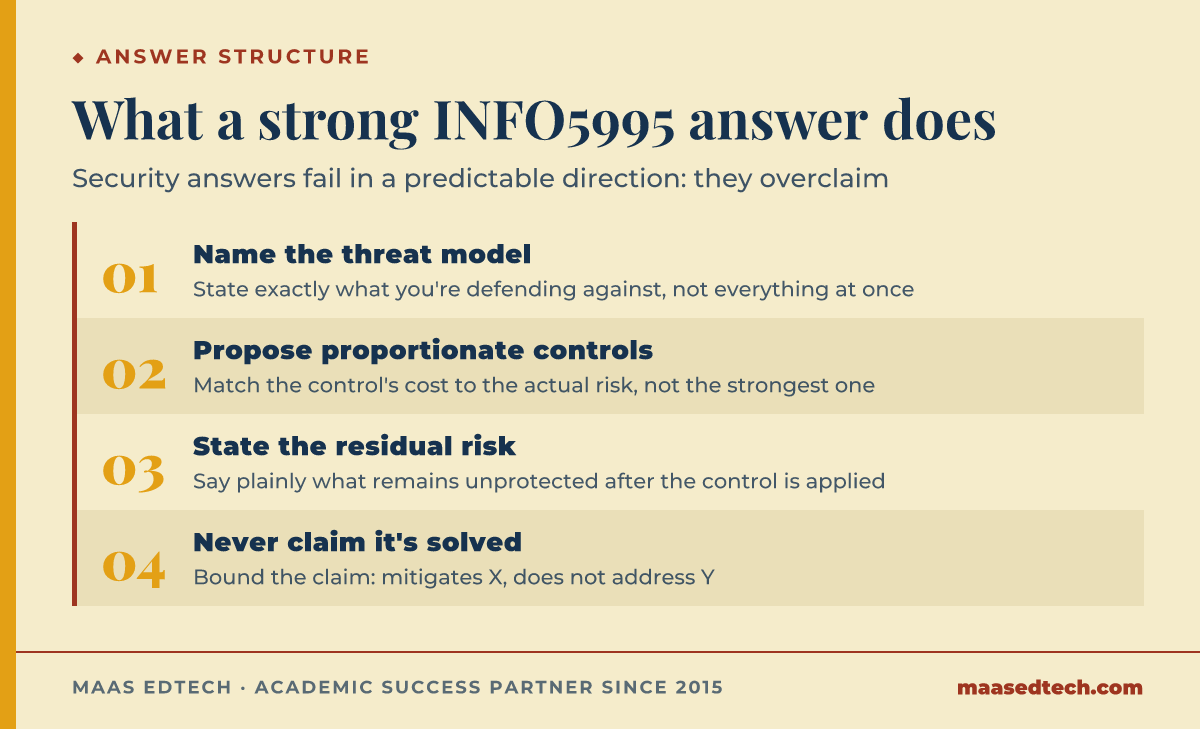
Security answers fail in a predictable direction: they overclaim. Writing that a measure will prevent attacks is a sentence no security professional would sign. The defensible version bounds the claim: this reduces the risk of credential stuffing specifically, does not address a compromised endpoint, and assumes the logging is monitored.
That structure also solves a language problem economically. If English is not your first language, the qualifying vocabulary here is short, repeatable and technical rather than literary: mitigates, reduces the likelihood of, assumes, does not address, residual risk remains in. 4 to 5 such phrases carry an entire semester of written work, and precision with them counts for more than fluency.
Keep the terms exact, because in this field near-synonyms are not synonyms. A threat is not a vulnerability, a vulnerability is not a risk, and an exploit is not an attack. Authentication is not authorisation, and encryption is not hashing. Loose use of these reads as a conceptual gap, and in a unit that has no prerequisites the marker has no reason to assume otherwise.
How MAAS mentors support students on security units
We work as advisors. On a unit like this the productive questions are about scope and justification rather than syntax. A mentor will ask what threat your proposed control actually addresses and press when the answer is everything; check whether you stated the trade-off and the residual risk; look for the regulatory or human dimension that a technical answer left out; and test whether you can explain a lab exercise without the sheet in front of you. You run your own labs, form your own recommendations, and hand in work that is yours.
A related question comes up constantly on this unit and is worth reading separately: how much generative AI you may use in your written work, and how to verify what it produces before you submit it. We cover that in the guide to INFO4994 AI Literacy and Competency, which sets out a reference verification routine and the evidence on why AI detectors misread second-language writing.
Frequently asked questions
Which university does this describe?
The University of Sydney, where INFO5995 is Introduction to Cybersecurity, a 6-credit-point postgraduate unit taught by the School of Computer Science within the Faculty of Engineering.
Do I need a computer science background?
The unit page lists no prerequisites and no assumed knowledge, which is unusual for a postgraduate unit and means the cohort is deliberately mixed. Requirements are reviewed between years, so confirm on the page for your own year.
Can I count this alongside a similar unit?
The published prohibitions cover OINF5995, INFO5992 and OINF5992. If you have credit in any of them, check before enrolling.
When is it taught?
The unit page shows Semester 1 and Semester 2 offerings for 2026 in evening delivery at Camperdown and Darlington. Patterns change, so verify for your own year.
Is the legal content really examined?
The published outcomes include human, organisational and regulatory aspects, and the description names the Australian Privacy Act and the GDPR. Treat it as examinable and give it proportionate preparation time.
How much depth is expected in any one area?
Less than the topic list suggests and more than a definition. The unit spans many domains, so questions tend to test whether you can apply principles to a specific situation rather than whether you know a domain exhaustively.
Does the unit map onto an industry certification?
The published description does not name one, but the domain spread overlaps with the CompTIA Security+ body of knowledge and the ISO/IEC 27001 control families used across the industry. Overlap is not equivalence, and the unit does not prepare you for a certification exam directly.
Related reading
- BUSS1020: quantitative business analysis
- How to write a university essay
- Data and coding project support
Ask a MAAS mentor about your unit
References
Adams, A., & Sasse, M. A. (1999). Users are not the enemy. Communications of the ACM, 42(12), 40–46. https://doi.org/10.1145/322796.322806
Saltzer, J. H., & Schroeder, M. D. (1975). The protection of information in computer systems. Proceedings of the IEEE, 63(9), 1278–1308. https://doi.org/10.1109/PROC.1975.9939