
◆ IT & Data
INFO4994 AI Literacy and Competency: how to write about AI
INFO4994 puts students in a position no earlier unit does. It asks you to use generative AI openly, in a university system that has spent 3 years building rules to detect and penalise exactly that. Most students resolve the tension by writing a careful, descriptive account of what ChatGPT is and what it can do. That account is safe, and it sits at the bottom of the marking range, because the unit is not assessing whether you know what a large language model is. It is assessing whether you can judge one.
◆ Question 1 / 7 · The unit
What is INFO4994, and where does it sit in the degree?
Direct answer: INFO4994 AI Literacy and Competency is a 6 credit point unit at the University of Sydney, taught by the School of Computer Science within the Faculty of Engineering. It has no prerequisites, no assumed knowledge and no prohibitions, and it runs in both Semester 1 and Semester 2 of 2026 as normal day attendance at the Camperdown and Darlington campus.
Evidence: That combination of zero prerequisites and a 4000-level code is unusual, and it tells you something about how the unit is built. A 4000-level unit normally assumes 3 years of accumulated technical vocabulary. This one deliberately does not, because it is open to students across the university rather than to computer science majors alone. The consequence is that your cohort will contain people who can write Python and people who have never opened a terminal, and the assessment cannot reward either group for what they walked in with. It has to reward reasoning, which is the part that is genuinely new to everybody.
Example: A student who came to MAAS from a Sydney arts degree assumed she would be outmatched by the engineering students in her tutorial. Her mentor pointed out the opposite risk. The engineering students were writing about model architecture, which the unit outcomes do not ask for, while the outcomes ask about societal implications, privacy, bias and fairness, where an arts background is an advantage rather than a handicap.
The University of Sydney (2026) publishes 5 learning outcomes for the unit. Reading them closely is worth 20 minutes, because 4 of the 5 are evaluative rather than descriptive. Students are asked to identify and define key concepts across machine learning, natural language processing, computer vision, robotics and cognitive systems. Then they are asked to select tools and use generative AI including prompt engineering, to critically examine societal and ethical implications especially in educational contexts, to analyse privacy, bias, algorithmic fairness, data security and the impact of automation on education and employment, and to critically evaluate the advantages and limitations of employing AI. Of those 5 outcomes, only the first is satisfied by knowing things. The other 4 ask you to reach a judgement of your own.
◆ Question 2 / 7 · Assessment
How is INFO4994 assessed?
Direct answer: The unit page defers assessment detail to the unit outline published for your session, which is the only authoritative source. Do not plan a semester from a study-notes site or from a previous year's structure. Read the outline in week 1, write the weightings down, and allocate revision time in proportion to them.
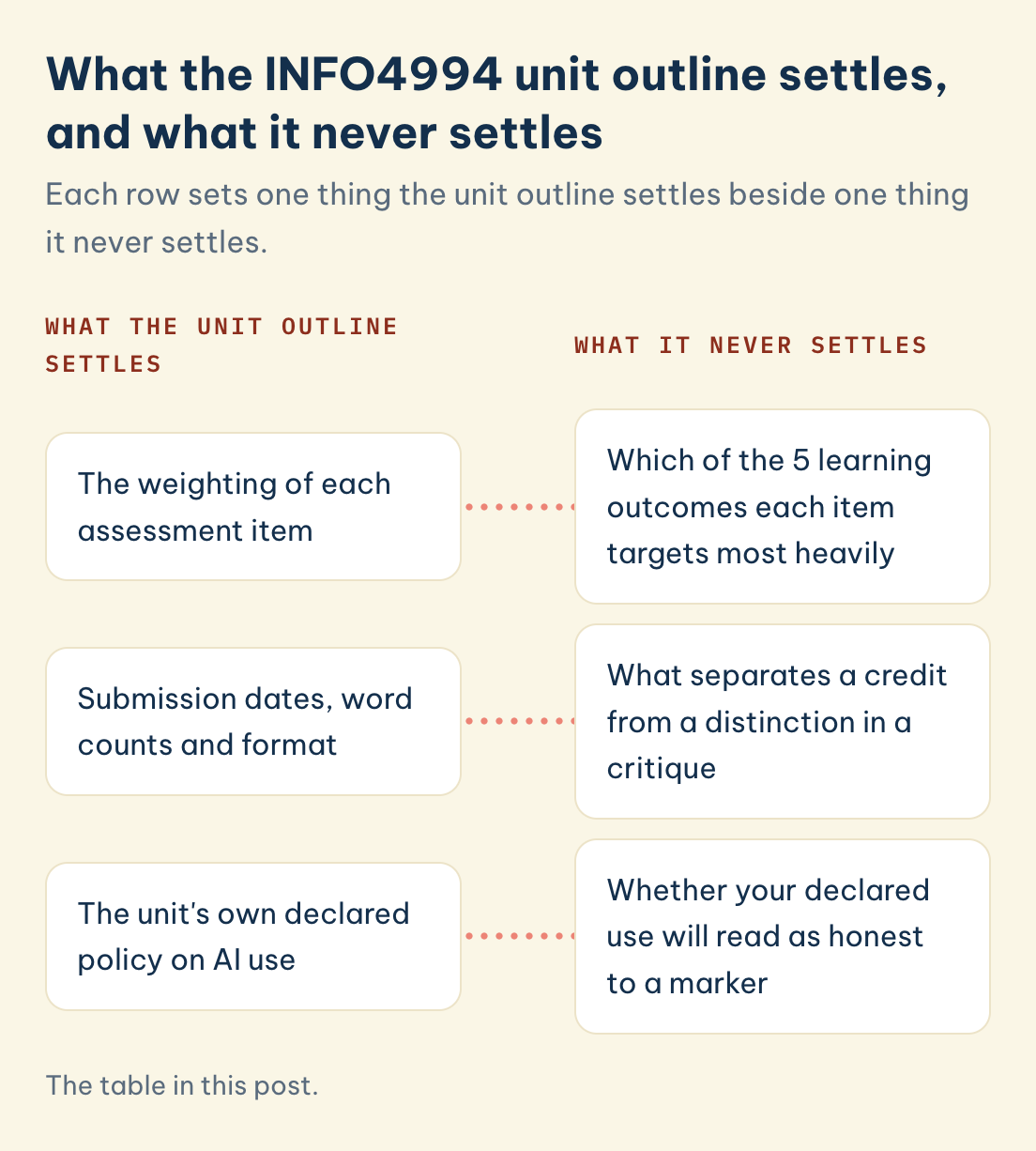
What the INFO4994 unit outline settles, and what it never settles
Each row sets one thing the unit outline settles beside one thing it never settles.
What the unit outline settles
What it never settles
The weighting of each assessment item
Which of the 5 learning outcomes each item targets most heavily
Submission dates, word counts and format
What separates a credit from a distinction in a critique
The unit's own declared policy on AI use
Whether your declared use will read as honest to a marker
Save this figure
Evidence: Reading the outline early matters more in INFO4994 than in a conventional unit, because a unit built around critical evaluation tends to weight extended written work heavily, and extended written work fails slowly. A student who discovers in week 10 that the largest component is a 2500 word critique rather than an exam has lost the 6 or 7 weeks during which they could have been collecting material as they went. The cheapest possible insurance is a 5 minute read of the outline in the first week of teaching.
| What the unit outline settles | What it never settles |
|---|---|
| The weighting of each assessment item | Which of the 5 learning outcomes each item targets most heavily |
| Submission dates, word counts and format | What separates a credit from a distinction in a critique |
| The unit's own declared policy on AI use | Whether your declared use will read as honest to a marker |
What to do about it: map each assessment item onto the learning outcome it is testing before you start writing. An item that names bias, fairness or privacy is testing outcome 4, and a submission that spends most of its words explaining how transformers work has answered a different question well.
◆ Question 3 / 7 · AI use
What counts as acceptable AI use when the unit is about AI?
Direct answer: Permission to use a tool is never permission to submit its output. Across the university policies studied in the integrity literature, the recurring rule is that fully AI-generated content is not accepted, that AI-derived content must be checked by the student, and that quoted or paraphrased output must be cited. INFO4994 changes what you may use, not who is accountable.
Evidence: The distinction that carries marks is between AI as an instrument and AI as an author. If you prompt a model to generate 3 counterarguments and then evaluate which of the 3 survives scrutiny, the intellectual work on the page is yours and the tool is visible in your method. If you prompt a model for a paragraph and edit its wording, the intellectual work is the model's and your edit is cosmetic. Markers can tell these apart more reliably than students expect, because the second kind of writing is confident everywhere and specific nowhere. It never says which claim it doubts.
Example: A Vietnamese student in a Sydney postgraduate program submitted a draft in which every section closed with a balanced sentence about how the technology "offers both opportunities and challenges". Her mentor asked her to delete all 6 of those sentences and replace each with the one thing in that section she personally thought was wrong. The word count fell by 300 and the draft moved from descriptive to evaluative, because a position had appeared.
Ng et al. (2021), in an exploratory review published in Computers and Education: Artificial Intelligence, volume 2, article 100041, organise AI literacy into 4 aspects: knowing and understanding AI, using and applying AI, evaluating and creating AI, and AI ethics. That structure maps almost directly onto the INFO4994 outcomes, and it is a useful checklist for auditing your own draft. If everything you have written sits in the first two aspects, you have written a competent piece that will not reach the top band.
◆ Question 4 / 7 · Citing AI
How do you cite generative AI in a university assignment?
Direct answer: Cite the model as a source with no retrievable location, because a conversation cannot be looked up by your marker the way a journal article can. Referencing styles differ, and several still have no official rule, in which case library guidance is to treat the output like personal communication. Name the tool, the version, the date, and keep the prompt.
Evidence: The practical requirement behind every version of this rule is reproducibility, and reproducibility is what a chat transcript destroys. Two students entering the same prompt on the same day receive different text, which means the citation is doing a different job from a normal one. It is not pointing your marker at the source so they can verify it. It is disclosing a method so they can judge it. That is why an appendix carrying your actual prompts is usually worth more than a tidy reference entry, and why a submission with a perfect reference list but no prompts often reads as less honest, not more.
What to do about it: keep a running log from week 1 with 4 columns: the date, the tool and version, the exact prompt, and what you did with the output. It takes 30 seconds per entry and it turns a reflective section that would otherwise be reconstructed from memory into a piece of evidence.
◆ Question 5 / 7 · Checking output
How do you check an AI output for hallucination before you submit it?
Direct answer: Check the citations first, individually, and treat every one as false until it resolves. Large language models fabricate references that are formally perfect and factually empty, with plausible authors, plausible journals and a DOI that leads nowhere. A reference list is the cheapest place for a marker to find a fabrication.
Evidence: Fabrication is not a bug, so better prompting does not remove it. Bender et al. (2021), in the ACM FAccT proceedings at pages 610 to 623, characterise a language model as a system that stitches together sequences of linguistic form according to probabilistic information about how they combine, without reference to meaning. A system built that way produces a citation shaped like a real citation for the same reason it produces a sentence shaped like a true sentence. Nothing in its construction distinguishes the two cases, so nothing in your prompt can reliably separate them either.
Example: A student building a lit review for an ethics assessment received 8 references from a model, and 7 of them resolved to real work. The eighth had a real author, a real journal and a DOI that returned nothing. Her mentor showed her a 20 second check that now runs on every reference she uses: paste the DOI into doi.org, and if it does not open the exact paper named, the reference does not exist. That single habit is worth more than any detector.
| Verification step | What it costs | What it catches |
|---|---|---|
| Resolve every DOI at doi.org | 20 seconds each | Fabricated references |
| Open the source and find the claimed sentence | 3 to 5 minutes each | Real source, invented claim |
| Check the publication year against the claim | 10 seconds each | Findings attributed before they existed |
| Confirm the author actually wrote in that field | 1 minute each | Real name, wrong person |
◆ Question 6 / 7 · AI detectors
Why do AI detectors matter more if English is your second language?
Direct answer: Because detectors misclassify second-language writing as machine-generated at a substantially higher rate than they misclassify native writing. If you are a Vietnamese student writing in English, the risk you carry is not only the risk of being caught using AI. It is the risk of being accused when you did not.
Evidence: Liang et al. (2023), publishing in Patterns volume 4, issue 7, article 100779, tested widely used GPT detectors against writing by native and non-native English speakers. Their finding is unambiguous: "GPT detectors frequently misclassify non-native English writing as AI generated, raising concerns about fairness and robustness" (Liang et al., 2023). They further report that simple prompting strategies both mitigate the bias and bypass the detectors, and they caution that use in educational settings may inadvertently penalise or exclude non-native English speakers. A tool that is both biased against you and trivially defeated by the people it targets is not a tool that should decide an integrity case, and this paper is the citation to have on hand if one is ever opened against you.
What to do about it: build a defensible record while you are writing rather than after you are accused. Draft in a document with version history turned on, keep the prompt log described above, and save the reading notes that preceded the draft. An investigation asks you to demonstrate process, and a process that exists only in your memory demonstrates nothing. This is also, incidentally, the argument for doing the work in the way the unit intends.
◆ Question 7 / 7 · Critical evaluation
How do you write the critical evaluation the unit actually rewards?
Direct answer: Make a claim that a reasonable person could disagree with, then defend it against the strongest objection you can find. Description tells the reader what a thing is. Evaluation tells the reader what you concluded and on what grounds you could be shown wrong. Only the second earns the higher bands.
Long and Magerko (2020), in the CHI 2020 proceedings at pages 1 to 16, define AI literacy as a set of competencies enabling people to critically evaluate AI technologies, communicate and collaborate effectively with AI, and use AI as a tool. Their definition rests on a scoping review of 150 documents, made up of 53 conference papers, 38 journal papers, 15 books and 44 pieces of grey literature, which they sorted into 5 overarching themes and a numbered list of competencies. The corpus also skews recent: 8 documents predate 2000, 43 fall in 2000 to 2009, 55 in 2010 to 2017 and 44 in 2018 to 2019, so the field the unit teaches was assembled largely inside 1 decade. The word doing the work there is critically, and it is worth noticing that their definition places evaluation before use. A student who can operate 5 tools fluently and cannot say which of them is inappropriate for a given task has competence without literacy, and that gap is precisely what an assessment in this unit is designed to expose.
The practical form of that principle is narrower than it sounds. Take one specific claim, such as the claim that AI tutoring systems widen access to education. Name the condition under which it holds, name the condition under which it fails, and say which condition your evidence supports. That is 3 sentences, and it does more evaluative work than 3 paragraphs of balanced summary. If you find yourself unable to name a failure condition, the claim is probably not one you have examined.
Frequently asked questions
Do I need a computing background to take INFO4994?
No. The unit lists no prerequisites and no assumed knowledge, and it runs in both semesters of 2026 at the Camperdown and Darlington campus. It is designed to be open across faculties, which means the assessment cannot reward prior technical training.
Can I use ChatGPT for my INFO4994 assignments?
The unit outline for your session is the authority, and in a unit whose second learning outcome is about using generative AI, some permitted use is likely. Permitted use still requires disclosure, still requires you to verify accuracy, and still holds you accountable for every claim submitted under your name.
How do I reference an AI conversation in APA 7?
Treat it as a source without a retrievable location and follow your faculty's current guidance, since styles vary and several are still developing rules. Whatever the format, name the tool and version, give the date, and keep the prompts. An appendix of prompts is usually stronger evidence of honest process than the reference entry itself.
What happens if a detector flags my work and I did not use AI?
Ask what evidence the finding rests on, and present your process record: version history, prompt log, reading notes and drafts. Liang et al. (2023) is directly relevant, because it documents systematic misclassification of non-native English writing by these tools.
Is INFO4994 the same code at other universities?
Verify before you use any study material you find online. Course codes are reused across institutions, and material written for a differently numbered unit elsewhere will describe assessments you are not sitting.
How MAAS supports students in this unit
MAAS works as an academic advisor, not a writing service. For a unit like INFO4994, that usually means 3 things: helping you turn a descriptive draft into an evaluative one by locating the missing claim, reviewing your reference list against the verification steps above before a marker sees it, and building the process record that protects you if your work is ever questioned. You write the assignment. Your mentor's job is to show you where the reasoning is not yet load-bearing.
If you would like an expert to look at a draft for this unit, talk to us about academic support or MAAS Assignment & Essay Support.
References
Bender, E. M., Gebru, T., McMillan-Major, A., & Shmitchell, S. (2021). On the dangers of stochastic parrots: Can language models be too big? In Proceedings of the 2021 ACM Conference on Fairness, Accountability, and Transparency (pp. 610–623). Association for Computing Machinery. https://doi.org/10.1145/3442188.3445922
Liang, W., Yuksekgonul, M., Mao, Y., Wu, E., & Zou, J. (2023). GPT detectors are biased against non-native English writers. Patterns, 4(7), 100779. https://doi.org/10.1016/j.patter.2023.100779
Long, D., & Magerko, B. (2020). What is AI literacy? Competencies and design considerations. In Proceedings of the 2020 CHI Conference on Human Factors in Computing Systems (pp. 1–16). Association for Computing Machinery. https://doi.org/10.1145/3313831.3376727
Ng, D. T. K., Leung, J. K. L., Chu, S. K. W., & Qiao, M. S. (2021). Conceptualizing AI literacy: An exploratory review. Computers and Education: Artificial Intelligence, 2, 100041. https://doi.org/10.1016/j.caeai.2021.100041
University of Sydney. (2026). INFO4994: AI literacy and competency [Unit of study outline]. https://www.sydney.edu.au/units/INFO4994
Tools & resources
- University of Sydney unit page for INFO4994: https://www.sydney.edu.au/units/INFO4994
- DOI resolver for checking whether a reference exists: https://www.doi.org
A free 20-minute consultation is a conversation about where you are with INFO4994.
Book a free consultation ▸