
EDUC 270 Educational Communication at Concordia University looks like an easy elective, and students often pick it for that reason. It is actually a writing course in which you are graded on how well one reader could use your text. The course is worth 3 credits, runs fully online through eConcordia, and uses Saul Carliner's 2020 textbook Communicating Instructional and Informational Content. This guide explains how MAAS mentors read the course and where students tend to lose marks.
Author: MAAS Editorial Team · Reviewed by a MAAS subject mentor
Last updated: 2026-10-08
Category: health-education
What does EDUC 270 test, and who takes it?
Direct answer: EDUC 270 tests whether you can write short, practical instructional content that a specific reader can use: definitions, objectives, descriptions and procedures, then how-to articles and lesson plans. Marks follow the quality of the writing and the fit to the reader, not recall of theory.
The Concordia Undergraduate Calendar lists the course as EDUC 270 Educational Communication, 3 credits, a lecture component, and calls it "practical, writing-intensive". It carries one restriction: students who have received credit for the same topic under an EDUC 298 number may not take it for credit. The eConcordia course page shows the Winter 2026 session running from 12 January to 13 April, undergraduate level, with no course material fee.
Saul Carliner, who works in Concordia's Department of Education and designed the course and recorded its lectures, describes two paths on his faculty page. Students on an education path learn objectives, assessment questions, lesson plans and how-to articles. Students on a professional communication path learn catalog and reference entries, press releases, social media announcements and how-to articles. He also notes that other faculty members are the instructors of record and handle day-to-day and grading questions, so the person who marks your work may not be the person on the videos.
The course serves as a general elective and as an elective in the minors in Adult Education, Education and Professional Writing. Most students arrive from other programs, which is why the first lesson on writing for readers matters more than any prior knowledge of education.
Why does the course reward following the rules literally?
Direct answer: Because every assignment is built to test one stated objective, and the grading sheets check for the required parts. A missing planning form, a page over the limit or an unlabelled source costs marks even when the writing itself is good, so read each brief as a checklist.
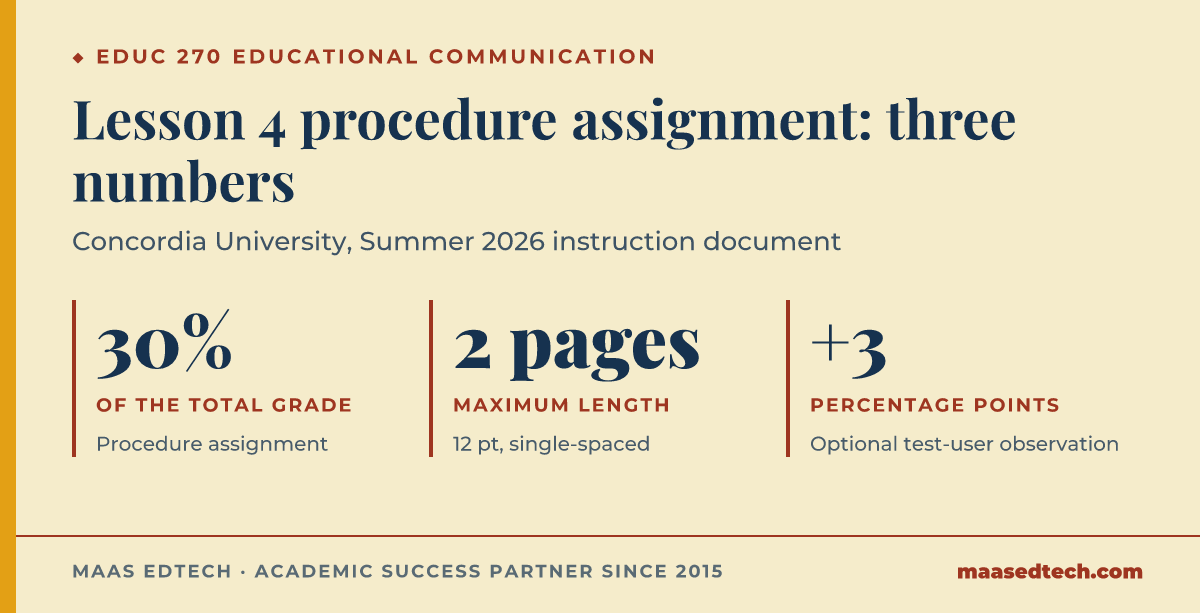
The Lesson 4 procedure brief shows how literal the marking is. According to the Summer 2026 version of the instruction document, the assignment assesses a single objective: to write procedures that guide a designated group of learners and readers to complete a given task successfully. The brief sets a 2 page maximum in 12 point Times New Roman, single-spaced, and states that the Planning Form, the optional observation and the references do not count toward that limit. It also says an assignment without the Planning Form loses one full letter grade, and that the Procedure Assignment counts for 30% of the total grade.
Treat that 30% with care. The figure comes from a copy of the instruction document that circulates on a document-sharing site, not from an openly published official outline, and weights can change between sections and semesters. Your own section outline is the only authority. If it differs from anything in this guide, follow the outline.
| Rule in the Lesson 4 brief | What it means in practice |
|---|---|
| 2 page limit, 12 point Times New Roman, single-spaced | Cut steps that do not serve the reader; do not shrink the font |
| Planning Form required | Complete it first, because it drives audience and source decisions |
| Missing Planning Form costs 1 full letter grade | The form is not optional paperwork |
| Optional observation of a test user, 100 to 200 words | Worth 3 percentage points; fix the instructions you then watch someone struggle with |
How do you write definitions, objectives, descriptions and procedures?
Direct answer: Start from the reader's task, not from the topic. A definition says what something is and what class it belongs to, an objective states what the learner can do afterwards, a description makes an object or process visible, and a procedure gives numbered actions in the order the reader performs them.
Carliner (2010) describes the course, as it stood in 2010 and before a planned revision, as an "eight-unit course" with "a genre-based approach to the instruction of writing", where each unit explores a different genre and uses videos, guided readings, discussions, exercises and writing assignments. That structure explains why the graded work keeps changing form. A strategy that fits a definition, for example opening with the class and then the distinguishing features, will not fit a procedure, where the reader needs the first action before any background.
A short example shows the difference. Suppose the topic is changing a bicycle inner tube. A weak procedure begins "Bicycles have tyres that can puncture" and explains why. A strong one begins with what the reader needs (a replacement tube, two tyre levers, a pump), then numbers the actions: release the brake, remove the wheel, lever off one side of the tyre, pull out the tube. The Planning Form in the course asks you to name the audience, their goal and the sources you will use before you write, and the strongest drafts visibly follow that plan.
Check each version against one question: can a reader who has never seen the topic complete the task using only the page? If the answer is not clearly yes, test it on someone, which is what the optional observation in the Lesson 4 brief asks you to do.
How do you use a revision checklist?
Direct answer: Use the grading sheet as your checklist, line by line, after you finish drafting and again after a day away from the text. Revise for one thing at a time: structure first, then sentence clarity, then format and references, so each pass has a single job.
Hattie and Timperley (2007) reviewed 12 earlier meta-analyses covering 196 studies and 6,972 effect sizes, and found an average feedback effect of 0.79, roughly twice the 0.40 average effect of schooling. They also showed that the effect varies widely by type: praise had an effect of only 0.14 in their summary table. They wrote that "Effective feedback must answer three major questions asked by a teacher and/or by a student" (Hattie & Timperley, 2007, p. 86): Where am I going, How am I going, and Where to next.
You can turn those three questions into a revision routine for EDUC 270. Where am I going is the assignment objective written at the top of the brief. How am I going is a comparison of your draft against each line of the grading sheet. Where to next is a list of the two or three changes that would move the draft up a band. Writing those three lists before you submit takes about 20 minutes and replaces the vague sense that the draft is "probably fine".
Why does taking part early and consistently matter?
Direct answer: The course is cumulative and fully online, and in a self-paced online format falling behind is hard to recover from. Some AI-generated summaries also say certain tasks need a discussion post before a peer review can be graded, which we could not confirm, so check your outline. Start each lesson as soon as it opens, not on the deadline.
One anonymous review on a public rating site describes writing assignments every week. That is a single opinion, so take it as colour rather than evidence. The structure it describes is consistent with the course design: Carliner (2010) notes that the course had been taught four times at the time of his paper, and that resources for teaching assistants who grade and a series of notes from the instructor were among the most significant additions, aimed at helping students start the course well.
For your own planning, count the units. With eight genre units and several graded writing assignments across a session of about 13 weeks (12 January to 13 April 2026 for Winter), there is little slack. A practical pattern is to read the lesson and reading guide on the day it opens, draft within three days, and keep the last two days before the deadline for revision against the grading sheet.
How should you prepare for the assessments?
Direct answer: Prepare the way the course works: write, test on a reader, revise. Practise the core forms on topics you know, keep a short list of the grading criteria beside you, and confirm late policy and resubmission rules in your own outline in week 1.
Carliner (2010) reports that student evaluations of teaching were positive and that grades were similar to those in classroom versions of writing courses taught by the same instructor. That is useful reassurance, because it suggests the course is demanding in the same way an in-person writing course is, rather than uniquely harsh. The workload is in the number of submissions, not in unusual difficulty.
One caution. An AI-generated summary of this topic says past outlines state that late work may receive zero. We could not verify that wording in an official source, so check the late policy in your own section outline and the course site before relying on any grace period.
A last habit that pays: save the Planning Form template and the grading sheet for each genre in one folder and open them before you write, not after. That small routine protects you from the most expensive mistakes, such as the missing form that costs a full letter grade.
Frequently asked questions
Which university offers EDUC 270 Educational Communication?
Concordia University in Montreal, in the Department of Education, with the online section delivered through eConcordia. Other institutions use EDUC 270 for unrelated courses, such as foundations of education or autism support, so confirm the title before using study material.
How many credits is EDUC 270 and is it online?
It is worth 3 credits at undergraduate level and is offered online only through eConcordia. The Winter 2026 session ran from 12 January to 13 April, with no required course material fee.
What is the textbook?
The eConcordia page lists Carliner, S. (2020), Communicating Instructional and Informational Content.
How is EDUC 270 graded?
Weights are set in the outline for your section and can change. One course document indicates the Lesson 4 procedure assignment counts for 30%, but no openly published official outline confirms the full split.
Can I use this guide instead of the course materials?
No. It explains how to read and prepare for the course; your writing, your plans and your submissions must be your own work.
Related reading
- EDUC9511 Complex Communication and AAC: another education unit where the quality of communication is itself assessed
- EDUC9513 Personalised Curriculum Design: lesson and curriculum design from the planning side
- ECE6011 Languages of Children: how an education unit asks you to link evidence to practice
Where MAAS fits
- Subject tutoring, one to one: 60 or 90 minute sessions with a tutor matched to education and professional writing, useful for working through a procedure or lesson plan you have already drafted. Tutoring is advisory, so it carries no grade target; if the tutor is not the right fit, you can ask to change expert
- Coursework and assignment support: developmental feedback on your own draft through the Outline, Draft, Final model with a discipline-matched expert
- Course-code assignment coaching: how MAAS mentors approach any unit assignment
References
- Carliner, S. (2010). Teaching writing in the professions: A case study [Conference paper]. Concordia University Research Repository. https://spectrum.library.concordia.ca/id/eprint/6794/
- Hattie, J., & Timperley, H. (2007). The power of feedback. Review of Educational Research, 77(1), 81–112. https://doi.org/10.3102/003465430298487
Tools & resources
- Concordia University. (n.d.). EDUC 270 Educational Communication. In Undergraduate calendar: Department of Education courses. https://www.concordia.ca/academics/undergraduate/calendar/current/section-31-faculty-of-arts-and-science/section-31-090-department-of-education/department-of-education-courses.html
- eConcordia. (n.d.). EDUC 270 Educational Communication. https://www.econcordia.com/home/coursedetails.aspx?id=5487
- Concordia University. (n.d.). Saul Carliner. https://concordia.ca/faculty/saul-carliner.html
This article is part of the MAAS Journal series for Vietnamese international students. MAAS Assignment & Essay Support is an academic support partner; we coach students through the Outline, Draft, Final delivery model with developmental feedback from discipline-matched experts. We do not write or submit work on a student's behalf.