
◆ Health & Education
How does reciprocal reading work, and what are the four roles?
Direct answer: Reciprocal reading is a small-group routine in which pupils take turns leading a discussion of a short text using four strategies: predict, clarify, question and summarise. The teacher models each strategy first, then hands the lead to pupils. It grew out of Palincsar and Brown's 1984 studies, and two EEF-funded trials in English primary schools have tested it.
◆ Question 1 / 8 · What reciprocal means
What does "reciprocal" mean in reciprocal reading?
Direct answer: "Reciprocal" means the teaching role passes back and forth. The teacher leads first and shows how an expert reader thinks, then pupils take turns acting as the teacher for the group. Each pupil both gives and receives support, which is the exchange the word describes.
Annemarie Palincsar and Ann Brown introduced the method in a paper titled "Reciprocal teaching of comprehension-fostering and comprehension-monitoring activities", published in Cognition and Instruction (Palincsar & Brown, 1984). Their design was a dialogue: an adult and a small group read a passage segment by segment, and the person leading each segment used four activities to keep the group's understanding on track. Reading Rockets, a US literacy site, describes the same idea for teachers today as "a cooperative learning strategy" in which "a group of students take turns acting as the teacher in guiding the comprehension of a text" (Reading Rockets, n.d.). The word matters for planning. If the teacher keeps the lead for the whole session, the lesson becomes guided reading with four prompts, which is useful, but it is not the reciprocal part. The gradual handover is what the method adds.
◆ Question 2 / 8 · The four roles
What are the four roles, and what does each pupil say?
Direct answer: The four strategies are usually given as four roles: the Predictor, the Clarifier, the Questioner and the Summariser. Each role has a short job on every chunk of text. Rotating the roles means every pupil practises all four strategies across a session, not just the one they find easiest.
Reading Rockets lists the four components as predicting, clarifying, questioning and summarising, and explains that pupils first "learn about and practice the four strategies" before running the discussion themselves (Reading Rockets, n.d.). The EEF's Teaching and Learning Toolkit includes predicting, clarifying, asking a question and summarising in its list of reading comprehension strategies, and describes the teaching as "consciously modelling and applying the tools used by expert readers until they become automatic for pupils" (Education Endowment Foundation [EEF], n.d.-b). The table below turns each strategy into a role card a pupil can hold. The sentence starters are classroom examples written for this guide, not text taken from any published programme.
| Role | Job on each chunk | Example sentence starter |
|---|---|---|
| Predictor | Uses the title, pictures and the last chunk to guess what comes next | "I think the next part will show... because..." |
| Clarifier | Spots a word, phrase or idea the group does not understand and works it out | "I wasn't sure what ... meant, so I reread the sentence before it." |
| Questioner | Asks a question about the chunk, ideally one that needs inference | "Why do you think the character...?" |
| Summariser | Restates the main point of the chunk in one or two sentences | "The most important thing in this part is..." |
Source: strategies from Palincsar and Brown (1984) and Reading Rockets (n.d.); sentence starters written by MAAS for this guide.
◆ Question 3 / 8 · How a session runs
How does a reciprocal reading session run, step by step?
Direct answer: A session works through a short text in small chunks. For each chunk the group predicts, reads, clarifies, questions and summarises, then the roles rotate. Early sessions are teacher-led, and later ones are pupil-led with the teacher listening and stepping in only when the discussion stalls.
The FFT programme tested in England gives a concrete shape. The EEF evaluation describes the intervention as using the four strategies "repeatedly on small sections of the text, to deal with comprehension difficulties as they emerge", delivered "for two 20–30-minute sessions per week, for a minimum of 12 weeks" in groups of four to eight pupils in Years 5 and 6 (Torres Blas et al., 2026, p. 4). A workable sequence for one chunk is: the Predictor makes a prediction from the heading or the previous chunk; everyone reads; the Clarifier raises anything confusing and the group fixes it; the Questioner asks one question and others answer from the text; the Summariser closes the chunk in a sentence. Then the cards pass to the left. With a 25-minute slot and four pupils, three or four chunks of a few paragraphs each is a realistic target. If the group cannot finish a chunk, shorten the next one rather than skipping a role.
◆ Question 4 / 8 · A lesson example
What is an example of reciprocal teaching in a lesson?
Direct answer: A Year 6 group reading a short non-fiction article about rivers might predict from the headline, clarify "meander", ask why towns grew beside rivers and summarise each paragraph in a sentence. The teacher models the first paragraph aloud, then hands the cards to pupils for the next three.
Here is how the first two chunks might sound, with the teacher leading chunk one. Teacher as Predictor: "The headline says 'Why rivers bend'. I predict it will explain what makes a river change direction." Teacher as Clarifier after reading: "I'm not sure what 'erosion' means here. The next sentence says the water wears the bank away, so erosion must mean wearing away." Teacher as Questioner: "Why would the outside of the bend wear away faster than the inside?" Teacher as Summariser: "This part says rivers bend because water wears away one bank more than the other." For chunk two the cards go to pupils, and the teacher's job changes to prompting: "Can you find the sentence that told you that?" This mirrors the handover Reading Rockets describes, where the teacher's role is "to model the process initially and then gradually hand over the responsibility to the students" (Reading Rockets, n.d.). The example text is invented for this guide.
◆ Question 5 / 8 · What the EEF found
Does reciprocal reading work? What does the EEF evidence say?
Direct answer: The 2019 EEF efficacy trial found about two months' additional progress for the targeted version. The larger 2023/24 trial estimated about one month, though its uncertainty range includes no effect. In that trial, pupils who received the full intended intensity did better than the average intervention pupil.
Reciprocal Reading trial results
Additional months of reading progress in two EEF trials.
Trial and group
Additional months of progress
Efficacy trial, targeted version
2 (vs control)
Effectiveness trial, all pupils
1 (vs control)
Effectiveness trial, 20+ sessions in 12 weeks
2 (vs average intervention pupil)
Save this figure
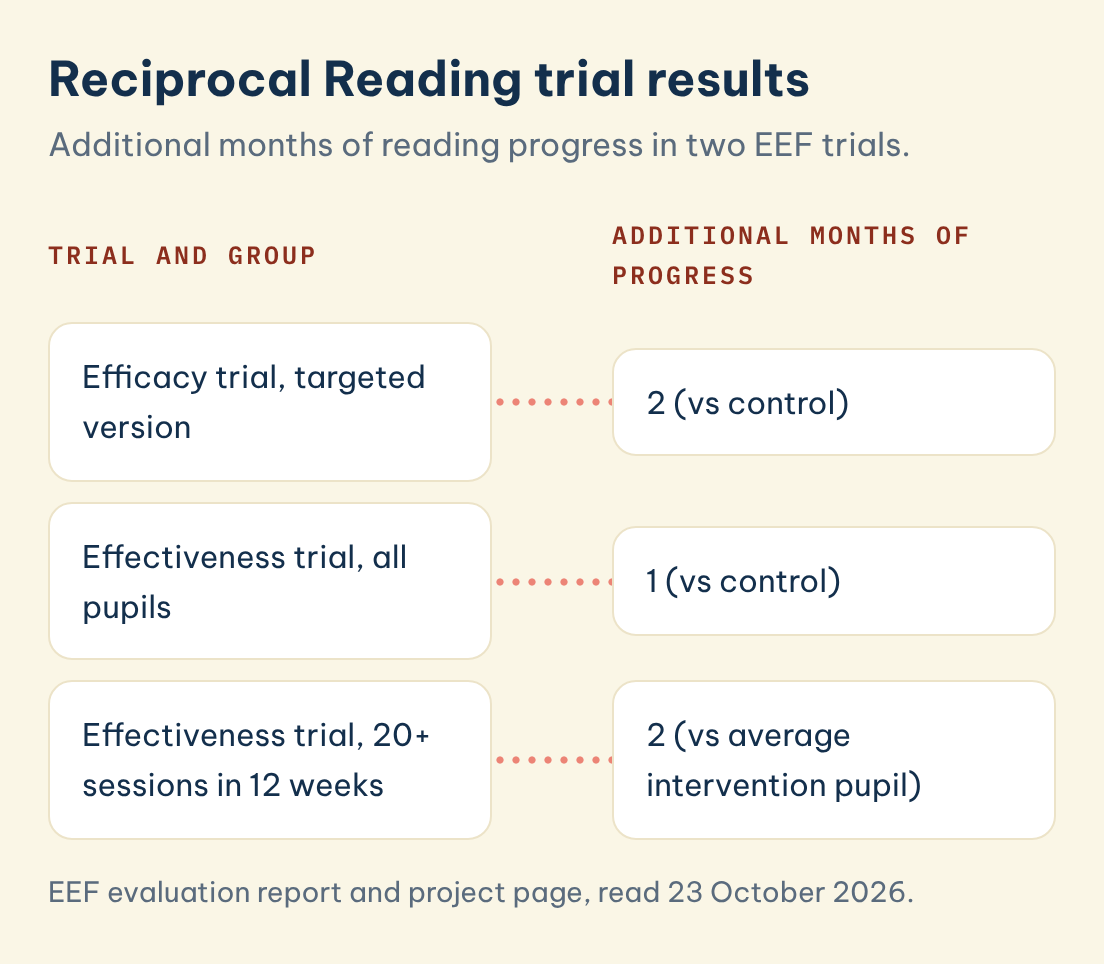
The 2019 EEF efficacy trial of FFT Reciprocal Reading involved 98 primary schools and 5,222 pupils, and found that pupils in the targeted intervention made an average of two months' more progress in reading comprehension and overall reading, with no evidence of improvement for the whole-class version (EEF, n.d.-a). The second, larger trial ran in 295 primary schools in 2023/24. Its report states that "Pupils in Reciprocal Reading schools made one month's more progress in reading on average, compared to pupils in other schools" and rates the result as high security (Torres Blas et al., 2026, p. 4). The same report notes that the possible impact also includes no additional progress. A supplementary analysis found that pupils who had "at least 20 sessions over 12 weeks or less" gained the equivalent of two months compared with the average pupil in the intervention group, not compared with control schools, which suggests intensity matters (Torres Blas et al., 2026, p. 4). Research outside England gives a similar, modest picture. A meta-analysis of 52 whole-classroom studies found "a very small effect on reading comprehension (Cohen's d = 0.186) for standardized tests" and a larger effect on researcher-developed tests (Okkinga et al., 2018).
| Study | Setting | Main reading result |
|---|---|---|
| EEF efficacy trial (FFT) | 98 schools, 5,222 pupils | Targeted: +2 months; whole-class: no evidence of impact |
| EEF effectiveness trial (FFT), 2023/24 | 295 primary schools | +1 month vs control (range includes no effect); supplementary: full-intensity pupils about +2 months vs average intervention pupil |
| Okkinga et al. (2018) meta-analysis | 52 whole-classroom studies | d = .186 on standardised tests; d = .431 on researcher tests |
Source: EEF project page, Torres Blas et al. (2026) and Okkinga et al. (2018), read 23 October 2026.
◆ Question 6 / 8 · Secondary school
Can reciprocal reading work in secondary school?
Direct answer: Yes, with two adjustments: harder texts cut into shorter chunks, and questions that ask for inference rather than recall. The two large EEF trials were in primary schools. Smaller English trials with 11 to 12 year olds gave mixed results, and Okkinga et al. found larger effects in grades 6 to 8.
The two large EEF trials covered Years 4 to 6, so their numbers say nothing directly about a Year 9 history class, and the 2026 report describes earlier secondary trials in England with mixed results (Torres Blas et al., 2026, p. 6). The best wider evidence is the whole-classroom meta-analysis, whose abstract reports that "effect sizes tended to be larger for studies conducted in grades 6–8" and that effects were larger when "setting reading goals" was part of the strategy package (Okkinga et al., 2018). For a secondary teacher, that suggests three practical moves. Start each session by stating what the group is reading to find out. Use subject texts the class must read anyway, such as a source extract in history or a method section in science, so the routine supports content learning. And raise the bar for the Questioner: a question whose answer is a single copied phrase is a recall check, while a question that needs two sentences from different parts of the text pushes inference. The same abstract notes that effects were larger when researchers rather than teachers delivered the training, which is a reason to rehearse the routine before relying on it.
◆ Question 7 / 8 · The 5 4 3 2 1 task
What is the 5 4 3 2 1 reading strategy, and is it the same thing?
Direct answer: No. The 5 4 3 2 1 routine is a separate countdown-style task that some teachers use for summarising or reflecting, and it is not one of the four reciprocal reading strategies. The sources checked for this guide do not define a standard version, so treat it as a local classroom activity.
The four strategies in reciprocal reading come from one research line, starting with Palincsar and Brown (1984) and continued in the EEF-funded FFT programme (Torres Blas et al., 2026, p. 4). A 5 4 3 2 1 sheet asks pupils to list a shrinking number of items, and different schools fill the numbers with different prompts. That can be a useful exit task, but it has no dialogue and no role rotation, so it does not do what the reciprocal routine does. If your class already uses one, it can sit alongside the Summariser role at the end of a session. The EEF Toolkit lists summarising as one strategy among many, and rates reading comprehension strategies overall as "High impact for very low cost based on moderate evidence" (EEF, n.d.-b), which supports teaching strategies explicitly whichever worksheet format you prefer.
◆ Question 8 / 8 · Problems and fixes
What goes wrong, and how do teachers fix it?
Direct answer: The common problems are time, staffing and pupils who repeat the same easy moves. The effectiveness trial reported timetabling as the biggest barrier. Fixed slots, short texts and role cards with sentence starters help keep sessions regular and discussion real.
In the effectiveness trial, "timetabling issues (65% of teacher survey respondents), insufficient staff resources (32%), and lack of physical space (29%)" were the main implementation challenges, though most schools found ways around them (Torres Blas et al., 2026, p. 5). Because the intensity finding showed better results when sessions were not spread out, protecting the slot matters more than polishing materials. The report also notes that only 5% of teachers reported a confidence boost for pupils with English as an additional language (Torres Blas et al., 2026, p. 5). Our own suggestion, not a trial finding, is that EAL pupils may need vocabulary pre-teaching before the Clarifier role works for them. A third problem is the Questioner who always asks "What colour was...?" Model one good inference question per session and praise it by name. Finally, watch the Summariser: a summary longer than the chunk usually means the pupil is retelling, so cap it at one sentence.
Frequently asked questions
What does reciprocal mean in reading?
It means the teaching role is shared. The teacher models the four strategies, then pupils take turns leading the group, so each pupil both teaches and learns.
How does reciprocal reading work?
A small group reads a short text in chunks. For each chunk, pupils predict, clarify, question and summarise, with each strategy held as a role that rotates around the group.
What are the four reciprocal reading strategies?
Predicting, clarifying, questioning and summarising, as set out by Palincsar and Brown (1984) and used in the FFT programme.
Is reciprocal reading recommended by the EEF?
The EEF lists FFT Reciprocal Reading as a Promising Programme after two large primary trials. The larger one estimated one month's additional progress, with a high security rating.
Is the 5 4 3 2 1 reading strategy part of reciprocal reading?
No. It is a separate summarising or reflection task. It has no dialogue or role rotation.
How long should a reciprocal reading session be?
The tested FFT programme used two 20 to 30 minute sessions per week for at least 12 weeks, and pupils who had at least 20 sessions within 12 weeks or less did better than the average intervention pupil.
Related guides
- EDUC 270 educational communication assignment guide: how feedback research shapes writing instruction
- Assignment command words explained: what "summarise", "explain" and "evaluate" ask for
- Become a MAAS expert: for teachers and subject specialists who want to support university students one to one
If you are a teacher who already runs routines like this and wants to tutor international students in your subject, you can apply to join the MAAS expert network. Experts guide students through their own work rather than completing it for them.
References
- Education Endowment Foundation. (n.d.-a). FFT Reciprocal Reading: Trial. Retrieved October 23, 2026, from https://educationendowmentfoundation.org.uk/projects-and-evaluation/projects/reciprocal-reading
- Education Endowment Foundation. (n.d.-b). Reading comprehension strategies. Teaching and Learning Toolkit. Retrieved October 23, 2026, from https://educationendowmentfoundation.org.uk/education-evidence/teaching-learning-toolkit/reading-comprehension-strategies
- Okkinga, M., van Steensel, R., van Gelderen, A. J. S., van Schooten, E., Sleegers, P. J. C., & Arends, L. R. (2018). Effectiveness of reading-strategy interventions in whole classrooms: A meta-analysis. Educational Psychology Review, 30(4), 1215-1239. https://doi.org/10.1007/s10648-018-9445-7
- Palincsar, A. S., & Brown, A. L. (1984). Reciprocal teaching of comprehension-fostering and comprehension-monitoring activities. Cognition and Instruction, 1(2), 117-175. https://doi.org/10.1207/s1532690xci0102_1
- Reading Rockets. (n.d.). Reciprocal teaching. Retrieved October 23, 2026, from https://www.readingrockets.org/classroom/classroom-strategies/reciprocal-teaching
- Torres Blas, N., Forsyth, E., Cueto, A., & Taylor, P. (2026). Reciprocal Reading effectiveness trial: Evaluation report. Education Endowment Foundation. https://files.eric.ed.gov/fulltext/ED680981.pdf
This article is part of the MAAS Journal series. MAAS is an academic support partner: experts guide students through each stage of their own work, and we do not complete assessed work on a student's behalf.
Teach or tutor a subject you know well? Apply to guide university students one to one in the MAAS expert network.
Apply to become an expert ▸