
◆ Health & Education
How do you write a lesson plan with clear learning objectives?
Direct answer: Start with the objective, not the activity. Write what learners will be able to do by the end, using an observable verb, then plan how you will check it. Only after that choose the stages, timings and materials. A good plan is detailed enough that a colleague could pick it up and teach the lesson.
◆ Question 1 / 6 · Lesson plan format
What should a lesson plan format include?
Direct answer: A usable format has a short header and a staged body. The header names the class, topic and objectives. The body lists each stage with its timing, what the teacher and learners do, the materials, and how understanding is checked. A closing line records what worked.
The British Council's TeachingEnglish checklist is a sensible baseline. Its list of what to include starts with materials, objectives, procedures and the estimated time for each activity, and continues with explanations, board work, extra activities, follow-on activities and a lesson evaluation of "what you would do differently next time or what went well" (British Council, n.d.-b). The same page gives a practical test for detail: "imagine that someone else has to cover your class. They should be able to read your plan and teach your lesson" (British Council, n.d.-b). That test is more useful than a word count, because a plan written only for yourself tends to skip the parts you think you will remember, such as the exact instruction for a pair task or the question you will use to check understanding. The page's own checklist runs to 10 items, and the list of planning questions above it also has 10. The table below turns the checklist into fields you can copy into any template, whether you plan on paper, in a shared document or in a school's own form.
| Field | What to write | Why it matters |
|---|---|---|
| Objective | "By the end, learners will be able to..." with one observable verb | Gives every stage a reason to exist |
| Success check | The question, task or exit ticket that shows the objective was met | Turns the objective into evidence |
| Stages and timing | Each stage with minutes | Keeps pace realistic |
| Teacher and learner actions | What each person does in that stage | Makes the plan teachable by someone else |
| Materials | Texts, slides, page numbers | Avoids gaps mid-lesson |
| Extra activity | A task for early finishers | Covers a lesson that runs short |
| Evaluation | What worked and what to change | Feeds the next plan |
Source: adapted from British Council TeachingEnglish, "Lesson plans" checklist, read 23 October 2026.
◆ Question 2 / 6 · Checkable objectives
How do you write learning objectives that can be checked?
Direct answer: Write each objective as something learners do, not something the teacher covers. Use a verb you can see or hear, such as compare, explain or calculate, and, in our experience, keep to one or two objectives per lesson. If you cannot say how you would check it, rewrite it.
TeachingEnglish defines aims as "what teachers (and learners) want to achieve in a lesson or a course", and notes that aims on lesson plans "often describe what the teacher wants learners to be able to do by the end of a lesson" (British Council, n.d.-a). The weak version of an objective names a topic ("the water cycle") or an activity ("watch a video"). The stronger version names a behaviour: "explain in three sentences how evaporation leads to rainfall". Verbs like understand, know and appreciate are hard to check on their own, so planners often borrow the revised version of Bloom's taxonomy, which Anderson, Krathwohl and colleagues published in 2001 as an update to Bloom's original 1956 framework. Krathwohl's 2002 overview in Theory Into Practice says it sorts cognitive processes into six categories: remember, understand, apply, analyze, evaluate and create (Krathwohl, 2002). The category "understand" is still usable: you check it through verbs such as explain, classify or summarise. The taxonomy helps you pitch the lesson. A first lesson on a topic may aim at remembering and understanding, while a later one asks learners to apply or evaluate. The British Council's planning workbook makes the same link when it asks teachers to "integrate different levels of thinking skills within a set of learning outcomes" and to "align assessment with learning outcomes" (British Council, 2025).
| Weak objective | Checkable objective | Revised Bloom category |
|---|---|---|
| Learn about fractions | Add two fractions with different denominators | Apply |
| Understand the poem | Identify two images in the poem and explain their effect | Analyze |
| Do the past simple | Write five sentences about last weekend using the past simple | Apply |
| Discuss climate policy | Judge which of two policies is fairer and give one reason | Evaluate |
Source: categories from Krathwohl (2002); example objectives written for this guide.
◆ Question 3 / 6 · Assessment first
Why plan the assessment before the activities?
Direct answer: If you decide first how you will know learners met the objective, the activities become a route to that check. Planning activities first often produces a busy lesson with no clear evidence of learning. This order is often called backward design.
Wiggins and McTighe first published Understanding by Design in 1998, and the 2005 second edition, issued by ASCD, sets out backward design in three stages: identify the desired results, determine acceptable evidence, then plan learning experiences and instruction. In a single lesson that sequence shrinks to three questions. What should learners be able to do? What will I see or hear that shows they can? Which activities build up to that? The check can be small: three questions on mini whiteboards, a one-line exit ticket, or listening to two pairs repeat the target structure. The point is that it is chosen in advance and matches the objective's verb. If the objective says "explain", a multiple-choice quiz will not show it; a short spoken or written explanation will. TeachingEnglish puts the same idea plainly for activities: "If you don't know what an activity is teaching the learners then take it off your plan" (British Council, n.d.-b).
◆ Question 4 / 6 · 5 step lesson plan
What is a simple 5 step lesson plan for teachers?
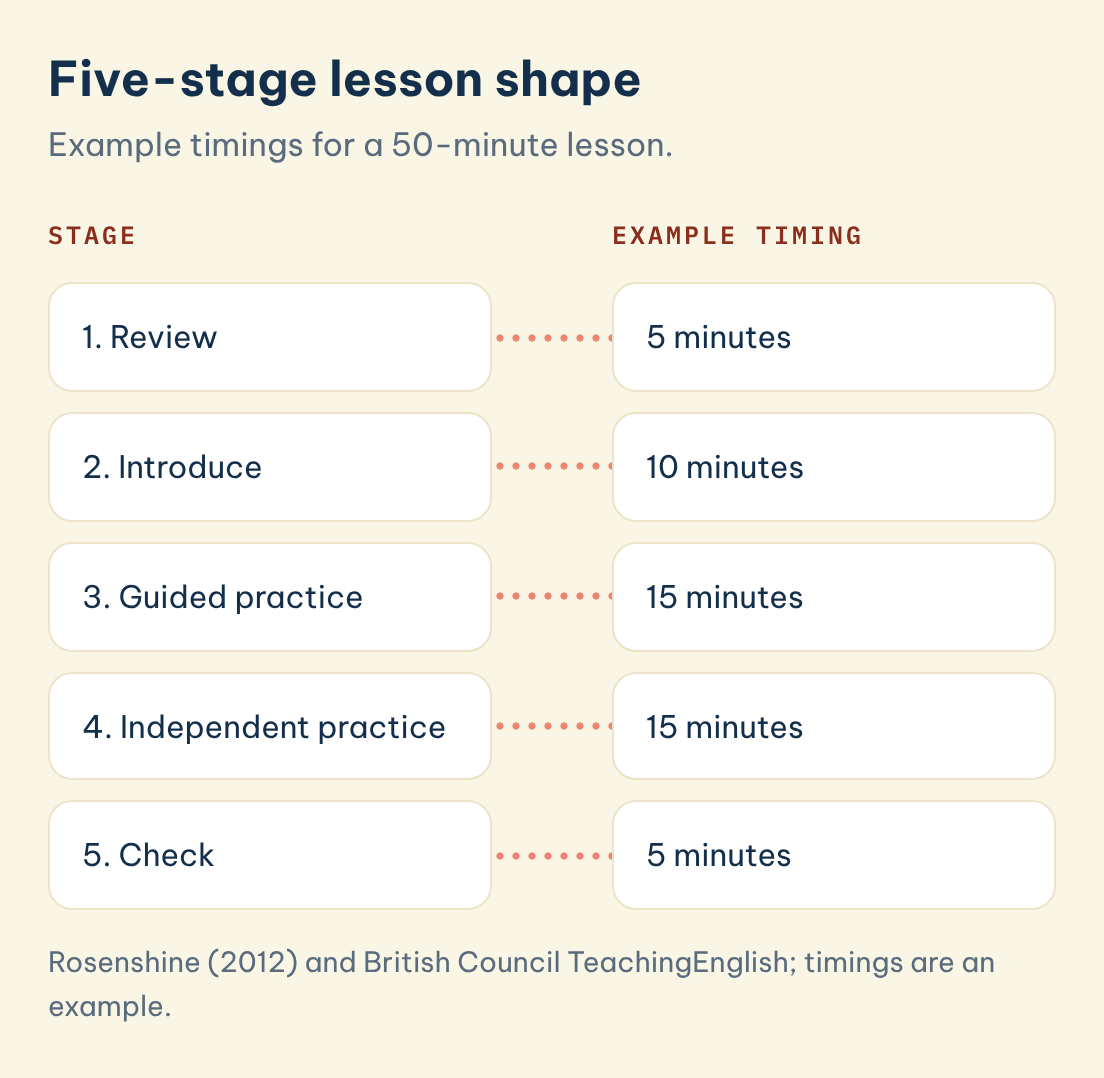
Direct answer: One simple five-stage shape is review, introduce, guided practice, independent practice and check. It is built from several of Rosenshine's principles: short review first, new material in small steps, plenty of practice with feedback, then a check that most learners can succeed alone.
Five-stage lesson shape
Example timings for a 50-minute lesson.
Stage
Example timing
1. Review
5 minutes
2. Introduce
10 minutes
3. Guided practice
15 minutes
4. Independent practice
15 minutes
5. Check
5 minutes
Save this figure
Rosenshine's summary of research on master teachers lists ten principles, and this shape borrows from several of them. Principle 1 is to begin a lesson with a short review of previous learning, principle 2 is to present new material in small steps with student practice after each step, principle 6 is to check for student understanding, and principle 10 is to engage students in weekly and monthly review (Rosenshine, 2012, p. 12). Rosenshine, an emeritus professor of educational psychology at the University of Illinois at Urbana-Champaign, adapted the article for the Spring 2012 issue of American Educator from a 2010 report for the International Academy of Education, and it draws on three bodies of research: cognitive science, studies of master teachers and studies of cognitive supports. His principles open with "Begin a lesson with a short review of previous learning" and "Present new material in small steps with student practice after each step" (Rosenshine, 2012, p. 12). He also reports that effective teachers "always did the experiential activities after, not before, the basic material was learned" (Rosenshine, 2012, p. 12). Guided practice matters because a high success rate there carries over to independent work: in one study of fourth-grade mathematics, "82 percent of students' answers were correct in the classrooms of the most successful teachers, but the least successful teachers had a success rate of only 73 percent" (Rosenshine, 2012, p. 17). Language teachers will recognise a similar order in the British Council's advice to start with an introduction, present the new language, give controlled practice and then move to freer practice (British Council, n.d.-b).
In a 50-minute lesson, one example split gives review 5 minutes, new material 10 minutes, guided practice 15 minutes, independent practice 15 minutes and the closing check 5 minutes; adjust the split to your class.
| Stage | Example timing in a 50-minute lesson | What happens |
|---|---|---|
| 1. Review | 5 minutes | Quick questions on last lesson's content |
| 2. Introduce | 10 minutes | New material in small steps, with a model |
| 3. Guided practice | 15 minutes | Learners practise with prompts and feedback |
| 4. Independent practice | 15 minutes | Learners work alone or in pairs on a similar task |
| 5. Check | 5 minutes | Exit ticket matched to the objective |
Source: stages adapted from principles in Rosenshine (2012) and British Council TeachingEnglish; timings are an illustrative example, not a fixed rule.
◆ Question 5 / 6 · Primary and English classes
How does a lesson plan for primary school or English language classes differ?
Direct answer: The structure stays the same, but the stages get shorter and more varied. Primary plans need a hook at the start, more review of earlier work and clear, visual instructions. English language plans add the target vocabulary or structure, and move from controlled to freer practice.
For young learners, TeachingEnglish advises beginning "by involving the children straight away" with "a picture, photo or object" and reviewing earlier words, because "teaching a word one lesson doesn't mean that all the learners have actually learnt it for the next" (British Council, n.d.-b). It also asks teachers to plan how they will explain each activity, keep explanations "short, clear and visual", and check understanding by having one or two learners demonstrate (British Council, n.d.-b). In an English class, the objective usually names the language point and the skill together, for example "use adverbs of frequency to talk about household jobs". Controlled practice, such as a gap-fill everyone completes, comes before freer practice like a role play where learners choose their own language. TeachingEnglish notes that older primary learners usually spend more time in the freer stage, while younger learners need the controlled stage for longer.
◆ Question 6 / 6 · Samples and templates
Should you use a lesson plan sample PDF or a template?
Direct answer: A template saves time, but a sample written for another class rarely fits yours. Use a template for the fields, then write your own objectives and checks. Copying a sample's activities without its objective keeps the activity and loses its purpose.
Sample plans are useful for seeing how others time stages or phrase instructions. Their weakness is that the objective was written for different learners, with a different starting point. Before adapting one, rewrite its objective for your class and confirm the check still matches. TeachingEnglish suggests keeping a lesson plan template "that you can just fill in and print off", ticking the activities that worked during the lesson, and adding notes at the end on what worked and what did not (British Council, n.d.-b). That evaluation line is the part most often left blank, yet it is what makes the next plan faster. Teachers moving into university tutoring use the same habits in one-to-one sessions: a clear objective for each session, a quick check, and a note for next time. Students who want the same structure applied to their own course can book one-to-one subject tutoring in 60 or 90 minute sessions. If you teach at university level and want to work with international students this way, read about becoming a MAAS expert. For a related skill on the research side, our guide on writing research questions and objectives applies the same "make it checkable" rule.
Frequently asked questions
How long should a lesson plan be?
Long enough that a colleague could teach from it. TeachingEnglish suggests imagining that someone else has to cover your class. In our experience one page is enough for most single lessons.
How many learning objectives should one lesson have?
One or two is a sensible limit for a single lesson. More than that usually means each objective gets too little practice time.
What is the difference between an aim and a learning objective?
In everyday use the terms overlap. Aims often describe the teacher's intention, while learning objectives or outcomes describe what learners will be able to do.
Which verbs should I avoid in learning objectives?
Avoid verbs you cannot observe, such as understand, know or appreciate. Prefer explain, compare, calculate, identify or write.
What is backward design in lesson planning?
It means deciding the result and the evidence first, then planning activities. Wiggins and McTighe (2005) describe it in three stages.
Do experienced teachers still write lesson plans?
Plans often get shorter with experience, but keeping the objective and the check costs little. Rosenshine (2012) lists checking for student understanding among his principles of instruction.
Related guides
- How to write research questions and objectives: the same "make it checkable" rule applied to research
- EDUC 270 educational communication assignment guide: objectives and lesson plans as written assignments
- Become a MAAS expert: tutoring international students one to one
References
- British Council. (2025). TeachingEnglish: Planning lessons workbook. https://www.teachingenglish.org.uk/sites/teacheng/files/2025-06/Planning_lessons_workbook_2025.pdf
- British Council. (n.d.-a). Aims. TeachingEnglish. Retrieved October 23, 2026, from https://www.teachingenglish.org.uk/professional-development/teachers/teaching-knowledge-database/c/aims
- British Council. (n.d.-b). Lesson plans. TeachingEnglish. Retrieved October 23, 2026, from https://www.teachingenglish.org.uk/professional-development/teachers/planning-lessons-and-courses/lesson-plans
- Krathwohl, D. R. (2002). A revision of Bloom's taxonomy: An overview. Theory Into Practice, 41(4), 212-218. https://doi.org/10.1207/s15430421tip4104_2
- Rosenshine, B. (2012). Principles of instruction: Research-based strategies that all teachers should know. American Educator, 36(1), 12-19, 39. https://www.aft.org/sites/default/files/periodicals/Rosenshine.pdf
- Wiggins, G., & McTighe, J. (2005). Understanding by design (2nd ed.). Association for Supervision and Curriculum Development.
This article is part of the MAAS Journal series for teachers and international students. MAAS is an academic support partner: experts guide students through each stage of their own work, and we do not complete assessed work on a student's behalf.
Teach at university level and plan sessions like this? Tutor international students one to one with MAAS.
Become a MAAS expert ▸