
◆ Economics
ECON3700: pricing what has no market, and defending the number
Environmental economics exists to put numbers on things that were never bought or sold. The numbers are contested, and you will be marked on saying so. That is an uncomfortable combination for students expecting a technical course, since the technique is the easy half. The harder half is holding a defensible position about a valuation method that senior economists have argued over in print for 30 years, then explaining it to someone who is not an economist.
◆ Section 1 / 8 · Right course
First, make sure you have the right ECON3700
Direct answer: This code is reused more widely than any other in this series. At the University of Queensland it is Environmental Economics (2 units). At Utah and Southern Utah University it is Sports Economics (3 credit hours). At Hong Kong University of Science and Technology it is Writing as an Economist. At William Paterson University it is International Economics (3 credits).
Evidence: Five institutions, four completely different subjects. Study material found by searching the code alone has roughly a one in four chance of being relevant to you, and the sports economics material in particular is abundant and looks convincing.
Example: A student building a reading list by code collected several weeks of material before noticing that all of it concerned athlete salaries and team profits. Nothing was wrong with the material. It simply belonged to a different course at a different university.
This guide is about the University of Queensland version. If you are enrolled elsewhere, stop here and work from your own course profile.
◆ Section 2 / 8 · UQ coverage
What does the UQ course actually cover?
Direct answer: ECON3700 Environmental Economics is a 2-unit undergraduate course in the School of Economics, within the Faculty of Business, Economics and Law. The prerequisite is ECON1010 or 1011 or 2011. The published coverage runs from markets, market failures and externalities, through the economics of environmental pollution problems and the economic measures used for pollution control and environmental regulation, to environmental change, economic growth, natural resource depletion and population growth.
Evidence: That sequence has a logic worth noticing before you start. It begins with why markets fail in this domain, moves to what can be done about it, and ends with whether the doing is enough at the scale of growth and population. Each block is a different kind of question. The first is diagnostic, the second is instrumental, and the third is evaluative, and answers that use the same register for all three tend to sit in the middle bands.
Example: Asked why a fishery collapsed, a weaker answer described overfishing. A stronger one identified the absence of enforceable exclusion as the market failure, then said which instruments address that specific failure and which do not. The first answer reported an outcome. The second located a mechanism.
◆ Section 3 / 8 · Assessment mix
Why does so much of the mark sit outside a written exam?
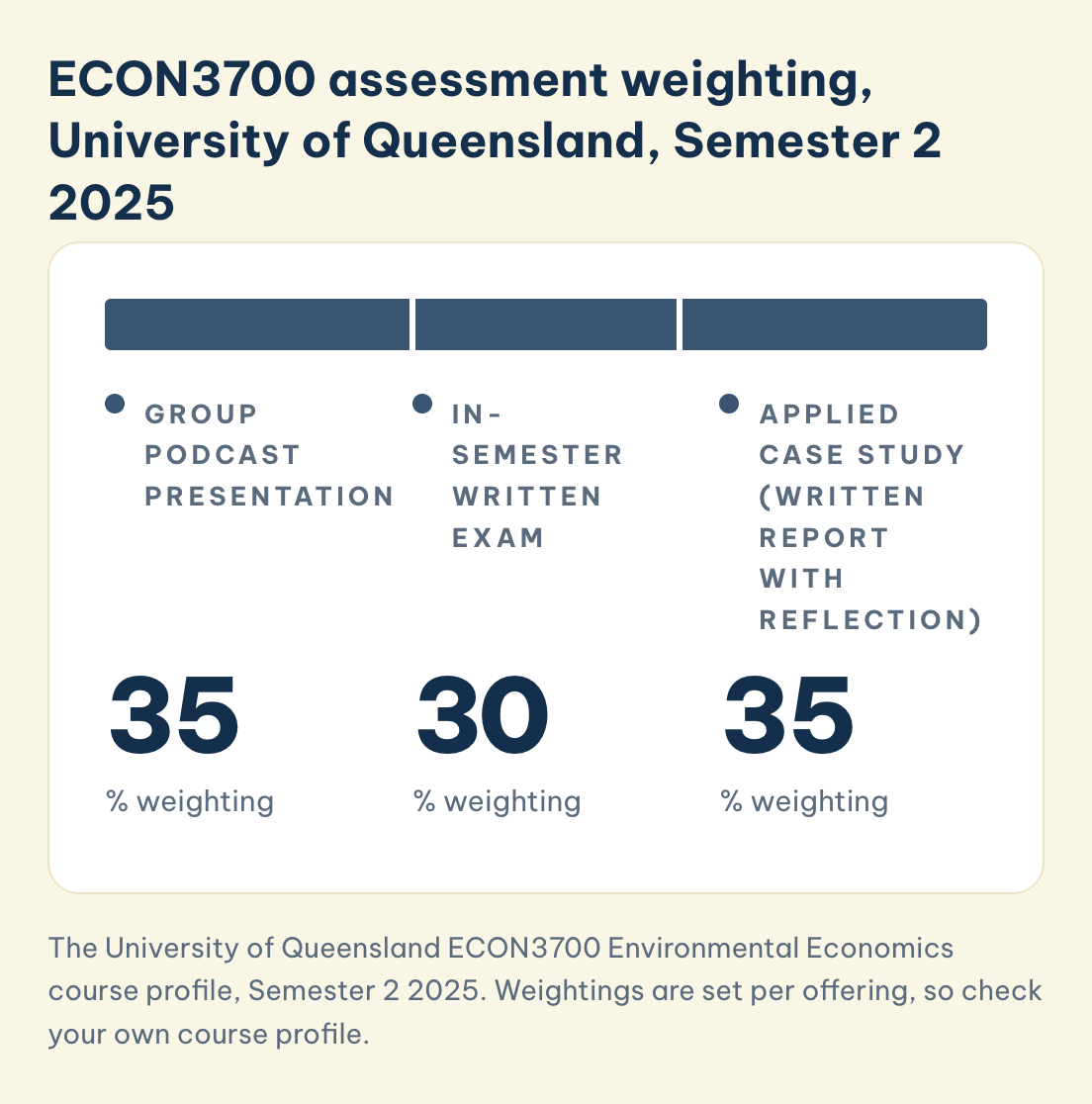
Direct answer: Because one of the stated learning outcomes is to communicate findings and solutions using diverse formats, and the assessment is built to test it. In the semester profile examined, the tasks were a group podcast presentation at 35%, an in-semester written exam at 30%, and an applied case study combining a written report with a reflection at 35%.
ECON3700 assessment weighting, University of Queensland, Semester 2 2025
The bars show the ECON3700 assessment weighting in the University of Queensland course profile for Semester 2 2025.
Group podcast presentation
35
% weighting
In-semester written exam
30
% weighting
Applied case study (written report with reflection)
35
% weighting
Save this figure
Note on sourcing: those weightings come from one published course profile for one teaching period, Semester 2 2025 (The University of Queensland, 2025). In that profile the podcast breaks into three separately marked milestones, group formation worth 5%, a proposal worth 10%, and the final video worth 20%, while the in-semester exam itself runs for only 60 minutes. UQ course profiles are reissued each semester and the task mix does move. Your own profile is the authority, and it is the first document to read in week one rather than the week before the podcast is due.
Evidence: The structure has a consequence students underestimate. If roughly two thirds of the mark sits in a spoken group task and an applied report with a reflective component, then the skills that carry the course are argument selection, plain explanation and honest self-assessment, and none of those improve by rereading lecture notes. They improve by drafting, saying things aloud, and cutting.
Example: A student with the strongest exam mark in his tutorial group scored mid-range overall. His podcast segment was accurate and unlistenable, a dense read-aloud of material written for the page. Nothing he knew was missing. The format was doing work he had not prepared for.
◆ Section 4 / 8 · What tasks reward
What is each task actually rewarding?
Direct answer: Each of the four assessed tasks carries a different outcome. The podcast tests communicating findings in diverse formats, the exam tests applying theories and frameworks, the case study tests implementing market and non-market tools, and the reflection tests critically evaluating your own decisions rather than praising them.
| Task | The outcome it carries | What earns marks | What quietly loses them |
|---|---|---|---|
| Podcast presentation (group) | Communicate findings using diverse formats | One clear claim, said in the listener's language, with the uncertainty stated | Reading a written paragraph aloud; four members delivering four disconnected talks |
| In-semester exam | Apply theories and frameworks | Naming the market failure before reaching for the instrument | Describing an environmental problem without diagnosing it |
| Applied case study | Implement market and non-market tools; critically evaluate | Choosing an instrument and defending the choice against a named alternative | Listing every instrument the course covered |
| Reflection component | Critically evaluate decision-making | Saying what you would do differently and why | Restating what you did in a positive tone |
◆ Section 5 / 8 · Valuation numbers
Where does the number come from, and why is it contested?
Direct answer: Much of environmental economics rests on valuing things with no market price, which is usually done by asking people what they would be willing to pay. That method, contingent valuation, is the site of one of the longest-running open arguments in applied economics, and a third-year course expects you to know that rather than to apply the method innocently.
Evidence: Diamond and Hausman (1994) asked in the Journal of Economic Perspectives whether some number is better than no number, and argued that contingent valuation responses fail basic consistency tests in ways that suggest they do not measure preferences at all. 18 years later the same journal ran the argument again. Hausman (2012) restated the case under the title "Contingent valuation: From dubious to hopeless", writing that "respondents to contingent valuation surveys are often not responding out of stable or well-defined preferences, but are essentially inventing their answers on the fly" (Hausman, 2012, p. 43). In the same issue, Kling, Phaneuf and Zhao (2012) revisited the question and reached a more qualified view about what the method can and cannot support. Haab, Interis, Petrolia and Whitehead (2013) then replied to Hausman directly in Applied Economic Perspectives and Policy.
Why this matters for your marks: the course outcome asks you to critically evaluate, and this is what a live disagreement looks like when it is genuine rather than staged. You are not expected to settle it. You are expected to know it exists, to say which side your analysis leans on, and to state what would change your mind.
Example: Asked to value a wetland, a weaker answer produced a willingness-to-pay figure and used it. A stronger one produced the same figure, noted that the method behind it is contested, named the specific weakness that mattered for this case, and said what the policy recommendation would be if the figure were half as large. The second answer was not less decisive. It was decisive about something it could defend.
◆ Section 6 / 8 · Choosing instruments
How do you choose an instrument rather than list them?
Direct answer: By asking what you do not know. The choice between a price instrument such as a tax and a quantity instrument such as a permit system is not a matter of taste, and there is a standard result that tells you what the choice turns on.
Evidence: Weitzman (1974) showed that under uncertainty about costs, the relative performance of prices and quantities depends on the slopes of the marginal benefit and marginal cost curves. Where marginal damages rise steeply, getting the quantity right matters more and a quantity instrument does better. Where marginal damages are relatively flat and costs are uncertain, a price instrument limits the damage from being wrong. That is a usable decision rule, and quoting it correctly separates an applied answer from a descriptive one.
Example: Two students recommended a carbon tax for the same case. One said a tax gives firms flexibility. The other said the marginal damage curve for this pollutant was relatively flat over the relevant range while abatement costs were highly uncertain, which is the condition under which a price instrument dominates, and added what would reverse the recommendation. Both recommended the same thing. Only one had made a choice.
◆ Section 7 / 8 · Common traps
What trips up students who prepared for an exam?
Direct answer: Three things, and none of them are about economics. The group format, the lay audience, and the reflection.
Evidence: A group podcast fails in a predictable way, which is four competent segments that do not answer one question. Agreeing the single claim before anyone writes a script is the cheapest fix available and it is almost always skipped. The lay audience is the second trap: explaining an externality without the word externality is harder than explaining it with the word, and it is what the outcome is testing. The reflection is the third, because a reflection that praises your own process is not a reflection, and markers read a great many of those.
Example: Vietnamese students on this kind of course are often stronger on the technical content than the assessment gives them room to show, and then lose marks in a spoken task for reasons that have nothing to do with understanding. The useful preparation is not more content. It is rehearsing one explanation aloud until it survives without notes, which also exposes the places where the understanding was thinner than it felt on paper.
◆ Section 8 / 8 · Order of work
A practical order of work
Direct answer: Six steps, in order: read your own course profile in week one and note the deadlines, write the market failure before naming any policy instrument, ask how each valuation number was produced, pick one instrument and argue it against the closest rival, agree the podcast's single claim before scripting, and write a reflection about a decision you would actually change.
- Open your own course profile in week one and write down the three task deadlines. The podcast is the one people plan late. In the profile examined for this guide, a late submission cost 10% of the maximum mark for every 24 hours it was overdue, up to 7 days, after which the mark became 0 (The University of Queensland, 2025).
- For each topic, write the market failure in one clause before writing anything about policy. Diagnosis first, instrument second.
- When you meet a valuation number, ask how it was produced. Revealed preference, stated preference and benefit transfer carry different weight and different objections.
- For the case study, choose one instrument and argue against the closest alternative. An argument against a real rival beats a survey of all options.
- Agree the podcast's single claim as a group before scripting. Then draft it, say it aloud, and cut everything that survives only because it is true.
- Write the reflection about a decision you would change. If nothing in the draft would change, the reflection has not started.
Frequently asked questions
Which university does this guide cover?
The University of Queensland, where ECON3700 is Environmental Economics, a 2-unit course in the School of Economics. The same code covers Sports Economics at two Utah institutions, Writing as an Economist at HKUST, and International Economics at William Paterson, so confirm before using any material found by code.
What do I need to have passed first?
The published prerequisite is ECON1010 or 1011 or 2011. Prerequisites are restated each year, so check the entry for your own year of enrolment.
What are the assessment weightings?
The course profile examined for this guide listed a group podcast at 35%, an in-semester exam at 30%, and an applied case study at 35%. Profiles are reissued every semester and the mix changes, so read your own rather than planning from this.
Do I need a maths background?
Less than students expect. The prerequisite is an introductory economics course rather than a mathematics one, and the analytical work is mostly about applying a framework to a case rather than about derivation.
How critical should I be about valuation methods?
Critical enough to name the disagreement and take a position within it. Applying contingent valuation with no acknowledgement that its validity is disputed reads as unaware at third-year level, and dismissing it entirely is equally unsupported.
How do I prepare for a podcast assessment?
By deciding the single claim first, then rehearsing aloud rather than polishing a script. A written paragraph read out will sound like a written paragraph read out, and the outcome being tested is communication in a different format rather than the same work delivered differently.
Related reading
Where MAAS fits
MAAS mentors work alongside students on courses like this rather than in place of them. On a course weighted towards spoken and applied work, the most useful session is often the least technical one: hearing you explain your case in your own words, telling you where a listener would lose the thread, and asking what would change your recommendation. Students usually find their economics was sound and their explanation assumed too much. The work stays yours. If that is useful, our tutoring service and our presentation design support are the two places to start.
References
Diamond, P. A., & Hausman, J. A. (1994). Contingent valuation: Is some number better than no number? Journal of Economic Perspectives, 8(4), 45–64. https://doi.org/10.1257/jep.8.4.45
Haab, T. C., Interis, M. G., Petrolia, D. R., & Whitehead, J. C. (2013). From hopeless to curious? Thoughts on Hausman's "dubious to hopeless" critique of contingent valuation. Applied Economic Perspectives and Policy, 35(4), 593–612. https://doi.org/10.1093/aepp/ppt029
Hausman, J. (2012). Contingent valuation: From dubious to hopeless. Journal of Economic Perspectives, 26(4), 43–56. https://doi.org/10.1257/jep.26.4.43
Kling, C. L., Phaneuf, D. J., & Zhao, J. (2012). From Exxon to BP: Has some number become better than no number? Journal of Economic Perspectives, 26(4), 3–26. https://doi.org/10.1257/jep.26.4.3
The University of Queensland. (2025). ECON3700 Environmental Economics: Course profile, Semester 2 2025. Retrieved August 21, 2026, from https://course-profiles.uq.edu.au/course-profiles/ECON3700-60562-7560
Weitzman, M. L. (1974). Prices vs. quantities. The Review of Economic Studies, 41(4), 477–491. https://doi.org/10.2307/2296698
Tools & resources
- The University of Queensland Library. (2026). ECON3700: Environmental Economics reading list. https://uq.rl.talis.com/courses/econ3700.html
- University of Utah course catalog: ECON 3700 Sports Economics: confirms the 3 credit hour Sports Economics course, in case you were routed here by mistake
- William Paterson University course catalog: ECON 3700 International Economics: confirms the unrelated 3 credit International Economics course
A free 20-minute consultation is a conversation about where you are with ECON3700.
Book a free consultation ▸