
Introductory microeconomics looks like a subject with right answers: you solve for equilibrium, compute elasticity, and the number is correct or not. Then a learning outcome asks you to critically evaluate the assumptions and limitations of the theories you have just learned, a skill no problem set ever trained. The uncomfortable fact is that even opportunity cost, the concept the subject rests on, has been the subject of a published dispute among professional economists.
Below is how MAAS mentors read ECON1001, a subject built like this.
Author: MAAS Editorial Team
Last updated: 2026-08-12
Category: economics

First, confirm which ECON1001 you are enrolled in
Direct answer: This code is shared by four universities: University of Sydney (Introductory Microeconomics, 6 credit points, prohibited against BUSS1040 and ECON1040), Southern Cross University (Economics for Decision Making), University of Newcastle (Microeconomics for Business Decisions), and University of Glasgow (Economics 1A, 20 credit Level 1, Adam Smith Business School).
Evidence: Each institution publishes its own description. The differences are not cosmetic. The Southern Cross unit runs six modules that include macroeconomic foundations and financial market structures, content the Sydney unit does not cover at all, because Sydney separates micro and macro into different units.
Example: A student revising from material found under her course code worked through several exercises on the Australian financial system before realising her own unit stopped at market failure. The material was accurate. It belonged to a different university's syllabus.
This guide describes the University of Sydney unit. Where the point applies broadly, it is written to hold for any introductory microeconomics course.
What is the assumed knowledge, and why does it catch international students?
Direct answer: Mathematics, and it is stated rather than implied. Sydney assumes a minimum result of Band 4 in HSC Mathematics Advanced or Band E3 in HSC Mathematics Extension 1 or 2, or equivalent, and states that prior knowledge of algebraic equations and differential calculus is assumed. Students without that background are strongly advised to enrol in ECON1003 before ECON1001 or alongside it.
Evidence: The handbook says both things: the assumed knowledge is expressed in the local secondary qualification, and the ECON1001 unit description separately names algebra and differential calculus. For a student who did not sit the HSC, the phrase "or equivalent" does no practical work, because nobody tells you whether your own schooling counted.
Example: A student from a Vietnamese high school had studied calculus perfectly adequately but had never seen it applied to cost curves. She was not short of mathematics. She was short of the habit of reading a derivative as a marginal quantity, which is a translation problem rather than a knowledge gap, and 2 weeks of deliberate practice closed it.
What does the unit say it wants from you?
Direct answer: ECON1001 names five learning outcomes: building supply and demand from individual choices, distinguishing market structures, identifying market failure, tracing resource allocation, and critically evaluating the theories' assumptions and limitations. The first four ask you to use the model; the fifth asks you to assess it, and that is where marks separate at the top of the distribution.
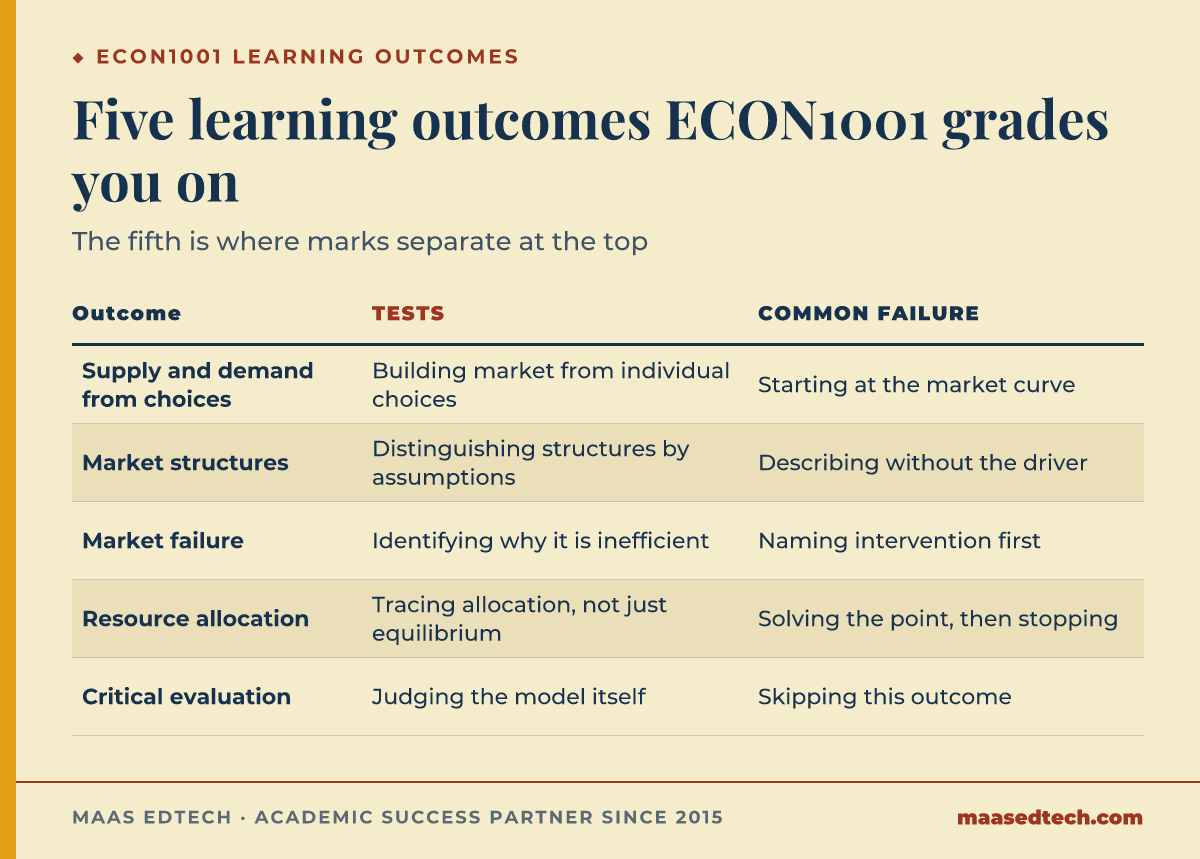
| Learning outcome | What it tests | How students under-deliver |
|---|---|---|
| How aggregate supply and demand arise from individual and firm decisions | Building the market up from choices | Starting at the market curve and never going below it |
| The fundamental market structures and competition | Distinguishing structures by their assumptions | Describing structures without saying what drives the difference |
| Market failure and the roles of government | Identifying why the market outcome is inefficient | Naming an intervention before naming the failure |
| How prices and quantities determine resource allocation | Tracing allocation, not just equilibrium | Solving for the point and stopping |
| Critically evaluating assumptions and limitations of the theories | Judging the model itself | Skipping this outcome entirely |
Evidence: Read that final outcome again and notice how different it is from the other four. The first four ask you to use the model. The fifth asks you to stand outside it and assess it. Most assessment weight sits with the first four, which is exactly why the fifth is where marks separate at the top of the distribution. When the market failure outcome asks you to identify why a market outcome is inefficient, it is quietly assuming the efficiency benchmark Vilfredo Pareto (1906) formalised: an allocation is efficient only if nobody can be made better off without making somebody else worse off.
Example: Asked to analyse a price ceiling, a competent answer showed the shortage and calculated the deadweight loss. A stronger one did the same and then asked what the analysis assumed about who ends up holding the scarce units, noting that the efficiency loss figure depends on an allocation mechanism the diagram never specifies.
What is elasticity actually for?
Direct answer: It converts a qualitative claim into a testable one. Saying demand falls when price rises is a direction. Saying demand is inelastic in this range is a magnitude, and magnitudes are what let you predict revenue, incidence and the size of a distortion. Alfred Marshall (1890) introduced the term itself in Principles of Economics, precisely because direction alone could not answer any of the questions the subject actually needed answered.
Evidence: Most of the applied questions in an introductory unit reduce to elasticity once you look at them. Who bears a tax depends on the relative elasticities of supply and demand, not on who legally remits it. Whether a price rise raises or lowers revenue depends on whether demand is elastic at that point. Students who treat elasticity as one topic among many find these questions unrelated; students who treat it as the measurement tool find they are the same question three times.
Example: Asked who bears the burden of a tax on a good with few substitutes, a weaker answer said consumers, because the seller passes it on. A stronger one said consumers bear more of it, and explained that this follows from demand being relatively inelastic, so the quantity adjustment that would otherwise push the burden back onto sellers does not occur.
Why is opportunity cost the concept worth taking seriously?
Direct answer: Because it is both the foundation of the subject and a documented site of genuine disagreement, which makes it the cleanest available example of what critical evaluation looks like in economics.
Evidence: Ferraro and Taylor (2005), in a short paper for The B.E. Journal of Economic Analysis & Policy, open by framing why the question matters at all: "One of the most important contributions economics has to offer as a discipline is the understanding of opportunity cost and how to apply this concept to all forms of decision making" (Ferraro & Taylor, 2005). They then posed an introductory-textbook opportunity cost question to 199 professional economists. The question asked for the opportunity cost of attending a Clapton concert given that a Dylan concert was the next best alternative, with stated values for tickets and willingness to pay. Only 21.6% selected the answer the authors treated as correct, which was the least popular of the four options; the responses were spread almost randomly across the alternatives. The authors also administered it to 358 students in the first week of an introductory microeconomics course and found that students who had taken a previous economics course did worse than those who had never studied economics.
That result is striking, but the more instructive part came afterwards. Potter and Sanders (2012), replying in the Southern Economic Journal, challenged the conclusion directly, arguing that once you allow for alternative opportunity cost accounting methodologies, every answer to the multiple-choice question is defensible, and that the question therefore fails to measure professional understanding of the concept at all. The disagreement sits on top of an older one: James Buchanan (1969) had already argued that cost is a subjective judgement made by the person choosing, not an objective quantity any outside observer can read off a market price, which is part of why a single "correct" opportunity cost is harder to pin down than an introductory textbook implies. Buchanan (1969), in Cost and Choice, adds that cost in this sense exists only at the moment of choice, because the alternative given up is never experienced, so no outside observer can measure it afterwards.
Example: A student who cites only the first paper writes that economists cannot compute opportunity cost. A student who cites both writes something far better: that the disagreement is about accounting convention rather than about economic reasoning, and that a concept can be foundational and still be contested at its edges. The second student has demonstrated the fifth learning outcome using the subject's own literature.
How do you write critically about a model without dismissing it?
Direct answer: By naming the assumption, saying what it buys, and saying where it breaks. Criticism that only points out that assumptions are unrealistic is not analysis, because every model is unrealistic on purpose, a point Milton Friedman (1953) made in Essays in Positive Economics, published by University of Chicago Press, when he argued that a model should be judged by the accuracy of its predictions rather than by the realism of its assumptions.
Evidence: The learning outcome asks for evaluation of assumptions and limitations, which is two things. An assumption is a modelling choice with a rationale. A limitation is the consequence of that choice in a particular application. Writing that perfect competition assumes many small firms is description. Writing that this assumption is what allows price-taking behaviour, and that the model's predictions degrade precisely where firms are large enough to notice their own effect on price, is evaluation.
Example: Two students criticised the perfect competition model. The first wrote that no real market has perfect information. The second accepted the assumption, then showed which specific prediction of the model fails when buyers cannot verify quality, and named the market failure that follows, the same style of question Ronald Coase (1937) asked in the journal Economica about the boundary of the firm itself: not whether the textbook model is realistic, but what changes once you drop one specific assumption.
A practical order of work
Direct answer: Fix your mathematics in the first 2 weeks, then work through six steps that run from stating each model's assumption to practising a criticism that survives the reply that a model is only a simplification. In between you solve for who gets the units, name the market failure before the intervention (Pigou, 1920), and keep one worked disagreement.
- Settle the mathematics early. If reading a derivative as a marginal quantity is not automatic, fix that in the first 2 weeks rather than at revision.
- For every model, write one line on what it assumes and one line on what the assumption is doing. You will need both for the fifth outcome.
- When you solve for equilibrium, ask who gets the units and at what cost. Allocation is the outcome ECON1001 names, not the intersection point.
- Name the market failure before you name the intervention. Reversing that order produces policy recommendations with no diagnosis behind them, the same order Arthur Pigou (1920) used when he first set out the case for government correction of externalities, though Coase's (1960) later paper in the Journal of Law and Economics complicated the story by showing that clearly defined property rights can sometimes let the two sides bargain to an efficient outcome without government stepping in at all.
- Keep one worked example of a genuine disagreement in the literature. Opportunity cost is the obvious candidate and you now have both sides of it.
- Practise stating a criticism that survives the response "yes, but the model is meant to be a simplification".
Frequently asked questions
Do I need strong mathematics to pass ECON1001?
You need the stated assumed knowledge, which is algebra and differential calculus. If your background is from another education system, treat the equivalence claim as unverified and test yourself early rather than assuming you are covered.
Is ECON1001 mostly graphs and calculations?
Most of the assessment is application, but ECON1001 explicitly asks you to critically evaluate assumptions and limitations. Students who train only for computation are prepared for four of the five learning outcomes. When the market structures outcome moves past perfect competition, remember that Joan Robinson (1933) built the imperfect competition case specifically to handle the firms that do not fit the perfectly competitive diagram.
Can I cite the opportunity cost dispute in a first-year assignment?
Check your unit outline for what sources are expected. Where secondary literature is permitted, using two papers that disagree is a stronger move than using one, because it lets you show reasoning rather than simply reporting a finding.
What is the difference between ECON1001 and BUSS1040?
At the University of Sydney they are prohibited against each other, meaning the faculty treats them as covering equivalent ground for your degree. Which one you take depends on your program, not on preference.
How should I handle a question that asks me to "discuss" rather than "calculate"?
Do the calculation if one is available, then treat it as the beginning of the answer. A discussion question is usually asking what the calculation assumes and what it leaves out.
Where MAAS fits
MAAS mentors work alongside students on units like this rather than in place of them. In first-year economics, the two most useful things a mentor does are unglamorous: checking that your mathematics is fluent enough that it stops competing for attention with the economics, and pushing on your critical paragraphs until they say something a marker has not read forty times already. The work stays yours. If that is useful, our academic support service and our tutoring service are the two places to start.
References
Ferraro, P. J., & Taylor, L. O. (2005). Do economists recognize an opportunity cost when they see one? A dismal performance from the dismal science. The B.E. Journal of Economic Analysis & Policy, 4(1), 1–14. https://doi.org/10.2202/1538-0645.1469
Potter, J., & Sanders, S. (2012). Do economists recognize an opportunity cost when they see one? A dismal performance or an arbitrary concept? Southern Economic Journal, 79(2), 248–256. https://doi.org/10.4284/0038-4038-2011.218
Friedman, M. (1953). The methodology of positive economics. In Essays in positive economics (pp. 3–43). University of Chicago Press.
Buchanan, J. M. (1969). Cost and choice: An inquiry in economic theory. Markham Publishing.
Marshall, A. (1890). Principles of economics. Macmillan.
Pigou, A. C. (1920). The economics of welfare. Macmillan.
Pareto, V. (1906). Manual of political economy. Società Editrice Libraria.
Coase, R. H. (1937). The nature of the firm. Economica, 4(16), 386–405.
Robinson, J. (1933). The economics of imperfect competition. Macmillan.
Coase, R. H. (1960). The problem of social cost. Journal of Law and Economics, 3, 1–44.
Tools & resources
- MAAS guide to ECON1011 Economics for Business, another first-year economics code shared by four universities
The University of Sydney. (n.d.). ECON1001: Introductory Microeconomics. https://www.sydney.edu.au/units/ECON1001