
◆ Economics
ECON1011: why does a 10% task decide your 25% video mark?
ECON1011 at UQ splits its largest assessment in two and puts 46 days between the halves. You submit a quote for approval in April worth 10%, then build a one-minute video around that same quote in May worth 25%. By the time you discover the quote does not contain an economic claim you can test, the choice is already locked.
◆ Section 1 / 7 · Which ECON1011
First, confirm which ECON1011 you are enrolled in
Direct answer: Four universities use this code for four different subjects. UQ teaches Economics for Business, Durham teaches Principles of Economics, Western Sydney teaches Principles of Economics, and Southampton teaches Quantitative Modelling in Economics. The content and the assessment rules do not transfer between them.
Evidence: The gap is wide enough to be dangerous. At UQ, ECON1011 is a 2-unit introductory course taught in what the course profile calls an issue-based format, built around 5 social topics: the housing crisis, cost of living, climate change, inequality, and migration. At Durham, the 2026-27 module handbook describes a conventional theory sequence covering indifference curves, game theory, the IS-LM model and growth theories, delivered through 40 lectures and 8 tutorials across a 200-hour total workload. At Southampton, ECON1011 is Quantitative Modelling in Economics, a 7.5 ECTS core module whose stated purpose is to let students apply A-level mathematical skills, and which acts as a prerequisite for ECON2041. Western Sydney lists ECON1011 Principles of Economics as an Undergraduate Level 1 subject, with ECON1007, ECON1009, ECON1010 and ECON1012 recorded as equivalent subjects.
A study guide written for one of these is close to useless for the others. The rest of this article covers the UQ version, because that is where most Vietnamese students searching this code are enrolled. If you are at Durham, Southampton or Western Sydney, the assessment sections below do not apply to you.
One further UQ restriction catches transfers. ECON1011 is not available to students enrolled in Economics programs, and you cannot take it if you have already completed ECON1010, ECON2011 or ECON2012.
◆ Section 2 / 7 · Assessment and weights
How is ECON1011 assessed at UQ, and what is each task worth?
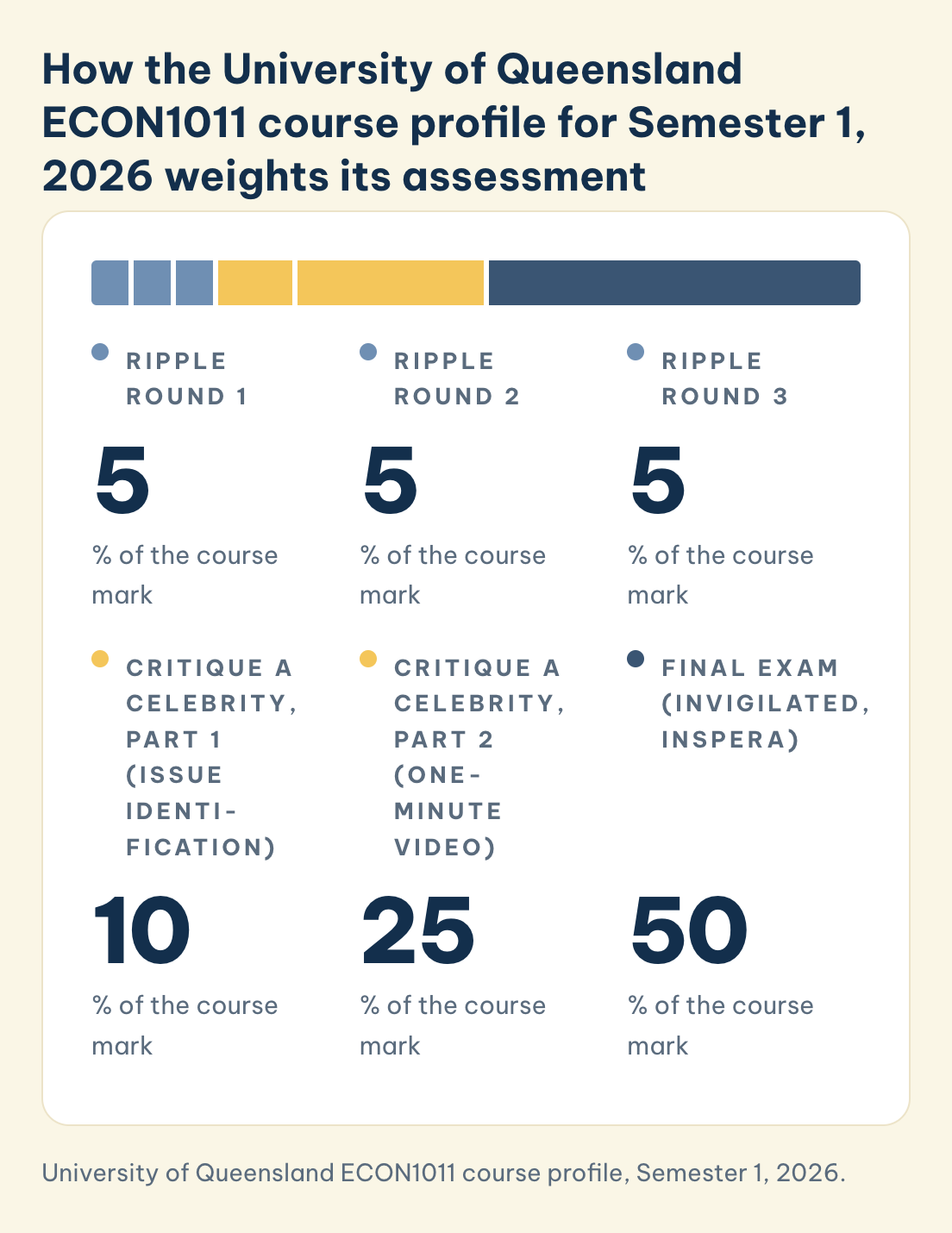
Direct answer: Three tasks. RiPPLE question authoring carries 15% across 3 rounds of 5% each. Critique a Celebrity carries 35%, split into a 10% issue identification and a 25% video. The final exam carries 50%, sat in person on the Inspera platform. No essay appears anywhere.
How the University of Queensland ECON1011 course profile for Semester 1, 2026 weights its assessment
The bar shows each task's share of the course mark in the Semester 1, 2026 course profile.
RiPPLE round 1
5
% of the course mark
RiPPLE round 2
5
% of the course mark
RiPPLE round 3
5
% of the course mark
Critique a Celebrity, part 1 (issue identification)
10
% of the course mark
Critique a Celebrity, part 2 (one-minute video)
25
% of the course mark
Final exam (invigilated, Inspera)
50
% of the course mark
Save this figure
Evidence: The Semester 1, 2026 course profile sets the dates as well as the weights, and the dates carry information the weights hide.
| Task | Format | Weight | Semester 1, 2026 due date |
|---|---|---|---|
| RiPPLE round 1 | Author, moderate and answer questions online | 5% | 30 March 2026, 2:00 pm |
| RiPPLE round 2 | Author, moderate and answer questions online | 5% | 5 May 2026, 2:00 pm |
| RiPPLE round 3 | Author, moderate and answer questions online | 5% | 25 May 2026, 2:00 pm |
| Critique a Celebrity, part 1 | Issue identification, template submission | 10% | 13 April 2026, 2:00 pm |
| Critique a Celebrity, part 2 | One-minute video | 25% | 29 May 2026, 2:00 pm |
| Final exam | Invigilated digital exam, Inspera | 50% | 6 to 20 June 2026 |
Critique a Celebrity is worth 35% in total, and reading its two rows together makes the design of the course visible. The 10% task closes on 13 April and the 25% task closes on 29 May, which is a 46-day gap. What you submit in April is not a draft of the video. It is the raw material the video must be built from, and the marks for the second half depend on how much analytical work the first half made possible.
The 46-day gap matters more than the weighting suggests, because the 25% video is the only task in the course where you choose your own object of analysis. RiPPLE questions are constrained by the syllabus and the exam is written for you. Hansen (2001) argued that an economics major should be able to do more than absorb existing knowledge, listing the capacity to create new knowledge and to interpret existing knowledge among the proficiencies a degree should build. The issue identification task is where that proficiency is first tested in ECON1011, and it is tested before most students realise it is being tested.
◆ Section 3 / 7 · Issue identification
Why does the issue identification task decide the video mark?
Direct answer: Because a quote that contains no testable economic claim cannot be critiqued, however well you make the video. The 4-step structure required in the video assumes you have something to correct, qualify or validate. Choose a quote with no such claim and steps 2 through 4 have nothing to operate on.
Evidence: The course profile is explicit about the shape of the video. You must introduce the quote, identify a claim within it as an economic statement, explain the economic concepts in that statement, and then correct the claim if it is wrong, qualify it if it is partially correct, or validate it if it is correct. Every one of those steps after the first depends on the claim identified in step 2 being the kind of statement that evidence can bear on.
The positive and normative divide is where the oldest distinction in the discipline earns its keep. A positive statement describes what is and can in principle be tested against data. A normative statement asserts what ought to be and cannot. When a public figure says that rents in Sydney rose because supply failed to keep pace with migration, that is a positive claim with a mechanism inside it, and the mechanism can be examined. When the same figure says the government should cap rents, that is a normative claim, and the only honest verdict on it is that economics can describe the consequences of a cap without adjudicating whether the cap is right.
Colander (2004) makes the related point that the classroom job of an economist is not to hand students conclusions but to teach the reasoning that produces them. Writing about what separates a good economics teacher from a bad one, he puts it bluntly: "Ultimately content, not delivery, determines whether one is or is not a good teacher" (Colander, 2004, p. 63). A one-minute video obeys the same rule. No amount of editing rescues a quote that had nothing in it to analyse.
What to do about it: before you submit the template in April, run each candidate quote through 3 questions. Does it assert a causal mechanism, or only a preference? Can you name the concept from the course that the mechanism belongs to? Can you imagine evidence that would show the speaker wrong? A quote that fails the third question is a quote you will still be stuck with 46 days later.
◆ Section 4 / 7 · Who is a celebrity
Who qualifies as a celebrity, and which quotes are eligible?
Direct answer: The task allows public figures and social media creators, and requires the quote to be an original post from a defined recent window, tied to one of the 5 course topics. The eligibility rules do more filtering than students expect, and they filter at the moment of choice rather than at marking.
Evidence: The course profile specifies that the quote should come from a celebrity such as a politician or a social media influencer, that it should have been made in the preceding period defined in that semester's brief, and that it should relate to one of the main topics covered in the course. The 5 topics at UQ are the housing crisis, cost of living, climate change, inequality and migration, so a quote about interest rates or unemployment is only usable if you can route it through one of those five.
The submission itself is small and easy to underrate. You complete a template on the course Blackboard site, supply background information, provide a link to the quote or attach a PDF where the source is traditional media, and state the topic the quote belongs to. That is the whole of the 10%. It is not an essay, and it takes an afternoon. The afternoon is worth spending on the choice rather than on the prose.
One practical constraint follows from the source requirement. A link that dies, a post that gets deleted, or a screenshot without provenance leaves you unable to evidence your own object of study in May. Save the original, record the date, and keep the PDF.
◆ Section 5 / 7 · AI rules
Can you use AI in ECON1011?
Direct answer: The rules differ by task within the same course. The course profile permits AI and machine translation in the RiPPLE task provided every instance is clearly referenced, and prohibits generative AI and machine translation in the final exam, where attempted use may constitute misconduct.
Evidence: The split in AI rules is not an inconsistency. It follows from what each task measures. RiPPLE asks you to author, moderate and answer questions written by peers and instructors, and the course profile notes that the task is peer assessed. Khosravi, Kitto and Williams (2019) describe RiPPLE as a crowdsourced adaptive platform in which learners contribute the learning resources that the system then recommends to other learners, so the value of your contribution lies in whether the question is good, not in whether you typed it unaided.
The exam measures something else and therefore forbids something else. It is identity verified and invigilated in person, and the prohibition is absolute rather than conditional on disclosure.
One under-read clause sits inside the RiPPLE rules and has nothing to do with AI. The course profile warns students to disable browser translation plug-ins while working in RiPPLE, because translation tools have repeatedly rendered submissions in a non-English language even when the screen appeared to show English, and any non-English submission is deleted and marked at 0. For a Vietnamese-speaking student running a translation extension by default, that is a live risk of losing 5% without ever seeing an error message.
What to do about it: read the AI clause on each task separately, not once for the course. Where AI use is permitted with referencing, keep a record of each instance as you go, because reconstructing it later is harder than logging it.
◆ Section 6 / 7 · Exam format
What is the exam format, and what can you bring in?
Direct answer: An invigilated digital exam on Inspera, 120 minutes plus 10 minutes of planning time, open book with any written or printed material permitted, sat in person on your own laptop with Safe Exam Browser installed. Calculators are limited to the Casio FX82 series or a UQ approved and labelled equivalent.
Evidence: Three of those details change how you should prepare. The first is that open book here does not mean unhurried. The paper covers the 5 main topics in 120 minutes, and time spent searching unfamiliar notes competes directly with time spent reasoning. The second is the 10 minutes of planning time, which is scheduled separately from the 120 minutes and is the only part of the assessment where you are explicitly given room to decide what to write before writing it. Most students treat it as spare reading time.
The third is logistical and unforgiving. You bring your own laptop with Safe Exam Browser already installed and a Casio FX82 series calculator, and the course profile states plainly that no power points will be provided, so battery capacity for the full duration is your responsibility. UQ Library laptop loans exist for students who cannot supply a machine, but that is a plan to make in advance rather than on the morning.
What to do about it: build one page, not forty. A single sheet organised by concept, with the definition, the diagram, and one line on when the concept applies, is searchable under time pressure in a way that a semester of lecture slides is not. Test it on a past question before the exam period rather than during it.
◆ Section 7 / 7 · Common mistakes
What do students most often get wrong in ECON1011?
Direct answer: They prepare for the course as though it contained an essay. It does not. Three tasks in three different formats all test the same underlying skill, which is explaining an economic concept to somebody who has not studied economics, and preparation built around memorising and reproducing content transfers to none of them.
Evidence: Look at what each task actually asks. RiPPLE asks you to write a question good enough that a peer can learn from it, then moderate somebody else's. Li et al. (2019) conducted a meta-analysis of peer assessment in higher education and found that peer assessment was associated with improved learning outcomes, with the effect stronger where students assessed peers rather than only receiving peer feedback, which is the direction RiPPLE runs in. Critique a Celebrity asks you to compress an evaluated argument into 60 seconds for a general audience. Reyna, Hanham and Meier (2018) examined learner-generated digital media as an assessment tool in tertiary education and note that producing media requires students to plan, select and structure content rather than reproduce it, which is the load the one-minute limit imposes. The exam asks you to apply a model to a scenario with your notes open, which removes recall from the list of things being rewarded.
A second recurring error is arithmetic rather than conceptual. Because the 3 RiPPLE rounds are due in late March, early May and late May, the entire 15% is decided before the exam period, and late submission is not possible for that task at all: the platform assigns marks based on when you created, moderated or answered, so a missed round is a zero rather than a penalty.
What to do about it: practise the explanation, not the recall. Take one concept a week and explain it aloud in 60 seconds to somebody outside the course. If they cannot restate it back, the gap is in your understanding rather than in their attention.
Frequently asked questions
Is ECON1011 hard for a first-year student with no economics background?
The course profile states that no previous study in economics is assumed or required, and that the mathematical requirements are modest, though basic arithmetic and the ability to read and manipulate simple graphs and equations are expected. The difficulty tends to come from the assessment formats rather than the content.
Can I change my quote after submitting the issue identification?
Treat the April submission as binding and check the current semester's brief before you assume otherwise. This is the single most consequential reason to spend the time on the choice rather than on the template.
How long is the ECON1011 exam and is it open book?
Two hours of writing time, preceded by a separate short planning window, and you may bring in notes of any kind. Invigilation is in person and the paper runs on Inspera.
What happens if I miss a RiPPLE round?
The course profile states that late submission is not possible for this assessment because of its adaptive and interactive nature, and that a 100% penalty applies to the relevant round. Each round is 5% of the final grade.
Does MAAS write my ECON1011 video or exam answers?
No. MAAS works as an academic advisor. A mentor can help you test whether a quote contains a critiquable claim, structure your 60 seconds, or review a concept you cannot yet explain aloud. The submission remains your own work.
References
Colander, D. (2004). The art of teaching economics. International Review of Economics Education, 3(1), 63–76. https://doi.org/10.1016/S1477-3880(15)30144-4
Hansen, W. L. (2001). Expected proficiencies for undergraduate economics majors. The Journal of Economic Education, 32(3), 231–242. https://doi.org/10.1080/00220480109596105
Khosravi, H., Kitto, K., & Williams, J. (2019). RiPPLE: A crowdsourced adaptive platform for recommendation of learning activities. Journal of Learning Analytics, 6(3). https://doi.org/10.18608/jla.2019.63.12
Li, H., Xiong, Y., Hunter, C. V., & Guo, X. (2019). Does peer assessment promote student learning? A meta-analysis. Assessment & Evaluation in Higher Education, 45(2), 193–211. https://doi.org/10.1080/02602938.2019.1620679
Reyna, J., Hanham, J., & Meier, P. (2018). Learner-generated digital media (LGDM) as an assessment tool in tertiary science education. IAFOR Journal of Education, 6(3), 93–109. https://doi.org/10.22492/ije.6.3.06
Tools & resources
- UQ course profiles for the assessment details of the semester you are actually enrolled in
- Durham module handbook if your ECON1011 is the Durham module
- MAAS exam support for structured preparation on timed assessment
- MAAS tutoring if you need to work through a concept before you can explain it
A free 20-minute consultation is a conversation about where you are with ECON1011.
Book a free consultation ▸