
◆ Economics
ECON1010: why does taking the maths out make the marking harder?
Economics as a formal discipline is usually dated to Adam Smith's The Wealth of Nations, published in 1776, 114 years before Marshall's supply-and-demand diagram gave this course its graphical toolkit. Students often expect algebra and calculus, but the course description promises the opposite: a focus on principles that are immediately applicable, not formal theorising. That relief is partial: once the algebra is gone, the only thing left to mark is whether you can explain the mechanism in words.

◆ Section 1 / 7 · Which ECON1010
First, confirm which ECON1010 you are enrolled in
Direct answer: This guide describes the University of Queensland course ECON1010 Introductory Microeconomics, a 2 unit course coordinated by the School of Economics and taught at St Lucia. UQ lists no prerequisite, but records the course as incompatible with ECON1011, ECON2011 and ECON2012, and closed to students in the Advanced Business (Honours) and Advanced Finance and Economics (Honours) programmes.
The University of Queensland was established in 1909, and it began moving from its original George Street site to the St Lucia campus, where ECON1010 is now taught, in 1946. ECON1010 is a code several institutions use, and the coordination details below come from the University of Queensland. At UQ the course is Introductory Microeconomics, worth 2 units, coordinated by the School of Economics and delivered at St Lucia, with one lecture and one tutorial a week. It carries no formal prerequisite, but it does carry restrictions worth checking before you enrol: it is listed as incompatible with ECON1011, ECON2011 and ECON2012, and it is not to be studied by students in the Bachelor of Advanced Business (Honours) or the Bachelor of Advanced Finance and Economics (Honours) programmes, who take a different entry course. If your enrolment system shows a different title or a different unit value, you are looking at another institution's course and the rest of this guide will not map onto it. The Bachelor's degree ECON1010 sits inside is itself governed by the Australian Qualifications Framework, established nationally in 1995, which places a Bachelor's degree at level 7 of a ten-level system running from senior secondary certificates up to doctoral degrees.
◆ Section 2 / 7 · What it assumes
What the course assumes, and what that assumption hides
Direct answer: The stated assumed background is basic arithmetic plus the ability to read and manipulate simple graphs, and nothing more. What that statement does not mention is the final learning outcome, communicating economic thinking in non-technical language, which is where marks are actually decided.
The stated assumed background is modest: basic arithmetic, and the ability to read and manipulate simple graphs. Nothing about calculus, nothing about prior economics. Many students read that line as evidence that the course starts from zero.
The course does start from zero on content. It does not start from zero on the skill it eventually marks. The learning outcomes move from interpreting economic terminology, through identifying and applying theory to real contexts, up to evaluating proposed outcomes using economic theory and communicating economic thinking in non-technical language. That last outcome is the one that decides marks, and it is the only one the assumed-background statement says nothing about. A student can hold the whole model in their head, work the graph correctly, and still lose marks because the written answer names the result without naming the mechanism that produced it.
This demand to communicate the mechanism, not just the result, matters more, not less, for students working in a second language. When a course is marked through algebra, the maths carries part of the argument for you and imperfect English costs you relatively little. When a course explicitly asks for economic thinking in non-technical language, the language is the assessment. Removing the formal mathematics does not lower the barrier for an international student. It relocates the barrier to the place where the load is heaviest.
◆ Section 3 / 7 · Assessment shape
The assessment shape is the thing to plan around
Direct answer: One published UQ profile assessed the course entirely through two parallel series of individual online items running across the semester, each series counted as the best five of six, with no end-of-semester examination in that offering. Weightings are set per offering, so read your own profile rather than relying on these figures.
Five features of a published University of Queensland ECON1010 assessment profile and what each means for how you work
Each row sets one feature of the published profile beside what it means for how you work, taken from the table in this post.
Feature of the published profile
What it means for how you work
Two parallel series of online items running across the semester
The course is assessed continuously; there is no single point where preparation pays off
Each series counted as best five of six
The sixth item is not a bonus, it is your only spare
No end-of-semester examination in that offering
Marks are banked progressively and a bad fortnight cannot be recovered later
Items open and close in fixed windows, some with a second attempt
Missing a window is a scoring event, not an administrative one
All items individual and online
Nothing is carried by a group and nothing is negotiable after the close
Save this figure
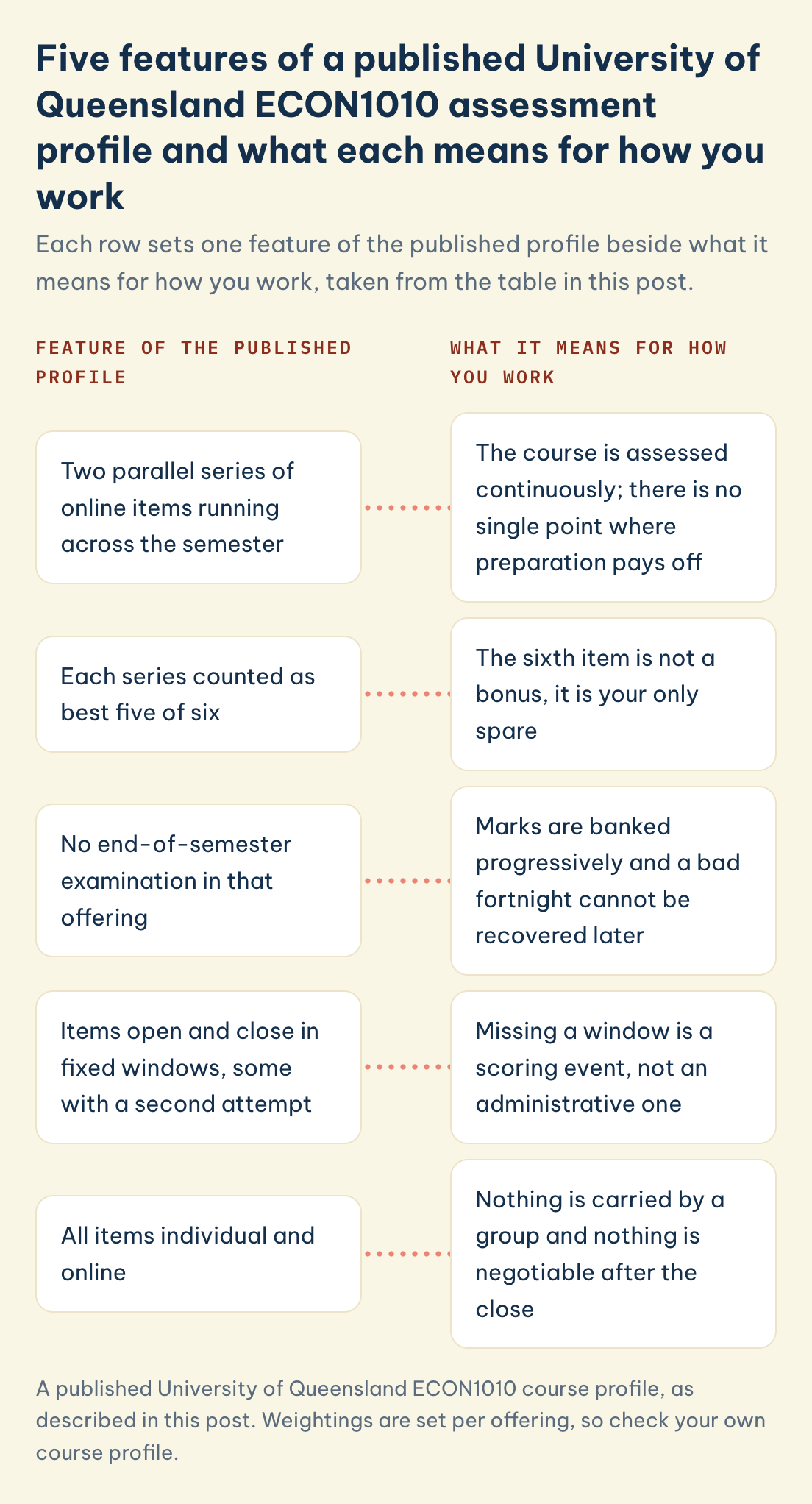
The published profile for one recent semester is unusual enough to be worth reading carefully, and it is the structure rather than the dates that should shape your semester.
| Feature of the published profile | What it means for how you work |
|---|---|
| Two parallel series of online items running across the semester | The course is assessed continuously; there is no single point where preparation pays off |
| Each series counted as best five of six | The sixth item is not a bonus, it is your only spare |
| No end-of-semester examination in that offering | Marks are banked progressively and a bad fortnight cannot be recovered later |
| Items open and close in fixed windows, some with a second attempt | Missing a window is a scoring event, not an administrative one |
| All items individual and online | Nothing is carried by a group and nothing is negotiable after the close |
Two things follow. The first is that a best-five-of-six rule is routinely misread as permission to skip one. It is more accurate to read it as the course's own allowance for the illness, the clashing deadline or the internet failure that will happen to somebody. Spend it deliberately, or by the time the genuine emergency arrives you have nothing left to spend.
The second is that this shape has a body of evidence behind it that works in your favour if you cooperate with it. Bloom (1968) argued for structuring courses around repeated, low-stakes mastery checks rather than a single high-stakes exam, on the grounds that most students can reach a high standard given enough attempts and fast feedback, and a best-five-of-six design is a direct descendant of that argument even where the course profile never cites it. Repeated low-stakes retrieval spread across weeks produces markedly better long-term retention than the same total effort concentrated into a block, both because of the spacing of the practice (Cepeda et al., 2006) and because being tested is itself a stronger learning event than re-reading (Roediger & Karpicke, 2006). The effect is counter-intuitive at first: immediately after studying, rereading feels more effective, but Roediger and Karpicke tested recall at three intervals, 5 minutes, 2 days and 1 week, and found the ranking flipped by the 2-day mark, with the tested group pulling further ahead by 1 week. A course built out of twelve small assessed encounters is, whether or not it says so, a course designed around those findings. Students who treat each item as an administrative hurdle to clear and then forget are paying the cost of the design without collecting its benefit.
One caution about the numbers. The structure described above comes from a published course profile for a past semester. Weightings, windows and the presence or absence of a final examination are set for each offering, and course coordinators do change them. Read the profile attached to your own enrolment and treat this guide as a description of the shape, not a substitute for your own document.
◆ Section 4 / 7 · Non-technical language
What "non-technical language" is actually asking for
Direct answer: It asks you to write causally rather than simply. A technical answer can leave the mechanism implicit in the notation; a non-technical answer earns marks only when the words themselves name the mechanism and the condition it depends on.
The phrase sounds like a request to write simply. It is a request to write causally.
A technical answer can hide behind notation: you can write that demand shifts left and the marker can reconstruct why. A non-technical answer has nowhere to hide, because the words either contain the mechanism or they do not. This is why the outcome is harder than it looks, and why the standard economics literature on undergraduate proficiency treats communication as a distinct capability rather than a presentational finish. Hansen (2001) sets out expected proficiencies for economics students as things a student can do: "This approach focuses on what graduating majors should be able to do with the knowledge and skills they acquire in the major, that is, their ability to demonstrate their learning in practical ways" (Hansen, 2001), and the ability to communicate economic reasoning to a non-specialist audience sits among them rather than beneath them. Colander (2005) surveyed graduate students at leading US economics departments and found many could manipulate the technical apparatus fluently while struggling to say in plain language what a model actually implied, which is the exact failure ECON1010's final learning outcome is designed to catch years earlier, while the habit is still cheap to fix.
In practice the difference shows up in a single sentence. Compare:
- A tax on petrol reduces the quantity demanded. This states a result. It is true and it earns very little.
- A tax raises the price the buyer faces, and because there are substitutes available in the medium term, the quantity demanded falls more over a year than over a week. This states a mechanism, names the condition it depends on, and makes the answer testable.
The second sentence is not longer because it is padded. It is longer because it contains the reasoning the first sentence assumed the marker would supply. Becker (1997) and Hansen (2001) name the same gap from two directions, one as a documented teaching failure and the other as a proficiency employers explicitly expect, which is worth remembering when the second sentence feels like more effort than the mark seems to justify.
◆ Section 5 / 7 · Where marks are lost
Where marks are lost in a course like this
Direct answer: Four recurring losses: reciting a model instead of applying it to the case, evaluating without naming the criterion, treating a graph as the argument rather than as support for it, and confusing a movement along a curve with a shift of the curve.
Reciting the model instead of applying it. The learning outcomes ask you to identify appropriate theory related to real-life contexts. Answers that reproduce a textbook treatment of monopoly, with no feature of the actual case doing any work, are answering a question the course did not ask. Becker (1997), reviewing decades of research on how undergraduate economics is taught, found this pattern widespread enough to have a name in the literature well before this course existed: students trained mainly through lecture and recitation could reproduce a model on demand but could not recognise when the model applied to a new situation.
Evaluating without a criterion. The evaluation outcome asks you to appraise proposed outcomes using economic theory. An evaluation needs a stated standard, usually efficiency or distribution, and needs to say which one is being applied. Vilfredo Pareto gave the efficiency criterion most introductory courses still use its modern form in 1906, in his Manual of Political Economy, and the distribution question he left largely open is exactly the gap a well-aimed evaluation fills by naming who gains and who loses. Writing that a policy is "bad for consumers" without saying whether the concern is total surplus or who bears the burden leaves the marker guessing.
Treating a graph as the answer. The assumed background says you should be able to manipulate simple graphs. It does not say a graph is an argument. A diagram supports a claim you have made in words; it does not replace it. The supply-and-demand diagram itself is older than the course by more than a century, Alfred Marshall popularised it in Principles of Economics in 1890, and that history is worth remembering precisely because a device built to compress an argument for experts was never meant to stand alone in an answer written for a non-specialist reader.
Confusing a movement with a shift. This is the most common technical error in first-year microeconomics and it is almost always a writing error rather than a conceptual one. Being explicit about which variable changed, and whether it is on an axis, prevents it.
◆ Section 6 / 7 · The course on AI
What the course says about AI, and how to read it
Direct answer: This unit allows AI and machine-translation tools, but marks the critical thinking those tools cannot supply on their own. Leaving generative AI use unacknowledged risks a misconduct finding under the university's Student Code of Conduct. Because each course sets its own rules, only the profile for your specific offering tells you what actually applies.
The published profile is direct: students may use artificial intelligence and machine translation tools, and successful completion will still require students to engage critically in specific contexts and tasks for which such tools provide only limited support. It also states plainly that failing to reference generative AI use may constitute misconduct under the Student Code of Conduct.
Read both halves. The permission is real and the disclosure requirement is real, and the second is where students get into trouble, usually through carelessness rather than intent. Two practical points. First, the rules are set course by course; a policy you were given in another subject tells you nothing about this one, and the profile attached to your own offering is the only document that governs you. Second, a tool that generates fluent economic prose is exactly the tool least able to help with the outcome this course marks hardest, because a mechanism you did not reason through is a mechanism you cannot defend in a tutorial or a follow-up question. Generative AI tools of this kind are recent enough that no policy on them predates the widely used chatbots that reached the public in 2022, which is one reason policies are written and rewritten course by course rather than inherited from an older, settled convention.
◆ Section 7 / 7 · Six things to do
Six things worth doing in this course
- Read your own course profile in week one and write the assessment windows into a calendar, including the second-attempt windows where they exist.
- Decide in advance which item in each series is your spare, and protect it rather than spending it in week three.
- For every result you learn, write one sentence naming the mechanism and one naming the condition it depends on. That pair is the unit of marking in this course.
- Practise explaining one concept a week to somebody outside economics. If they cannot follow it, the answer is not yet at the standard the final learning outcome describes.
- Check the incompatible-course list against your enrolment before the census date, particularly if you have credit from another institution.
- Keep a record of any AI or translation tool you use as you go, rather than reconstructing it at submission.
Related reading
If you are also enrolled in, or choosing between, other first-year economics courses, these guides cover the different demands each one makes:
Frequently asked questions
Is ECON1010 a maths-heavy course?
The University of Queensland course description states that the focus is on principles that are immediately applicable rather than on formal mathematical theorising, and the assumed background is basic arithmetic plus the ability to read simple graphs. The course is not maths-free, but the marked difficulty sits in explanation rather than in computation.
Does ECON1010 have a prerequisite?
The published UQ course information lists no prerequisite. It does list incompatible courses, including ECON1011, ECON2011 and ECON2012, and it is not to be studied by students in the Advanced Business (Honours) or Advanced Finance and Economics (Honours) programmes.
Why does this guide not give exact assessment percentages?
Because the weightings, windows and the presence of a final examination are set for each offering and have varied between semesters. The structure described here comes from a published profile for a past semester, and the document that governs your marks is the profile attached to your own enrolment.
What does the best-five-of-six rule really mean?
It means one item in each series can be dropped without penalty, which is best understood as the course's built-in allowance for an unavoidable problem rather than as a free pass. Once it is spent, a later illness or clash costs marks directly.
Can I use AI tools in this course?
The published profile permits the use of AI and machine translation tools while stating that they offer only limited support for the critical work being assessed, and it warns that failing to reference generative AI use may constitute misconduct. Rules differ between courses, so check the profile for your own offering rather than assuming a policy from elsewhere applies.
Where MAAS fits
MAAS mentors work alongside students in courses like this rather than in place of them. In a first-year course marked through explanation, the two most useful things a mentor does are to push you until every claim you write names its mechanism, and to read your answers as a non-specialist would so you can hear where the reasoning stops being followable. The work stays yours. If that is useful, our academic support service and our tutoring service are the two places to start.
Students who go on to test these relationships with data face a different kind of argument, set out in the guide to the ECON2300 econometrics research report.
References
Becker, W. E. (1997). Teaching economics to undergraduates. Journal of Economic Literature, 35(3), 1347–1373.
Bloom, B. S. (1968). Learning for mastery. Evaluation Comment, 1(2), 1–12.
Cepeda, N. J., Pashler, H., Vul, E., Wixted, J. T., & Rohrer, D. (2006). Distributed practice in verbal recall tasks: A review and quantitative synthesis. Psychological Bulletin, 132(3), 354–380. https://doi.org/10.1037/0033-2909.132.3.354
Colander, D. (2005). The making of an economist redux. Journal of Economic Perspectives, 19(1), 175–198. https://doi.org/10.1257/0895330053147976
Hansen, W. L. (2001). Expected proficiencies for undergraduate economics majors. The Journal of Economic Education, 32(3), 231–242. https://doi.org/10.1080/00220480109596105
Roediger, H. L., & Karpicke, J. D. (2006). Test-enhanced learning: Taking memory tests improves long-term retention. Psychological Science, 17(3), 249–255. https://doi.org/10.1111/j.1467-9280.2006.01693.x
Tools & resources
- MAAS guide to ECON1011 Economics for Business, where the assessment contains no essay at all
The University of Queensland. (2026). ECON1010: Introductory Microeconomics. https://programs-courses.uq.edu.au/course.html?course_code=ECON1010
A free 20-minute consultation is a conversation about where you are with ECON1010.
Book a free consultation ▸