
◆ Integrity & AI
How do you pick a dissertation proofreading service safely?
Direct answer: A dissertation proofreading service is safe when it flags surface errors in your finished draft and nothing more. The University of Nottingham (2025) says proofreaders "must not actively amend existing, or create new, content in draft work", so ask for an editor who works in tracked changes that you approve one by one.
What may a dissertation proofreader change, and what is off limits?
Direct answer: A proofreader may point out spelling, punctuation, grammar, formatting and repeated words, and may flag a passage that is unclear. A proofreader may not rewrite passages, reorder paragraphs, fix calculations or facts, or add material. Three UK universities draw this same line, with small differences.
The University of Nottingham (2025) lists what a third party may do: identify spelling and typographical errors, poor grammar, formatting inconsistencies and referencing errors, and highlight a sentence or paragraph that is overly complex or unclear. Its prohibitions include rewriting passages "to clarify the meaning", changing words or figures other than to correct spelling, checking calculations, and altering a faulty argument. Swansea University (n.d.) adds that a proofreader should not offer advice about what to add or leave out, and should use handwritten notes or the comments function so that the original errors stay visible.
The University of Essex (n.d.) separates two levels. Final editing means mistakes, occasional spelling or punctuation errors, repeated phrases and inconsistent layout. Language correction extends to grammar, vocabulary, sentence structure and expression, and the proofreader should correct only where the intended meaning is clear. Anything that would "substantially change the content" is outside proofreading. Wikipedia describes proofreading as the final check for surface errors, and copy editing as the wider job of improving clarity and style, which is why the two words are often mixed up in advertisements.
| Policy | May do | Must not do |
|---|---|---|
| University of Nottingham (2025) | Flag spelling, grammar, formatting, referencing errors and unclear passages | Rewrite passages, change words or figures, alter faulty logic, add material |
| University of Essex (n.d.) | Final editing and language correction where meaning is clear | Rewrite faulty argumentation, rearrange paragraphs, correct data or facts |
| Swansea University (n.d.) | Flag errors, ambiguity and inconsistent layout | Reorganise paragraphs, advise on content, correct factual errors or references |
Source: the three university policies listed under References, read 2026-10-31.
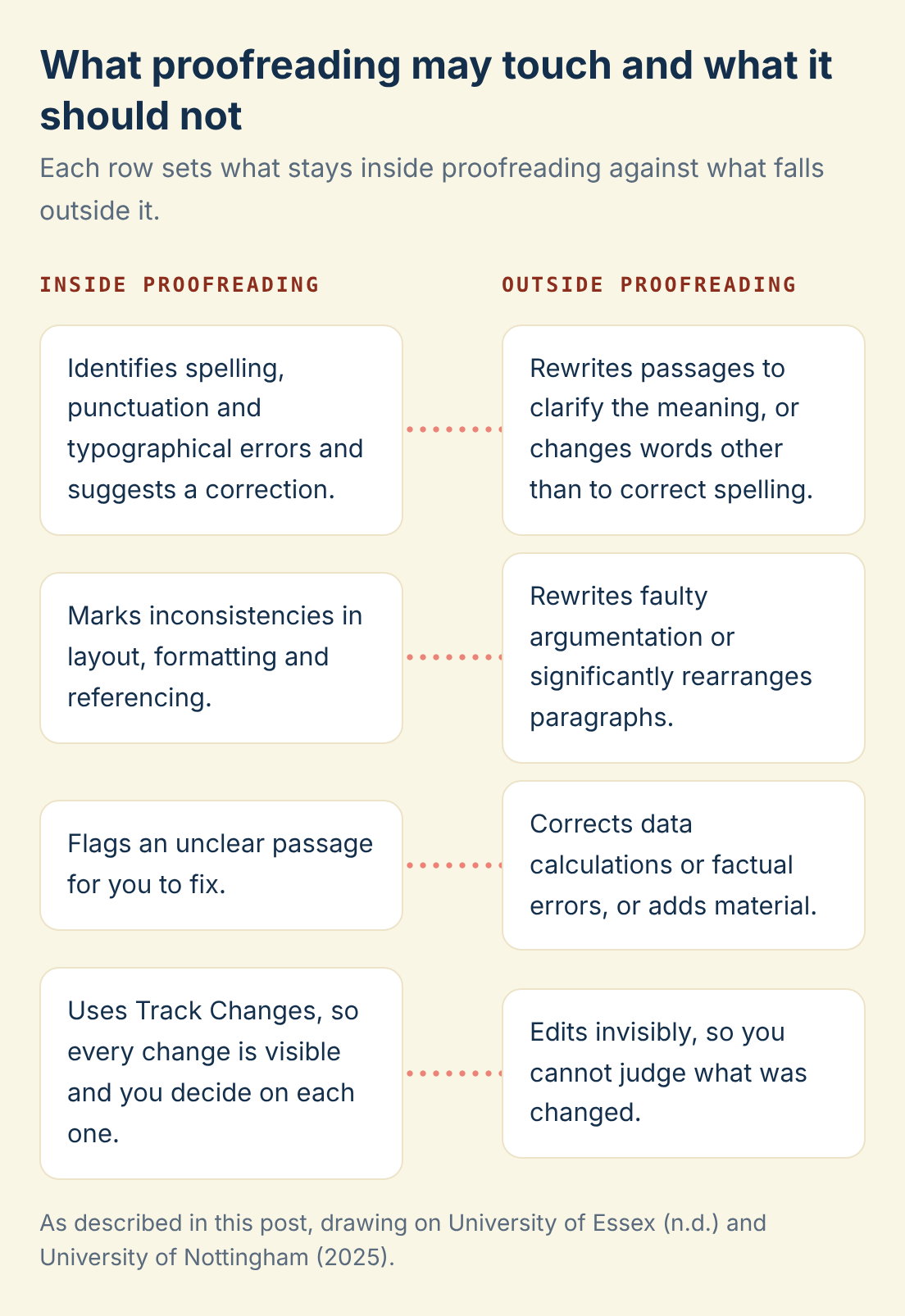
What proofreading may touch and what it should not
Each row sets what stays inside proofreading against what falls outside it.
Inside proofreading
Outside proofreading
Identifies spelling, punctuation and typographical errors and suggests a correction.
Rewrites passages to clarify the meaning, or changes words other than to correct spelling.
Marks inconsistencies in layout, formatting and referencing.
Rewrites faulty argumentation or significantly rearranges paragraphs.
Flags an unclear passage for you to fix.
Corrects data calculations or factual errors, or adds material.
Uses Track Changes, so every change is visible and you decide on each one.
Edits invisibly, so you cannot judge what was changed.
Save this figure
Is a dissertation proofreading service allowed at your university?
Direct answer: It depends on the university and your level of study. Swansea University (n.d.) does not permit professional proofreading services for taught students, while Nottingham (2025) allows third-party proofreading with a declaration at submission and Essex (n.d.) has no rule against it. Read your own handbook first.
Swansea University (n.d.) states that it "does not permit the use of professional third-party proofreading services" for taught undergraduate and postgraduate students unless approved for a defined purpose, such as a reasonable adjustment, and it treats use of such a service as potential academic misconduct. Postgraduate research students have separate guidance there. Nottingham (2025) takes another route: students must do their own initial proofreading, make sure the proofreader knows the regulation, and declare at submission whether the work was proofread and whether the proofreader stayed within the limits.
Essex (n.d.) says no student is obliged to hire a paid proofreader, notes that doctoral dissertations are often proofread because they aim at publication standard, and mentions that students writing in a second language may want a master's dissertation proofread. It asks students to consult their supervisor before engaging anyone. The same service can therefore be forbidden, declared or merely discouraged, depending on where you study.
Our guide on whether using a proofreading service counts as cheating goes through the integrity question, and the one on proofreading academic writing in a second language covers non-native writers. The practical step is the same everywhere: find the policy, quote it in your email to your supervisor, and keep the reply.
How differently do proofreaders treat the same dissertation text?
Direct answer: Very differently. In Harwood's (2018) study, 14 UK proofreaders worked on one 2,511-word master's essay and made between 113 and 472 interventions each. Some also rewrote content, and some introduced new errors. A sample edit before you commit shows how a particular proofreader works.
Harwood (2018) gave 14 university proofreaders the same authentic, low-quality master's essay, written by a second-language speaker and awarded a bare pass mark of 50. The proofreaders talked aloud while working and were interviewed afterwards. Each proofreader worked on the same 2,511 words, so the gaps in what they changed came from the people, not the text. The most active made 472 interventions and the least active 113, so one made over four times as many changes as another. Another made 161. The proofreader with the fewest interventions recorded the most teaching comments, 84, which is closer to the formative feedback that Essex (n.d.) asks proofreaders to provide.
The wider concern was content. Some proofreaders made lengthy suggestions about essay structure and argumentation, while others kept to language. Harwood (2018) also found that a few introduced errors into the text and left the writer's own errors uncorrected, and he called the results a cause for deep concern for universities writing proofreading policies.
| Measure from Harwood (2018) | Result |
|---|---|
| Proofreaders who edited the same essay | 14 |
| Length of the essay | 2,511 words |
| Interventions, fewest to most | 113 to 472 |
| Teaching comments by the lowest-intervention proofreader | 84 |
Source: Harwood (2018), Written Communication, 35(4), accepted manuscript read 2026-10-31.
One essay and 14 UK proofreaders cannot tell you the average for the whole market. What it shows is variation, and Essex (n.d.) offers the matching safeguard: a proofreader marks two or three representative pages first, so that scope and fee are clear before the full text goes over.
Does proofreading change how readers judge your writing?
Direct answer: In experiments it does. In Feld et al.'s (2024) trial, writing experts rated language-edited papers 0.6 standard deviations better written, while economists rated them 0.2 standard deviations better overall and were 8.4 percentage points more likely to accept them for a conference. These studies measure readers' impressions, not dissertation marks, and none promises a result.
Feld et al. (2024) language-edited 30 papers by 22 PhD students in economics, then had 18 writing experts and 30 economists judge original or edited versions, 480 paper-expert judgments in all. Writing experts rated the edited papers 0.6 standard deviations better written, 1.22 points on an 11-point scale, and economists were 4.1 percentage points more likely to expect publication in a good journal. The effect was larger for papers that had been poorly written to begin with.
Outside academia, a controlled experiment with 201 community adults showed that a cover letter with two grammar errors per 100 words scored 3.61 for writing quality against 5.79 for an error-free letter, and 2.95 at four errors per 100 words (Bleske-Rechek et al., 2019). The authors concluded that "the grammar usage errors still tainted evaluators' impressions of the applicant on every dimension we measured" (Bleske-Rechek et al., 2019, p. 49). In an online experiment, 301 participants rated forum posts with five misspellings as 8.86 points less trustworthy on a 0 to 100 scale, and the penalty for misspellings combined with capital letters was 14.33 points (Witchel et al., 2020). Boland and Queen (2016) tested 83 readers, who rated an email with three typos 0.47 lower on a 7-point scale and one with three homophone errors 0.22 lower.
| Study | Sample | Reported result |
|---|---|---|
| Feld et al. (2024) | 30 papers, 18 writing experts, 30 economists | Writing experts rated edited papers 0.6 SD better written; economists were 8.4 percentage points more likely to be accepted at a conference |
| Bleske-Rechek et al. (2019) | 201 adults | Writing quality 5.79 clean, 3.61 at 2 errors per 100 words |
| Witchel et al. (2020) | 301 participants | Misspellings cost 8.86 trust points |
| Boland and Queen (2016) | 83 readers | Typos cost 0.47, homophone errors 0.22 |
Source: the four papers listed under References, read 2026-10-31.
Read these carefully. Nobody tested a dissertation marked against a rubric, and an examiner reads for argument first. The studies do show that surface errors shape impressions of the writer, which is the reason a final clean pass is worth planning for.
When should you send the draft, and what should come back?
Direct answer: Send it when it is complete and as good as you can make it, never as an outline or fragments. Essex (n.d.) wants the file to come back in tracked changes or a marked paper copy, with every correction decided by you, and with a short list of your most common errors.
Essex (n.d.) advises that text normally goes to a third-party proofreader at completion stage only, to limit the risk of interventions that affect meaning, and that it should never be based on outlines or notes. Nottingham (2025) expects you to proofread first yourself, so run through an editing and proofreading checklist before anyone else sees the file.
For the return, Essex (n.d.) says an electronic proofreader "must use Track Changes rather than direct (i.e. 'invisible') edits" and that students must consider each suggested correction rather than accepting all. The proofreader should not take responsibility for the final decision on any change, and Essex adds that the student must maintain ownership of corrections, however minor. It also recommends a written agreement covering the type of corrections, format, communication, deadlines and payment, and a summary list of common errors so that your next draft improves. Keep your original file, and thank the proofreader in the acknowledgements where your university expects it.
Budget time as well as money. Essex (n.d.) observes that proofreaders typically charge by the hour or by the page and that proofreading "typically takes much longer than student writers expect", because the proofreader must take great care not to alter meaning. Begin the conversation weeks before your deadline, which leaves room to review every change at your own pace.
Which warning signs should make you walk away?
Direct answer: Walk away from any service that edits invisibly, rewrites your sentences, corrects your data or argument, promises a grade, or tells you to skip a declaration. Each conflicts with the limits that Essex (n.d.), Nottingham (2025) and Swansea University (n.d.) set for proofreaders.
- Edits you cannot see. Essex (n.d.) allows only tracked changes or hand-marked copy, and Swansea University (n.d.) rejects edits that hide the original errors.
- Rewritten sentences or restructured chapters. Nottingham (2025) bars rewriting passages and rearranging text, and Harwood (2018) found that interventions can drift into content.
- Fixes to numbers, citations or facts. All three policies keep calculations, data and factual errors with the student.
- A grade or acceptance promise. A proofreader does not control marking, and an assurance of a result suggests the plan goes beyond the surface.
- Pressure to hide the help. Where a declaration is required, as at Nottingham (2025), an adviser who suggests leaving it out is moving the risk onto you.
- No scope, sample or turnaround in writing. Essex (n.d.) recommends agreeing all three before work begins.
If a provider answers a question about its limits vaguely, treat that as the answer. A proofreader who works within these policies can say, in one sentence, what they will touch and what they will leave to you.
Frequently asked questions
Is dissertation proofreading the same as editing?
No. Proofreading flags errors for you to fix, while editing that reworks passages, structure or reasoning changes the content. Universities such as Essex and Nottingham only accept the first.
Can I use a proofreading service for a taught master's dissertation?
Not at every university. Swansea does not allow it for taught programmes unless approved, Nottingham asks for a declaration, and Essex has no rule against it. Ask your supervisor and quote the policy.
Should I send a first draft to a proofreader?
No, wait for the finished version. Early drafts invite changes to meaning, and Essex says outlines or notes should never be proofread by a third party.
Do I need tracked changes?
Yes, or a marked paper copy. You need to see each correction to accept or refuse it, and a file with invisible edits leaves you unable to show what changed.
How far ahead should I book?
Weeks, not days. Essex says the work takes longer than students expect, and a sample of two or three pages will give an honest estimate of time and fee.
Talk through your editing needs with MAAS
If your dissertation is finished and you want an expert to read it for language, referencing and formatting, our thesis editing and revision service works in Word with Track Changes on, so you approve every change yourself. The argument and the authorship stay yours, and we do not promise a grade. Before you book anyone, check what your own university allows and ask your supervisor.
Related guides
- Is using a proofreading service cheating?: the integrity side of the question, with university wording on what counts as acceptable help.
- Editing and proofreading checklist: the self-check to finish before any outside reader sees your file.
- How to write a dissertation conclusion: a chapter worth reading again before the final clean pass.
References
- Bleske-Rechek, A., Paulich, K., Shafer, P., & Kofman, C. (2019). Grammar matters: The tainting effect of grammar usage errors on judgments of competence and character. Personality and Individual Differences, 141, 47-50. https://doi.org/10.1016/j.paid.2018.12.016
- Boland, J. E., & Queen, R. (2016). If you're house is still available, send me an email: Personality influences reactions to written errors in email messages. PLOS ONE, 11(3), Article e0149885. https://doi.org/10.1371/journal.pone.0149885
- Feld, J., Lines, C., & Ross, L. (2024). Writing matters. Journal of Economic Behavior & Organization, 217, 378-397. https://doi.org/10.1016/j.jebo.2023.11.016
- Harwood, N. (2018). What do proofreaders of student writing do to a master's essay? Differing interventions, worrying findings. Written Communication, 35(4), 474-530. https://doi.org/10.1177/0741088318786236
- Swansea University. (n.d.). Proof reading policy. https://hwb.swansea.ac.uk/academic-life/academic-regulations/aqs-policies/proof-reading-policy/
- University of Essex. (n.d.). University policy and guidance on proofreading of student texts. https://www.essex.ac.uk/-/media/documents/directories/academic-section/proofreading-policy-guidance.pdf
- University of Nottingham. (2025). Regulation and code of practice on proofreading. https://nottingham.ac.uk/QualityManual/Assessment-awards-and-deg-classification/Pol-proofreading.aspx
- Witchel, H. J., Thompson, G. A., Jones, C. I., Westling, C. E. I., & Romero, J. (2020). Spelling errors and shouting capitalization lead to additive penalties to trustworthiness of online health information: Randomized experiment with laypersons. Journal of Medical Internet Research, 22(6), Article e15171. https://doi.org/10.2196/15171
This article is part of the MAAS Journal series for students. MAAS is an academic support partner: experts guide students through each stage of their own work, and we do not complete assessed work on a student's behalf.
Not sure how this guide applies to your own case? Talk it through with MAAS in a free 20-minute consultation.
Book a free consultation ▸