
◆ Academic writing
How do you proofread academic writing in a second language?
Academic writing support is usually written with native English speakers in mind, aimed at a single structural read-through, not at a writer whose uncertainty sits at the level of which article belongs before a noun. That gap matters most for anyone submitting coursework in English as a second, third or fourth language, at RMIT, BUV, ISB or any English-medium programme, where marks are lost to errors clustering in a small, known set rather than scattering evenly.
◆ Question 1 / 8 · Why generic advice fails
Why generic proofreading advice under-serves L2 writers
Direct answer: Proofread in a second language by splitting the work into 2 passes, the split George Mason University Writing Center recommends alongside UNC's Writing Center. First run a systematic check for the error types your English repeats, one type at a time. Then check separately whether a reader understands your meaning, not the same question as grammatical correctness.
Standard proofreading guidance tells you to read your whole draft once, slowly, looking for anything wrong. That works when errors are scattered and idiosyncratic. It works badly when errors are patterned, which is the normal case for a second-language writer: the same handful of structures misfire again and again because they do not map cleanly onto your first language's grammar. Scanning for "anything wrong" under-checks the errors you actually make constantly. A system built around your own error patterns is the more efficient use of a limited editing pass.
◆ Question 2 / 8 · The learning log
Keep a language learning log, and work from your own top three
Direct answer: Both George Mason University Writing Center and UNC's Writing Center point to the same tool: a language learning log, a running record of the errors, words and structures that keep tripping you up. Once you have it, narrow your focus to your three most frequent sentence-level mistakes, and check each new draft against only those, rather than hunting for everything.
The starting point is a language learning log. George Mason University Writing Center defines it plainly: "a written record where you collect and keep track of words, phrases, sentences, grammatical concepts, or any examples of writing that you want to remember" (George Mason University Writing Center, n.d.), kept over time so patterns become visible. From that log, pick your three most frequent sentence-level errors and check the draft against only those three, one at a time, rather than trying to catch everything in a single read (George Mason University Writing Center, n.d.; The Writing Center, University of North Carolina at Chapel Hill, n.d.). A ruler that covers everything except the current line helps enforce this, stopping your eye jumping ahead before you finish checking that one fault. The log is the asset: after a semester it tells you which three errors to check first on any new draft.
◆ Question 3 / 8 · Recurring error types
The error types that recur most for L2 writers
Direct answer: Four error categories, per George Mason University Writing Center, account for a disproportionate share of L2 sentence errors: word form, subject-verb agreement, verb tense and form, and modals combined with the wrong infinitive. Article use (a/an/the) is a fifth recurring pattern for writers whose first language handles articles differently. None are typos a spell-checker catches.
University writing centre guidance for multilingual writers points to four categories that account for a disproportionate share of L2 sentence errors (George Mason University Writing Center, n.d.):
- Word form. The wrong part of speech from a word family, for example the noun where the sentence needs the adjective (significant where it needs significantly). This survives a spell-check, because the word itself is spelled correctly; it is the wrong form for its slot.
- Subject-verb agreement. The verb has to match the actual subject, which gets harder once a phrase sits between the two and pulls the verb toward the wrong form.
- Verb tense and form. Consistency of tense within an argument, and whether an irregular verb has taken its correct past or participle form.
- Modals plus the infinitive. Errors combining a modal verb (can, must, should) with the wrong following verb form; a specific, recurring L2 pattern rather than a random slip.
Article use (a/an/the, or no article) is a fifth pattern for writers whose first language does not use articles the same way English does; add it to your own log if it appears there.
None of these are typos, and none reliably trip a basic spell-checker. They are grammatical-slot errors, which is why a targeted, one-category-at-a-time pass catches them and a single fast read-through usually does not.
◆ Question 4 / 8 · Checking techniques
Techniques that separate checking the surface from reading for meaning
Direct answer: Four techniques interrupt the autopilot that hides your own errors, per UCLA Graduate Writing Center and the University of Washington's Odegaard Writing & Research Center (2023): read the sentence aloud, read the draft backward from the last sentence, print a hard copy or take a break, and use Find to search for words your log shows you repeat.
Four proofreading techniques for second-language writers
Tap a technique to see how it works, in the post's own words.
Item 1 of 4
Read aloud
Saying each word, rather than skimming it silently, surfaces missing words and awkward phrasing your eye would otherwise glide past.
Item 2 of 4
Read backward
Start from the last sentence, because reading in the order you wrote the draft lets your brain predict what comes next.
Item 3 of 4
Print or take a break
A paper printout, or the same text after a few hours away, looks different enough from what you remember typing to make errors visible again.
Item 4 of 4
Use Find
Once your log shows a word or structure you keep getting wrong, search your document for it directly.
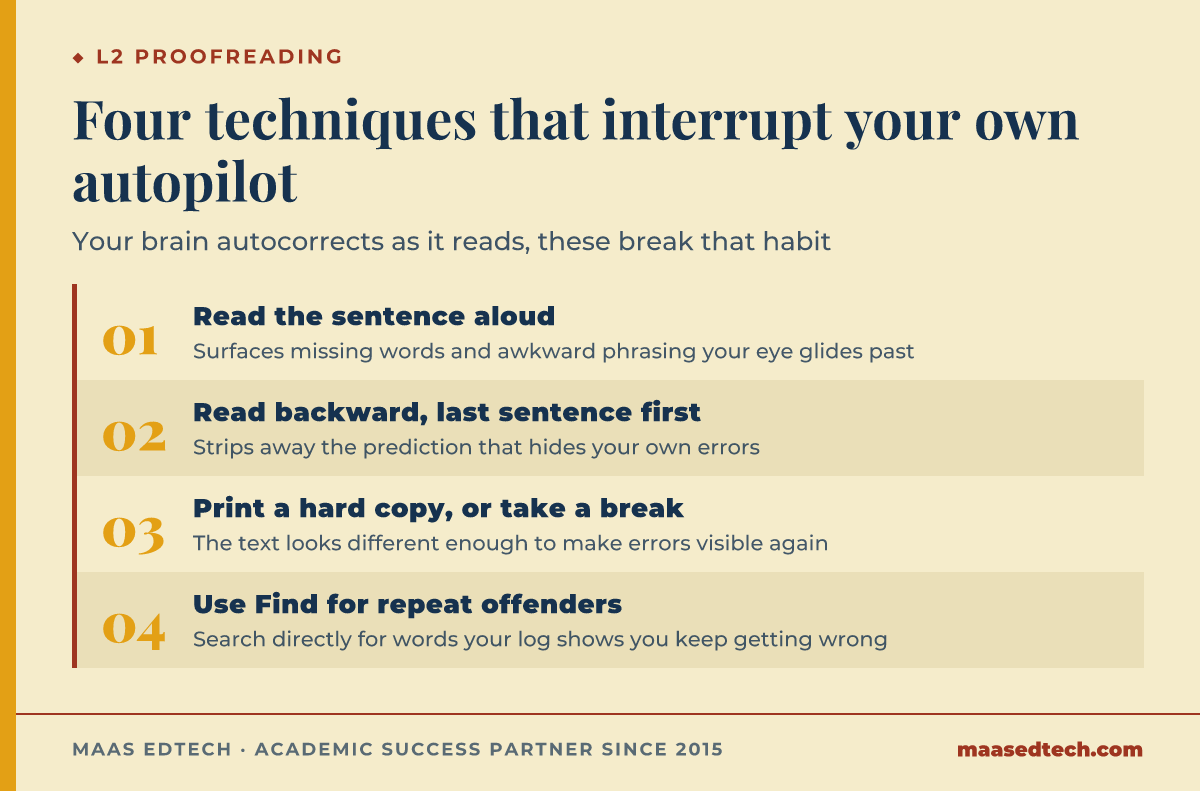
A normal read-through misses your own errors because your brain autocorrects as it reads, filling in what you meant rather than registering what is on the page. A few techniques break that autopilot:
Read the sentence aloud. Saying each word, rather than skimming it silently, surfaces missing words and awkward phrasing your eye would otherwise glide past (UCLA Graduate Writing Center, n.d.; University of Washington, Odegaard Writing & Research Center, 2023).
Read backward, from the last sentence to the first. Reading in the order you wrote the draft lets your brain predict what comes next; starting from the end strips that prediction away (UCLA Graduate Writing Center, n.d.; University of Washington, Odegaard Writing & Research Center, 2023; The Writing Center, University of North Carolina at Chapel Hill, n.d.).
Print a hard copy, or take a break before returning. A paper printout, or the same text after a few hours away, looks different enough from what you remember typing to make errors visible again (University of Washington, Odegaard Writing & Research Center, 2023; The Writing Center, University of North Carolina at Chapel Hill, n.d.).
Use Find to hunt down your own repeat offenders. Once your log shows a word or structure you keep getting wrong, search your document for it directly rather than hoping to spot every instance on a normal read (UCLA Graduate Writing Center, n.d.).
Each technique interrupts the same habit, reading for meaning instead of surface form, which is exactly what lets errors survive undetected when you already know what the sentence is supposed to say.
◆ Question 5 / 8 · Corpus tools
Corpus tools and learner's dictionaries for word choice
Direct answer: Grammatical correctness is not the only gap, per UCLA Graduate Writing Center. A corpus tool or learner's dictionary checks collocation, whether words conventionally pair the way you have written them, and which connective word such as however or nevertheless fits the logical relationship you intend. A grammatically flawless sentence can still read as slightly off.
Grammatical correctness is not the only gap. Academic English also relies on collocation (which words conventionally pair together) and on connective words such as however and nevertheless that signal logical relationships a native reader expects. A corpus tool or a learner's dictionary checks exactly this: whether a phrase actually occurs in academic English the way you have written it, and which connective fits the relationship you intend (UCLA Graduate Writing Center, n.d.). A sentence can be grammatically flawless and still read as slightly off if the collocation is unusual.
◆ Question 6 / 8 · The reader first
The reframe: revision is about the reader, not just the rulebook
Direct answer: Treating proofreading as purely a hunt for rule violations sets an impossible bar, per The Chicago School's Academic Support Center, since no writer produces flawless grammar on a first attempt. The better question is whether your reader understood what you meant, since a correct sentence can be hard to follow if organised the way your first language structures its argument.
Treating proofreading as purely a hunt for rule violations is tempting, and for a multilingual writer that sets an impossible bar: no writer produces flawless grammar on a first attempt. The more useful question is different: will your reader understand what you meant (The Chicago School, Academic Support Center, n.d.)? A sentence can be entirely correct by the rulebook and still be hard to follow if it is organised the way your first language organises an argument rather than the way academic English expects; rhetorical conventions differ between languages, and that is often what makes a paragraph feel effortful to a marker even when no individual sentence is wrong (The Chicago School, Academic Support Center, n.d.). Checking against "does this communicate what I intended" catches problems a rule-by-rule grammar check misses entirely.
◆ Question 7 / 8 · Checkers and judgement
Do not let a checker stand in for your own judgement
Direct answer: UNC's Writing Center is clear that a checker has a place, just a limited one: it flags typos, but runs on a narrow rule set, overlooks correctly spelled words used in the wrong context, and its grammar advice often misfires on the sentence patterns L2 writers rely on most. Use it last, not instead of your own checks.
A spelling or grammar checker has a real but narrow role: it catches typos, but it runs on a limited rule set, misses errors that are correctly spelled but wrong in context (your for you're), and its grammar suggestions are frequently wrong for the sentence structures L2 writers use most (The Writing Center, University of North Carolina at Chapel Hill, n.d.). Treat it as one more pass, run after your own targeted checks, not a substitute for them.
◆ Question 8 / 8 · A second pair of eyes
When should you ask for a second pair of eyes?
Even with a working log and a targeted checking system, it helps to have someone else confirm whether a sentence actually reads the way you intended, because that is the one question you cannot fully answer about your own writing. Through academic support at MAAS, a mentor reviews your draft, flags the specific sentences where meaning is unclear or a recurring error has slipped through, and explains why, so you can fix it yourself and add the pattern to your own log. The draft stays yours throughout; your mentor points out what needs attention and talks you through the fix, not through a rewrite. For the fuller multi-pass system this ESL-specific approach sits inside, see the general editing and proofreading checklist, and for the full set of guides, the proofreading and editing resource hub.
Frequently asked questions
What makes L2 proofreading different from regular proofreading?
Regular proofreading assumes scattered, unpredictable errors. L2 writers tend to make patterned errors instead, concentrated in word form, subject-verb agreement, verb tense and modal use, so checking your own top three recurring errors, one at a time, catches more than a generic sweep (George Mason University Writing Center, n.d.).
What is a language learning log and why keep one?
A running record of the errors, words and structures you get wrong across assignments, kept over time so patterns become visible (George Mason University Writing Center, n.d.). After a semester it tells you exactly which errors to check first on any new draft.
Which error types should I prioritise?
Word form, subject-verb agreement, verb tense and form, and modal-plus-infinitive errors are the four categories most frequent for multilingual writers (George Mason University Writing Center, n.d.). Article use (a/an/the) is worth adding if it shows up in your own log.
Will a grammar checker catch these errors for me?
Only partially; checkers run on a limited rule set, miss correctly spelled words used in the wrong context, and are frequently wrong on the exact structures L2 writers use most, so treat one as an extra pass after your own targeted check (The Writing Center, University of North Carolina at Chapel Hill, n.d.).
Why does reading backward or reading aloud help?
Both interrupt your brain's habit of predicting what comes next from memory of your own argument. Reading aloud forces you to register every word; reading from the last sentence to the first strips away that predictive context (UCLA Graduate Writing Center, n.d.; University of Washington, Odegaard Writing & Research Center, 2023).
Is a grammatically correct sentence automatically a clear one?
No; a sentence can follow every rule and still be hard to follow if it is organised the way your first language structures an argument. The more reliable check is whether your reader would understand what you meant (The Chicago School, Academic Support Center, n.d.).
Can I ask someone to fix these errors for me?
A proofreader or mentor can flag where meaning is unclear or an error pattern has recurred and explain why, but the fix and the writing stay yours; someone rewriting the sentences for you crosses into an integrity issue.
References
George Mason University Writing Center. (n.d.). How to edit your own essay: Strategies for multilingual writers. https://writingcenter.gmu.edu/writing-resources/writing-as-process/how-to-edit-your-own-essay-strategies-for-multilingual-writers
The Chicago School, Academic Support Center. (n.d.). Choose effective language. TCS Education System Library.
The Writing Center, University of North Carolina at Chapel Hill. (n.d.). Editing and proofreading. https://writingcenter.unc.edu/tips-and-tools/editing-and-proofreading/
UCLA Graduate Writing Center. (n.d.). Self-editing strategies for non-native speakers.
University of Washington, Odegaard Writing & Research Center. (2023). Self-editing and proofreading techniques [Handout].
A free 20-minute consultation with a MAAS academic mentor, to talk through where a second pair of eyes would help. The draft stays yours.
Book Free Discovery ▸