
◆ Health & Education
What is the communicative approach to language teaching?
Direct answer: The communicative approach teaches a language by asking learners to use it for real meaning, not only to practise forms. Richards (2006) treats communicative language teaching (CLT) as a set of principles about goals, learning, classroom activities and roles. It balances fluency work with accuracy work.
◆ Question 1 / 8 · What CLT is
What is the CLT method, and is it really one method?
Direct answer: CLT is better described as an approach than a single method. Richards (2006) defines it as a set of principles, and a recent systematic review of research in Japan found that the term is often defined inconsistently. Teachers who treat it as a fixed recipe usually end up adapting it anyway.
Richards (2006) gives the most quoted definition: "Communicative language teaching can be understood as a set of principles about the goals of language teaching, how learners learn a language, the kinds of classroom activities that best facilitate learning, and the roles of teachers and learners in the classroom" (Richards, 2006, p. 2). The British Council summarises the central idea in one line: "The communicative approach is based on the idea that learning language successfully comes through having to communicate real meaning" (British Council, n.d.). In practice the British Council also describes "more emphasis on skills than systems, lessons are more learner-centred, and there may be use of authentic materials" (British Council, n.d.).
The label "method" causes trouble. Flinn (2026) reviewed classroom research on CLT in Japan and reported "significant inconsistencies in how CLT is defined and conceptualized, often conflating it with a method of training speaking proficiency" (Flinn, 2026). Flinn argues that CLT is an approach rather than a method. Richards (2006) makes a similar point in his teacher self-check, where "CLT is usually described as a method of teaching" is one of the statements readers are asked to judge (p. 2), and on p. 9 he calls CLT "a new approach to language teaching". Littlewood (2014) also treats CLT as an umbrella for communication-oriented teaching and asks which versions suit specific learning situations. The practical consequence is simple. You do not "install" CLT; you decide which of its principles your learners, timetable and assessment can carry.
The theoretical root is communicative competence. Canale and Swain (1980) set out an influential model of what a learner needs beyond grammar. Richards (2006, p. 3) gives a teacher-friendly list of the aspects of communicative competence, which the next section uses.
◆ Question 2 / 8 · Communicative competence
What does communicative competence ask learners to do?
Direct answer: Communicative competence means knowing how to use language for a range of purposes, to vary it by setting and participants, to handle different text types, and to keep communicating despite limitations. Grammar is one part of it. Richards (2006) warns that mastering sentence rules does not guarantee successful communication.
Richards (2006, p. 3) lists four aspects of language knowledge under communicative competence. The table below restates them as questions a teacher can ask of a planned activity.
| Aspect on Richards (2006, p. 3) | Question for the teacher |
|---|---|
| Range of purposes and functions | Does the task ask learners to do something with language, such as request, persuade or explain? |
| Variation by setting and participants | Do learners need to change formality, or move between spoken and written forms? |
| Different text types | Do they meet or produce narratives, reports, interviews or conversations? |
| Communication strategies | Must they keep going when they lack a word or structure? |
Source: Richards (2006, p. 3).
The warning that follows matters for planning. Richards (2006, p. 3) notes that "one can master the rules of sentence formation in a language and still not be very successful at being able to use the language for meaningful communication". This is why a worksheet of correct sentences, however neat, cannot be the whole lesson. It is also why Richards (2006, p. 9) records that, in planning courses within a communicative approach, "grammar was no longer the starting point". The same page places the classic phase of CLT between the 1970s and the 1990s and says that earlier methods such as Audiolingualism and Situational Language Teaching fell out of fashion.
◆ Question 3 / 8 · Fluency and accuracy
How do fluency and accuracy fit together in communicative teaching?
Direct answer: Both are goals. Richards (2006) includes "Both accuracy and fluency are goals in CLT" in a self-check for teachers, and later recommends a balance. Fluency activities mirror natural language use and need meaningful communication. Accuracy activities practise correct forms out of context. Accuracy work can come before or after fluency work.
Richards (2006, p. 14) states that "One of the goals of CLT is to develop fluency in language use". He then contrasts the two kinds of activity in a way that is easy to use as a planning checklist.
| Feature | Fluency activity | Accuracy activity |
|---|---|---|
| Relation to real use | Reflects natural use of language | Reflects classroom use |
| Focus | Achieving communication | Forming correct examples |
| Context | Links language use to context | Practises language out of context |
| Meaning | Requires meaningful use | Does not require meaningful communication |
| Language produced | May not be predictable | Choice of language is controlled |
| Strategies | Requires communication strategies | Works with small samples of language |
Source: Richards (2006, p. 14).
Richards (2006, p. 15) gives one example of each. The fluency task is a role play of a car collision, with drivers, witnesses and police working from cue cards. The accuracy task puts learners in groups of three: two read a dialogue and the third monitors falling intonation in Wh-questions. His advice is that "Teachers were recommended to use a balance of fluency activities and accuracy and to use accuracy activities to support fluency activities. Accuracy work could either come before or after fluency work" (Richards, 2006, p. 15). A tutor with 45 minutes can therefore give a short accuracy segment before a role play, or return to errors that surfaced during it, without breaking the approach.
◆ Question 4 / 8 · Techniques and examples
What are communicative approach techniques and examples?
Direct answer: The best-documented examples are information-gap tasks, role plays and personalised question practice. Richards (2006) describes spot-the-difference pictures in pairs and a railway booth role play with cue cards. The British Council gives asking colleagues for personal information to practise question forms.
The information gap is the core technique. Richards explains the logic directly: "in real communication, people normally communicate in order to get information they do not possess" (Richards, 2006, p. 18). In a typical task, learners in A-B pairs sit back to back, each holding a picture with small differences, and must find the differences by speaking alone. In a second example, one learner plays a railway information booth clerk and the other a traveller, each with a cue card carrying different details (Richards, 2006, p. 18). The task works because neither partner can finish without the other's information.
The British Council offers a classroom-ready example for question forms: "Practising question forms by asking learners to find out personal information about their colleagues" (British Council, n.d.). Compare this with a drill in which learners ask the teacher scripted questions. In the first, the answer is unknown and the question has a purpose; in the second, nobody wants the answer.
For teachers searching for "communicative method examples", three features show up across these sources. The task has a reason to talk, the learners choose some of their language, and the teacher monitors rather than controls every utterance. Role plays with cue cards, pair work with different information and open discussions all share them.
◆ Question 5 / 8 · Strategies and methods
Are there 7 types of communicative strategies or 7 methods of teaching?
Direct answer: The sources checked here do not support a fixed list of seven communicative strategies, seven teaching methods or five communicative styles. Richards (2006) names communication strategies as one part of competence and names Audiolingualism and Situational Language Teaching as earlier methods. Treat numbered lists online as one author's classification.
Several searches on this topic ask for sevens and fives. The published sources used for this guide do not give those numbers, and inventing them would be unfair to readers who plan lessons from them. What the sources do say is narrower and more useful. Communication strategies are the skills that let a learner "maintain communication despite having limitations in one's language knowledge" (Richards, 2006, p. 3), such as continuing when a word is missing. Fluency tasks "Require the use of communication strategies" (Richards, 2006, p. 14), which means that you can teach them by designing tasks where a gap in vocabulary is likely.
On methods, Richards (2006, pp. 6-9) places CLT after Audiolingualism and Situational Language Teaching, both of which began with structures rather than meaning. If a course syllabus asks you to compare "methods of teaching", the safest route is to name the methods your own reading supports, say what each treats as its starting point, and cite the source for the classification.
◆ Question 6 / 8 · Lesson sequence
How does a communicative lesson run from practice to real communication?
Direct answer: A common sequence moves from mechanical practice to meaningful practice to communicative practice. Richards (2006) uses superlatives as the example. Learners first read a grammar box aloud, then complete sentences with their own information, then hold an open-ended group discussion.
Practice stage and example activity
Richards (2006) pairs each practice type with a classroom task.
Practice type
Example activity
Mechanical
Read the grammar box aloud
Meaningful
Complete sentences with your own information
Communicative
Open-ended group discussion
Fluency task
Role play of a car collision
Accuracy task
Monitor falling intonation in Wh-questions
Save this figure
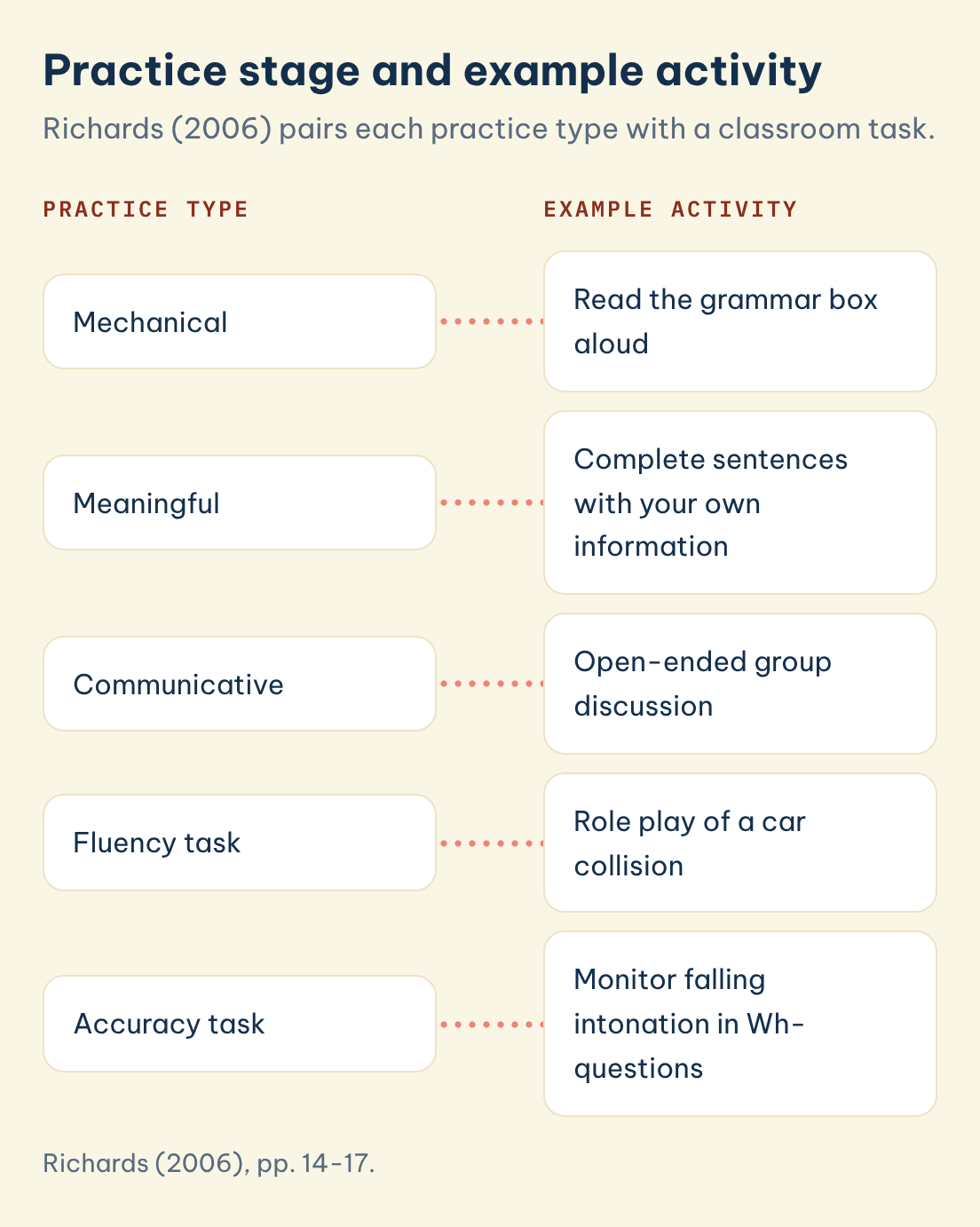
Richards (2006, p. 17) describes this progression as moving "from mechanical, to meaningful, to communicative practice". It matters because it gives a teacher a way to include form-focused work without letting it become the lesson. The table follows his superlatives example.
| Stage | What learners do | Control of language |
|---|---|---|
| Mechanical | Read the grammar box aloud | Fully controlled by the model |
| Meaningful | Complete sentences with their own information | Form is guided, content is the learner's |
| Communicative | Hold an open-ended group discussion | Learners choose the language |
Source: Richards (2006, p. 17).
A lesson built on this sequence needs no special equipment. Start with a short, tightly controlled segment that sets up the language. Move to a task where each learner supplies true information. Finish with a task in which the pair or group has a reason to talk and no script. Throughout, the teacher listens for patterns of error to revisit, which is the accuracy work Richards (2006, p. 15) says can follow fluency work.
Richards (2006, p. 18) also records, from earlier work by Littlewood, a grouping of activities into pre-communicative ones (structural and quasi-communicative) and communicative ones (functional communication and social interaction). The labels help in reflection after a lesson. If every activity you used belongs to the first group, you have taught a form-focused lesson; if none do, learners may not have had the language to attempt the tasks.
◆ Question 7 / 8 · Exam-driven contexts
How can you adapt communicative teaching for exam-driven contexts such as Vietnam or Japan?
Direct answer: Adapt it rather than copy it. Foley (2022) argues that CLT principles are best applied in low-proficiency contexts in Southeast and East Asia through scaffolding with the CEFR and English as an International Language. Butler (2011) reviewed Asia-Pacific implementation and found that exams, class conditions and teacher factors shape what happens.
Foley (2022) examined Thailand, Japan, Vietnam and China, and concluded that basic principles of CLT "can be best applied through scaffolding using CEFR and EIL given the reality of teaching in relatively low English language proficiency contexts" (Foley, 2022). In these four countries, ministries introduced the CEFR alongside CLT syllabuses that already existed, so a Vietnamese teacher is usually working with both at once.
Butler (2011) makes the broader point for the region: communicative and task-based teaching meets contextual constraints, including examinations, classroom conditions and teacher factors. Flinn (2026) adds that classroom studies in Japan offer "some empirical evidence that CLT has language learning benefits" but that there are not enough studies of context-appropriate adaptation (Flinn, 2026).
What does this mean for a teacher whose learners face a written exam? Three adjustments follow from the sources and from Richards (2006). First, keep the fluency and accuracy balance but make the accuracy segment visible, since it is the part exams reward. Second, use the mechanical to meaningful to communicative sequence so that each stage is short and the final stage is tied to a real task. Third, choose scaffolds, such as CEFR descriptors, that help you state what learners can do at their level. None of these claims that a given approach will raise exam scores; the cited studies do not measure that.
◆ Question 8 / 8 · For teachers
Are you an experienced language teacher who wants to guide learners?
Direct answer: MAAS recruits experienced teachers and subject experts who guide international students through their own work. If you have taught communicatively and can explain the reasoning to a learner, you can apply through the expert page. The role is advisory, and learners keep ownership of what they write and say.
Teachers who work comfortably with fluency tasks, information gaps and error patterns often find that the same habits transfer to one-to-one academic guidance. If that describes you, read about the role and apply on our become an expert page. The guide above is general practice rather than a MAAS curriculum, so check it against your own institution's requirements.
Frequently asked questions
What is the CLT method?
CLT is an approach, not a single method. Richards (2006) describes it as a set of principles about goals, learning, activities and roles, and Flinn (2026) argues that it is an approach rather than a method.
What is an example of the communicative approach?
An information-gap task is the standard example. Learners in A-B pairs find differences between two pictures without showing them, so each needs the other's information (Richards, 2006, p. 18).
Is the communicative approach only about speaking?
No. Richards (2006, p. 3) includes producing and understanding different text types, both written and spoken, within communicative competence. Flinn (2026) notes that CLT is often conflated with training speaking.
Does communicative teaching ignore grammar?
No. Richards (2006, p. 9) says grammar was no longer the starting point, which is different from leaving it out. Accuracy activities support fluency activities and can come before or after them (Richards, 2006, p. 15).
What are the 7 types of communicative strategies?
The sources checked here do not give a fixed list of seven. Richards (2006, p. 3) names communication strategies as one aspect of communicative competence, covering the ability to keep communicating despite limitations.
Can the communicative approach work in exam-driven classrooms?
Studies suggest it needs adaptation. Foley (2022) recommends scaffolding with the CEFR in Southeast and East Asia, and Butler (2011) found that exams and class conditions shape implementation. Neither study promises exam results.
Related guides
- How do you proofread academic writing in a second language?: a self-check system for learners who write in an additional language
- How is a graded presentation marked?: what assessors look for when spoken communication is graded
- 1-on-1 university subject tutoring: how MAAS experts tutor students one to one
- Become an expert with MAAS: for experienced teachers who want to guide learners
References
- British Council. (n.d.). Communicative approach. TeachingEnglish. Retrieved October 23, 2026, from https://www.teachingenglish.org.uk/professional-development/teachers/knowing-subject/c/communicative-approach
- Butler, Y. G. (2011). The implementation of communicative and task-based language teaching in the Asia-Pacific region. Annual Review of Applied Linguistics, 31, 36-57. https://doi.org/10.1017/S0267190511000122
- Canale, M., & Swain, M. (1980). Theoretical bases of communicative approaches to second language teaching and testing. Applied Linguistics, 1(1), 1-47. https://doi.org/10.1093/applin/I.1.1
- Flinn, C. (2026). Is it a method or approach? A systematic review of communicative language teaching in Japan. Asia Pacific Journal of Education, 46(4), 1358-1375. https://doi.org/10.1080/02188791.2024.2431706
- Foley, J. (2022). CLT using CEFR and EIL in Southeast Asia and East Asia in the English language classroom. RELC Journal, 53(1), 240-252. https://doi.org/10.1177/0033688221998079
- Littlewood, W. (2014). Communication-oriented language teaching: Where are we now? Where do we go from here? Language Teaching, 47(3), 349-362. https://doi.org/10.1017/S0261444812000134
- Richards, J. C. (2006). Communicative language teaching today. Cambridge University Press. https://www.professorjackrichards.com/wp-content/uploads/Richards-Communicative-Language.pdf
This article is part of the MAAS Journal series for teachers and international students. MAAS is an academic support partner: experts guide students through each stage of their own work, and we do not complete assessed work on a student's behalf.
Experienced language teacher? Find out how MAAS experts guide international students through their own work.
Become an expert ▸