
◆ Academic integrity
Is using a proofreading service cheating?
Students who pay for editing help, or ask a friend to look over a draft, are often unsure where routine language support ends and academic misconduct begins. The boundary is not obvious from the outside, and getting it wrong is treated as contract cheating rather than an honest mistake. Universities do not draw that boundary in the same place, though UK policies sit inside a framework set by the Quality Assurance Agency for Higher Education (QAA).
The short answer is no, not on its own: proofreading that only corrects surface errors, spelling, punctuation and grammar, is normally permitted, because a third party is not changing your content, argument or structure (The University of Edinburgh, 2025). It becomes a problem the moment that third party starts rewriting sentences, altering your argument, adding material, or translating your work, and universities classify that as contract cheating (Loughborough University, n.d.). Many institutions, including Loughborough University and Swansea University, also restrict who is allowed to proofread your work in the first place, so you need to check your own university policy before sending a draft to anyone.
This guide draws the line precisely: what a proofreader is allowed to touch, where universities say the line moves into misconduct, why the permitted level of help differs by university and by study level, what generative AI tools add to the risk, and how to get feedback on your writing without losing authorship of it. Every claim traces to a university policy or writing centre guide, listed under References.
◆ Section 1 / 5 · What they may touch
What a proofreader is allowed to touch
Direct answer: No, not on its own. Correcting surface errors of spelling, punctuation and grammar is normally permitted, because nobody is changing your content, argument or structure. The University of Edinburgh (2025) draws the line at the point a third party rewrites sentences, alters the argument, or adds material, which universities classify as contract cheating.
What a proofreader may touch and what they should not
Each row sets what stays inside proofreading against what falls outside it.
Inside proofreading
Outside proofreading
Flags a spelling mistake, fixes a misplaced comma or corrects a verb tense.
Rewrites a sentence or paragraph to sound more polished or academic.
Where something is unclear or repetitive, leaves a comment explaining why it does not work, and the fix stays yours to make.
Reorders your argument, renumbers cross-references, or adds a sentence, a data point or a piece of evidence you had not included.
Works in Track Changes or Comments, so every change is visible and attributable.
Edits a file silently, so you cannot see what was changed or confirm the work is still yours.
Stays with errors local to the sentence, usually a single word or punctuation mark in a sentence you already wrote.
Checks whether your facts or calculations are correct, touches your reference list or switches citation styles, translates any part of your work, or trims it to fit a word limit.
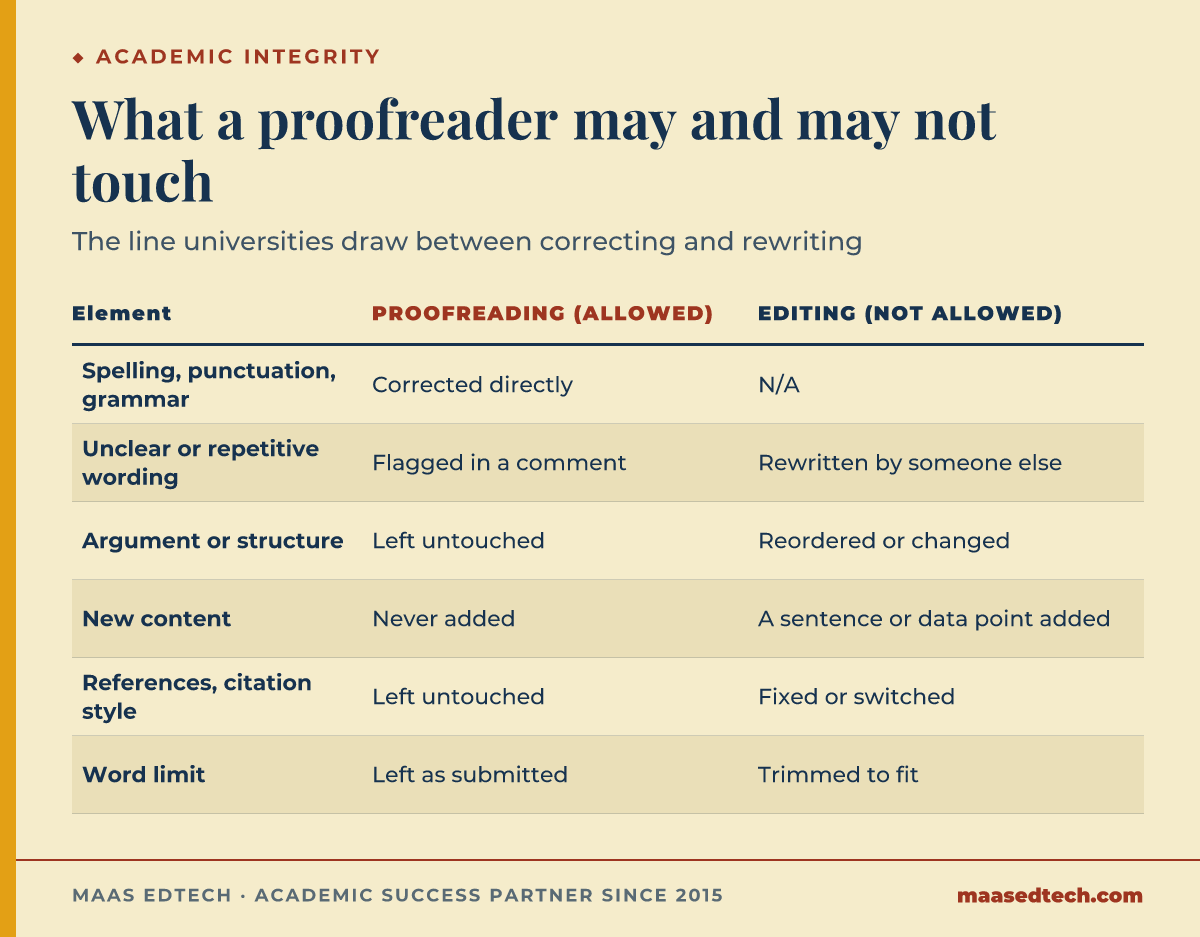
The principle most university policies converge on is narrow: proofreading corrects errors local to the sentence, usually a single word or punctuation mark in a sentence you already wrote, and it stops there (The University of Edinburgh, 2025). A proofreader can flag a spelling mistake, fix a misplaced comma, or correct a verb tense; where something is unclear or repetitive, they can leave a comment explaining why it does not work, but the fix stays yours to make (The University of Edinburgh, 2025). Any change should also be visible and attributable, which is why guidance points to Track Changes or Comments rather than a silently edited file (The University of Edinburgh, 2025); if you cannot see what was changed, you cannot confirm the work is still yours.
What falls outside that boundary is where most of the risk sits. A proofreader should not rewrite a sentence or paragraph to sound more polished or academic, reorder your argument or renumber cross-references, or add anything new, a sentence, a data point, a piece of evidence you had not included (The University of Edinburgh, 2025). They should not check whether your facts or calculations are correct, touch your reference list or switch citation styles, translate any part of your work, or trim it to fit a word limit (The University of Edinburgh, 2025). Each of those actions substitutes someone else's judgement for yours on a question your marker is meant to be assessing. Feedback on content rather than surface correction is the territory of academic work review.
◆ Section 2 / 5 · Contract cheating
When help becomes contract cheating
Direct answer: What counts as cheating hinges on how much of the work is still yours, not on whether money changed hands. Loughborough draws the line once edits become so substantial the work stops reading as the student's own. Victoria University of Wellington permits proofreading and general feedback, but rules out someone writing for you or making extensive edits.
Universities do not measure this by how much money changed hands. Loughborough University's student handbook defines the risk in terms of how much of the work has effectively been done by someone else: proofreading crosses into contract cheating once "the amendments made are so substantial that the work can no longer be considered to be the student's own" (Loughborough University, n.d.), regardless of whether the helper was paid. A friend who rewrites your conclusion for free sits on the same side of that line, under Loughborough University's own framing, as a paid editing service that does the same thing; what matters to your university is how much of the final content, argument or wording is actually yours, not who provided the help or what it cost.
Victoria University of Wellington states the same boundary from the student's side: you are permitted to have someone proofread your work or offer general feedback, but having someone "write for you or make extensive edits to your work" is not acceptable (Victoria University of Wellington, 2026). Notice what both institutions are doing here: they are not banning outside eyes on your writing, they are banning outside authorship of it. A second reader who points out that a paragraph is confusing is on the right side of that line; a second reader who then rewrites the paragraph to fix it is not, even if you would have written something similar yourself given more time.
◆ Section 3 / 5 · Rules differ
Why the rules differ by university and by level
Direct answer: No single rule applies everywhere. Many UK universities restrict professional proofreading for taught coursework unless it is an approved reasonable adjustment, while postgraduate research theses can use proofreading within a defined framework. National bodies like the QAA set the UK framework, and Australia treats contract cheating as a criminal offence, so always check your own university's policy.
There is no single national rule that applies the same way everywhere, which is why checking your own institution's policy matters more than following a general rule of thumb. Swansea University's proofreading policy states that many UK universities do not permit a professional third-party proofreading or editing service for taught undergraduate and postgraduate coursework, unless that support has been formally approved as a reasonable adjustment, for instance through Disabled Students' Allowance (Swansea University, n.d.). The same policy treats postgraduate research students differently: proofreading support for a thesis is permitted, but within a defined framework that mirrors the surface-only boundary set out above (Swansea University, n.d.). University of Leeds guidance on academic integrity and assistance draws a comparable line around what third-party help is acceptable at different stages of study (University of Leeds, n.d.). The same surface-only boundary shows up across Russell Group universities and post-1992 institutions alike, because it traces back to the same national guidance rather than to any one university's house style.
In the UK, individual policies like these sit inside a national framework set by the Quality Assurance Agency for Higher Education (QAA), whose guidance on contract cheating and third-party services is what most university-level policies, including Swansea's and Loughborough's, ultimately draw on. Australia goes further still: since 2020, offering or advertising a commercial contract cheating service has been a criminal offence there, enforced by the Tertiary Education Quality and Standards Agency (TEQSA), which makes the line between proofreading and ghost-writing a matter of law rather than only university policy. The practical consequence is that the same manuscript, at the same university, can be treated differently depending on whether you are an undergraduate submitting coursework or a doctoral candidate finalising a thesis; a service acceptable at one university may be restricted at another. If you study under a reasonable adjustment such as DSA, that should be declared through your disability service, not assumed to cover any proofreading you arrange privately. Your module handbook, your school's academic integrity policy, or a quick question to your supervisor will tell you exactly where your university draws the line. If you disagree with how your university applied that line and you are studying in England or Wales, the Office of the Independent Adjudicator (OIA) is the body that reviews student complaints once your university's own appeals process is exhausted.
◆ Section 4 / 5 · Generative AI
Where generative AI tools fit into this
Direct answer: The same boundary applies to software, not just people. If a proofreading tool has generative AI features that change tone, shorten a passage, or paraphrase a sentence, that counts as AI use and must be declared, exactly like substantial human editing. The tool cannot add content, translate text, or trim it to a word limit undeclared.
The same boundary now extends to software, not just people. The University of Edinburgh's 2025 guidance is explicit that if you use an online proofreading tool with a generative AI function, one that can change the tone of your writing, "shorten" a passage, or paraphrase a sentence, you need to declare that as AI use, the same as you would declare a human editor's substantial input (The University of Edinburgh, 2025). The tool is bound by the same restrictions as a human proofreader: it should not add content, change your tone, translate your text, or cut it to meet a word limit without that being declared (The University of Edinburgh, 2025).
Many students reach for a browser-based grammar or writing tool without registering that some of its "improve this sentence" features go well beyond spelling and punctuation. If a tool rewrites your sentence rather than flagging what is wrong with it, treat that the same way as a human editor rewriting it: it needs declaring, and depending on your university's AI policy, may not be permitted at all. This is also part of why students get second-guessed over AI-detection flags even when they wrote every word themselves; undeclared tool use at the editing stage is one of the quieter ways that risk enters an otherwise honest piece of writing.
◆ Section 5 / 5 · Safe feedback
How to get feedback safely, without losing authorship
Direct answer: Treat a proofreader's notes as prompts, not replacement text, so authorship stays with you. Request Track Changes or Comments instead of a silently edited file, then rewrite each flagged sentence yourself rather than pasting in a suggested fix. Save each draft version, and ask the proofreader upfront exactly what they will and will not touch.
Four habits for getting feedback without losing authorship
Tap a habit to see what it asks you to do.
Step 1 of 4
Keep changes visible
Ask a proofreader, human or software, to work in Track Changes or Comments rather than editing a clean copy, so you can see exactly what was flagged and why.
Step 2 of 4
Fix it yourself
Treat every suggestion as a prompt to fix the sentence yourself, not a replacement sentence to paste in. If a comment says a paragraph is unclear, rewrite it in your own words.
Step 3 of 4
Keep your drafts
Keep a version history of your drafts, so that if a question ever comes up about how your submission came to be, you have a trail showing the work was yours at every stage.
Step 4 of 4
Ask before you send
Ask what they will and will not do before you send anything: will they only mark and comment, or make direct edits, and do they use a tool with generative AI features.
The safest way to use outside eyes on a draft is to keep every change visible and keep the decision to accept it yours. Ask a proofreader, human or software, to work in Track Changes or Comments rather than editing a clean copy, so you can see exactly what was flagged and why (The University of Edinburgh, 2025). Treat every suggestion as a prompt to fix the sentence yourself, not a replacement sentence to paste in; if a comment says a paragraph is unclear, rewrite it in your own words. Keep a version history of your drafts, so that if a question ever comes up about how your submission came to be, you have a trail showing the work was yours at every stage.
It also helps to ask the proofreader what they will and will not do before you send them anything: will they only mark and comment, or make direct edits; do they use a tool with generative AI features, and will you be told which changes came from it. A proofreader who cannot answer those questions clearly is a bigger risk than one with a narrow, well-defined scope of work.
HOW MAAS HANDLES THIS
MAAS's academic integrity check flags spelling, grammar, punctuation, referencing and clarity issues, and explains what needs a bigger rethink instead of rewriting it for you. Nothing is rewritten, translated or submitted on your behalf, and no one puts their name to your work, so the draft your marker sees is still the one you wrote.
MAAS's academic integrity check service is built around the boundary described above: your mentor flags spelling, grammar, punctuation, referencing and clarity issues, and where something needs a bigger rethink, explains why and leaves the rewrite to you. Nothing is rewritten, translated or submitted on your behalf, and no one puts their name to your work; the draft that goes back to your marker is still the one you wrote, with clearer sentences because you know exactly what to fix and why. If you want the fuller checklist for running your own edit-then-proofread passes before you get to that stage, our editing and proofreading checklist walks through it pass by pass, and our proofreading and editing resource hub gathers the related guides in one place.
Frequently asked questions
Is it cheating to have someone proofread my essay?
Not on its own. Correcting surface errors, spelling, grammar, punctuation, in a sentence you already wrote is normally permitted (The University of Edinburgh, 2025). It becomes a problem once that person starts rewriting your sentences, changing your argument, or adding content that was not there before.
Can I get in trouble even if I didn't pay for the help?
Yes. Loughborough University's handbook defines contract cheating by how substantial the change is, not by whether money changed hands; correction "so substantial that the work can no longer be considered to be the student's own" counts, paid or unpaid (Loughborough University, n.d.), and Victoria University of Wellington draws the same conclusion from the student's side (Victoria University of Wellington, 2026).
Are the rules the same for undergraduate coursework and a PhD thesis?
No. Swansea University's policy notes that many UK universities restrict professional third-party proofreading for taught undergraduate and postgraduate coursework unless it is an approved reasonable adjustment, while postgraduate research theses can use proofreading support within a defined framework (Swansea University, n.d.). Always check your own university's policy for your specific level of study.
Do I need to declare an AI proofreading tool the same way I'd declare a human editor?
Yes, if it does more than flag surface errors. The University of Edinburgh's guidance says a proofreading tool with generative AI features, one that changes tone, shortens text, or paraphrases, needs to be declared, the same as substantial human editing would be (The University of Edinburgh, 2025).
What's the safest way to get feedback on a draft without crossing the line?
Ask for comments and Track Changes rather than a clean rewritten file, and fix every flagged issue yourself rather than accepting someone else's replacement sentence (The University of Edinburgh, 2025). Keep your draft history so you can show the work was yours at every stage.
What does MAAS do differently from an editing service that rewrites my work?
MAAS's academic integrity check flags errors and explains what needs attention; your mentor does not rewrite your sentences, translate your work, or submit anything on your behalf. The document that goes to your marker is still the one you wrote.
References
Loughborough University. (n.d.). Proofreading. Student Handbook. https://www.lboro.ac.uk/students/handbook/assessments/coursework-feedback/proofreading/
Swansea University. (n.d.). Proof reading policy. Academic Quality Services. https://hwb.swansea.ac.uk/academic-life/academic-regulations/aqs-policies/proof-reading-policy/
The University of Edinburgh. (2025). Proofreading of student assessments [Guidance]. Registry Services. https://registryservices.ed.ac.uk/
University of Leeds. (n.d.). Academic integrity and assistance policy. Secretariat.
Victoria University of Wellington. (2026). Understanding academic misconduct. https://www.wgtn.ac.nz/students/study/exams/academic-integrity/understanding-academic-misconduct
A free 20-minute consultation with a MAAS mentor, to talk through what help with your draft your university allows.
Book Free Discovery ▸