
◆ Business & Management
BUSI1692 International Entrepreneurship: what makes a born global?
BUSI1692 has six learning outcomes, and every one begins with the word "critically", unusual even for Level 7 and a signal that no descriptive register is available to you here. The first outcome, the one students most often misread, asks you not only to understand International Entrepreneurship but to compare it against mainstream International Business, and the born global firm is where the two fields visibly disagree, which is the module's intellectual spine.

◆ Question 1 / 7 · The module
What is BUSI1692 International Entrepreneurship about?
Direct answer: BUSI1692 is a Level 7 module worth 30 credits in the Business, Operations and Strategy department at Greenwich Business School. It examines how international business operations influence the international entrepreneurial firm and how entrepreneurs conduct business abroad. Content runs in four parts: perspectives in international entrepreneurship, identifying international opportunities, networks and partnerships, and internationalisation choices.
Evidence: The module explicitly introduces the field's emergence as a distinct area, examining born global companies and how those differ from traditional companies. That framing is doing analytical work. It positions the module as an argument with established internationalisation theory rather than as a survey of startup practice. The field's older roots run back to Schumpeter's (1934) entrepreneur as the innovator who carries out "new combinations" of resources, a concept he sharpened into "creative destruction" (Schumpeter, 1942), the process by which new ventures displace incumbent firms and technologies. The Uppsala and international-new-venture theories the module actually assesses you on are a later, more specific argument within that older tradition, not a replacement for it.
Example: A Vietnamese student on a Greenwich master's expected BUSI1692 to be about how to start an export business. Her mentor showed her the first learning outcome, which asks her to compare the field with mainstream International Business. The module was not teaching her to be an entrepreneur; it was teaching her to argue about whether existing theory explains entrepreneurs adequately.
◆ Question 2 / 7 · Born global
What is the born global argument, and why does it matter here?
Direct answer: Traditional internationalisation theory says firms go abroad gradually, in stages, learning as they go. Born globals contradict that: they are international from inception. The module examines exactly this tension, and understanding it gives you the comparison that outcome 1 demands.
Evidence: Johanson and Vahlne (1977) built the Uppsala model from Swedish firms, finding that internationalisation proceeds through a series of incremental decisions as the firm gradually acquires and uses knowledge about foreign markets, with the establishment chain running from irregular exporting to an agent, to a sales subsidiary, to production. They also found the order of country entry related to psychic distance, the sum of factors preventing information flow, such as differences in language, education, business practices and culture. Oviatt and McDougall (1994) then argued that firms international from inception are incongruent with traditionally expected characteristics of multinational enterprises, and proposed four necessary and sufficient elements for international new ventures: internalisation of some transactions, strong reliance on alternative governance structures to access resources, establishment of foreign location advantages, and control over unique resources.
Example: A student wrote that born globals "prove the Uppsala model wrong". His mentor asked whether that was fair. Oviatt and McDougall argued that stage theory's own stated exceptions, large resources, stable markets, generalisable prior experience, do not apply to new ventures, which is a narrower and far stronger claim than "wrong". Rewriting to that precision moved the paragraph from opinion to critical comparison.
◆ Question 3 / 7 · Assessment
How is BUSI1692 assessed?
Direct answer: Check your module handbook for the exact assessment components, weightings and deadline for your cohort, since the module specification's assessment details are reissued each academic year. What the specification does state clearly is the assessment strategy's intent: it is designed so that real-world business situations drive the work, and the module offers you the opportunity to reflect on the various challenges an entrepreneur might face in the international arena while developing critical thinking about practical issues.
Evidence: Whatever the components turn out to be, the six outcomes constrain what a strong submission looks like. Outcome 4 asks you to critically evaluate and identify new market opportunities, undertake substantial investigations into the creation of a new venture, and demonstrate critical understanding of intellectual property issues in foreign markets. The word "substantial" there is a scope instruction, and IPR is named explicitly, which means it is not optional colour.
Example: A student's draft covered market entry, networks and financing thoroughly and mentioned intellectual property in one sentence. His mentor pointed at outcome 4, where IPR appears by name. In a module where six outcomes are assessed, a named element treated in one sentence is a gap a marker will notice.
◆ Question 4 / 7 · Frameworks
Which frameworks should you use in BUSI1692?
Direct answer: Pair one internationalisation theory with one opportunity theory, then add networks. The module's content gives you the shortlist directly.
| Framework | What it explains | The critical use |
|---|---|---|
| Uppsala stage model | Gradual, knowledge-driven internationalisation | Use as the baseline your case either fits or contradicts |
| International new ventures (Oviatt and McDougall) | Firms international from inception | Test whether your case meets all four elements, not just the label |
| Causation and effectuation (Sarasvathy, 2001) | Whether the entrepreneur predicted or controlled | Diagnose the actual decision logic, do not assume effectuation |
| Network perspective | How relationships create opportunity and market access | The module treats networks as a whole part, not a footnote |
Evidence: The module's second part covers causation and effectuation alongside the discovery versus creation of opportunities, and its third part is devoted entirely to networks and managing partnerships, including SME to multinational partnerships. Sarasvathy draws the line precisely: "effectuation processes take a set of means as given and focus on selecting between possible effects that can be created with that set of means" (Sarasvathy, 2001, p. 245), the reverse of causation's goal-first planning, which is why calling a firm's behaviour "effectuation" without checking which direction the reasoning actually ran is a common misuse of the term. A submission that uses only entry-mode theory has ignored two of the module's four parts.
Example: A student labelled her case firm a born global because it exported in year one. Her mentor ran it against Oviatt and McDougall's four elements. The firm had no control over unique resources and no foreign location advantage; it was simply an early exporter. Applying the test rather than the label produced a far more interesting finding, and outcome 1's comparison came naturally out of it.
◆ Question 5 / 7 · Structure
How should you structure the work?
Direct answer: Build around the comparison rather than around a chronology of a firm. A structure that serves the outcomes: (1) introduce the venture and the specific international question it faced; (2) establish the mainstream International Business account of what should happen, using the stage model; (3) show what actually happened and where it departs; (4) explain the departure using opportunity theory and networks; (5) address the practical constraints, financing, family business dynamics if relevant, and IPR in the target markets; (6) conclude on what your case suggests about the adequacy of existing theory. Step six is where outcome 1 is finally demonstrated.
Evidence: Outcome 6 asks you to demonstrate innovative solutions, synthesise, and independently apply new approaches for the expansion of a new venture or family business. Synthesis is a structural requirement, not a closing flourish: it means the parts have to be brought together into a position, which a firm-by-firm or topic-by-topic structure never forces you to do.
Example: A student organised her work as four sections mirroring the module's four parts. It covered everything and concluded nothing. Her mentor had her rebuild it around one question, whether her case firm's rapid internationalisation was explained better by network access than by resource control. The same content, reorganised around a contested claim, demonstrated synthesis for the first time.
◆ Question 6 / 7 · Common mistakes
What are the most common mistakes that lose marks in BUSI1692?
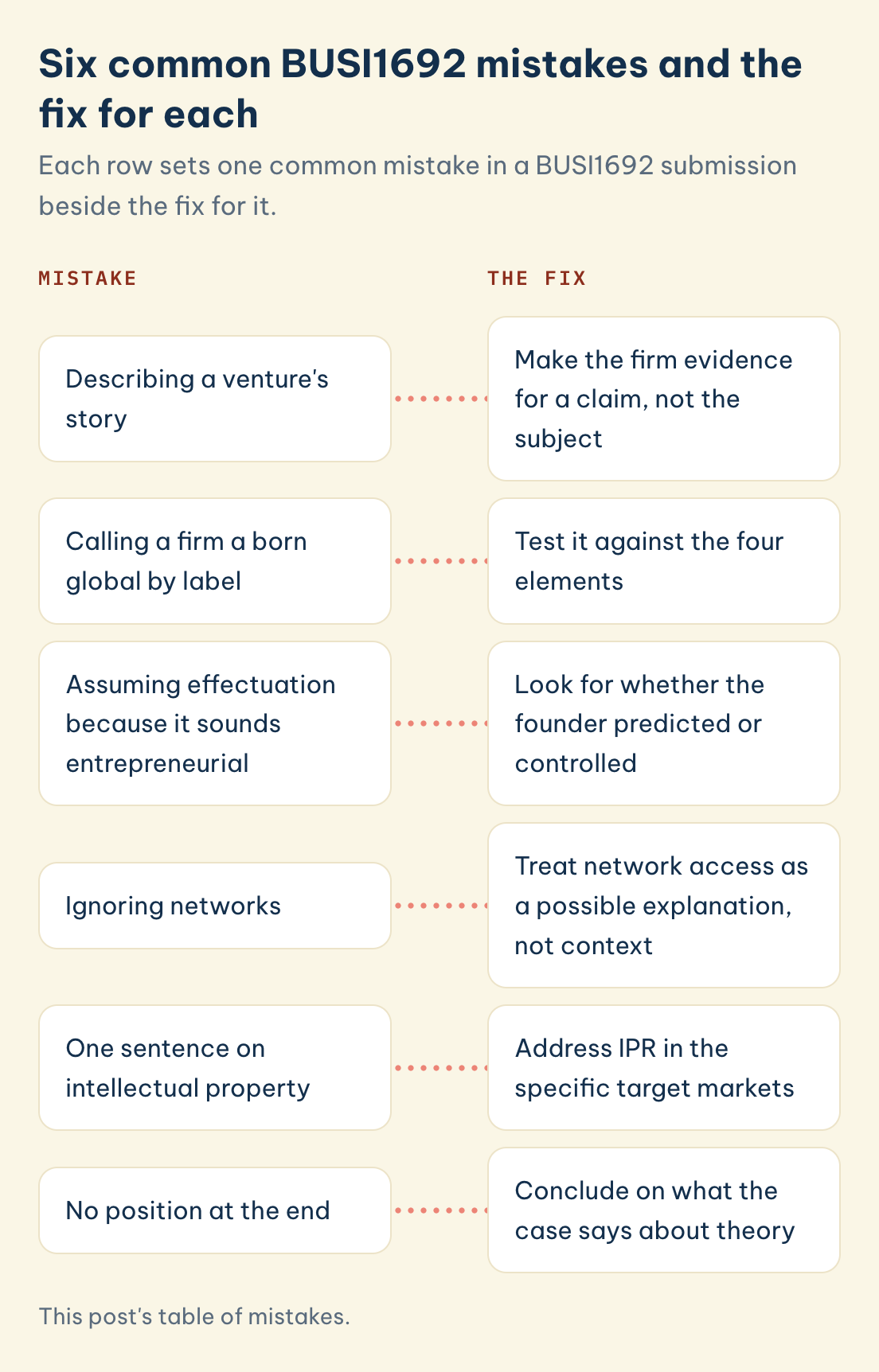
Direct answer: Submissions in this field tend to slip in the same places.
Six common BUSI1692 mistakes and the fix for each
Each row sets one common mistake in a BUSI1692 submission beside the fix for it.
Mistake
The fix
Describing a venture's story
Make the firm evidence for a claim, not the subject
Calling a firm a born global by label
Test it against the four elements
Assuming effectuation because it sounds entrepreneurial
Look for whether the founder predicted or controlled
Ignoring networks
Treat network access as a possible explanation, not context
One sentence on intellectual property
Address IPR in the specific target markets
No position at the end
Conclude on what the case says about theory
Save this figure
| Mistake | Why it costs marks | The fix |
|---|---|---|
| Describing a venture's story | Every outcome begins with "critically" | Make the firm evidence for a claim, not the subject |
| Calling a firm a born global by label | Outcome 1 asks for critical comparison | Test it against the four elements |
| Assuming effectuation because it sounds entrepreneurial | Misdiagnoses the decision logic | Look for whether the founder predicted or controlled |
| Ignoring networks | The module devotes a whole part to them | Treat network access as a possible explanation, not context |
| One sentence on intellectual property | IPR is named in outcome 4 | Address IPR in the specific target markets |
| No position at the end | Outcome 6 requires synthesis | Conclude on what the case says about theory |
Evidence: Six outcomes assessed together means coverage is structural. When every outcome carries the word "critically" and one names IPR explicitly, a submission's weakest outcome tends to set its ceiling, because a marker looking for evidence of six things will find one thin. The same discipline applies to theory: whichever of Johanson and Vahlne (1977), Oviatt and McDougall (1994), or Sarasvathy (2001) you draw on, a marker checks whether the named theory was actually applied to your case, not merely mentioned by name.
Example: One student produced an elegant analysis of opportunity identification and never mentioned family business, despite her case being a second-generation family firm expanding abroad. The module introduces family business challenges in part one and outcome 3 names the design, management and financing of a start-up or family business. She had walked past the most relevant outcome in the module.
◆ Question 7 / 7 · Intellectual property
How do you handle intellectual property without a law background?
Direct answer: You are not being asked for legal analysis. You are being asked to show critical understanding of IPR issues in foreign markets, which means recognising that protection is territorial, that registration in one jurisdiction does not travel, and that the practical risk differs by market and by what is being protected. Identify what your venture's protectable asset actually is, a brand, a design, a process, a database, then discuss how exposed it is in the specific markets your case enters.
Evidence: Outcome 4 places IPR alongside opportunity identification and venture creation, which frames it as a commercial constraint on expansion rather than as a legal topic. The module's fourth part covers the legal and other IP issues entrepreneurs might face in international markets in exactly that practical register.
Example: A student writing about a Vietnamese consumer brand expanding into two Asian markets treated IPR as a compliance checkbox. Her mentor asked what the firm would actually lose if its brand name were registered by someone else in a target market first. Framing it as a commercial risk to market entry, rather than a legal formality, connected the section to the rest of her argument.
Frequently asked questions
Is BUSI1692 the same as the entrepreneurship module at undergraduate level?
No. Level 5 entrepreneurship modules typically ask you to develop and reflect on an idea. This module asks you to critically compare a research field with mainstream International Business theory, which is an argumentative task rather than a developmental one.
Do I need my own business idea?
Check your brief, but the outcomes centre on analysis of ventures and opportunities rather than on your own startup. Outcome 4 asks for substantial investigation into venture creation, which can be conducted on a real case.
Is every fast-internationalising firm a born global?
No, and assuming so is the commonest error. Test the case against Oviatt and McDougall's four elements before applying the term.
How much theory versus case material should I include?
Enough theory that the case is being explained rather than narrated. A useful test: if you removed the firm and kept the argument, would a theoretical claim remain? If not, the case is doing the work theory should be doing.
Can MAAS help me with BUSI1692?
MAAS mentors work with you on choosing a case that genuinely tests the theory, applying frameworks as tests rather than labels, and checking your draft addresses all six outcomes including IPR. You remain the author of your work; the mentor checks whether your case is really doing the work you claim for it.
How old are the theories this module builds on?
Older than the module itself. Schumpeter's account of the entrepreneur dates to 1934, Johanson and Vahlne's Uppsala model to 1977, Oviatt and McDougall's international-new-venture theory to 1994, and Sarasvathy's causation-effectuation distinction to 2001, a 67-year span the module compresses into a handful of weeks of reading.
Where this guidance comes from
The theories behind the framework table above sit in a small number of foundational, heavily cited papers rather than in course-specific summaries. Johanson and Vahlne (1977) and Oviatt and McDougall (1994) were both published in the Journal of International Business Studies, 17 years apart, and Sarasvathy (2001) appeared in the Academy of Management Review. Reading even one of these three in the original, rather than a secondary summary, is usually enough to answer outcome 1's comparison convincingly.
Making your case earn its place
The submissions that do well here rarely stand out for with the most exciting venture. What they share is that they that set up what established theory predicts, show precisely where the case departs from it, and explain the departure with opportunity theory and networks rather than with admiration for the founder. If you have a case but cannot yet see the argument it supports, a MAAS mentor can work through the comparison with you before you write.
Talk to a MAAS mentor about your module
Related guides
References
- Johanson, J., & Vahlne, J.-E. (1977). The internationalization process of the firm: A model of knowledge development and increasing foreign market commitments. Journal of International Business Studies, 8(1), 23–32. https://doi.org/10.1057/palgrave.jibs.8490676
- Oviatt, B. M., & McDougall, P. P. (1994). Toward a theory of international new ventures. Journal of International Business Studies, 25(1), 45–64.
- Sarasvathy, S. D. (2001). Causation and effectuation: Toward a theoretical shift from economic inevitability to entrepreneurial contingency. Academy of Management Review, 26(2), 243–263. https://doi.org/10.2307/259121
- Schumpeter, J. A. (1934). The theory of economic development. Harvard University Press.
- Schumpeter, J. A. (1942). Capitalism, socialism and democracy. Harper & Brothers.
Tools & resources
- University of Greenwich. (n.d.). Module information [Module catalogue entry]. Retrieved July 29, 2026, from https://www.gre.ac.uk/modules/modules?crse=1692&subj=BUSI&term=205000
- University of Greenwich. (n.d.). Academic skills. Retrieved July 29, 2026, from https://www.gre.ac.uk/students/support/academic-skills
This article is part of the MAAS Journal series for Vietnamese international students. MAAS Assignment & Essay Support is an academic support partner; we coach students through the Outline, Draft, Final delivery model with developmental feedback from discipline-matched experts. We do not write or submit work on a student's behalf.
A free 20-minute consultation is a conversation about where you are with BUSI1692.
Book a free consultation ▸