
◆ Health & Education
BIOL234 ACU: how do you write Nutritional Physiology assignments?
BIOL234 Nutritional Physiology is a 10-credit-point unit at Australian Catholic University (ACU), taught in Semester 2 on the Blacktown, Melbourne and North Sydney campuses. The 2026 handbook sets three written assessments worth 30%, 30% and 40%, and students must meet every learning outcome as well as reach 50% overall. This guide explains how MAAS mentors read that structure and where, in their experience, students lose marks.
Note on the code: this guide describes the ACU unit. The University of British Columbia in Canada uses BIOL 234 for Fundamentals of Genetics, a different subject, so forum advice and notes filed under the same code may belong to that course. MAAS is an independent academic support provider with no affiliation to Australian Catholic University.
◆ Question 1 / 9 · The unit
What is BIOL234 Nutritional Physiology, and who takes it?
Direct answer: BIOL234 is a 200-level ACU unit on how the gut, hormones and nervous system regulate digestion, appetite and metabolism. The prerequisites point to students from nutrition, exercise science or health degrees who have completed BIOL204, or a pairing of BIOL125 or BIOL126 with EXSC118 or NUTR101.
Evidence: The 2026 ACU handbook lists BIOL234 at 10 credit points in the structure of the Bachelor of Nutrition Science, next to BMSC209 Pathophysiology and CHEM206 Advanced Metabolic Biochemistry. The prerequisite rule offers five routes: BIOL204 Human Body in Health and Disease 2 on its own, or one of the two human biology units combined with either EXSC118 Nutrition and Exercise or NUTR101 Introduction to Nutrition. The content list has 13 topics, from the enteric nervous system and cell-to-cell signalling to osmoregulation, acid-base balance, the gut microbiome and metabolic syndrome. Representative texts include the 9th edition of Sherwood's Human Physiology and the 4th Australian and New Zealand edition of Understanding Nutrition.
Example: A nutrition science student and an exercise science student can sit side by side in the same Semester 2 tutorial. The first is comfortable with dietary guidelines but has not drawn a hormone feedback loop since first year, while the second knows muscle metabolism well but has never read a food label claim closely. BIOL234 asks both of them for the same thing, which is a clear causal chain from food to physiological effect.
◆ Question 2 / 9 · Assessment
How is BIOL234 assessed in 2026?
Direct answer: Three written tasks carry the whole grade: 30%, then 30%, then a final 40%. The handbook describes them in general terms, so the task sheet in your own unit outline decides the format. To pass, you need an aggregate of at least 50% and evidence of all four learning outcomes.
How the BIOL234 grade is weighted at ACU, 2026 handbook
Three written tasks carry the whole grade. To pass, you need an aggregate of at least 50% and evidence of all four learning outcomes.
Assessment 1 (written task)
30
% of the grade
Assessment 2 (written task)
30
% of the grade
Assessment 3 (final written task)
40
% of the grade
Save this figure
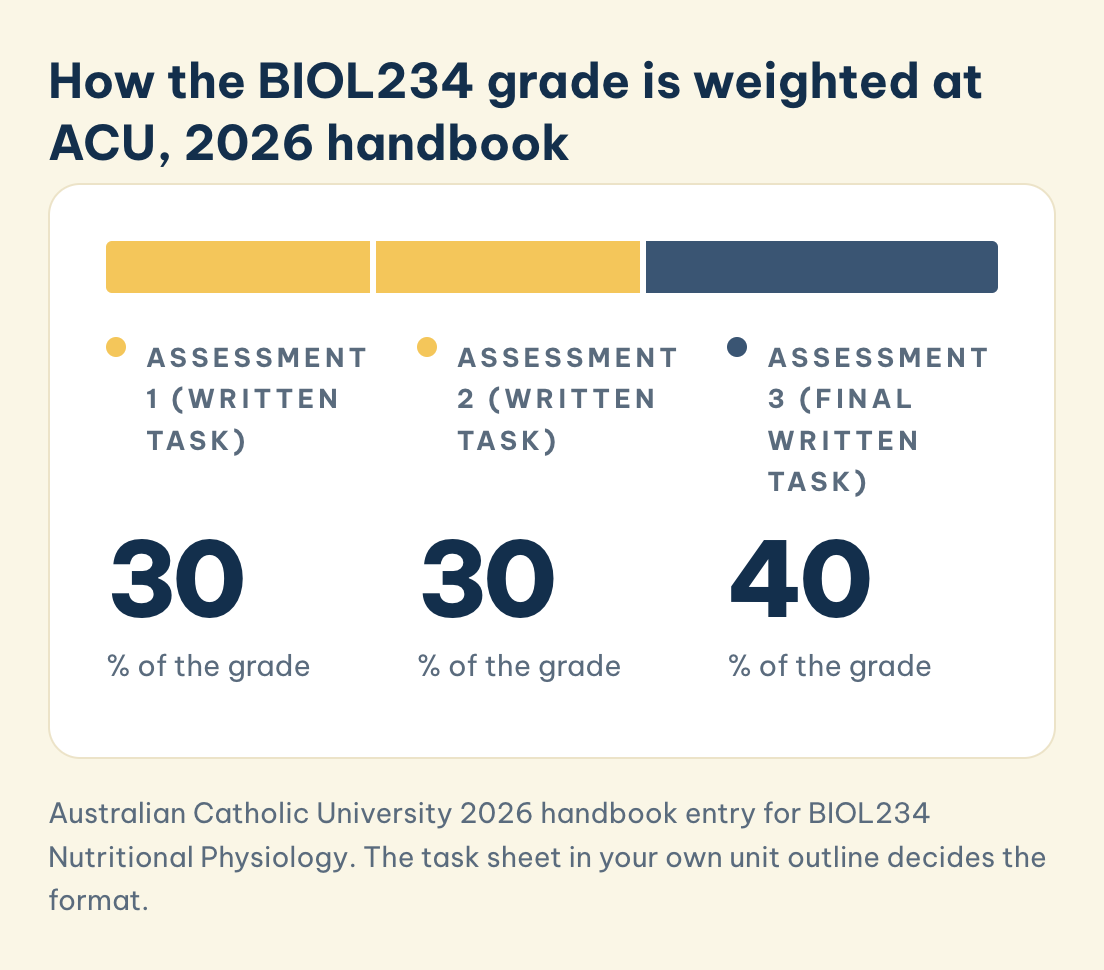
Evidence: The handbook links Assessment 1 to learning outcomes 1, 2 and 4, and links Assessments 2 and 3 to all four outcomes. Its assessment rationale says the tasks are "examples that have the requisite purpose", so the exact prompts can change from year to year. In that rationale, the early written task tests critical analysis and writing for a lay reader, the second asks students to present new knowledge and their reasoning, and the final task tests critical analysis and knowledge of the unit content.
| Task | Weight | Learning outcomes | What it rewards |
|---|---|---|---|
| Assessment 1, written | 30% | LO1, LO2, LO4 | Critical analysis of one issue, explained clearly for a non-specialist |
| Assessment 2, written | 30% | LO1 to LO4 | Applying knowledge and showing the reasoning |
| Assessment 3, written | 40% | LO1 to LO4 | Critical analysis across the whole unit |
| Pass rule | 50% aggregate | Every outcome shown | Both conditions, not one |
Example: A student who scores 70% on the first two tasks has 42 of the possible 60 points before the final task begins. Even so, the rule about demonstrating every learning outcome means a final paper that ignores the critique of popular and scientific literature named in LO4 is a risk, whatever the running total says.
◆ Question 3 / 9 · Nutrition or physiology
Is BIOL234 a nutrition assignment or a physiology assignment?
Direct answer: Physiology comes first, and nutrition supplies the context. Learning outcome 1 is about mechanism: which signal, from which cell, acting on which receptor or organ, with what measurable effect. In MAAS mentors' reading, a paper that lists foods, nutrients and health tips without that chain leaves the first learning outcome largely unaddressed.
Evidence: Learning outcome 1 asks students to articulate how endocrine and neural regulation of gastrointestinal function interact and why that matters for metabolism. Ghrelin shows what that level of explanation looks like. Cummings et al. (2001) took 38 blood samples over 24 hours from 10 healthy adults on a fixed meal schedule and reported that "plasma ghrelin levels increased nearly twofold immediately before each meal and fell to trough levels within 1 h after eating" (p. 1714). Together with the reciprocal pattern of insulin, that rise before meals and fall after them led the authors to propose a role for ghrelin in starting meals.
Example: Two answers to a question on why people feel hungry at habitual mealtimes can cite the same study. The weaker one writes that ghrelin is the hunger hormone and that eating regularly controls appetite. The stronger one states that ghrelin is secreted mainly by the stomach, rises before a scheduled meal, falls within an hour of eating, and that the finding shows association in 10 people rather than proof of cause, so the claim about controlling appetite needs other evidence.
◆ Question 4 / 9 · Mechanism detail
How much mechanism detail is enough?
Direct answer: Enough that each step in the chain could be checked by a reader with a physiology textbook. Name the signal, its source, its target and its effect, and stop there unless the next level of detail changes your argument. Molecular detail the question does not ask for uses up words that the critique section needs.
Evidence: Leptin is a useful test of scope. Zhang et al. (1994) cloned the mouse obese gene and its human homologue, and the protein it encodes, later named leptin, is released by fat tissue and acts on the brain to signal energy stores. A BIOL234 answer on appetite needs that source, target and direction of effect. It rarely needs the gene cloning method, but it often does need the observation, discussed in the unit's own reading list, that many people with obesity have high leptin levels and a weak response to them.
Example: Suppose a 1,500-word task, in which a student spends 400 words on receptor subtypes in the hypothalamus and then has 150 words left to evaluate the evidence. MAAS mentors suggest planning the word budget before writing: roughly a third for normal physiology, a third for how the condition or intervention changes it, and a third for evaluating the evidence. The split is a starting point for discussion, not a rule from ACU.
◆ Question 5 / 9 · Nutrition claims
What is a nutrition claim, and how do you analyse one?
Direct answer: A nutrition content claim describes how much of a nutrient a food contains, such as "high in fibre". A health claim links a food or nutrient to a health effect. In Australia, Standard 1.2.7 of the Food Standards Code governs both, and it is a practical starting point for any BIOL234 claim analysis.
Evidence: Food Standards Australia New Zealand (FSANZ) separates general level health claims, such as calcium for healthy bones and teeth, from high level health claims, which refer to a serious disease or a biomarker of one. More than 200 food-health relationships are pre-approved for general level claims, while high level claims must rest on one of 13 pre-approved relationships in Schedule 4. Becker et al. (2024) describe a course in which "a scaffolded nutrition and health claim assignment is used to teach critical thinking skills" (p. 320) among nutritional sciences students, a format that fits the handbook's description of an early critical-analysis task if your own task sheet uses it.
Example: A supplement advertisement says its fibre blend "resets your metabolism". A structured analysis asks four questions in order: what kind of claim this is under Standard 1.2.7, which physiological pathway would have to change for the claim to be true, what studies test that pathway in humans, and whether those studies measured the outcome the advertisement promises. Learning outcome 1 asks for mechanism, so MAAS mentors treat the second question as the core of the analysis: a claim that names no mechanism has to be tested against the mechanisms the unit teaches.
◆ Question 6 / 9 · Lay audience
How do you critically analyse a claim for a lay audience?
Direct answer: Keep the physiology accurate but explain every technical term in the same sentence that introduces it. Lay writing in BIOL234 is not simpler science; it is the same science with fewer assumptions about the reader. State how strong the evidence is in plain words, and never let clarity turn a possible effect into a promise.
Evidence: Alcohol is a topic the handbook names directly, and it shows how to handle strength of evidence. The National Health and Medical Research Council (2020) advises healthy adults to drink no more than 10 standard drinks a week and no more than 4 on any one day, and estimates that at that level the lifetime risk of dying from an alcohol-related cause stays below 1 in 100. The same guideline names adults aged 18 to 25 as a group at greater risk. A lay explanation can carry all of those numbers without jargon, and it should keep the guideline's own point that lower risk is not zero risk.
Example: A student writing for readers with no science background explains that alcohol is absorbed mainly in the small intestine and broken down mostly in the liver, then links that to why drinking on an empty stomach raises blood alcohol faster. The same paragraph names the NHMRC limits and adds that the figures come from modelling on population data, so they describe risk across many people rather than a safe threshold for one person.
◆ Question 7 / 9 · Sources
Can you use websites, blogs or influencer content as sources?
Direct answer: Use them as the claims you are testing, not as evidence for your argument. The unit description itself refers to analysing scientific and pseudoscientific literature, so quoting a wellness blog is fine when you then check it against peer-reviewed studies, systematic reviews, textbooks and official guidelines.
Evidence: The ACU handbook states that students will study current issues "through analysis of scientific and pseudoscientific literature", and learning outcome 4 asks them to critique information in both popular and scientific sources. Official sources count as evidence of a different kind: the Food Standards Code tells you what a label may legally say, and NHMRC guidelines summarise systematic reviews, but neither replaces a primary study when the question is whether a mechanism exists.
Example: A video claims that intermittent fasting "switches the body into fat-burning mode". A strong paragraph quotes the video, identifies the physiological idea behind it, which is a shift in fuel use during fasting, and then asks what human trials measured, over how long, and whether weight change differed from a simple energy deficit. The video stays in the paper, but only as the thing being examined.
◆ Question 8 / 9 · Metabolic syndrome
How should you handle metabolic syndrome in BIOL234?
Direct answer: Metabolic syndrome tests whether you can connect several systems at once: fat distribution, lipid transport, blood pressure and glucose control. Strong answers use the agreed diagnostic criteria to define the problem, then explain the physiology that links the components rather than treating each one as a separate disease.
Evidence: Alberti et al. (2009) brought several international definitions together and agreed that "three abnormal findings out of 5 would qualify a person for the metabolic syndrome" (p. 1640). Their shared cut points are triglycerides of 1.7 mmol/L or more, HDL cholesterol below 1.0 mmol/L in men or 1.3 mmol/L in women, systolic blood pressure of 130 mm Hg or more and/or diastolic of 85 mm Hg or more, and fasting glucose of 100 mg/dL (5.6 mmol/L) or more, with waist circumference set by population and country. The same paper notes that people with the syndrome face about twice the risk of cardiovascular disease over 5 to 10 years and a fivefold increase in risk of type 2 diabetes.
Example: A case describes a 45-year-old with a waist above the population cut-off, triglycerides of 2.1 mmol/L and blood pressure of 134/86 mm Hg. A descriptive answer lists the three abnormal results and stops. A critical answer confirms that three of five criteria are met, explains how insulin resistance is thought to link them, and notes the paper's own caution that the syndrome does not include age, smoking or LDL cholesterol, so it is not a measure of absolute risk.
◆ Question 9 / 9 · Getting help
Can you get help with BIOL234 assignments?
Direct answer: You can get help understanding the physiology and how to structure an argument, but the analysis you submit must be your own. ACU treats paying or asking a third party to prepare any part of an assessment as contract cheating, and that includes friends, file-sharing websites and editing services.
Evidence: ACU's Student Academic Integrity and Misconduct Policy defines contract cheating as a student contracting a third party "to prepare part or all of an assessment, or to sit an examination for them (paid or unpaid)". The policy names family and friends, file-sharing websites, editing services and assessment writing services as possible third parties. When its Academic Integrity Team learns of a cheating service during an investigation, the policy says it reports that service to TEQSA, the national regulator.
Example: Search results for the unit include document-sharing sites that host study materials uploaded by ACU students. Building your answer from a past submission can breach ACU's academic integrity policy, and it also skips the reasoning that the 40% final task tests. A legitimate tutoring session looks different: a student brings a mechanism diagram they drew, explains it aloud, and is asked where the evidence for each arrow comes from.
Frequently asked questions
Is BIOL234 at ACU the same as BIOL 234 at UBC?
No. At ACU, BIOL234 is Nutritional Physiology, a 10-credit-point unit on gut, hormonal and metabolic regulation. At the University of British Columbia, BIOL 234 is Fundamentals of Genetics, so study notes and forum advice for the UBC course do not apply to the ACU unit.
Which campuses teach BIOL234 in 2026?
The 2026 handbook lists Semester 2 campus attendance at Blacktown, Melbourne and North Sydney. ACU notes that unit offerings may depend on minimum enrolment numbers, so check your own timetable before planning around a campus.
What do I need to pass BIOL234?
You need an aggregate of at least 50% across the three written tasks and you must demonstrate every one of the four learning outcomes. The tasks carry 30%, 30% and 40% of the grade.
Which textbook should I read for BIOL234?
The handbook lists representative texts rather than one required book, including the 9th edition of Sherwood's Human Physiology and the Australian and New Zealand 4th edition of Understanding Nutrition by Whitney and colleagues. Your unit outline gives the current reading list.
Does MAAS write BIOL234 assignments?
No. MAAS tutors explain physiology and question the reasoning in mechanism diagrams and notes you have prepared yourself. Every submitted task must be your own work, in line with ACU's academic integrity policy.
Related reading
- BIOL 155 Human Biology at UBC: a physiology course guide where exams, not essays, carry the grade
- How to write a critical review: a step-by-step method for judging a source rather than summarising it, useful for the LO4 critique
- How to design a systematic review in the health sciences: how reviews rank and combine evidence, which helps when a claim rests on one small study
- NURS6028 Health and Substance Misuse: another health unit guide in which clinical reasoning matters more than description
Where MAAS fits
- Subject tutoring, one to one: 60 or 90 minute sessions with a tutor matched to health and life sciences, working through mechanisms and reasoning you have already attempted. Tutoring is advisory, so it carries no grade target; if the tutor is not the right fit, you can ask to change expert
- Course-code assignment coaching: how MAAS mentors approach any unit assignment
References
- Alberti, K. G. M. M., Eckel, R. H., Grundy, S. M., Zimmet, P. Z., Cleeman, J. I., Donato, K. A., Fruchart, J.-C., James, W. P. T., Loria, C. M., & Smith, S. C., Jr. (2009). Harmonizing the metabolic syndrome: A joint interim statement of the International Diabetes Federation Task Force on Epidemiology and Prevention; National Heart, Lung, and Blood Institute; American Heart Association; World Heart Federation; International Atherosclerosis Society; and International Association for the Study of Obesity. Circulation, 120(16), 1640–1645. https://doi.org/10.1161/CIRCULATIONAHA.109.192644
- Becker, T. B., Cardino, V. N., Lucas, J., & Fenton, J. I. (2024). Teaching critical thinking in nutritional sciences: A model course and assignments. Advances in Physiology Education, 48(2), 320–329. https://doi.org/10.1152/advan.00177.2023
- Cummings, D. E., Purnell, J. Q., Frayo, R. S., Schmidova, K., Wisse, B. E., & Weigle, D. S. (2001). A preprandial rise in plasma ghrelin levels suggests a role in meal initiation in humans. Diabetes, 50(8), 1714–1719. https://doi.org/10.2337/diabetes.50.8.1714
- National Health and Medical Research Council. (2020). Australian guidelines to reduce health risks from drinking alcohol. Commonwealth of Australia. https://www.nhmrc.gov.au/sites/default/files/documents/attachments/Alcohol/Australian%20guidelines%20to%20reduce%20health%20risks%20from%20drinking%20alcohol.pdf
- Zhang, Y., Proenca, R., Maffei, M., Barone, M., Leopold, L., & Friedman, J. M. (1994). Positional cloning of the mouse obese gene and its human homologue. Nature, 372(6505), 425–432. https://doi.org/10.1038/372425a0
Tools & resources
- Australian Catholic University. (2026). BIOL234 Nutritional physiology [Handbook entry]. Retrieved September 28, 2026, from https://www.acu.edu.au/handbook/handbook-2026/unit/biol234
- Australian Catholic University. (n.d.). Student academic integrity and misconduct policy. Retrieved September 28, 2026, from https://policy.acu.edu.au/download.php?id=222&version=3
- Food Standards Australia New Zealand. (n.d.). Nutrition content claims and health claims. Retrieved September 28, 2026, from https://www.foodstandards.gov.au/consumer/labelling/nutrition
This article is part of the MAAS Journal series for Vietnamese international students. MAAS is an independent academic support provider. For health and life sciences units, we offer one-to-one tutoring on concepts and methods only; we do not write, complete or submit any assessed work.
A free 20-minute consultation is a conversation about where you are with BIOL234.
Book a free consultation ▸